
Good morning,
Today I’m presenting a company that, at first glance, looks like an unattractive investment. Its principal business is in structural decline, group revenue is falling, and the balance sheet looks exposed.
But beneath the surface is a far more interesting setup.
This company owns a growing software business, generates more cash than headline figures suggest, and is divesting assets that should meaningfully simplify the business.
My base case valuation suggests 39% upside from current levels, but potential returns could be considerably higher if management delivers on its own targets.
- Sponsored By Baseline -
Today’s post is brought to you in partnership with Baseline which is an equity research tool developed out of multi-strategy investment fund A5 Capital.
I receive plenty of requests to review investment tools and most fail to pique my interest. But this one is seriously good and I recommend you give it a try.
Use code olalpha to get 10% off your first six months.
Thanks to my affiliate partnership with Baseline, today’s article is free to read for the next seven days, with no paywall applied.
The team has also unlocked Quadient on Baseline, giving you full access to the stock without the usual $39 a month subscription that covers all 3,700 names.
Let’s get into it…

Introducing Quadient SA
Today’s company is Quadient SA (Euronext Paris:QDT), a French communications company that is transforming itself from a traditional postage-equipment and locker company into a more robust software and automation business.
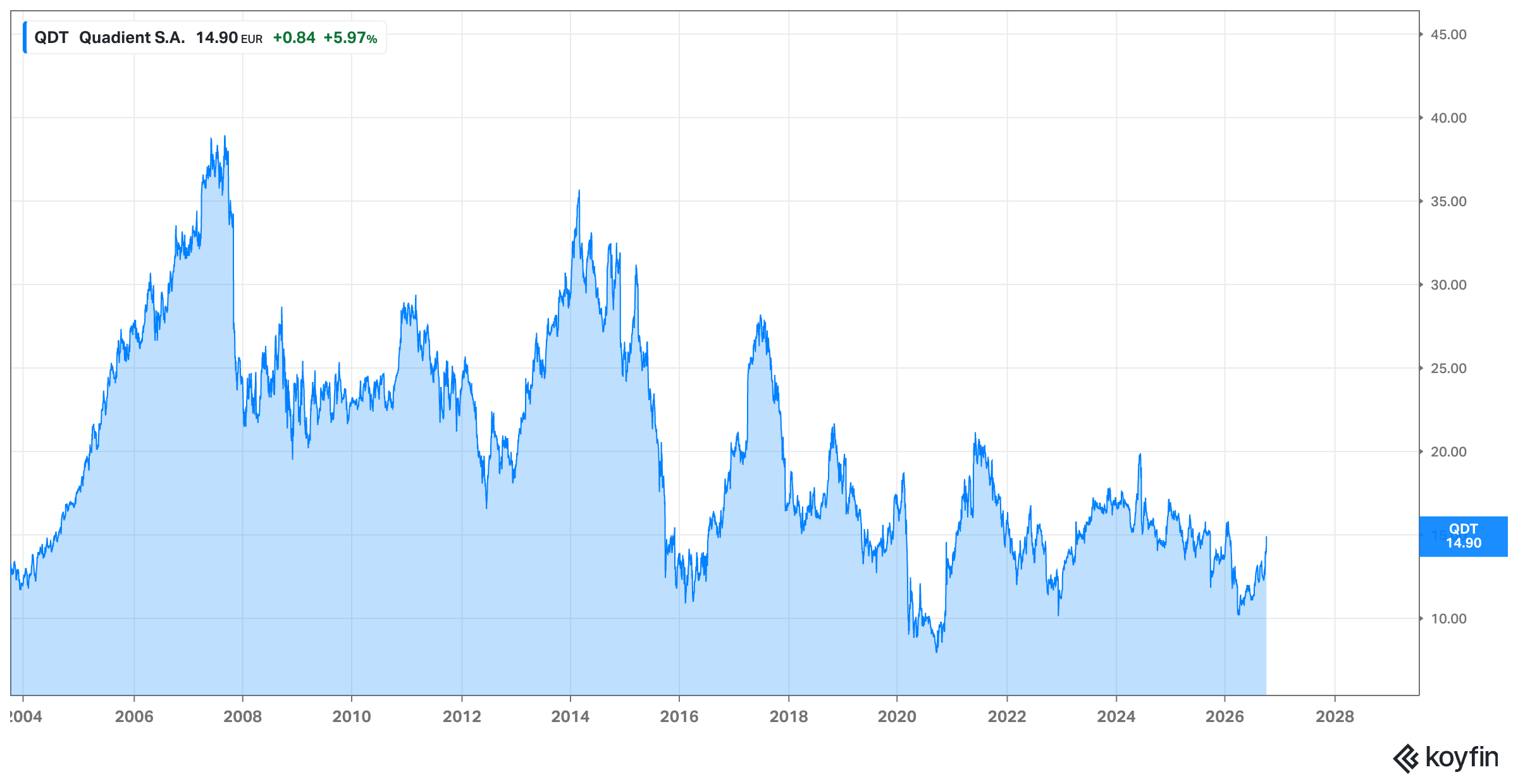
Formerly known as Neopost, Quadient built its business selling and leasing postage meters, mailing machines and related accessories to organisations that send large volumes of physical correspondence.
For decades, this was a highly profitable business. Customers required specialist equipment, contracts generated recurring revenue and switching suppliers was often more trouble than it was worth.
However, the long-term outlook for physical mail is poor and demand for traditional mailing equipment is in decline. Quadient has therefore spent the last several years investing in digital communications software and parcel delivery infrastructure (lockers) to offset its legacy operations.
On 23rd September 2026, this transformation took a step forward as Quadient announced its intention to exit its parcel locker business including an agreed €65 million sale of its UK locker network to Royal Mail.
This is a meaningful development which should release capital, reduce investment requirements and leave Quadient (market cap €536 million) with a cleaner business going forward.
Investment Case
At first glance, an investment in Quadient doesn’t look promising.
Letters are disappearing, postage meters are becoming obsolete, top line revenue is falling and the company’s reported net debt has climbed to €683 million, against a market cap of only €536 million.
However, that description doesn’t tell the whole story.
First, Quadient owns a growing software business in customer communications and financial automation that benefits from recurring revenue and could receive a meaningful boost from European e-invoicing regulations. Current ARR is €264 million with 13% organic growth.
Second, a large portion of Quadient’s debt supports an interest-earning customer-financing portfolio. This means its true corporate debt burden is considerably less intimidating than the headline number suggests and below what is shown on most financial screeners.
Third, the company is in the process of divesting its parcel locker operations. These assets require significant capital investment while contributing relatively little to group profitability so their disposal should release cash and simplify the investment case.
There are some risks to explore. The mail business could deteriorate faster than expected, digital profitability has not yet scaled adequately and there is no guarantee that management will allocate its resources effectively.
However, with shares still hovering near all-time lows, the investment case for Quadient doesn’t depend on heroic assumptions. The mail business does not need to recover to have value and the digital business does not need exceptional growth.
Valuing the individual parts of Quadient, I arrive at a conservative sum-of-the-parts valuation of €20.9, roughly 40% upside to today’s price. A more optimistic scenario, based on stronger execution and progress towards management’s targets, supports a substantially higher valuation.
The Mail Business
Quadient’s mail division sells and leases mailing equipment and accessories like franking machines, folder-inserters, mail openers, addressing equipment and scales. Most equipment is supplied through rental or leasing contracts which generates recurring revenue and provides a surprisingly sticky and profitable business.
At the same time, many organisations like banks, insurers and government agencies are still unwilling to eliminate their mailing systems entirely.
The Hidden Financing Business
Quadient also operates an important financing business alongside its mail division which allows customers to purchase mailing equipment and repay the cost over several years.
Quadient borrows money to fund these arrangements then earns a profit from the difference between the interest charged to customers and its own funding costs. This is an important part of Quadient’s business because the financing business has the potential to release cash as it shrinks.
Importantly, the debt used to fund these arrangements (and reported on Quadient’s balance sheet) is supported by corresponding receivables from Quadient’s customers.
For example, at July 2026, Quadient held €522 million of net leasing receivables (down from €533 million in January.) These were supported by approximately €440 million of associated debt, leaving around €82 million in residual net assets.
This distinction matters because financial screeners typically include the financing debt in Quadient’s reported net debt without separately recognising the economic value of the associated receivables. It also creates an interesting cash flow dynamic for Quadient going forward.
As the mail business shrinks, fewer customers require new financing but existing customers continue making repayments. As customers repay their loans (default rates are currently low and reported around 1%) Quadient can use the proceeds to reduce debt and release surplus capital.
This can be seen in the financials where the financing business contributed approximately €71.9 million of EBITDA in FY2025, roughly 42% of total mail EBITDA.
Recent Performance
From a broad view, the mail business has remained relatively resilient until recently.
Mail revenue was around €710-750 million from FY2021 through FY2024 before dropping sharply (-9.5%) in FY2025.
EBITDA margins have shown a similar pattern with EBITDA falling from €218 million in FY2023 (29.9% margin) to €173 million in FY2025 (27.1%). That decline has continued into the first half of 2026 with organic revenue down -5.6% and EBITDA margin falling 0.6 points to 24.9%.
The principal risk with mail is operating leverage. The mail business is highly profitable but it will only remain a cash cow for Quadient, if management is able to reduce costs as revenue declines.
Unsurprisingly, management are confident they can keep profits coming in despite long-term structural decline. Guidance for 2030 is for €500 million of mail revenue with an EBITDA margin of 20-25%. At the bottom end, that would imply €100 million of EBITDA in 2030, down from €173 million in FY2025.
The mail business also provides an established distribution network, thousands of customers that Quadient can cross sell its digital software.
Valuing Mail
My approach to value the mail business is to estimate normalised free cash flow from the underlying mail operations excluding the financing portfolio and then value that portfolio separately.
Separating the financing business from mail is not straightforward but management do provide some figures to work with.
Starting with FY2025 EBITDA of €173.2 million, I subtract financing-related EBITDA of €71.9 million to get to non-financing EBITDA of €101.3 million.
I then subtract €17 million in estimated cash taxes, €30.3 million of capex (reported in accompanying notes) and €4 million of additional costs. This gets us to an estimated, normalised free cash flow for the mail business of €50 million.
I then model this cash flow declining by 8% annually over 15 years, with no terminal value. This produces cumulative free cash flows of €410 million over the period, worth around €238 million when discounted at 10%.
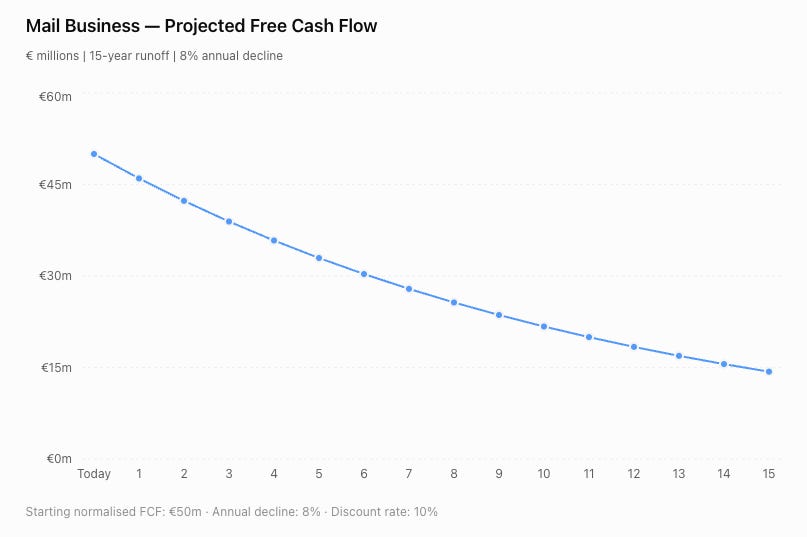
To this amount, I add the residual value of the financing portfolio.
As discussed earlier, the portfolio contains approximately €82 million of net assets after associated borrowings. Applying a 10% haircut for defaults and other costs reduces this to €73.8 million. Combining the two components gives an estimated intrinsic value for the mail business of €311.8 million.
This figure feels conservative since it represents roughly 2x annualised H1 EBITDA, including financing. There is clearly a risk that cash flow deteriorates more rapidly than modelled, particularly if margins compress faster than expected.
But as long as management maintains cost discipline, the mail business should remain an important source of cash.
The Digital Business
Quadient’s Digital business is best understood as a collection of software assembled around two main platforms Customer Communications Automation, dominated by Quadient Inspire and Impress, and Financial Automation built largely through the acquisitions of YayPay, Beanworks and Serensia.
There are also smaller software products such as iForms and CDP Communications that have been incorporated into the core platforms.
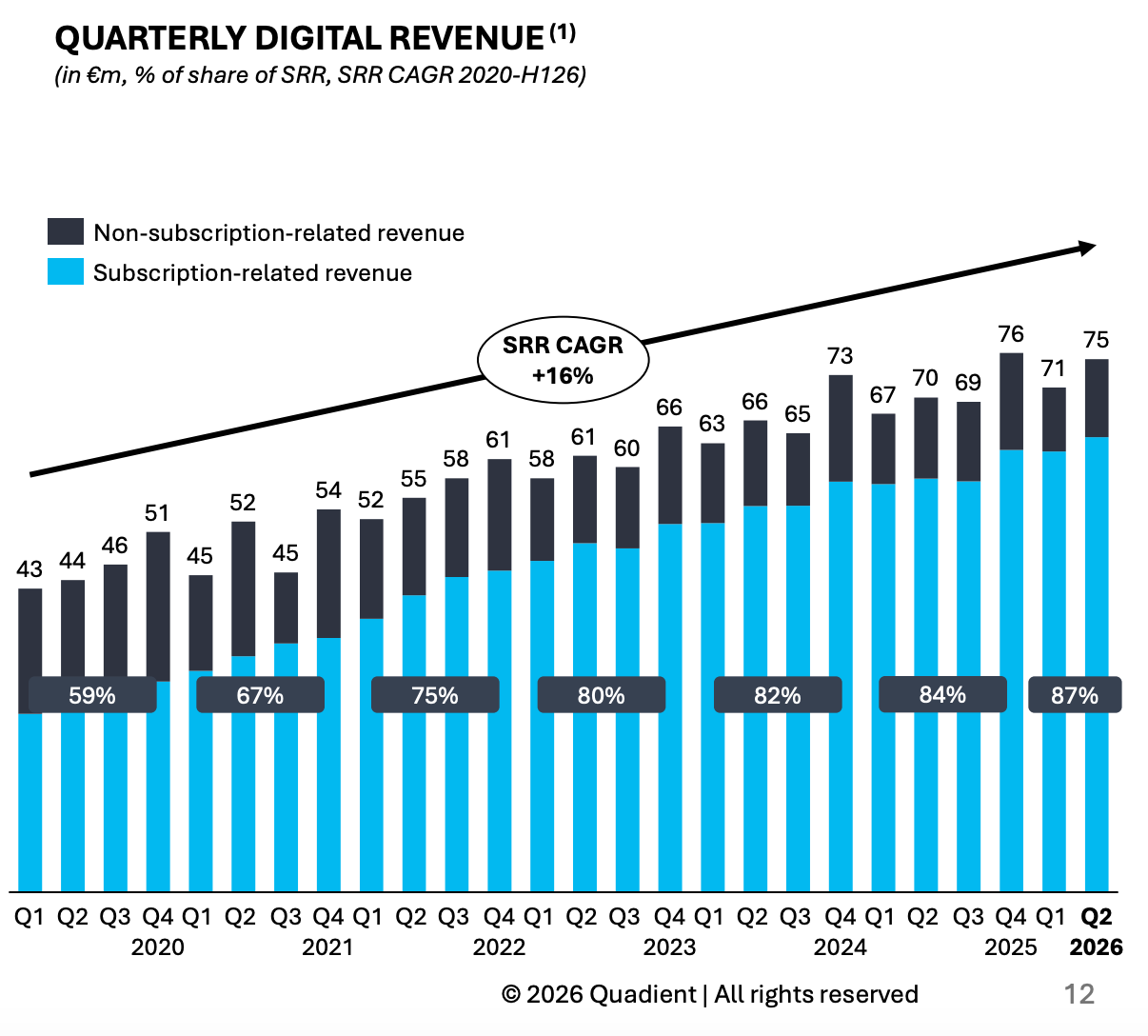
The overall portfolio is now substantial. FY2025 digital revenue was €282m, subscription revenue was 84% of sales and EBITDA margin reached 18%. By H1 2026, ARR had increased to €264m, representing 12.9% annualized organic growth, while subscription revenue had risen to 87% of the segment. Management now targets €550m of digital revenue by 2030.
And Quadient’s software products appear to score strong reviews. According to IDC, Quadient ranked #1 globally in CCM in 2024 with 11% market share. Quadient Inspire scores 4.8 out of 5 on G2 from 130 reviews. Beanworks has 4.4/5 from 270+ reviews and newly acquired Serensia supports over 800,000 organizations.
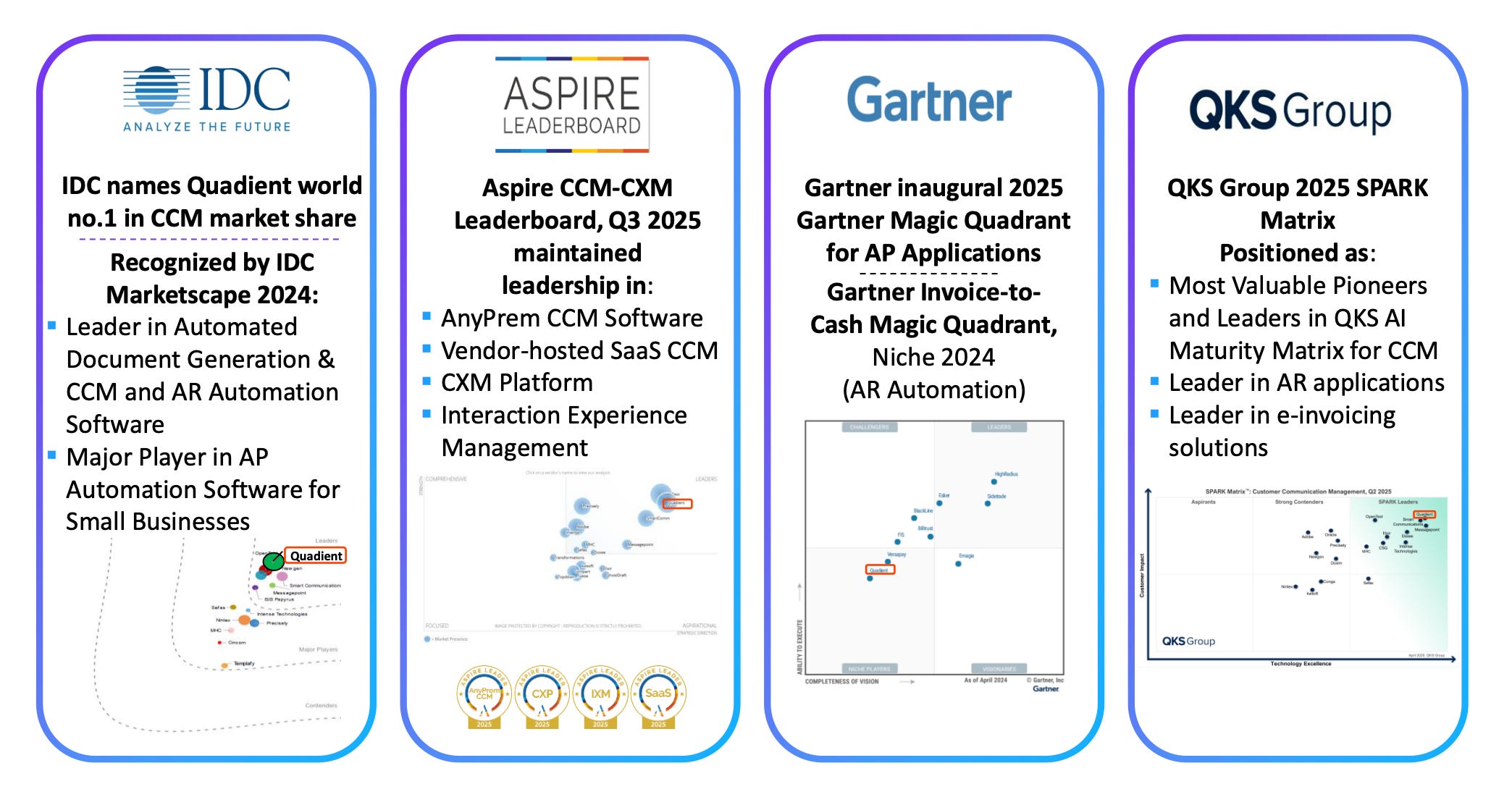
E-invoicing regulations also represent a significant catalyst for Quadient as European governments increasingly mandate electronic invoicing.
France introduced the first phase of its mandate on 1 September 2026 with another phase scheduled for September 2027. Quadient purposefully acquired Serensia to give it a certified French e-invoicing platform and by 21 September 2026, 950,000+ entities had registered through Quadient’s platform. Altogether 13 EU countries including Germany, Poland and Spain have e-invoicing mandates already in motion or beginning 2026 onwards.
Another key talking point for the digital segment is recent H1 EBITDA margins which looked modest coming in at 14.5%. Management attributed the lower margin to investment ahead of French e-invoicing.
As indicated by Baseline, the low margin is a concern since it is a long way from the 30% margins that management is guiding to by 2030 and it sets up a demanding second half if management is to achieve its FY2026 EBITDA margin guide of above 19%.

That being said, some seasonal context is important.
In H1 2024, Digital recorded a 15.7% EBITDA margin before finishing the full year at 17.5%. Similarly, in H1 2025, margins were 15.0% before recovering to 18% for the year.
In other words, weaker first-half margins are not unusual for this business. Management’s justification relating to e-invoicing investment makes some sense and I expect some recovery in H2 2026.
Looking further ahead, management is targeting €550 million of digital revenue by 2030, with an EBITDA margin of 30%. That implies €165 million of EBITDA, compared with approximately €51 million in FY2025.
That would transform Quadient’s earnings profile and rerate the stock significantly but some caution is necessary in light of current profitability.
Valuing Digital
Management’s EBITDA figure for the digital business was €21 million in H1 and €47.3 million on a TTM basis. However, the metric doesn’t include capitalized software costs (€13 million in H1 equivalent to 8.9% of revenue). Capitalised software costs therefore need to be deducted to get to a reliable figure for actual free cash flow.
A useful starting point is therefore EBITDA less capitalised software development costs, which on a trailing twelve-month basis, produces an estimated margin of approximately 7.9%. On a TTM basis this produces a figure of €22.3 million.
Moving forward, I use a 10-year discounted cash flow model to estimate intrinsic value using the following assumptions:
Starting digital revenue: €281.7m
Revenue growth: 5% annually
EBITDA margin: 18% rising to 24%
D&A % of revenue: 10%
Digital capex % of revenue: 8.9% falling to 7%
Working capital % of revenue: 1%
Tax rate: 25%
Discount rate: 10%
Terminal growth rate: 2.5%
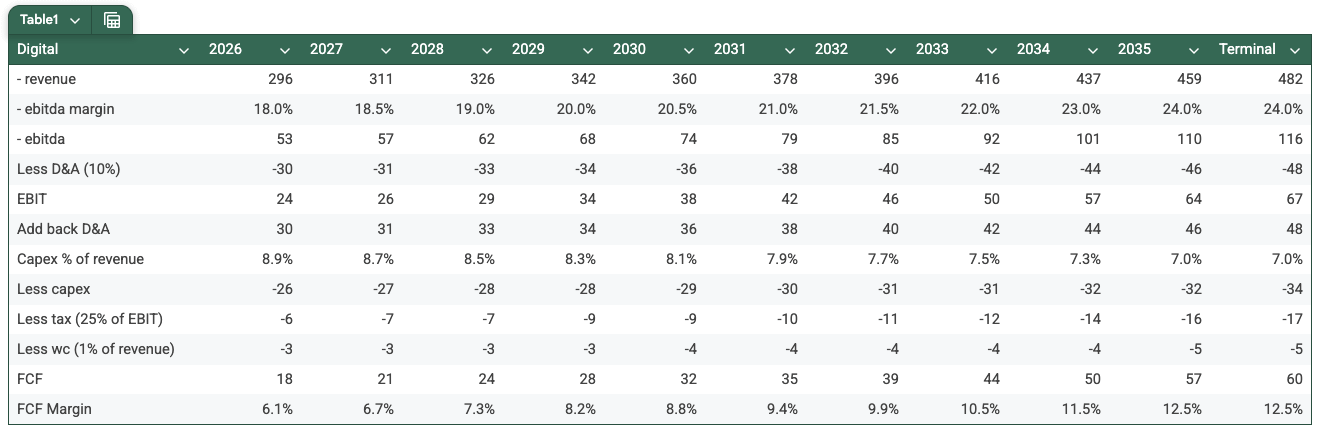
Under these assumptions I arrive at an intrinsic value for the digital business of €511 million with terminal value accounting for 62% of the total.
The valuation is conservative since it represents 1.94x ARR and the values fall well below management’s 2030 targets which call for €550 million of revenue and €165 million of EBITDA.
A more aggressive view illustrates what the potential upside could be if management targets are achieved.
If you assume 12% annual revenue growth through 2030, moderating to 3% thereafter, and EBITDA margins expanding from 18% to 30%, the estimated intrinsic value rises to €901 million.
Peer takeout multiples are also supportive with French financial automation business Esker acquired in 2024 by Bridgepoint at a reported €1.62 billion, roughly 7.8x 2024 revenue.
For now though I will keep the valuation conservative to account for acquisition risks and competitive threats from AI. Management outlook looks aggressive to me considering the required ramp in EBITDA margin.
For example, my valuation above starts at 18% EBITDA margin which is below management’s guide for 19%+ but it still requires significant improvement from a TTM run rate of ~16%. This is a key watchpoint for the next earnings update and is one reason why I have not yet taken a full position in the stock.
The Locker Business
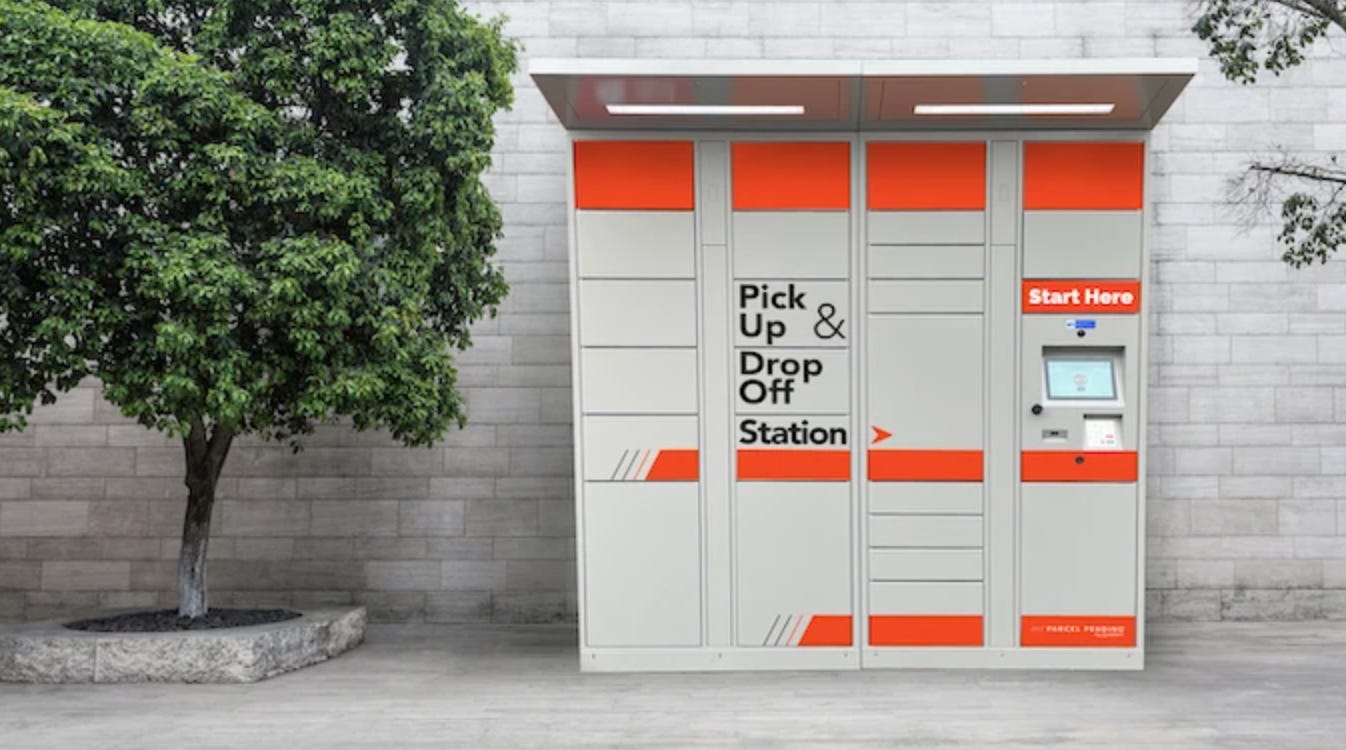
The final part of Quadient is parcel lockers which have become a popular method of delivering and receiving goods with the rise of e-commerce.
Quadient operates roughly 27,000 lockers through different regional models across Japan, US, UK and Europe.
Japan and the UK largely operate through owned open networks whereas North America includes lockers sold to customers alongside software and support.
Owned networks require capital investment before usage matures and Quadient’s group profits have been negatively impacted by this investment.
For example, the global locker business generated €114 million of revenue in FY2025 with 22.4% growth but EBITDA margin was only 5% (approximately €6 million of EBITDA) and capital expenditure approximately €32 million.
In other words, the locker business was growing quickly but consuming considerable cash.
On September 23rd Quadient announced it would divest its locker business and said it had already agreed to sell the UK open network to IDS Holdco (Royal Mail’s parent) for €65 million enterprise value.
Although the locker business was a useful source of growth, its sale will reduce Quadient’s future capex requirements by about €120 million over five years. The cash can be used to pay off debt and simplify the investment case.
Valuing Lockers
Quadient’s parcel locker business comprises approximately 27,000 lockers across the UK, Europe, US and Japan.
The UK business has about 3,000 lockers, with revenue a little over €10 million and EBITDA around breakeven. This business has been sold to IDS for €65 million which works out to roughly 6x revenue or almost €22k per locker.
US makes up 85-90% of remaining locker revenue and Quadient says it holds a leading position (30-40%) of the market with most lockers sold to property managers. Japan has about 7,000 lockers with an estimated 60-70% market share, held through a subsidiary that Quadient owns 51% of.
Europe makes up a smaller segment (about €7 million of revenue) which won’t be sold. The remaining locker business (US and Japan) therefore generates around €97 million of revenue.
Valuing the locker business on current cash flows likely undervalues the business while extrapolating 6x revenue or €22k per locker seems exorbitant. It’s worth noting that the UK buyer, IDS, is linked to Vesa, who is a more than 25% Quadient shareholder.
For my base case I apply a 1x revenue multiple to the remaining US and Japanese operations.
Adding the €65 million agreed value for the UK network produces an estimated total disposal value of approximately €165 million.
This represents a meaningful discount to Quadient’s €215 million of assets classified as held for sale, leaving some room for disposal costs, taxes and transaction uncertainty.
Accounting For Debt
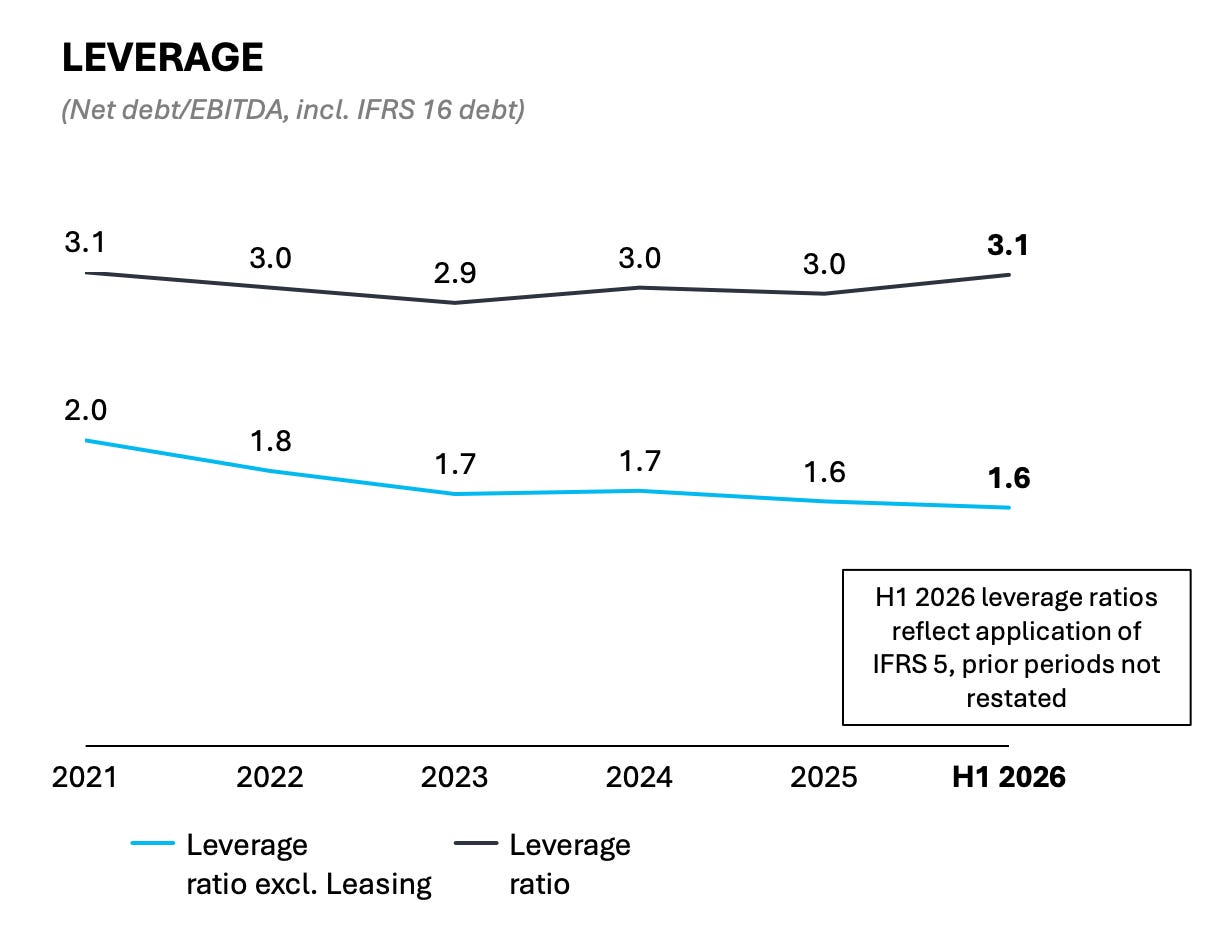
One of the main reasons Quadient looks unattractive on financial screeners is its debt burden. Reported net debt stands at approximately €683 million, which is substantially greater than its market capitalisation.
However, as discussed earlier, Quadient operates a financing business that supports its mail equipment customers. At July 2026, leasing receivables stood at €522 million with a default rate of around 1%. The company also has €123 million of cash plus a €300 million undrawn credit facility maturing in 2030.
Management and Quadient’s lenders measure leverage excluding leasing, and its bank covenants are set on that basis. Excluding leasing, leverage was 1.6x at July 2026, against 3.1x on the headline figure. Working back from those ratios, roughly €440 million of debt is attributable to the leasing book, leaving corporate net debt of around €240 million.
In my valuation, I use this figure as an estimate for corporate net debt and account for the financing portfolio separately as part of the Mail business, using its estimated residual net asset value as a proxy for forward cash flow.
Net debt to EBITDA is therefore more palatable than it looks. Management reconciles the figure at 1.6x and this could fall to 1.2x after the sale of UK lockers.
Final Valuation
Putting all the parts together I get the following sum of parts:
Dividing the estimated equity value by approximately 35.9 million diluted shares produces an intrinsic value of €20.86 per share.
Against the current share price of €14.96, that implies approximately 39.4% upside. That is a conservative valuation that assumes ~2x EBITDA for mail, under 2x ARR for digital and 1x revenue for the remaining locker assets.
Counter View From Baseline
While writing this report I also used Baseline to examine the competitive position and long-term prospects.
Baseline uses frontier AI to evaluate more than 3,600 global companies across factors such as pricing power, switching costs and competitive advantages and the tool provides a healthy counter balance to my research while also highlighting things I missed.
Each criterion, such as pricing power, is scored from 1 to 5, with 5 the most favourable. That lets you filter for your own thesis (low switching costs or high AI risk), and surface candidates quickly. The real value, though, is the detailed rationale behind every score, which speeds up both your due diligence and your understanding of the business.
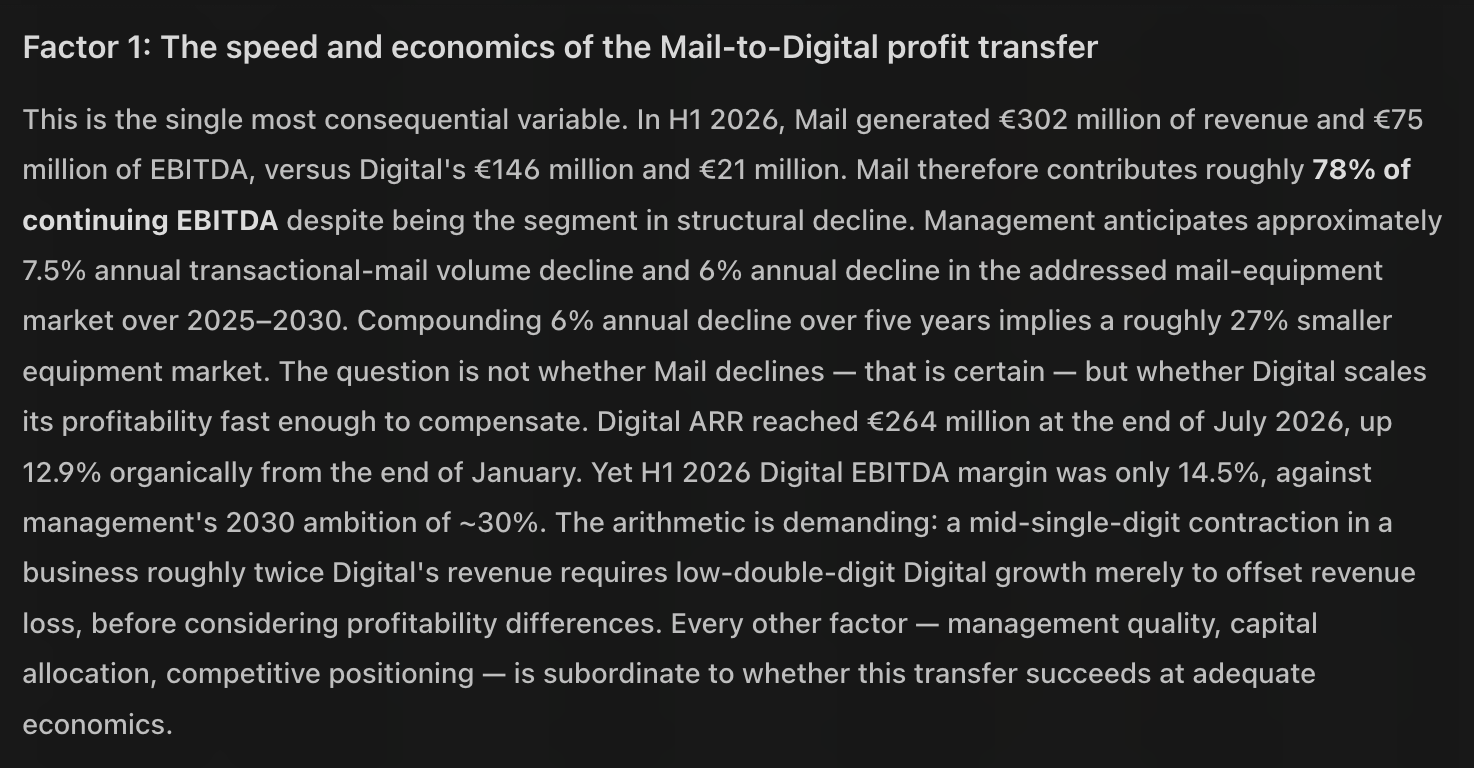
For example, Baseline correctly identified the key tension in the stock between the growing digital business and speed of the mail business decline:
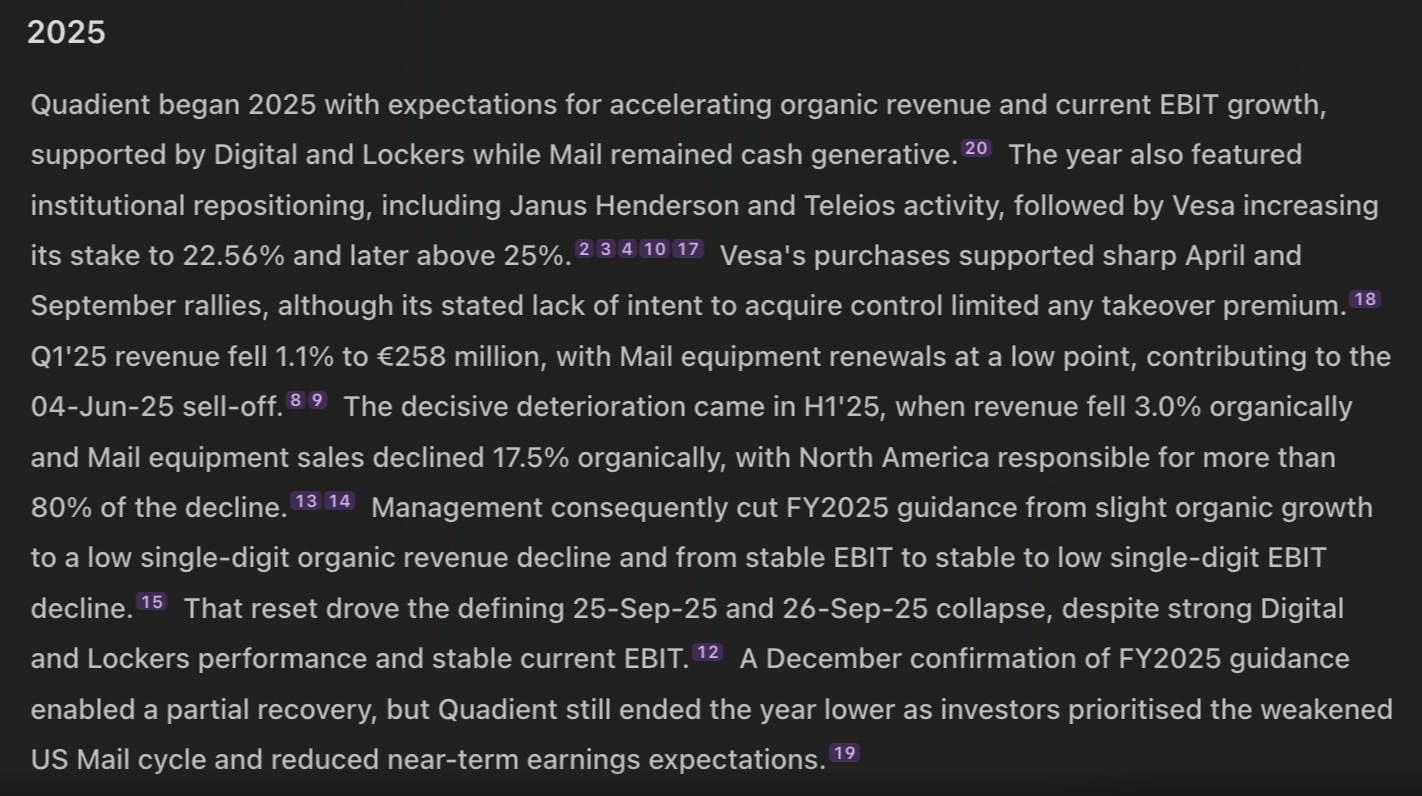
Baseline also provided a timeline of events that help to show the key factors that have moved the stock price. The tool suggests that narrative around mail is currently the driving force behind market swings:
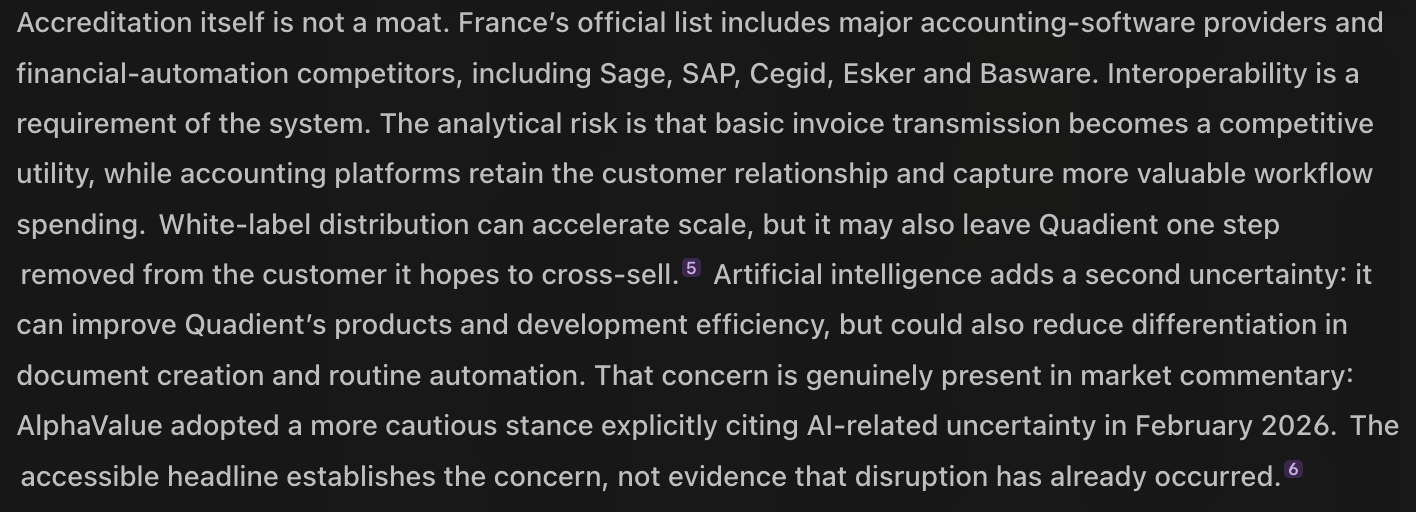
Baseline also argues that Quadient’s e-invoicing registrations do not equal revenue quality and it correctly highlights the threat from competitors like Sage, SAP, Cegid, Esker and Basware.
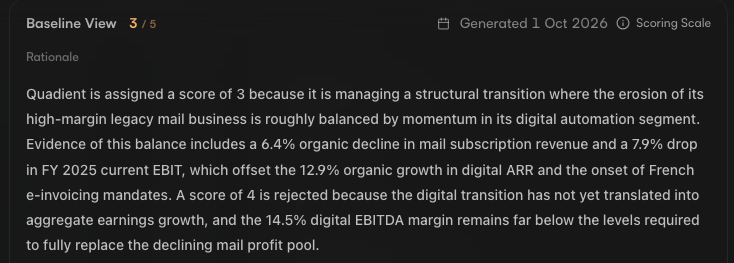
Overall, Baseline scores Quadient a 3 which indicates ‘stable or mixed; a strong static business’. I argue that Quadient is likely a 3 but being priced more like a 2. Baseline is valuation agnostic so it’s power comes from assessing genuine business quality.
Click below to download a complimentary research report generated by Baseline:

Final Thoughts
Quadient is a French business that looks modestly priced against the sum of its parts and I think there are a few reasons for the disconnect.
First, the company is small and French equities are out of favor.
Second, the company’s largest historical source of profits is shrinking, while digital has yet to demonstrate it can consistently deliver the margins management is targeting.
Third, headline financial figures make the company look indebted and capital-intensive, obscuring some of the cash generation and asset value beneath the surface.
These concerns are legitimate but likely priced in at current levels.
At approximately 2x annualised EBITDA for mail, under 2x ARR for digital and 1x revenue for lockers, I think the valuation provides attractive risk:reward for Quadient stock and meaningful potential for upside.
Thank you for reading Overlooked Alpha.
If you enjoyed this analysis please help us by clicking the “♡ Like” button.
Disclosure: Overlooked Alpha is written by Joe Marwood. I currently don’t hold a position in any securities mentioned. I am still evaluating my confidence in Quadient’s digital growth and may take a position in the near future. Overlooked Alpha has an affiliate partnership with Baseline and receives payment and a share of subscription revenue from referred customers.
Disclaimer: The information in this newsletter is not and should not be construed as investment advice. Overlooked Alpha is for information, entertainment purposes only. Contributors are not registered financial advisors and do not purport to tell or recommend which securities customers should buy or sell for themselves. We strive to provide accurate analysis but mistakes and errors do occur. No warranty is made to the accuracy, completeness or correctness of the information provided. The information in the publication may become outdated and there is no obligation to update any such information. Past performance is not a guide to future performance, future returns are not guaranteed, and a loss of original capital may occur. Contributors may hold or acquire securities covered in this publication, and may purchase or sell such securities at any time, including security positions that are inconsistent or contrary to positions mentioned in this publication, all without prior notice to any of the subscribers to this publication. Investors should make their own decisions regarding the prospects of any company discussed herein based on such investors’ own review of publicly available information and should not rely on the information contained herein.