
Highlights:
This business exploded during the pandemic thanks to COVID testing revenue. But the business was performing well before then.
With COVID revenue bottoming, strength in a historically attractive business is about to shine through.
We think the stock has 50% upside in a conservative scenario, making it more than worth the risk near the lows.
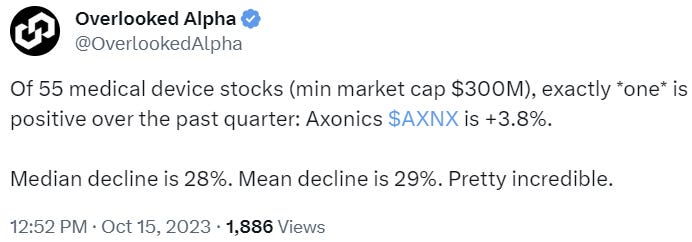
A week after the above Tweet, the story for medtech is much the same. Using a Koyfin screen for Health Care Equipment and Supplies stocks listed in the U.S. and Canada returns 72 names: only two1 are positive over the past three months, and the average return over that period is negative 26%.
The easy narrative is an overreaction from investors amid the rise of GLP-1 agonists like Ozempic. Indeed, the sheer size and breadth of the decline (last week, Barron’s cited a loss of $370 billion in market cap among medical device stocks since July) would suggest an overreaction almost by definition. After all, even assuming GLP-1s are the “magic bullet” some adherents claim, not everyone suitable for weight loss drugs will be able to access the drugs — or stay on them. That aside, a material portion of sector plays do not have any exposure at all to obesity or diabetes.
But what’s interesting is that going through the list, that easy narrative starts to fall apart somewhat. In many cases, there are legitimate reasons for the sell-off — or, at least, legitimate reasons why the new, lower valuation might be more appropriate. Dialysis plays have been hammered because of the direct challenge posed by Ozempic’s apparent success in treating kidney failure. Sell-offs in bigger names leave intriguing valuations, but the likes of Medtronic MDT 0.00%↑ or Smith & Nephew SNN 0.00%↑ have actually been rather poor performers over time.
To our eye one name sticks. QuidelOrtho QDEL 0.00%↑ has struggled for reasons that go beyond sector weakness. But the market’s sudden aversion to the space has driven the most recent leg of a long sell-off. At this point, that sell-off seems like it’s gone way too far.

Introducing QuidelOrtho
Quidel Corporation was founded in 1982 as a biotech startup. But two years later, the company launched its first diagnostic product: a dipstick-based, at-home, pregnancy test. The therapeutic efforts were eventually spun off2 and the diagnostics business in 1991 merged with Monoclonal Antibodies. The combined company kept the Quidel name. A 1995 acquisition of an Eli Lilly LLY 0.00%↑ unit expanded the business into a wide-ranging in vitro diagnostics player, with tests for influenza, helicobacter pylori (H. pylori) bacteria, mononucleosis, pregnancy, and osteoporosis, among other conditions.
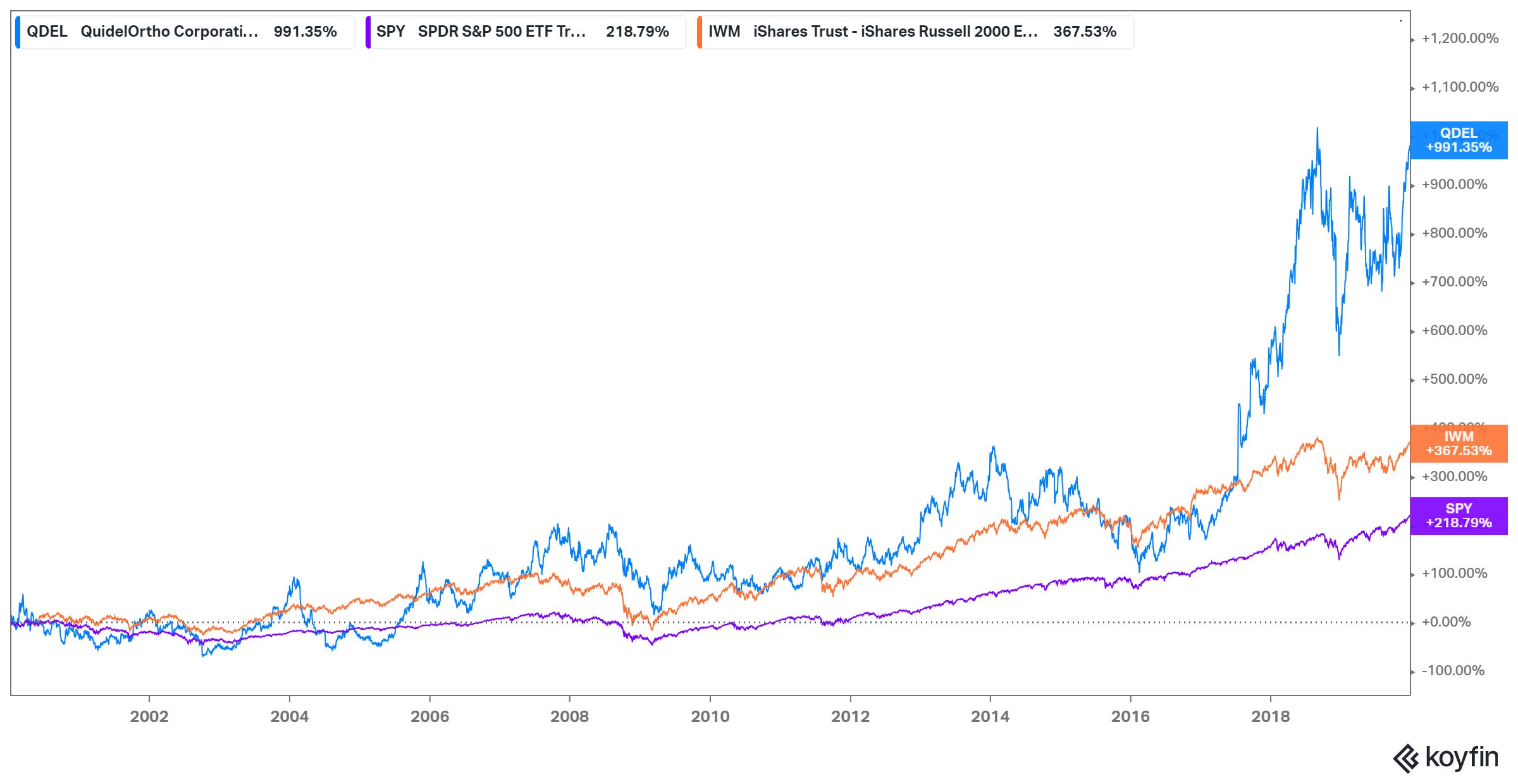
Quidel was a decent, if unspectacular, business. But in the second half of the 2010s, thanks in part to a smart acquisition driven by antitrust factors3, performance improved and the stock took off, gaining 159% (21% annualized) over that period.
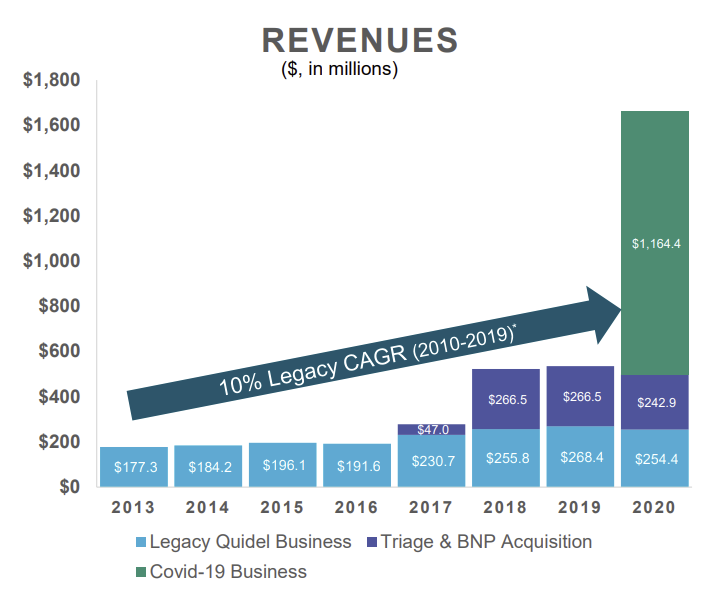
From there, the novel coronavirus pandemic provided a stunning source of demand:
Quidel presentation, June 2021
Thanks to massive demand for point of care tests, as well as an at-home version, Quidel’s sales skyrocketed. So did the stock, which gained 139% in 2020.
Early the next year, Ortho Clinical Diagnostics took advantage of market conditions to go public. Ortho provided clinical laboratory tests for coronary conditions and sepsis, along with a strong franchise in blood transfusion. The company had originally been founded as a unit of Johnson & Johnson in the late 1930s, and had been acquired by Carlyle Group CG 0.00%↑ for a reported $4 billion back in 2014. Though the January IPO was not well-received (Ortho stock slipped 9%), Ortho’s first-day close suggested a market cap of $3.3 billion.
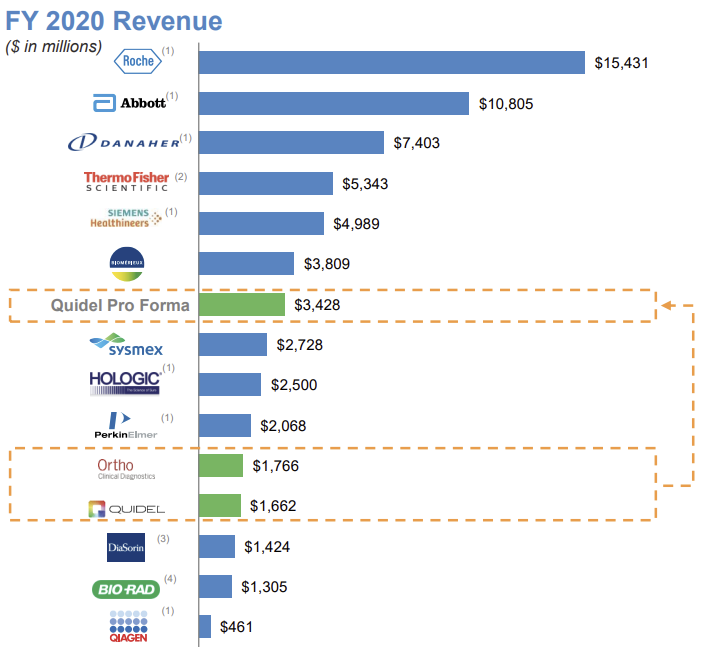
Quidel had been looking for an acquisition target throughout 2021, and toward the end it found one in Ortho. It paid $6 billion in a cash-and-stock deal, while also assuming about $2 billion in debt. The combination created the ability to provide testing everywhere from the home to the lab, while expanding Quidel’s portfolio thanks to Ortho’s reach to over 130 countries. It added significant scale as well:
source: Quidel/Ortho merger presentation, December 2021
The combined company is thus a leader in diagnostic testing for dozens of conditions at essentially every possible point, from the home to the lab. Much of the revenue of course is recurring, as customers use consumables while running QuidelOrtho machines. Excluding Covid revenues, about half of revenue comes from the Labs business unit, with Transfusion 25%, Point of Care ~20%, and Molecular Diagnostics roughly 5%.
A Pandemic Winner
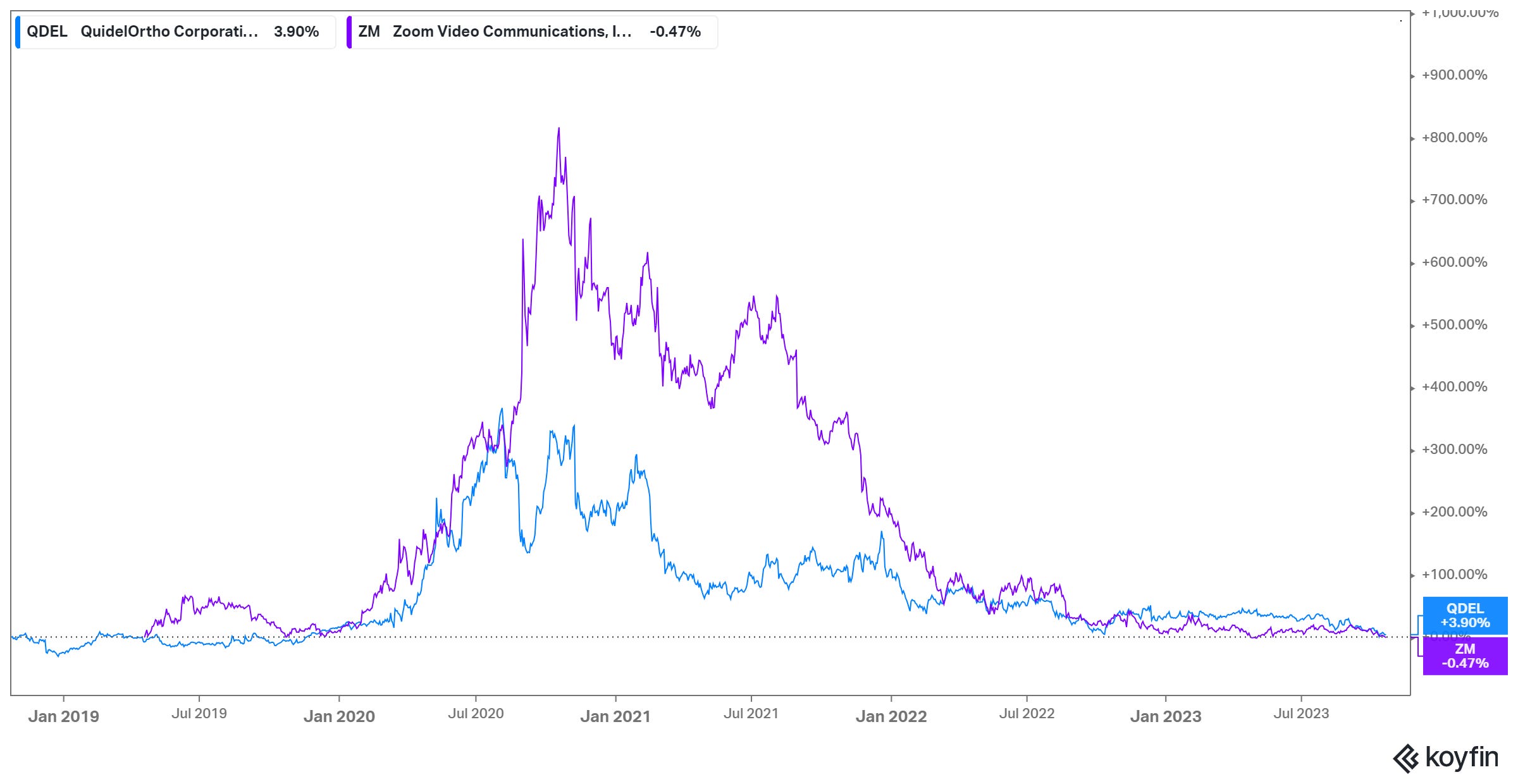
At least so far, the merger has not worked out. In fact, QDEL looks like a more muted version of one of the most-covered pandemic winners, Zoom Video Communications ZM 0.00%↑:
source: Koyfin; five-year chart for QDEL
Given the impact of the pandemic on Quidel (the company’s revenue more than tripled in 2020) the similarity between ZM and QDEL perhaps isn’t stunning.
More recently, QuidelOrtho simply hasn’t performed that well. The combined company’s first Investor Day, in December, inspired no confidence at all: the stock actually fell 16% in trading that session. Guidance for Adjusted EBITDA provided after Q2 results in August was modestly worse than the original outlook given after Q4; QDEL slipped 7.3% after that release.
That outlook looks particularly concerning on an absolute basis as well. At the midpoint of this year’s outlook, against pro forma 2022 results for the combined company, revenue should decline 26%. Adjusted EBITDA will drop 47%, with margins plunging to 27%-plus from 38% a year ago. In that context, the painful decline from the highs seems perfectly logical.
The COVID Impact Fades
The chart highlights the “falling knife” risk but it also gets to the more fundamental concern: that what QuidelOrtho looks like in a world with endemic Covid-19 simply isn’t that attractive. The Ortho deal levered up the balance sheet: net debt is just under 3x 2023 Adjusted EBITDA. And if Covid revenue keeps withering, profits keep doing the same, which mean the business is more levered and the valuation less attractive.
But the market may well be overreacting to the risk from Covid-related declines — because those declines have already played out. Full-year guidance for this year now contemplates just $300 million to $400 million in Covid revenue, a cut from the $300M-$500M range given after both Q4 and Q1. Commentary from the Q1 and Q2 calls suggests that in the first half QuidelOrtho generated $272 million in Covid revenue. There’s simply not that much left in the outlook — and, of that figure, over 90% is coming from the professional side of the business, per chief financial officer Joseph Busky on the Q2 earnings call.
That professional business will remain even should COVID stay in an endemic state. Chief executive officer Douglas Bryant said at a conference last month that his company expects $200-$400M in annual COVID revenue going forward.
There will be some more difficult comparisons in the first half of 2024, certainly, and the revenue generated in 1H 2023 had a beneficial impact on margins. Indeed, Busky said after Q2 that the reason EBITDA margin guidance was lowered after Q2 was because of the impact of lower expected COVID revenues. But at the same time, lingering effects of the pandemic have pressured the business elsewhere, notably in China (which accounts for over 10% of non-Covid revenue).
Simple math suggests that there is a bottom coming for the business, and coming soon. There simply isn’t that much COVID revenue left to lose, and even in an endemic state there will be some demand for diagnosis of the virus. Perhaps driven by worries about the sector more broadly, factor bets, or just the broader sell-off in small- and mid-caps, investors have continued to abandon QDEL despite the fact that normalcy is pretty much fully at hand. Indeed, QuidelOrtho less than two weeks ago reiterated full-year guidance while delivering preliminary revenue for Q3 that was nicely above consensus estimates. QDEL fell more than 6% anyway, though the stock has since recovered half of those losses.
What Does This Business Look Like In 2024?
The reiterated guidance for 2023 projects Adjusted EBITDA of $800-$830 million and adjusted EPS of $4.85-$5.30. With a market cap of $4.5 billion and an enterprise value of $6.8 billion, both suggest an exceptionally conservative valuation for QDEL: a little over 8x EV/EBITDA, 13x earnings, and ~11x free cash flow4. (It’s worth noting that QuidelOrtho does not back stock-based compensation out of its adjusted figures.)
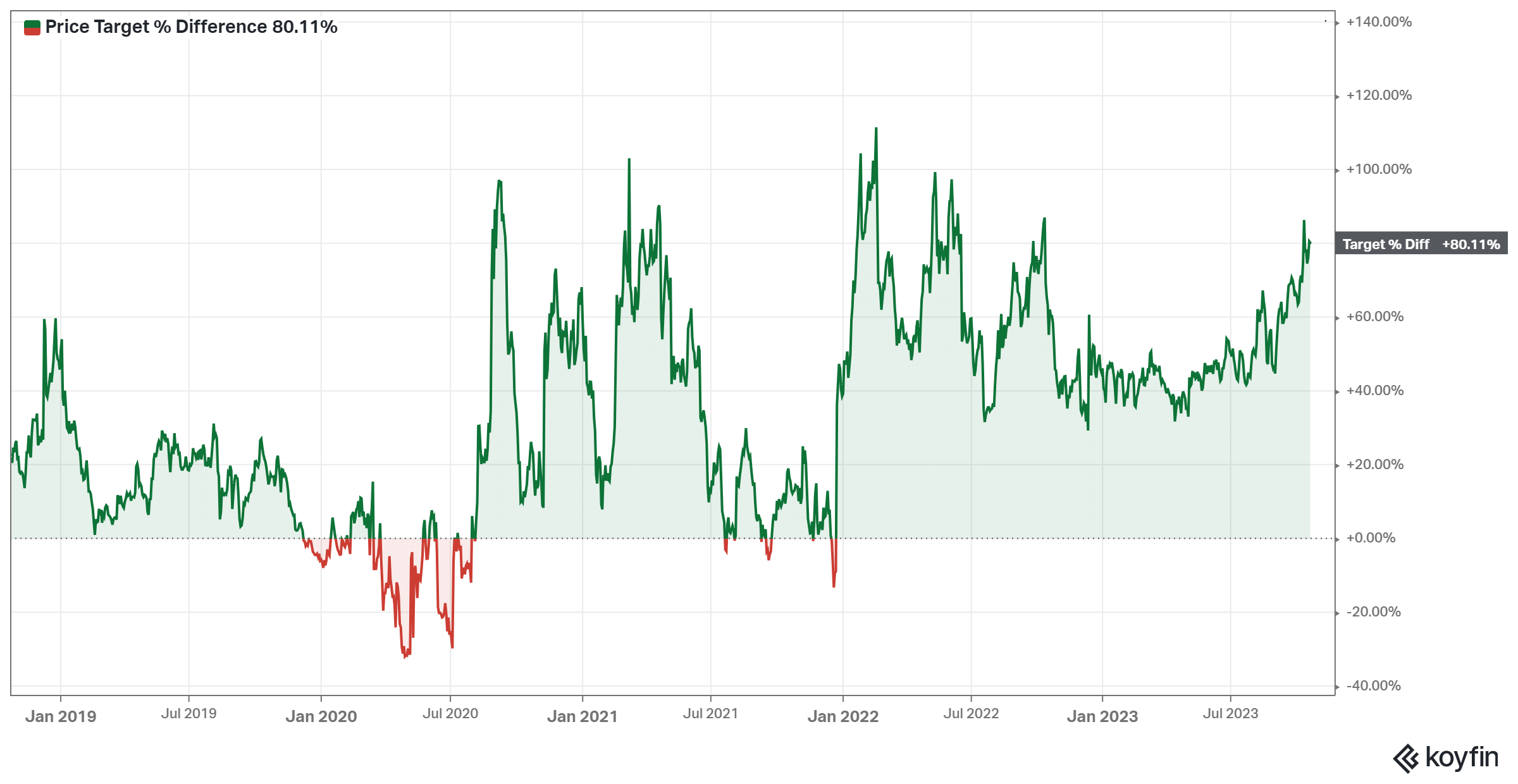
At the moment, Wall Street consensus (per Koyfin) forecasts Adjusted EBITDA of $851 million in 2024, with adjusted EPS of $5.55. Not coincidentally, the Street is exceptionally bullish on QDEL: the average price target sits at $121, which implies 80% upside. The gap between expectations and price is near the high end of the pandemic-era range:
source: Koyfin
In essence, QDEL is a bet on whether the Street is correct in its earnings expectations, or at least close. In other words, does QuidelOrtho have yet another year of a COVID hangover ahead, or does normalcy — and growth — finally return?
There’s a strong argument for the latter answer. Again, direct COVID revenue is petering out. Notably, QuidelOrtho expects another $50 million in merger synergies on top of a similar amount of savings this year; that alone suggests 6% growth. Non-respiratory revenue is expected to grow, in constant currency, 5.0% to 6.5% year-over-year in 2023, and management has said the company is taking market share. More broadly, despite how equities in the industry are performing, there is a clear sign of normalcy returning to health care in the post-pandemic environment.
There’s another aspect to consider: what these businesses looked like before the pandemic. In 2019, Quidel generated $535 million in revenue, and Ortho $1.8 billion. Quidel’s Adjusted EBITDA was $171 million; Ortho’s $478 million.
Pro forma, then, revenue was about $2.34 billion; the Street expects $3 billion next year, with ~half the growth attributable to COVID. Combined 2019 Adjusted EBITDA was $650 million; add $100 million in synergies, and apply 30% margins to the $300 million in incremental COVID revenue, and the total gets to $840 million.
That’s just shy of the $851 million consensus. And while that math is far from definitive — R&D spending has risen, and gross margins this year have disappointed — it is another piece of evidence in favor of the idea that this business is bottoming.
The one key cause for concern looks to be the impact of Q1 2023 COVID revenue as it is lapped next year. The company generated over $200 million in such sales in the quarter; per the Q1 call, $143 million came from a pair of government contracts that hit at rather high margins. The lack of similar profits in 2024 could offset any synergy benefits, driving a year-over-year decline. But there is enough elsewhere in the business to suggest that overall profit growth still is achievable in 2024, with further growth ahead after that.
The Case For QDEL
And if that’s the case, then QDEL stock is a buy here, and perhaps a screaming buy. Again, the multiples here are exceptionally conservative for any business — but this actually is quite a business in what historically has been a successful and highly-valued industry.
Before the pandemic, Quidel provided strong returns:
source: Koyfin
Before the merger, Ortho was trading at more than 10x 2019 Adjusted EBITDA — and that business was not a COVID beneficiary (2020 revenue actually declined year-over-year, though margins expanded).
The combined company still is targeting double-digit adjusted EPS growth from 2019 to 2025, and Bryant has reiterated a 2025 adjusted EPS target of $6 to $7. Savanna, a real-time PCR (polymerase chain reaction) testing platform, has been in development for years and is headed for a U.S. launch. That’s a potential game-changer, with its size bringing PCR testing to many more potential locations; early sales in Europe have gone well, according to management. And while the Quidel side of the business benefited from the pandemic, the company also launched a number of new assays, expanding its reach and potential in the post-pandemic environment as well.
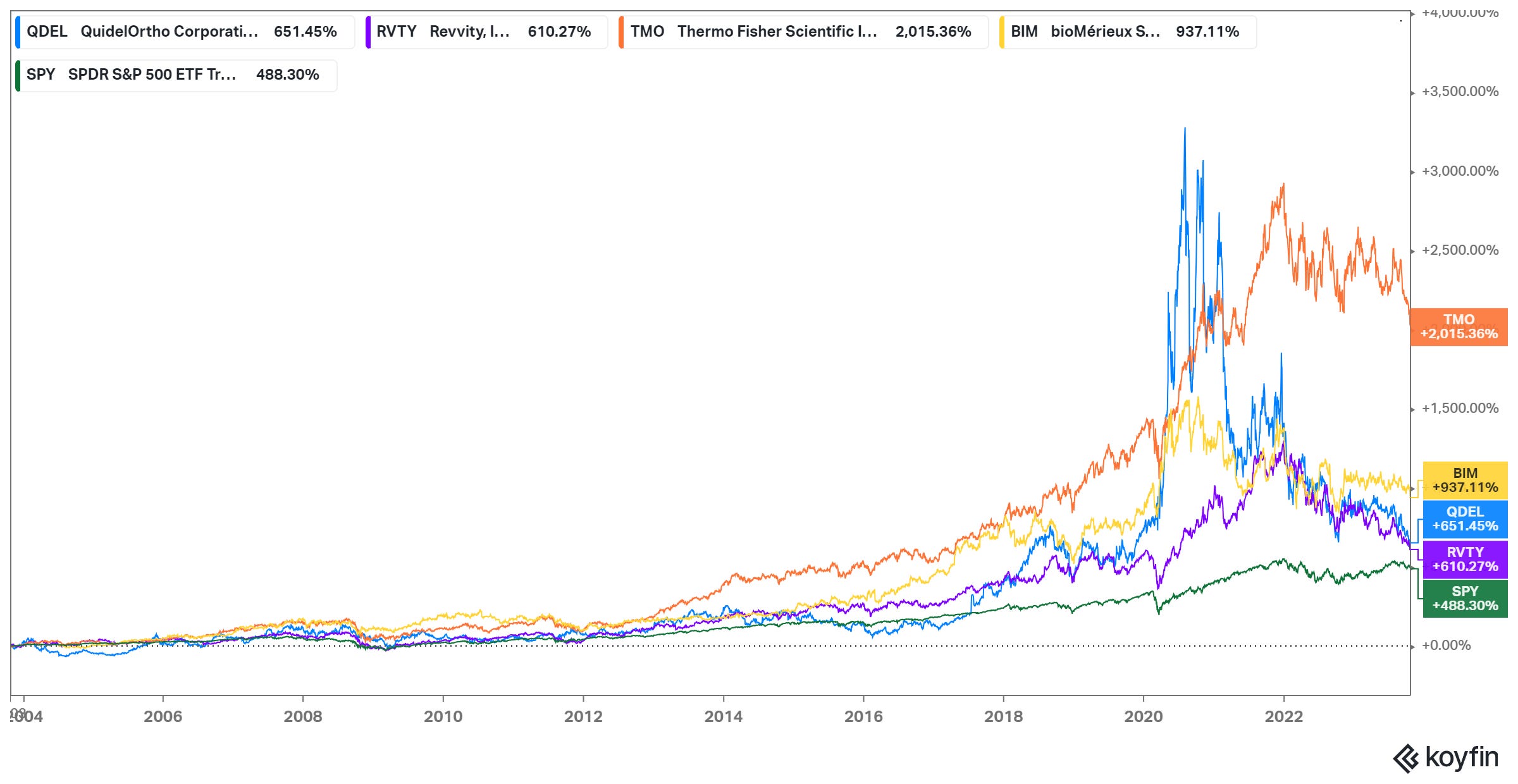
This is a good business. EBITDA margins trending toward 30% prove as much. And it’s a good industry. Thermo Fisher TMO 0.00%↑ trades at nearly 18x next year’s consensus EBITDA. bioMérieux S.A. is at 11x, and 18.5x earnings. Revvity RVTY 0.00%↑, the former PerkinElmer, is valued at 15x EBITDA. For that matter, Quidel itself traded at ~18x EBITDA at the end of 2019.
The current multiples assigned the group all follow sharp year-to-date declines of their own (ranging from 11% to 27%), but the long-term performance remains exceptionally impressive:
source: Koyfin
And it seems almost certain that, at some point, the market is going to return its focus back to the positive attributes about the industry: recurring revenue, high barriers to entry, and (not coincidentally) strong long-term outperformance.
Right now, however, the focus is on COVID revenue and a guidance cut from Thermo Fisher, and (perhaps) GLP-1s. Those issues will pass, however. When they do — and it may be soon — QDEL has a path to both EBITDA growth and multiple expansion. Based on consensus for next year, 10x EBITDA and 15x earnings — both still-conservative valuations — would value the stock right at $1005, for about 50% upside. That doesn’t seem an unreasonable target, given that all it really requires is for QuidelOrtho to grow at all next year.
Certainly, the stock can keep falling in the short-term: as noted, this is an ugly chart. And it’s possible that noise in the results of the past few years, plus the impact of the merger, are hiding concerns within the business that will become much more clear in 2024, essentially the company’s first full, normal, year.
But at this point, that risk seems worth taking. Even acknowledging leverage and the chart, something close to a worst-case scenario looks priced in. The benefits of Savanna, the end of declining COVID revenue, and broader healthcare growth are not. That will change, and when it does, QDEL has huge potential upside.
As of this writing, Vince Martin has no positions in any securities mentioned. He may initiate a position in QDEL this week.
Disclaimer: The information in this newsletter is not and should not be construed as investment advice. Overlooked Alpha is for information, entertainment purposes only. Contributors are not registered financial advisors and do not purport to tell or recommend which securities customers should buy or sell for themselves. We strive to provide accurate analysis but mistakes and errors do occur. No warranty is made to the accuracy, completeness or correctness of the information provided. The information in the publication may become outdated and there is no obligation to update any such information. Past performance is not a guide to future performance, future returns are not guaranteed, and a loss of original capital may occur. Contributors may hold or acquire securities covered in this publication, and may purchase or sell such securities at any time, including security positions that are inconsistent or contrary to positions mentioned in this publication, all without prior notice to any of the subscribers to this publication. Investors should make their own decisions regarding the prospects of any company discussed herein based on such investors’ own review of publicly available information and should not rely on the information contained herein.
OraSure Technologies OSUR 0.00%↑ is +21%, after gaining 43% in two sessions following earnings in early August. Axonics AXNX 0.00%↑ is +4%.
Into La Jolla Pharmaceuticals, which last year was acquired by Innoviva INVA 0.00%↑.
Quidel acquired assets from Alere ahead of its sale to Abbott Laboratories ABT 0.00%↑.
QuidelOrtho has guided for free cash flow to in the range of 50% of Adjusted EBITDA.
One potentially hidden fundamental boost here: first-half free cash flow was quite weak, at just $41 million. Given guidance for full-year 2023 and assuming similar conversion next year, QuidelOrtho could generate FCF of close to $500 million in six quarters, about 11% of its current market cap.