
💡 Highlights:
The global foodservice industry has recovered fully from the pandemic, and strong growth continues.
Secular shifts toward outsourcing should benefit the industry’s three major players — including its biggest.
Shares do trade at a premium to peers. But that premium seems worth paying up for.
This may not be a glamorous business but Investors are ignoring some significant tailwinds.
For many U.S. investors, Compass Group (CPG.LON) is a stock they’ve never heard of, but a business they know. Compass provides catering, vending, support, and other services to facilities, arenas, schools, and other institutions across the U.S., with about 20% share of the contract food service market.
It’s not necessarily a sexy business, but it’s been an excellent one. Shareholder returns have been impressive, return on capital excellent, and market share has steadily grown over time. Right now, investors are worried that a cyclical and post-pandemic recovery will end, but that ignores a significant secular tailwind at the company’s back.

Introducing Compass Group
Compass Group traces its roots to a pair of English businesses founded in 1941 in response to a British government order requiring that large manufacturers feed their workers. The businesses merged in the 1980s, were the target of the largest management buyout in U.K. history in 1987, and the re-named Compass Group PLC went public the following year.
In 1994, the company took a major step with its first acquisition in the U.S. Many more deals followed, including stadium and arena operator Levy Restaurants in 2000. Those deals are why Compass is an anomaly: a U.K.-listed company whose business is primarily in the U.S. The country accounted for almost two-thirds of revenue in 2023, and Compass is in fact the largest player in the U.S. market, ahead of Aramark ARMK 0.00%↑ and France’s Sodexo (SW.PA)
Those U.S. acquisitions are also why Compass operates under such an extensive number of brands:
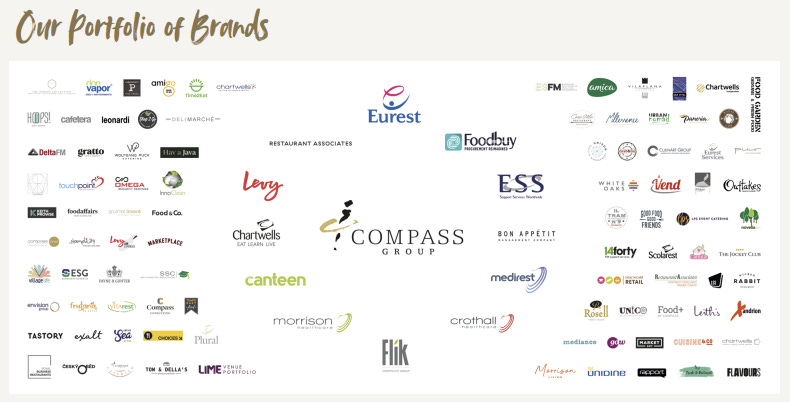
source: Compass Group plc factsheet
But there is another reason for the huge number of nameplates: Compass doesn’t really operate as a single business. It operates in five sectors, as it calls them, and each has very different requirements:
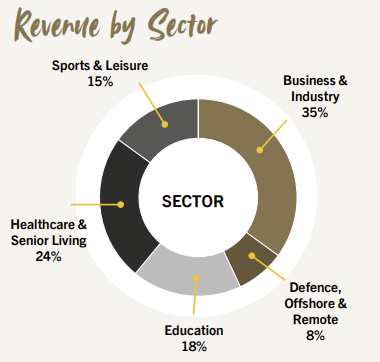
source: Compass Group plc factsheet
There simply isn’t that much commonality, in terms of operations or the customer base, between running a university cafeteria, serving workers on an offshore oil rig, and providing various meals at a basketball game are simply different operations.
And so Compass focuses on “sectorising” and even “sub-sectorising” its business, creating relatively small, empowered units that work with customers with very different needs. At the same time, scale does provide some help. Compass can provide multiple offerings to a single client (think food, laundry, and transportation services for a senior living facility, or event planning in addition to dining services for a major corporate customer). And the company has a global purchasing organization, Foodbuy, which can help the company lower costs for customers.
An Excellent Business Over Time
Over the past twenty years, with one notable exception, CPG has been an outstanding stock, with annualized returns of 12.7% over that period:
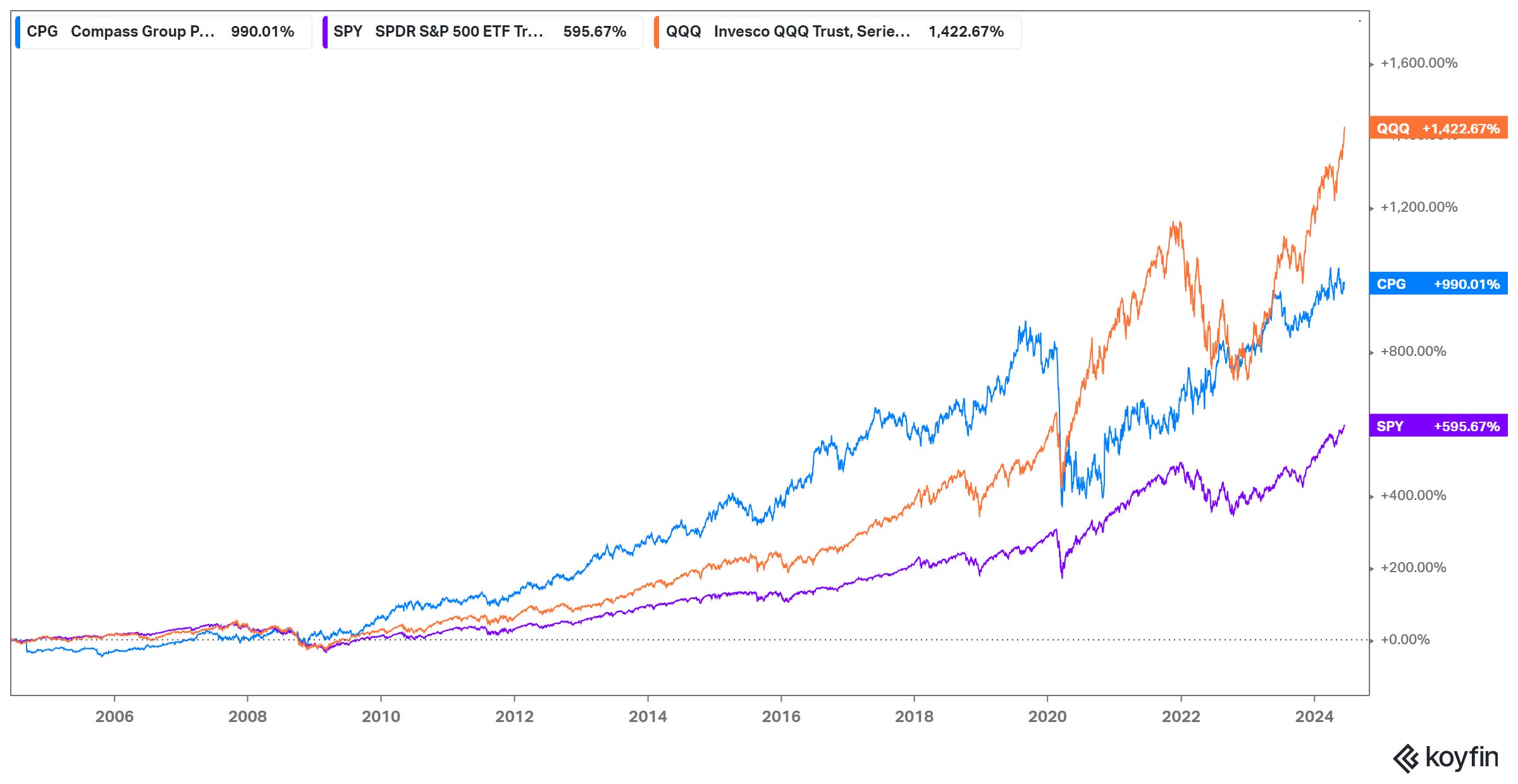
source: Koyfin; total return chart
Shares unsurprisingly were hit hard by the novel coronavirus pandemic, given not just the near-term exposure from business and facility closures, but lingering worries about the impact of work-from-home policies on revenue. That period aside, however, CPG has been an easy long-term winner.
The reason the stock has done well is because the business has done quite well. Revenue has risen at a 6.6% compound annual rate over the past decade, with most of that growth apparently organic (Compass has focused on tuck-in acquisitions since the financial crisis). Given the low volume growth in the market (and the lack of inflation during much of the 2010s), that growth is much more impressive than it sounds.
And, at the moment, the business seems to be doing extraordinarily well. In fiscal 2023 (ending September), organic revenue increased nearly 20%; adjusted operating profit rose 30%. For this year, Compass expects organic revenue growth of nearly 10%, with adjusted operating profit up about 15%; both figures were raised after the half-year release last month.
To be sure, post-pandemic recovery (and high event spending) is still at play. Aramark’s 2023 results and 2024 outlook are essentially the same, and Sodexo is not far behind. So this is not necessarily a case where there is a permanent growth acceleration going forward.
Still, after muddling through pandemic impacts, Compass has returned to its old ways. Given those old ways drove nearly 13% annualized returns, that’s certainly good news. So are the drivers that can keep revenue and profits growing going forward.
The Shift To Outsourcing
For the contract food industry, volume growth at the customer level is close to zero. In a normalized environment, a university cafeteria or a senior living center doesn’t serve substantially more meals each year; the figure might rise along with the facility’s population, but that’s about it.
So the two levers to drive growth are pricing and contract wins. Taking pricing is not terribly easy. Each of the three majors, along with other regional rivals, are constantly trying to poach business. For many customers, foodservice is a cost center, not a differentiator; for them, the lowest bid wins1.
It’s contract wins — and contract retention — that drive organic growth. Over time, Compass has been excellent on both fronts: its retention rates generally hover around 96%, though the company did see some contract losses in calendar 2023 that lowered that figure. Net new business drove 5 points of growth last year, with guidance suggesting another 4 to 5 points in FY24. Overall, Compass is targeting something like 8% to 8.5% in gross new business each year, with retention offsetting that figure to get to 4-5% annual increases on a ‘net new’ basis.
Notably, that target, in an environment with normalized inflation, would suggest substantially faster organic revenue growth than Compass posted during the 2010s. 2-3 points of pricing from existing customers alone would get revenue growth to the ~7% level, with modest potential for help from volumes as well.
Faster revenue growth in turn suggests operating leverage and better margins. Those margins still haven’t quite returned to pre-pandemic levels, though they’re on their way: guidance suggests a low-7% print this year, against 7.4% in fiscal 2019. If Compass can grow faster than it did before the pandemic, its margins should be better, which in turn should drive faster bottom-line growth from the current level, improved return on invested capital (from already-solid levels), and a stronger valuation.
The good news for Compass, and one key reason to be bullish on CPG stock, is that there is a huge pool of business to be taken. Compass estimates the total addressable market for food service to be at least $300 billion, meaning the company has share of about 15%. In Europe, its share is less than half that.
Nearly all of that market is held by either self-operated facilities or smaller, regional players. Over time, through both organic and inorganic growth, Compass has steadily taken share from those operators.
It should be able to take more share going forward. In food service, like so many other industries in the modern world, being subscale is simply too difficult. Again, Compass’s centralized buying can hold down costs, which becomes more important amid higher inflation. A tight labor market provides the company an advantage on that front. Nutritional and labeling requirements (notably around allergens) both add complexity and increase risk. Each year, essentially, it gets more and more difficult to operate a single facility, or even a handful of facilities.
Operators across the space already are seeing the results. On its fiscal Q2 call last month, Aramark said that 40%-45% of new business wins were coming from customers outsourcing for the first time. And, of course, once won that business likely stays over time. For myriad reasons, outsourcing is a relatively difficult decision to reverse.
So while investors may worry that growth will slow dramatically — and, indeed, they are pricing CPG and its peers as if growth will slow dramatically — there is an important reason for optimism toward the secular outlook here. And if Compass can grow at even a marginally faster rate than it did pre-2020, then the stock almost certainly will do quite well from here.
Is CPG Cheap Enough?
On its face, CPG’s valuation does not look all that impressive. Based on our reading of guidance, shares trade for about 13x FY24 Adjusted EBITDA2. Price to adjusted earnings is likely ~24x; price to free cash flow is closer to 30x, given that capex is running higher than depreciation and amortization3.
Across the board, the multiples assigned to CPG are higher than those assigned to Aramark or Sodexo, which are closer to the 11x range using FY24 estimates. But Aramark gets a little over 20% of operating profit from a uniform business that merits a lower valuation, at least based on the obvious peer, UniFirst UNF 0.00%↑, which is valued at 8.5x this year’s consensus. It also has a much more levered balance sheet, at more than 4x this year’s EBITDA with a 2027 target of getting to 3x4. Sodexo, meanwhile, is getting a one-time bump in Q4 from the Paris Olympics.
To be sure, we’re not opposed to either ARMK or SW here, but it’s also true that history matters:
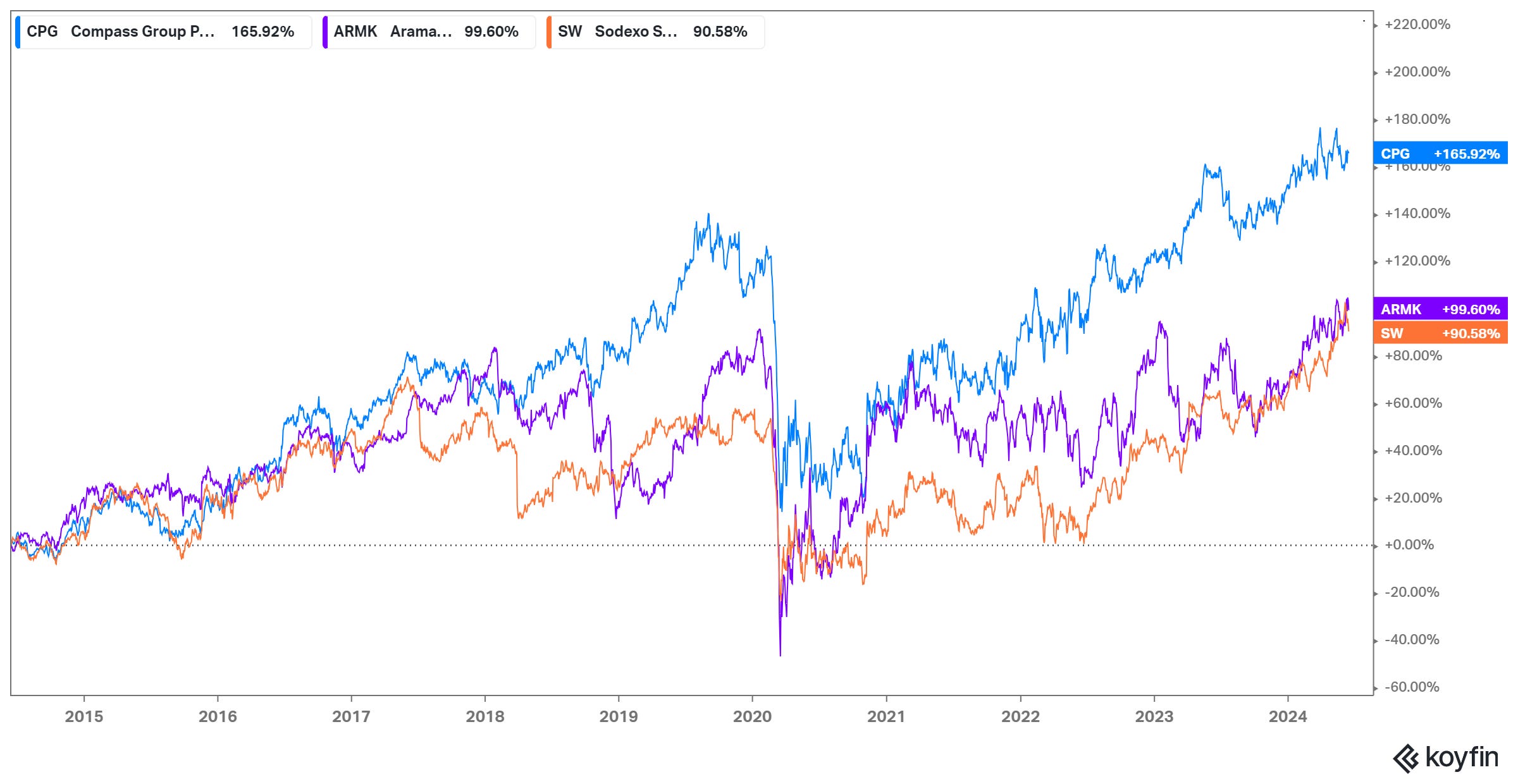
source: Koyfin
Over time, Compass has been the better stock. That’s largely because it’s been the better business, with (usually) stronger top-line growth and higher operating margins. Given little apparent sign that its competitive edge has weakened, it does seem wise to pay up for quality here — particularly given that Aramark, when adjusted for the uniform business exposure and the balance sheet, probably isn’t actually any cheaper5.
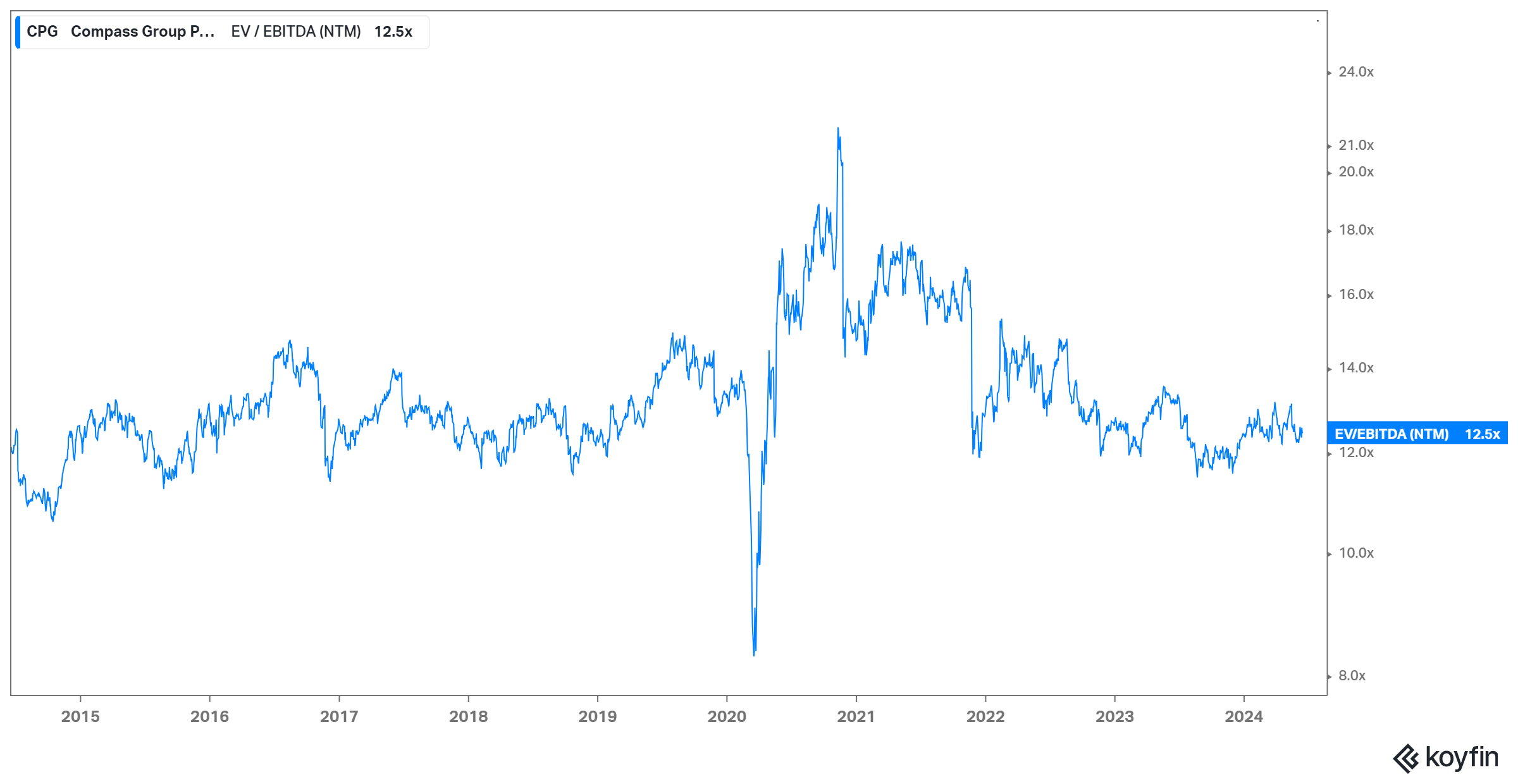
It would be nice if CPG were cheaper, certainly. But at least on a short-term basis, the reaction to the guidance hike after Q2 has been surprising (the stock is down 4.5% since earnings), and taking the longer view the stock doesn’t really get much cheaper without very good reason:
source: Koyfin
We’re a bit skeptical of arguments that a stock is “at the low end of its five-year range”; in many cases, stocks should see their multiples narrow over time. But if an investor believes in the secular opportunity from outsourcing, and the continuation of Compass’s leadership in food service (it is now larger than Aramark and Sodexo combined), there really isn’t any reason for the multiple to compress. To this point, investors have done perfectly fine paying 12-13x EBITDA for this business, and that should continue.
A U.S. Listing And Other Potential Catalysts
Overall, this looks like a relatively boring, successful business, and a stock that has a path toward double-digit annualized returns for quite a while. But it’s worth calling out a few catalysts that could juice those returns.
The first is around acquisitions and divestitures. Again, particularly on a P/FCF basis Compass doesn’t necessarily look cheap, but there is some noise in the numbers between the exits from multiple countries (including China) and a pair of small acquisitions this year. Net/net, underlying growth is probably slightly better than even underlying figures suggest. More broadly, Compass simply seems to be a good acquirer, at least based on the data points that make their way to investors6.
In 2021, management called out senior-focused Unidine as having 17% annual revenue growth since its acquisition. On this year’s first-half call, group chief executive officer Dominic Blakemore called out Fazer, a catering business in the Nordic business, as driving growth in the region even though the deal closed just weeks before the pandemic hit. Obviously, management is going to tout the good deals, but Compass does not appear to have taken an impairment charge in at least a decade.
The second is around leverage. Compass runs at relatively low leverage (about 1.5x EBITDA pro forma for this year’s acquisitions), particularly relative to Aramark. Analysts have asked on occasion whether the company might lever up for buybacks; with a new chief financial officer arriving in December, it’s possible there could be a change in strategy there.
The third potential catalyst surrounds a U.K. listing. U.S. exchanges have successfully targeted U.K. companies for initial public offerings, given better liquidity stateside and more demand from exchange-traded funds. (Performance in the U.K. market likely is a factor as well. The FTSE 100 has returned 20.2% total over the past decade; the NASDAQ 100 18.9% annualized.) Those exchanges are also gaining primary listings as well, including of CRH plc CRH 0.00%↑ and Ferguson FERG 0.00%↑.
Interestingly, at the end of fiscal 2023, Compass switched to reporting in dollars instead of pounds. On the Q2 FY23 call, then-CFO Palmer Brown insisted that the U.K. listing “is not under review”. But there is zero doubt that Brown and new CFO Petros Parras are being pitched by U.S. exchanges, and at some point the temptation may become too great.
To be sure, none of these catalysts are thesis-changing; these are developments that could add modestly to overall returns in Compass Group. But that’s kind of the point: this isn’t a business that needs dramatic catalysts, or a new listing. It just needs to keep doing what it has been doing: that’s been more than good enough for shareholders so far.
As of this writing, Vince Martin has no positions in any securities mentioned.
Disclaimer: The information in this newsletter is not and should not be construed as investment advice. Overlooked Alpha is for information, entertainment purposes only. Contributors are not registered financial advisors and do not purport to tell or recommend which securities customers should buy or sell for themselves. We strive to provide accurate analysis but mistakes and errors do occur. No warranty is made to the accuracy, completeness or correctness of the information provided. The information in the publication may become outdated and there is no obligation to update any such information. Past performance is not a guide to future performance, future returns are not guaranteed, and a loss of original capital may occur. Contributors may hold or acquire securities covered in this publication, and may purchase or sell such securities at any time, including security positions that are inconsistent or contrary to positions mentioned in this publication, all without prior notice to any of the subscribers to this publication. Investors should make their own decisions regarding the prospects of any company discussed herein based on such investors’ own review of publicly available information and should not rely on the information contained herein.
This isn’t necessarily true in parts of the business and industry sector, or perhaps in U.S. higher education at the moment. But, for instance, management has explained its decision to exit the Brazil market this year as driven in part by the fact that customers in the country overwhelmingly focused on price over quality.
Market cap is $49 billion at the current exchange rate and the 22.17 GBP close on Friday. Net debt is $5.3 billion, for EV of $54.3 billion. Adjusted EBIT growth of 15%, as guided, would get the figure just shy of $3 billion, with first-half D&A running at about $1.1 billion on a full-year basis, for Adjusted EBITDA of $4.1 billion.
Adjusted net income should be about $2,060 million, with interest guided to $235M, D&A at $1,100M, and the effective tax rate at 25.5% (~$705M). With capex guided to ~3.5% of revenue ($1.5 billion), FCF would be $1.66 billion for a P/FCF of 29.5x
To be fair, if an investor believes that the three majors will benefit from first-time outsourcing, ARMK’s balance sheet might be a point in its favor. Indeed, we don’t dislike ARMK here, either. But higher leverage usually implies a lower multiple, and we’ll get to a point against both Aramark and Sodexo momentarily.
One rough approach is to consider that ARMK trades at 11.5x consensus FY24 EBITDA, and UNF 8.5x; that implies that the ~80% of profit coming from Aramark foodservice is valued at ~12.5x or so, a half-turn discount to CPG. When adding back Aramark’s stock-based compensation (which Compass doesn’t exclude from its adjusted figures), the gap disappears.
That’s not a criticism; many of the deals are small and/or quickly integrated into broader offerings, meaning it’s not feasible for management to break out their performance.