
TL;DR
Marketing firm Advantage Solutions closed at an all-time low on Thursday, a ~50% sell-off since the Q2 report in early August.
Advantage is clearly dealing with significant near-term challenges, most notably in terms of wage inflation. But forward guidance has been re-affirmed.
End customers should see stable performance, and long-term relationships suggest a reliable revenue and profit base.
Leverage is a risk, but at 5.4x EV/EBITDA and 4x normalized free cash flow, this sell-off seems overdone.
Welcome to Overlooked Alpha. If this is your first time, subscribe below to get our best investing ideas in your inbox every Sunday morning:
Introduction
On Tuesday Aug. 9th, after the market close, Advantage Solutions ADV 0.00%↑ reported second quarter earnings. The report seemed relatively uneventful. Q2 results were roughly in line with analyst consensus (depending on the source). Advantage re-affirmed full-year guidance for Adjusted EBITDA (the only metric given) after doing the same after the Q1 release in May.
ADV stock did dip 8% the day after the report. But it regained all of that ground, and then some, the following session. Shares closed the week up 7%, against a 3.3% rise in the S&P 500. ADV retreated the following week, but a support level around $4, first touched during the broad market sell-off in May, still held.
Support isn’t holding anymore. Since its close on Aug. 11, two days after earnings, ADV stock has dropped by more than 50% — on literally no news. Not a single public news source has a headline since the Q2 release; Advantage has made one filing with the SEC, an updated investor presentation1.
To clarify, “literally no news” means literally no news about Advantage itself. Obviously, there’s been plenty of news in the market and the economy, and in fact more news than most of us would care to see. One of the changes in the external environment — a 98 bps rise in 10-year Treasury yields just since Aug. 12 — no doubt is material given Advantage’s debt-heavy balance sheet.
That said, it doesn’t look to be material enough. There are risks here, most notably on that balance sheet. But this is also a somewhat defensive business trading at ridiculously low multiples despite reasonably solid performance year-to-date.
We’re at a point in this market where, from a long-term perspective, the broad sell-off is creating opportunities. ADV looks like one of those opportunities.

What Advantage Solutions Does
Advantage essentially works as a middleman in the CPG (consumer packaged goods industry). Pre-pandemic (and presumably at some point post-pandemic), the business split roughly 50/50 between sales and marketing functions.
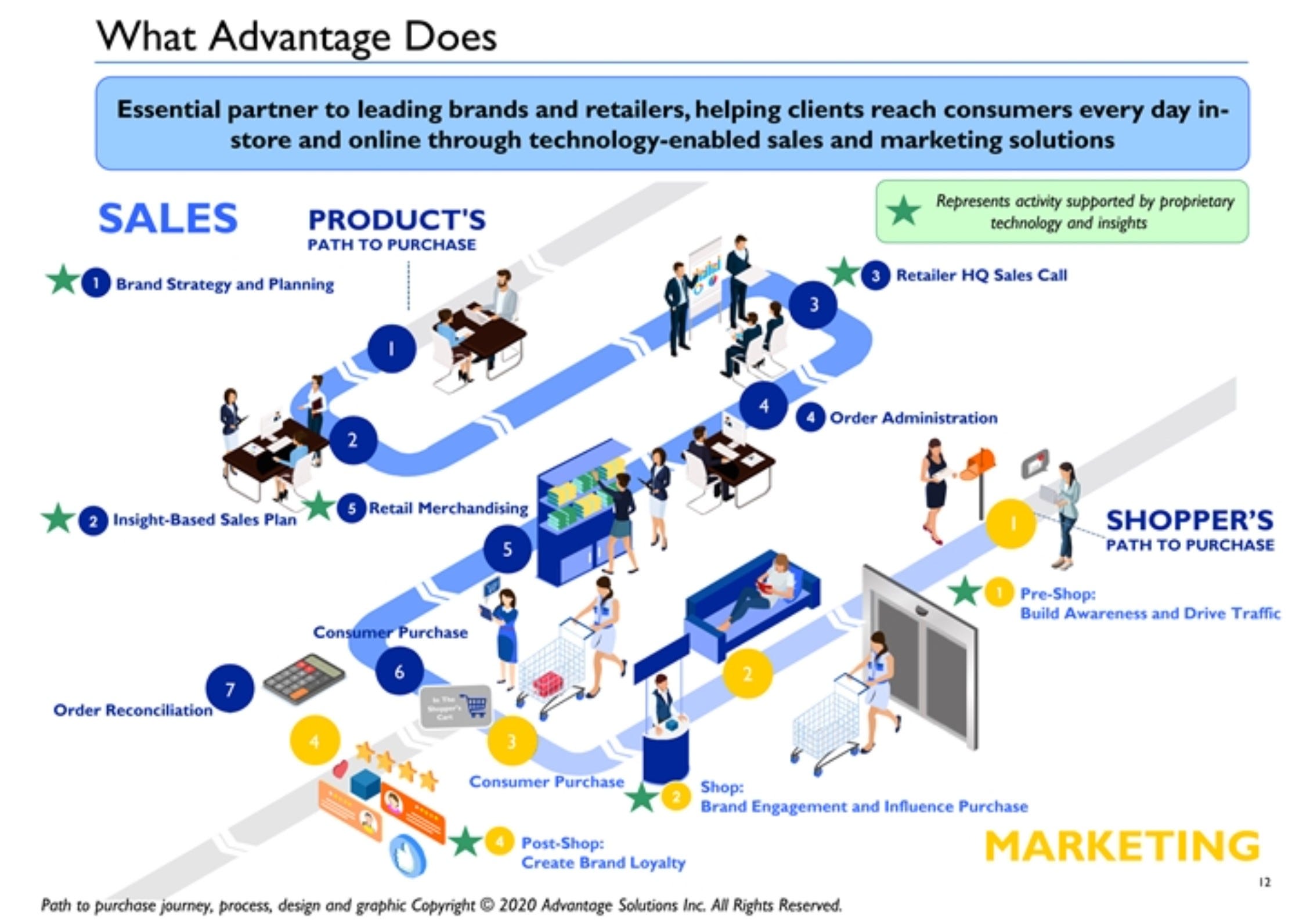
source: Advantage Solutions/Conyers Park merger presentation
In sales, the core business comes from so-called "headquarter sales" and merchandising. This makes up about 75% of segment revenue, per the company’s conference call ahead of its de-SPAC merger2. In headquarter sales, Advantage sets up an office near a major retailer's corporate office and then uses data to pitch its client brands to that retailer. For each brand, and working with the retailers, Advantage sets up annual plans for every aspect of sales, ranging from promotions to pricing to shelf placement.
In-store merchandising services are provided to both brands and retailers to ensure products are appropriately displayed and priced. Advantage also operates in the foodservice channel and runs an international business steadily recovering from the pandemic (~20% of consolidated 2021 revenue came from outside the U.S.) .
In the marketing segment, 70% of revenue comes from sampling: Advantage staffs the well-known sampling booths at Costco (COST), along with essentially every other major retailer (the company has 90%-plus market share in that category). The remainder comes from agency services, including digital advertising, mailed coupons, and in-store promotions. Notably, Advantage works with private label brands from major retailers, offering design, pricing, and strategic advice.
The overall market is relatively fragmented: Advantage’s last survey, commissioned in 2018, suggested it had leading market share of ~20%, ahead of privately held rivals Acosta (~19%) and Crossmark (~6%). Advantage has over 3,500 clients, including PepsiCo (PEP), Unilever (UL), Mars, J.M. Smucker (SJM) and many others with long-term relationships:
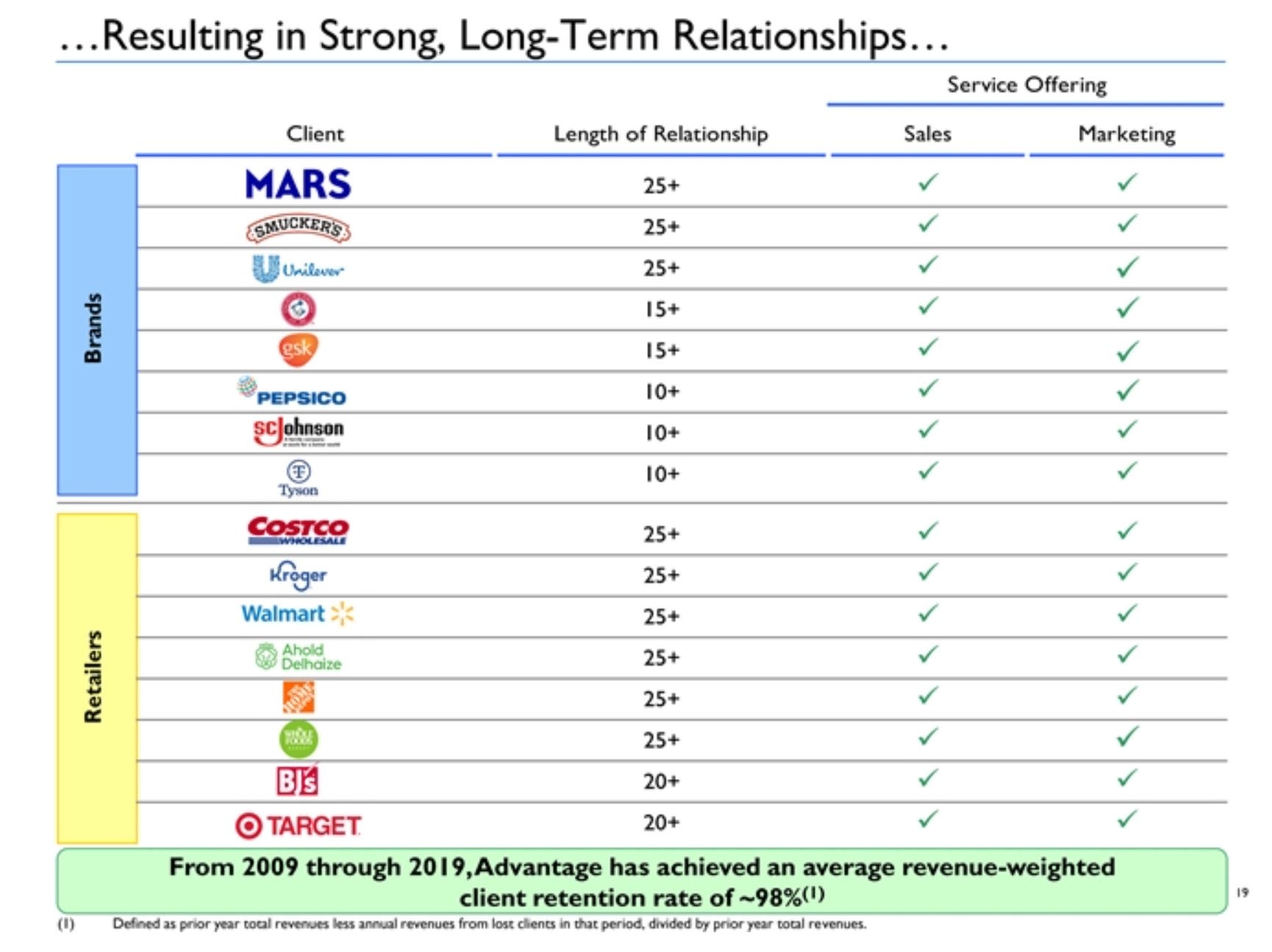
source: Advantage Solutions/Conyers Park merger presentation
After private equity ownership that began in the mid-2000s, Advantage went public via the aforementioned de-SPAC merger in September 2020. Its growth has been impressive, albeit driven in large part by acquisitions: Advantage has made over 70 acquisitions since the beginning of 2014.
The ~55% of the market still held by smaller companies suggests more room for M&A going forward — and that is a key part of the growth strategy. Even at the time the SPAC merger was announced, Advantage only targeted a long-term organic revenue growth rate of 1-3%, in line with the broader CPG (consumer packaged goods) industry, with modest margin expansion over time.
The Not-Quite-Right Bull Case
It does seem like this should be a relatively stable business. Indeed, it has been over time:
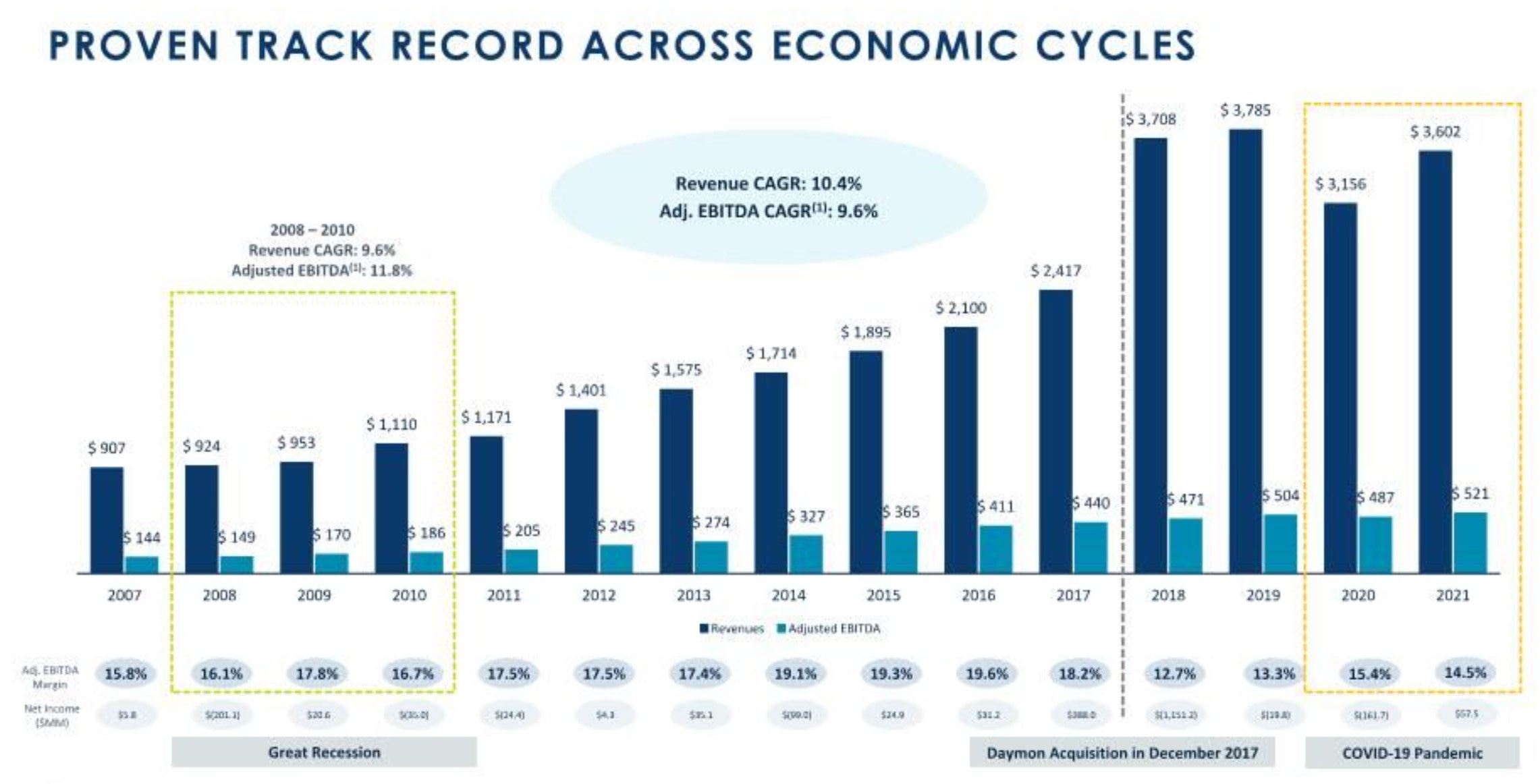
source: Advantage Solutions investor presentation, September 2022
The market absolutely is not treating it as such:
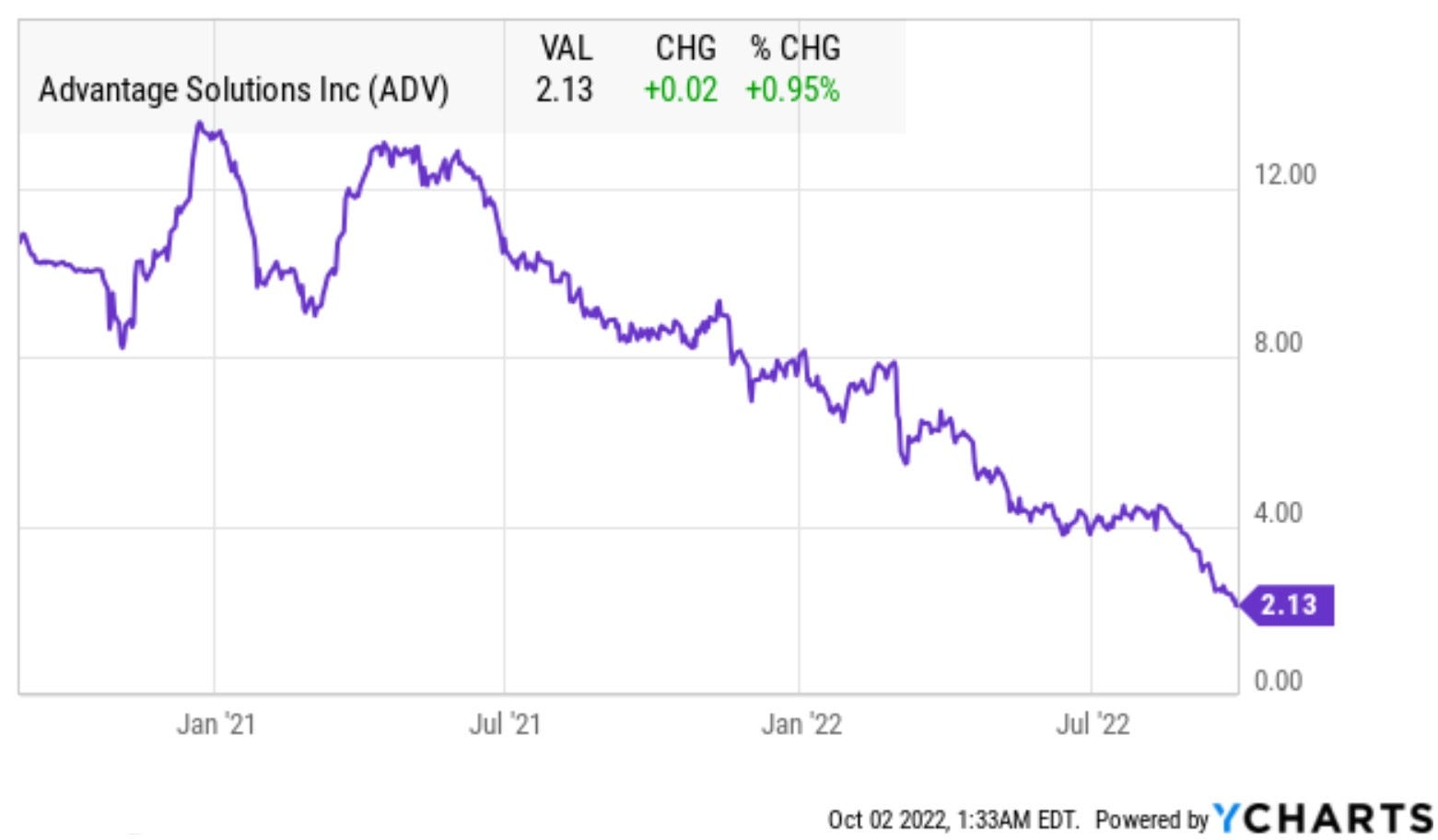
source: YCharts
There’s a way to see the decline this year — ADV is down 73% year-to-date — as a complete overreaction by the market. In that telling, the stock is being punished for two reasons: the broad market sell-off, as well as disappointing guidance for 2022 given with the Q4 release in early March.
As far as the market sell-off goes, it admittedly doesn’t make a ton of sense why ADV is trading like, well, pretty much every other de-SPAC. CPG stocks as a group are down in 2022, certainly, but the declines have been modest on a relative basis. ADV is more leveraged than all of those companies (net debt is 4x-plus this year’s EBITDA guidance), but it’s not leveraged to the point that would support such a steep decline.
Guidance is disappointing, yes — but also understandable. Advantage is a hugely labor-intensive business. On the Q1 2021 conference call, former CEO Tanya Domier said that an analyst’s estimate of nearly $2 billion in annual labor expense was “directionally correct”. 2019 Adjusted EBITDA was $504 million; the midpoint of the 2022 outlook (again, reaffirmed after Q2) is $500 million. To add to the headwinds, the sampling business still hasn’t quite returned to pre-pandemic levels.
Purely as a business, the argument for Advantage is that it’s already been operating amid a negative external environment. For most businesses, that’s not yet the case: for S&P 500 companies, for instance, earnings estimates only recently started coming down sharply.
Importantly, the environment shouldn’t get much worse. Inflation is a risk to branded clients, but the private label business provides a bit of a hedge assuming cost-sensitive customers move downmarket. End customers operate defensive businesses (the struggles at Walmart (WMT) and Target (TGT) are not coming in the grocery segment, but in apparel and other categories), limiting macro effects.
If Federal Reserve interest rate hikes, as is feared, lead to increased unemployment, that in turn should minimize the wage inflation that has pressured Advantage’s margins. And Advantage management has said that there remains a lag between when it can take price and when it has to pay higher labor rates, perhaps helping margins into 2023. (The company has also cited investments in innovation and new marketing categories as another headwind, though that appears from commentary to be rather modest.)
From a distance, this seems like an unjustified sell-off, one that has accelerated as major market indices have dipped below June lows. This is a stable business with a history of growth now trading at ridiculous levels. Based on 2022 guidance, ADV trades at 5.4x EV/EBITDA.
Free cash flow, per an EBITDA conversion range given in the September presentation, should come in at ~$100 million even at the low end of the guided range, suggesting a 6.8x multiple. Normalized FCF conversion of 35-40%, at the bottom of that range and the bottom of EBITDA guidance, suggests ADV is trading at just four times this year’s free cash flow.
Again, that free cash flow is not coming in some massively beneficial environment. In theory, Advantage’s business shouldn’t turn south if and when the economy does. (As the chart above shows, it didn’t do so in 2008-2009.)
ADV is trading like a cyclical and/or a pandemic stock. It’s neither.
Why The Market Might Be Right
To be fair, the market probably doesn’t have the stock completely wrong. There are risks even to a business that serves a relatively defensive industry.
One obvious risk is pricing pressure from clients or outright defections. Advantage has said that it’s not losing market share, and that may well be the case. But the company has faced those pressures before: in 2018, the company (see p.262) took a write-down and saw organic sales revenue decline ~5%. That came amid lower in-store programs as well as the loss of “several clients”, one of which took business in-house.
Advantage has cited a 98% average annual revenue retention rate (that’s 98% gross, not net), and as noted its relationships with major customers have lasted for years. But Goldman Sachs analyst Jason English underscored this risk on the Q4 2021 call after Advantage gave the disappointing 2022 outlook:
I'm cognizant that this seems like almost an every couple of year type event where something happens in the marketplace that causes your profitability to be rebased lower. Whether it'd be pressure from the manufacturing community on one era, whether it be pressure from Walmart…
All of them have resulted in a reset low on profitability that you've been unsuccessfully able to pass through or price to. Is there any reason to believe that this is different, that this isn't just a structural reset that in the end you're not going to be able to price for this? [Is this] a lower enduring profitability level for the business?
The fact that Advantage so far has reaffirmed guidance on this front does give some confidence: presumably a major client defection in Q1 or Q2 would have led to a reduced outlook. New CEO Jill Griffin also said specifically on the Q2 call that the company was taking price without losing clients.
Still, in an inflationary environment, consumers are going to be watching price, which means manufacturers are going to be watching price, which presumably leaves Advantage exposed. And though some of the long-term margin decline from 19%-plus in 2014 and 2015 to ~13% now comes from a major acquisition of Daymon in 2017, overall margins have trended in the wrong direction over the past few years.
The second clear risk is the balance sheet. Advantage closed Q2 with $2.13 billion in gross debt. $775 million comes from secured notes that mature in 2028 and yield 6.5%. But $1.3 billion is in the form of a term loan with a floating rate. The move in interest rates just since August suggests a ~$10 million pre-tax headwind to free cash flow; the move over the past year incredibly is adding roughly $30 million to annual interest expense.
Advantage does have $650 million worth of interest rate hedges through December 2024. (Unfortunately, another $1.55 billion rolled off at the end of 2021.) But the size of the debt means the debt will need to be renegotiated, presumably at higher rates: the senior secured notes (equal in priority to the term loan) now yield 11.3%.
Taking On The Risks
In the context of the opportunity, however, the risks seem worth taking. Worries about pricing are driven by fears of client defection — and that simply hasn’t played out so far. It’s worth noting as well that this is a low fixed-cost model: SG&A totaled less than 5% of 2021 revenue, even on a GAAP basis.
It’s too sanguine to assume that lost business won’t matter that much. But it’s too pessimistic to assume that the business, leverage or no, is going to collapse if clients pull back in an inflationary environment. And while the yield on Advantage bonds has expanded, rapidly, the spread to Treasuries still implies relatively low default risk through 2028.
That default risk centers on essentially everything going wrong: interest rates staying elevated through 2025 (when renegotiation discussions would begin); clients defecting; wage inflation continuing and labor availability remaining low. (Advantage has said repeatedly that demand continues to outstrip supply in sampling and merchandising.)
And it assumes that nothing breaks in the company’s favor. Yet this broad market sell-off to at least some extent is pricing in higher unemployment that should provide some relief for Advantage’s labor problems. In addition, the sampling business still isn’t back to previous levels.
For Advantage to really get into trouble, the leverage ratio probably needs to get to 6x, which in turn suggests a ~one-third decline in EBITDA from the midpoint of this year’s guidance. That is an enormous move given the low fixed costs; it requires double-digit declines in revenue and several hundred basis points in gross margin compression.
It’s an exceptionally narrow path to get to that point. In an ugly 2018, sales segment revenue declined only 5% on an organic basis. The segment bounced right back the following year.
And if Advantage pulls through, the odds are that the stock bounces nicely at some point. The equity slice now is one-quarter of enterprise value. A one-turn move in the EBITDA multiple, all else equal, moves the stock up almost 75%. Deleveraging in the second half of this year alone (based on guidance and, again, all else equal) suggests gains of nearly 20%.
The upside here is real. English, the Goldman Sachs analyst quoted above, has been impressively dogged in questioning management on Advantage’s earnings calls to this point. He clearly has some skepticism toward recent results — and also has a price target of $5 on the stock (which was reiterated after Q2), for 135% upside. A return to EBITDA growth at any point suggests a pretty easy triple: $550 million (+10% from 2022) in EBITDA at 7x with some debt reduction does the trick (and still values the business, even with higher interest expense, at ~12x normalized free cash flow).
The warrants (ADVWW), which have an exercise price of $11.50 and don’t mature until October 2025, look like an intriguing lottery ticket at $0.10. The bonds are also potentially attractive, even in the context of a 10-year yield nearing 4%.
The risks are real, too, with the “falling knife” problem an obvious short-term concern. But as we wrote in July, these environments are the time to buy risk, not quality. Investors willing to buy risk should be taking a long look at ADV.
As of this writing, Vince Martin has no positions in any securities mentioned. He may take a position in ADV stock, bonds, or warrants in the near future.
Disclaimer: The information in this newsletter is not and should not be construed as investment advice. Overlooked Alpha is for information, entertainment purposes only. Contributors are not registered financial advisors and do not purport to tell or recommend which securities customers should buy or sell for themselves. We strive to provide accurate analysis but mistakes and errors do occur. No warranty is made to the accuracy, completeness or correctness of the information provided. The information in the publication may become outdated and there is no obligation to update any such information. Past performance is not a guide to future performance, future returns are not guaranteed, and a loss of original capital may occur. Contributors may hold or acquire securities covered in this publication, and may purchase or sell such securities at any time, including security positions that are inconsistent or contrary to positions mentioned in this publication, all without prior notice to any of the subscribers to this publication. Investors should make their own decisions regarding the prospects of any company discussed herein based on such investors’ own review of publicly available information and should not rely on the information contained herein.
Director Brian Ratzan also disclosed the acquisition of 100,000 shares at $2.47, a 16% premium to Friday’s close of $2.13.
We’ve long been skeptical toward de-SPACs as a whole, as we wrote just last week. Yet, somehow, this is now the third de-SPAC we’ve pitched, following Ranpak Holdings (PACK) and Ardagh Metal Packaging (AMBP). We have at least focused on earlier de-SPAC vintages, before the boom really took off, but admittedly the first two ideas haven’t played out yet. Hopefully, the third time is the charm.
At least the recently promoted CEO isn't stupid: she bought 4.3K shares at $11.63 in March 2021 then turned around and dumped 24.2K shares 10 months later at $7.36 and another 37.7K shares at $5.53 two months after that.