
📍 TLDR:
DLH’s acquisition of Grove Resource Solutions, announced this month, seems like a wildly risky move.
But it’s in line with the company’s multi-year strategy — which has rewarded shareholders richly.
Another success could bring a multi-year double in DLHC.
You ride her ‘til she bucks you — or you don’t ride at all.
— Roy McAvoy (as played by Kevin Costner) in Tin Cup
After the close on Dec. 8, government contractor DLH Holdings DLHC 0.00%↑ announced it had acquired privately-held Grove Resource for $185 million. The market was not quite sure what to think:
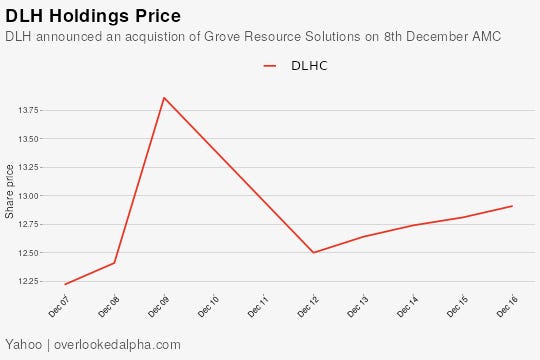
DLHC gained 11.7% on Friday, the first trading session following the after-hours announcement, and then lost 9.8% the following Monday. That volatility makes some sense.
On the one hand, this is a massive deal. At the close on Dec. 7, DLH had a market capitalization of $178 million. It’s spending roughly its current market cap on this acquisition, with the consideration almost entirely in cash. It’s making that debt-fueled move obviously at a time of higher interest rates. It’s not surprising that some investors see a heavily-leveraged micro-cap making a “bet the company” deal in this environment and say “no thanks”.
On the other hand, aggressive M&A created massive gains in DLHC over the past twelve years. That success creates some trust in the company’s management — and optimism towards what could be enormous upside if this acquisition works out like past deals did.
It’s that upside that makes the stock worth a flyer here. I personally owned DLHC for several years in the past, and, while acknowledging the risks going forward, I’m happy to bet on management and own the stock again.
source: DLH Holdings
The Initial Turnaround
It’s imperative to put the Grove acquisition in the context of DLH’s history since chief executive officer Zachary Parker arrived.
Parker was named CEO in February 2010, and the company (then known as TeamStaff) was a mess. TeamStaff, as the name suggests, was a staffing agency with business lines including the procurement of temporary healthcare workers such as travel nurses.
At the beginning of 2010, DLH sold the TeamStaff Rx healthcare staffing business, and flipped its focus to government contracts. In fiscal 2010 (ending September), the Department of Veterans Affairs (DVA) accounted for 95% of the company’s revenue, split almost evenly between logistics services and healthcare services.
That revenue wasn’t nearly enough. At one point in calendar 2010, TeamStaff’s market cap dipped below $2 million. The FY10 10-K discussed at length the financing challenges facing the company, and with good reason. TeamStaff ended the year with $1.18 million in cash and $1.86 million in borrowings. It had posted free cash flow of negative $2.4 million in FY10 and negative $2.1 million the year before.
But Parker managed to right the ship. A new quarterly review program improved quality, and TeamStaff/DLH won new business with the DVA. By FY14, DLH had returned to net profitability. When Parker celebrated his six-year anniversary in February of 2016, DLHC had nearly tripled during his tenure, providing annualized returns just shy of 20%.
DLH Gets Bigger
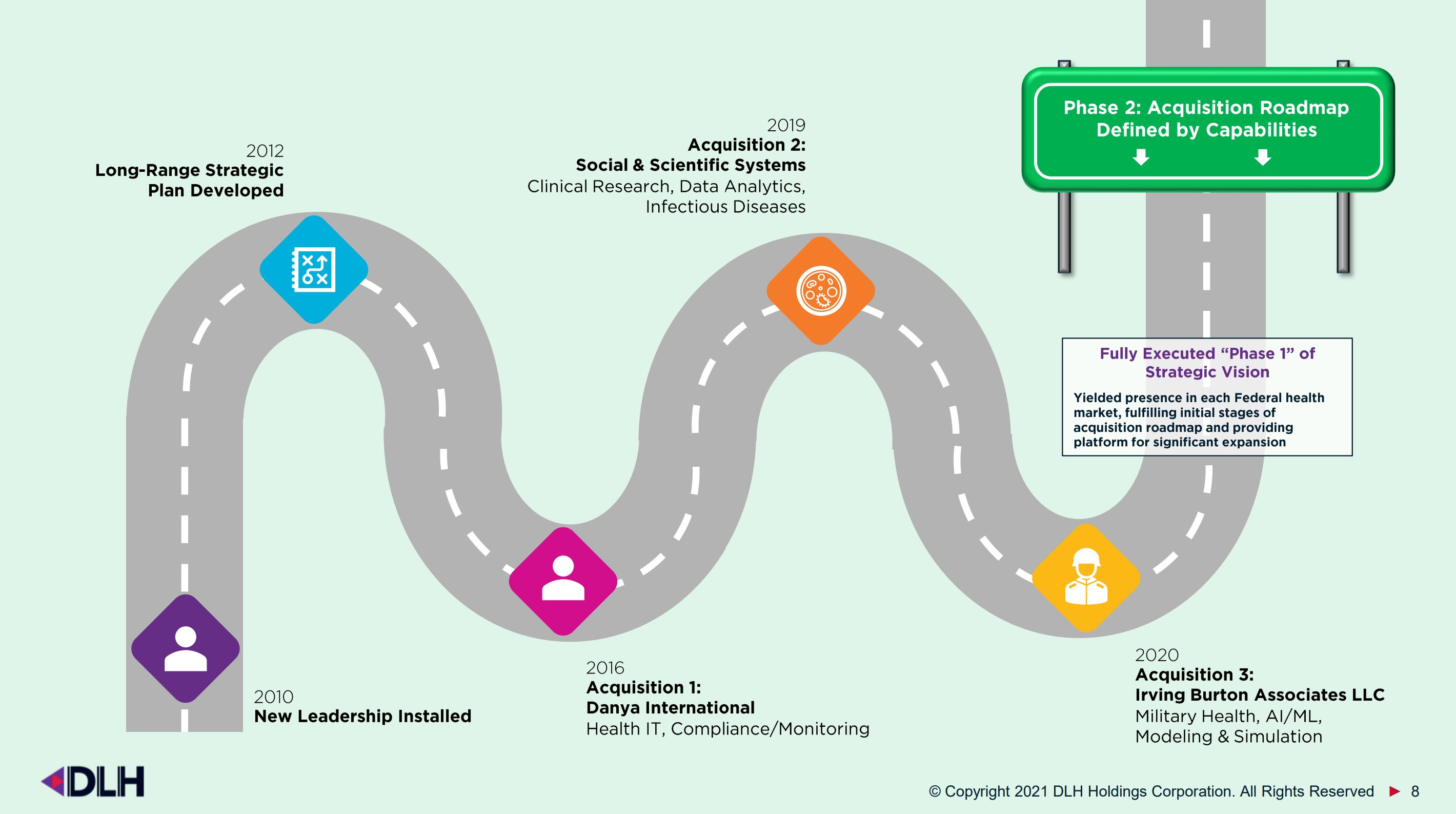
That said, DLH was still a tiny company, with FY15 revenue of $65 million and a market cap in early 2016 around $30 million. But with the core business largely fixed, DLH went on offense. In May 2016, the company acquired Danya International for $38 million. The deal provided DLH entry into the Department of Health and Human Services (HHS), for which Danya monitored providers to the Head Start program, and improved its presence in government IT services.
Like the recently announced Grove Resource deal, this was a big swing. Like the Grove deal, the purchase price was greater than DLH’s market cap at the time. (This deal, too, was almost all in cash.) Parker and chief financial officer Kathryn JohnBull argued that the combined company would generate substantial cash flow, which would lead to deleveraging and, eventually, open the door for another acquisition.
That’s indeed how it played out. In fact, by 2019, DLH had repaid the entirety of its acquisition debt. And so the company went shopping once again, this time buying health research provider Social & Scientific Systems in an all-cash, $70 million transaction. Readers will be stunned to learn that the SSI deal was also for an amount roughly equal to DLH’s market cap at the time. And after deleveraging for a few quarters, DLH the next year made a small (by its standards) acquisition, paying $32 million for Irving Burton & Associates, which expanded DLH’s reach with the U.S. Department of Defense and further built out the company’s tech capabilities.
A History Of Success
After that acquisition closed in September 2020, on a pro forma basis DLH was 2.8x net levered. The company had an enterprise value of about $170 million, and on Sept. 30, 2020 its stock closed at $7.20.
At the close on Dec. 2 of this year (the session before fiscal Q4 earnings were announced) DLH had an EV of about $213 million, up ~25% from the figure two-plus years earlier. But net debt had declined from nearly $70 million to barely $20 million; net leverage had fallen from a pro forma 2.8x to roughly 0.75x (excluding the FY22 profit benefit driven by since-ended awards from the Federal Emergency Management Administration). And so as EV rose 25% over the 26 months following the last merger close, DLHC stock increased 86%.
In other words, we’ve been here before. The Grove Resource acquisition fits almost perfectly into the framework that DLH already used twice, in the Danya and SSI acquisitions. And those acquisitions have worked tremendously well. Here’s how DLHC has performed since Parker came on (CFO JohnBull joined in 2012, and deserves credit as well):
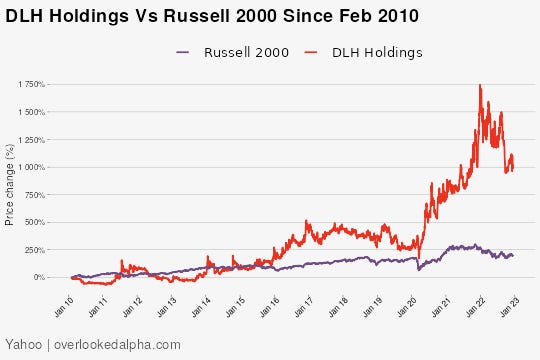
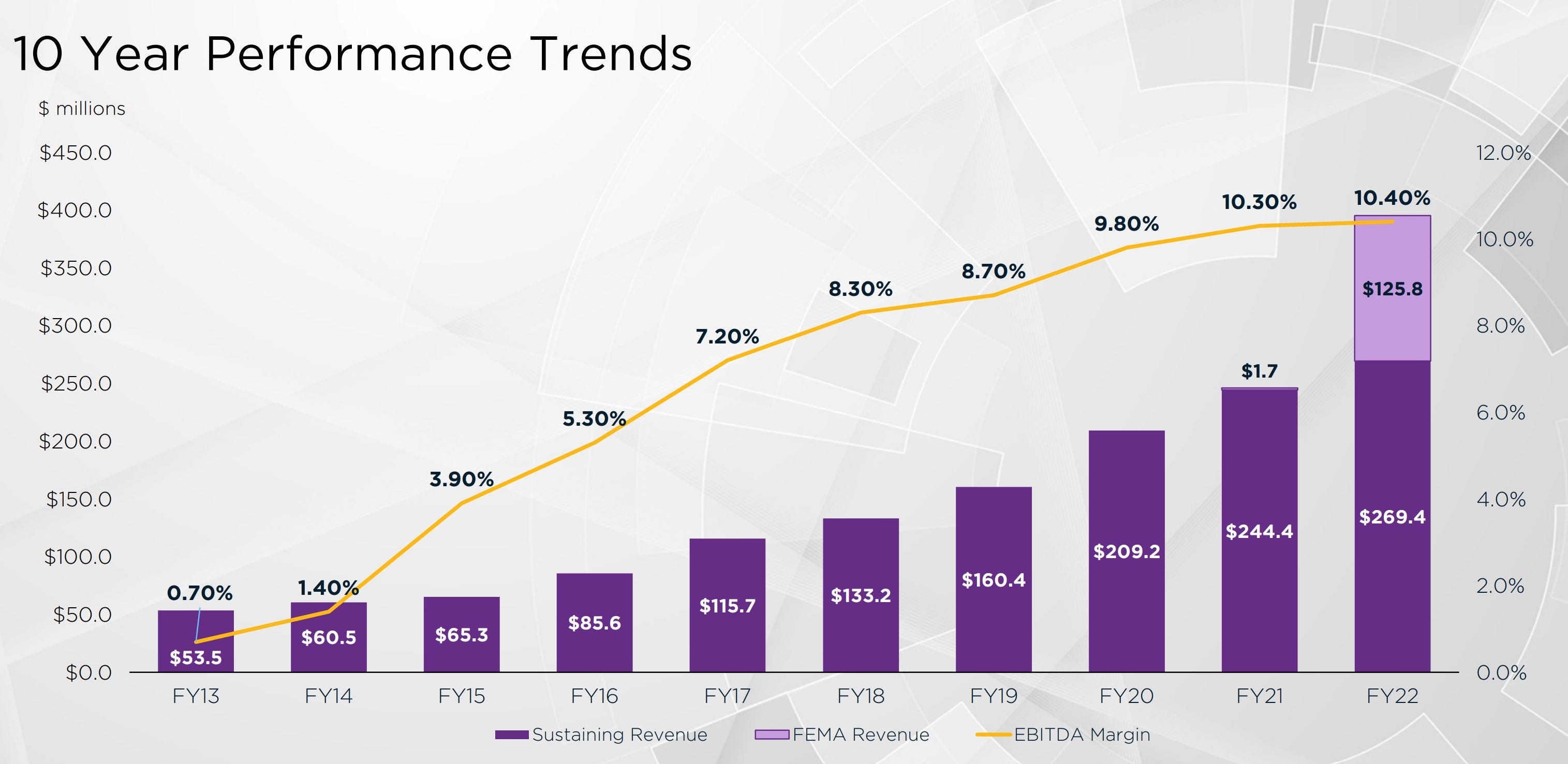
The results are impressive across the board. DLHC has returned 21% annualized for nearly thirteen years under Parker. Revenue and EBITDA have grown. A company on the brink of bankruptcy has profit margins that match much larger government contractors like Leidos LDOS 0.00%↑ and Booz Allen Hamilton BAH 0.00%↑.
The pandemic unquestionably gave a boost to DLH. The company received awards from FEMA1 as well as a contract for clinical trials of therapeutics with the National Institutes of Health. But COVID-19 has also spurred spending in several key agencies served by DLH.
But that tailwind aside, DLH’s strategy has been an unequivocal success. DLHC has gained 1,000%-plus under Parker because the business has dramatically improved:
source: DLH Q4 earnings presentation
That history doesn’t guarantee the Grove deal will be a success. There are risks, and it was a bit easier to deleverage when DLH was borrowing at lower rates2.
Still, the history does matter, which is why we’ve spent so much time on it. Yes, corporate M&A has a poor track record of success3, and yes, DLH is levering up big. But DLH has done this before — twice! — and it’s worked out awfully well so far.
The Grove Resource Acquisition
And based on what we know, there seems a good chance that this deal will work out similarly well. It’s a deal that makes sense in a number of different ways, while also providing a base for continued growth in earnings and cash flow and resulting appreciation in DLHC stock.
For one, Grove seems a solid fit with DLH’s group of businesses. On the conference call (registration required) discussing the acquisition, JohnBull called the two companies “beautifully complementary”. Grove adds strength in cybersecurity, for instance, and adds to DLH’s existing capabilities in data analytics. Grove does not, however, have an infrastructure cloud offering that is FedRAMP (Federal Risk and Authorization Management Program) authorized; DLH’s Infinibyte Cloud fills that gap.
Second, at least per DLH management, there aren’t any obvious weaknesses in the Grove business. Johnbull said the company has organically grown the top line at a low double-digit rate over the past few years, with 2022 its eighth straight year of record revenue.
The offerings here are in-demand and high-tech, rather than more commoditized. Areas of expertise such as artificial intelligence and digital transformation drive three to five year contracts, and given the size and requirements of the federal bureaucracy, demand is likeky not going to be a problem for some time to come.
There are no material contracts (defined as more than 10% of revenue), an obvious potential red flag in the mid-tier space. There are no major recompetes (contracts up for reopened bidding) in the near term, and Grove operates almost solely as a prime contractor (as opposed to a subcontractor).
Even the question of why the company wanted to sell seems to have a satisfactory answer: Grove management worried about a lack of scale, and after looking to be the acquirer to grow out of that problem (as Parker pointed out, that has been DLH’s strategy), instead pivoted to be a seller.
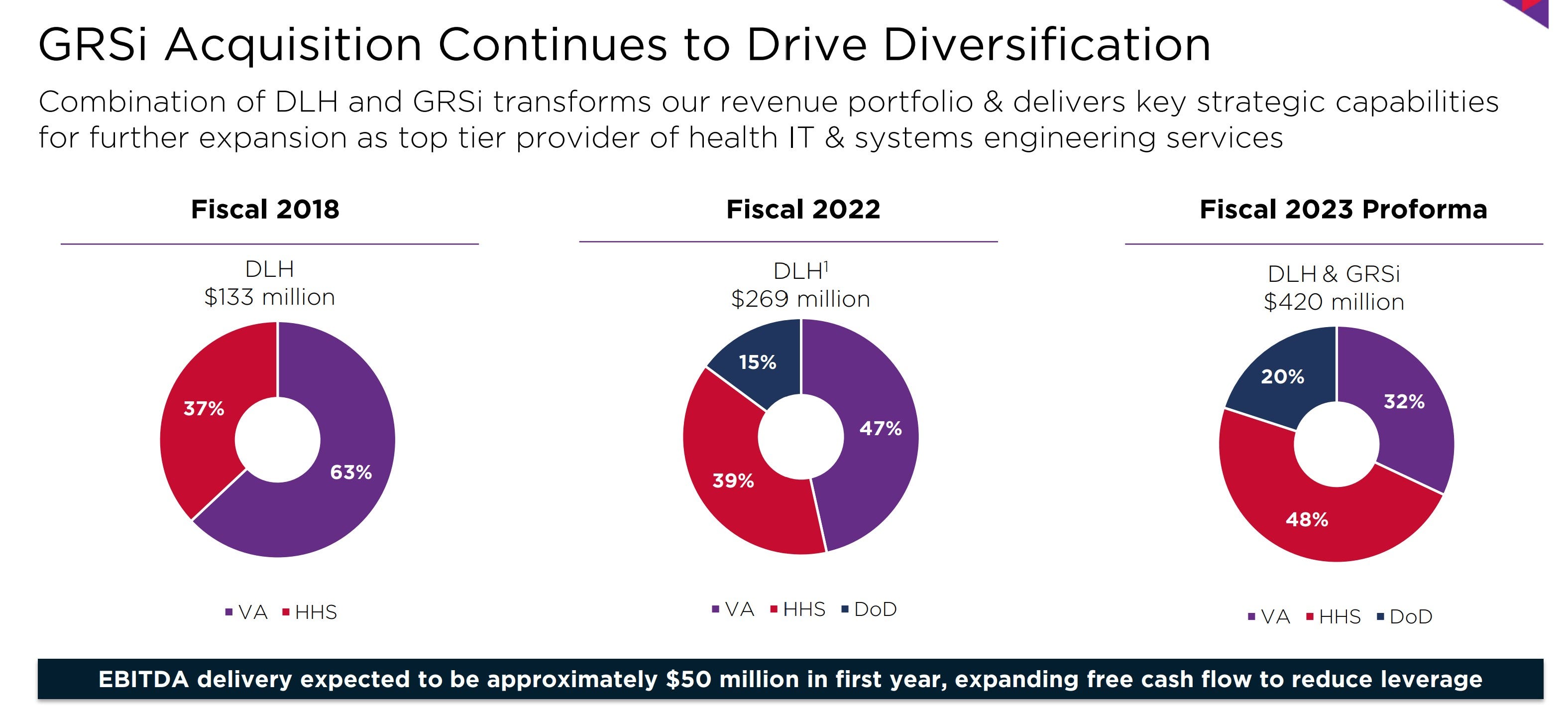
There’s a final and key point here: Grove provides further diversification for DLH:
source: DLH acquisition presentation
This is not simply a fact to be thrown on a merger presentation slide. DLHC historically has traded at a significant discount to the likes of Leidos or BAH despite having essentially equivalent profit margins. Scale certainly is one factor, but the reliance on a couple of key programs is another.
In 2016, the U.S. Supreme Court issued its ruling in Kingdomware vs. United States, which held that all DVA procurements were subject to the “Rule of Two”. If at least two veteran-owned or service-disabled veteran-owned businesses were capable of providing a service, Kingdomware held that the DVA had to set aside existing awards for that service. Kingdomware hit DLHC stock owing to its reliance on the DVA, and may still provide something of an overhang. DLH can get around the Rule of Two by becoming a subcontractor instead of prime contractor (it’s bid accordingly of late), but that shift adds risk and lowers profit.
Meanwhile, Danya was available cheap (DLH paid less than 6x EBITDA) at least in part because it was heavily reliant on Head Start. The preschool program long has been targeted by Republicans, who want the program either reduced or switched to a model of block grants to states, who would manage programs independently. When in power, Republicans haven’t actually made much of a move toward the program (its funding grew under the Trump Administration), but GOP House control and a 2024 presidential election suggest some risk.
More broadly, the nature of being a company reliant on a dozen core programs means a single government decision can move the stock double-digits without warning. As a result, DLHC can merit a higher profit multiple simply by being a larger, more diversified provider. And multiple expansion can be a powerful upward force on the stock.
The Fundamentals Work
Pro forma for the acquisition, DLHC trades at ~8x its expected EBITDA (which does not exclude stock-based compensation) for FY23. BAH is at 16x for this fiscal year (ending March 2023); LDOS about 13x for CY22.
DLHC should not see its multiple expand to meet those of its larger peers. But there’s certainly room for some expansion. Again, the company has EBITDA margins in line with both companies (10%-plus). Organic revenue growth this year (excluding Alaska) roughly matches that of Leidos; the historical mid- to high-single-digit algorithm implied by the tie-up with Grove is in the range of what those larger companies traditionally post. A 10x EBITDA multiple here is not out of line, particularly given DLHC was valued well above that toward the beginning of the year.4
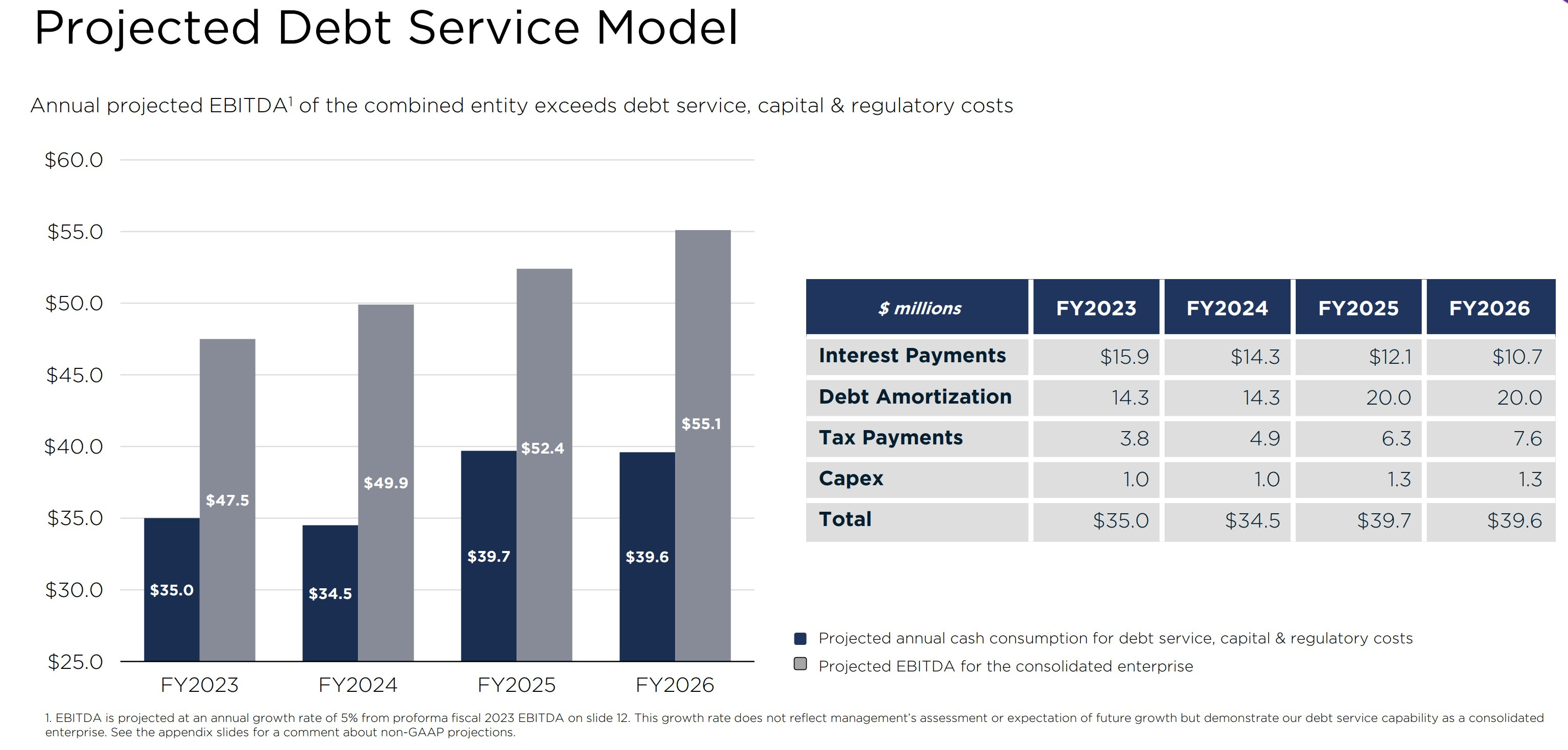
Free cash flow numbers look potentially better. DLH’s capital expenditures are minimal: $872,000 in FY22, and just $103K the year before. Interest and principal repayment is going to eat up a big chunk of EBITDA in FY23, but the gap starts to grow over time even assuming just 5% annual growth5:
source: DLH acquisition presentation
This is a chart crime, admittedly, but the point still holds. Particularly with tax benefits from the acquisition, this is a business looking at growing from a base of $26.8 million in free cash flow starting in FY23. Pro forma market cap is about $200 million, suggesting a P/FCF multiple below 8.
Look out to FY26, and even assuming low-single-digit growth to $50 million in EBITDA, normalized free cash flow is still $30 million. At that point, net debt is under $100 million (assuming all FCF goes to debt repayment, in keeping with past practice); maintain the same 8x multiple and DLHC still has gained ~50% in four years — with profit growth disappointing and zero multiple expansion despite a net leverage ratio dropping from almost 4x to roughly 2x.
If, however, management is right (or close), there’s a pretty clear path to a double or better. A mid-9x multiple on $55 million in FY26 EBITDA puts the market cap above $400 million and the stock price around $27. Hit the high-single-digit growth the combined company has posted in recent years and the upside is greater.
To be sure, every levered acquisition is going to have this paper upside. The potential downside can be seen on the chart: when the business disappoints, every lost dollar of EBITDA comes off the free cash flow line at ~75%.
As always, there’s execution risk, and a contract loss (or two) can change this story in a hurry. But it’s important to remember that this isn’t a leveraged cyclical, but a stable government provider. This isn’t a CEO wantonly building an empire, but one taking another step down a path it’s followed successfully for more than twelve years now.
Shareholders who followed DLHC down that path saw 1,000% returns. A repeat of that performance is exceptionally unlikely, but over a multi-year period, 100%-plus is absolutely on the table.
As of this writing, Vince Martin is long shares of DLHC and GTLS.
Disclaimer: The information in this newsletter is not and should not be construed as investment advice. Overlooked Alpha is for information, entertainment purposes only. Contributors are not registered financial advisors and do not purport to tell or recommend which securities customers should buy or sell for themselves. We strive to provide accurate analysis but mistakes and errors do occur. No warranty is made to the accuracy, completeness or correctness of the information provided. The information in the publication may become outdated and there is no obligation to update any such information. Past performance is not a guide to future performance, future returns are not guaranteed, and a loss of original capital may occur. Contributors may hold or acquire securities covered in this publication, and may purchase or sell such securities at any time, including security positions that are inconsistent or contrary to positions mentioned in this publication, all without prior notice to any of the subscribers to this publication. Investors should make their own decisions regarding the prospects of any company discussed herein based on such investors’ own review of publicly available information and should not rely on the information contained herein.
Almost one-third of FY22 revenue, and ~30% of EBITDA, came from a contract to support the state’s response to COVID-19. That contract has now ended.
The spreads for the debt backing SSI and Grove are roughly the same. SSI’s debt was LIBOR + 4.0%; the new facility has a rate of SOFR (the LIBOR replacement) plus 4.10%. But SOFR is ~200 bps higher than LIBOR was in 2019.
This is the second deep dive in a month we’ve done on a major acquisition; in November, we highlighted Chart Industries GTLS 0.00%↑. The GTLS story is quite different, however; we saw value in the stock after it had plunged following a substantial deal of its own.
Obviously, multiples have shrunk across the market, and there also was a clear misreading by the market of the benefit to DLH from the pandemic response. That multiple was the core reason why I sold the stock a year ago — but I sold at 13x EBITDA, not 10x. And it’s the core reason why DLHC has struggled since those highs. The business has been fine, the market simply mispriced the stock as it did so many others.
JohnBull said on the acquisition call that this slide uses that 5% baseline, which she rightly pointed out is conservative relative to the company’s organic performance over the past decade.