
Welcome to Overlooked Alpha. If this is your first time, subscribe below to get our best investing ideas in your inbox every Sunday morning:
Dole plc DOLE 0.00%↑ seems like it should be a winner in this market. The food business (at least to some degree) is both defensive and inflation-resistant.
Overall consumer trends in the West seem to lean away from processed foods and toward healthier eating: bananas, pre-packaged salads, and fresh vegetables would seem to fit the bill.
DOLE even looks attractive from an ESG (environmental, social, and governance) perspective1. As the company itself points out, produce has by far the lowest carbon footprint of any food category. Higher-margin organic options continue to outpace the broader market amid worries about pesticides. Those concerns, along with thoughts for animal welfare, have helped drive a small yet growing adoption of vegan or vegetarian lifestyles, another potential boost to long-term demand.
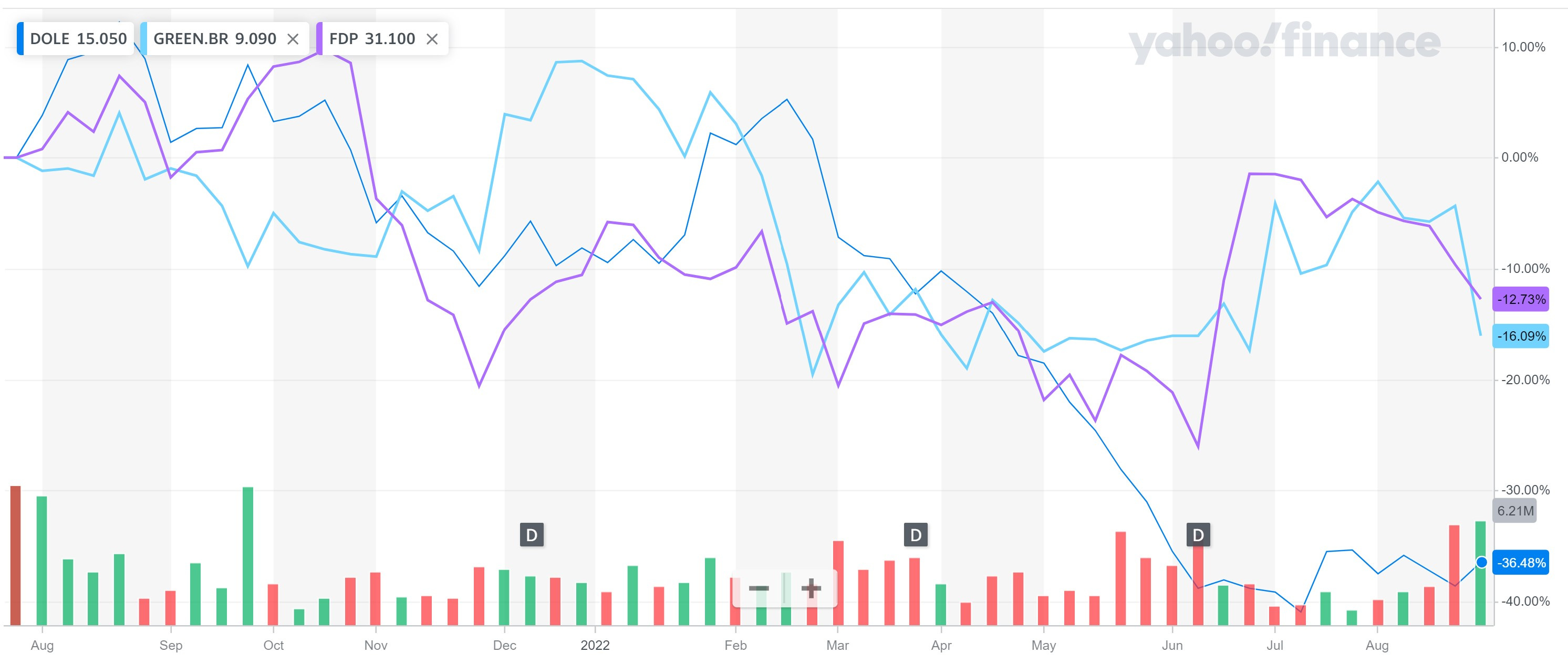
But since DOLE went public last year after a merger of Dole Holdings and Ireland’s Total Produce, that story has not played out at all:
source: Yahoo Finance
Even with a lowered IPO price, DOLE has badly underperformed the market, as well as peers Fresh Del Monte Produce FDP 0.00%↑ and Greenyard NV (GREEN.BR). And, to be sure, there are some reasons why.
Dole’s execution has not been completely on point, most notably with a pair of recalls in its salad business. The balance sheet is more leveraged than those of peers. Inflationary pressures and the strong dollar have pressured margins; in its Q2 report last month, Dole cut its full-year outlook for the second consecutive quarter. Guidance now assumes EBITDA will decline not only against pro forma results for 2021, but for 2020 as well.
And so on its face, the story surrounding DOLE stock perhaps is not that attractive. Shares do look cheap, yes, but this is also a leveraged business with thin margins whose profits are heading in the wrong direction. In that context, investors looking for the broader profile offered by the business might choose (and indeed have chosen) to invest in peers instead.
But looking closer, the recent results — even this year — are stronger than they might appear. In fact, it seems as if the long-term case here is reasonably intact. Meanwhile, valuation is surprisingly low for a defensive business, and three 5%-plus owners have entered since mid-June. As always, there are risks, but below $10 there are solid rewards as well.
More Than Bananas
Dole is one of the best-known fruit companies in the world; in its 20-F, the company touts an unaided brand awareness score of 73%, 42 points better than that of its closest competitor. In the U.S., the company is probably best-known for bananas and pineapples, but Dole in fact offers 300-plus products sourced from more than 30 countries and sold in over 75.
As noted, the company returned to the public markets last year. Total Produce, at the time a publicly-traded firm, purchased 45% of the company in 2018, after Dole went private in 2013 under, shall we say, questionable circumstances2. Total Produce merged Dole with its business and then floated the combined company on the NYSE last July.
Based on 2020 results (per the F-1; more recent results are messy due to the mid-year merger close), bananas drove 27% of revenue, fresh vegetables 28%, and other fruit the remainder. North America accounts for just shy of half of sales, with Europe 45% and smaller markets (India, South Africa, Chile, and Brazil) about 6%.
The combined company reports in four segments. In 2020, Fresh Fruit (bananas and pineapples) was the highest-margin, driving just over 30% of revenue but 46.5% of Adjusted EBITDA. The Diversified Fresh Produce (EMEA) segment essentially is the legacy Total Produce, offering fresh fruits and vegetables; it generated 36% of revenue and just shy of 30% of profit. Fresh Vegetables (14% of revenue, 11% of EBITDA) and Diversified (Americas & Rest of World) (19%, 14%) round out the business.
The Bull Case
DOLE is a stock for which the investment process is based on understanding the risks to the bull case, rather than finding some hidden value. Particularly in terms of valuation, the bull case is essentially self-evident.
At Friday’s close of $9.21, Dole has a market cap of $874 million. Net debt, including $142 million in pension obligations3, totals $1.181 billion, for an enterprise value just over $2 billion.
Adjusted EBITDA guidance for this year is now $330 million to $350 million. And so EV/EBITDA, even conservatively measured, sits just below 6x. Normalized free cash flow, based on the details of the outlook, should be $125 million, suggesting a P/FCF at 7x. (Note that Dole does not exclude stock-based comp from Adjusted EBITDA, while the FCF estimate here is derived from the company’s Adjusted EBITDA calculation, so multiples include potential share issuance.)
Yes, Dole is a leveraged business, but at 3.1x net it’s not disastrously leveraged. This is a business valued as if earnings are headed for a decline and/or are receding from a recent peak. Yet, again, there should be some degree of defensiveness here (to the extent that defensiveness is even a thing in this volatile environment). In that context, the balance sheet is perhaps risky, but far from unwieldy.
This is also a business valued at a discount to peers. Based on trailing twelve-month results, DOLE trades at a bit under 7x EBITDA. FDP is above 11x; Greenyard (based on results through calendar Q1) is a touch below 6x, albeit with lower EBITDA margins and ~95% exposure to Europe. And it’s not an apples-to-apples comparison given that the former Total Produce business accounts for ~half of sales, but Murdock’s undervalued offer in 2013 valued Dole at just over 10x EBITDA.
But even those multiples understate the case here. At the time of the merger, Dole estimated $30 million to $40 million in synergies. That is a “medium-term” target, per the Q3 2021 conference call; Dole hasn’t given a figure for the synergies realized so far, but said after Q2 the initiative “continue[s] to progress well.” So there appears to be an incremental boost to profits on the way.
There’s also the aforementioned recalls. After Q4, Dole estimated a $25 million hit to 2022 Adjusted EBITDA from the costs, lost volume, and delayed price increases. Assume there’s $20 million in remaining synergies and account for the recall costs, and DOLE now is trading near 5x EBITDA and 6x free cash flow.
Business Problems
Once again, the question is: what is driving these depressed multiples? One possible reason is that DOLE stock is trading at a discount to FDP, in particular, because the Dole business isn’t as good as that of Fresh Del Monte.
Fundamentally, Dole doesn’t look that impressive, perhaps. Pro forma Adjusted EBITDA in 2020 was $370.8 million, per the F-1; the midpoint of this year’s guidance suggests an ~8% reduction over two years. The recall accounts for most, not all, of the decline; at the least, this looks like a stagnant (and, again, leveraged) business.
Nor can that recall be dismissed out of hand. It’s possible the recall — driven by natural contamination of a piece of equipment — damaged the Dole brand. It also interrupted the company’s efforts to grow pre-packaged salads, perhaps allowing competitors to take further share.
Neither explanation really holds up, however. The reason profits are declining are because of inflation and the resulting volatility in the business. Dole’s first-half Adjusted EBITDA is down 31% year-over-year; FDP’s Adjusted EBITDA fell 29%. Excluding Diversified EMEA, admittedly, Dole saw a 38% decline, an underperformance to FDP — but the totality of that underperformance, and then some, is due to the recall which drove a first-half loss in the Fresh Vegetables segment (which includes the salad business).
Meanwhile, FDP reported stable volumes, and didn’t call out salads after either Q1 or Q2, as one might expect if a wounded competitor was bleeding market share. There’s little evidence to suggest that there’s something structurally wrong with Dole.
The End Of The Banana
Another possible explanation is that the impending end of the banana as we know it suggests a long-term problem for Dole plc.
The modern banana, known as the Cavendish, is not the banana offered decades ago. That was the Gros Michel, essentially wiped out in the 1950s by Panama disease. Gros Michels are still available, though they run about $1 each in bulk.
But the Cavendish too is under threat, from Banana Fusarium Wilt Tropical Race 4 (TR4). Like Panama disease (technically known as TR1) TR4 is a fungus that destroys banana plants. Dole writes in the F-1 that a “TR4-tolerant” variety is being used in some regions — but that variety is less productive and thus more expensive for growers. Dole is spending ~$7 million this year simply on researching potential alternatives if TR4 does to the Cavendish what TR1 did to the Gros Michel.
This is not the only problem, however. Inflation is a general problem for Dole as it is for all food producers, but as FDP chief executive officer Mohammad Abu-Ghazaleh said on his company’s Q2 call, it’s a bigger problem for the banana:
…we have seen as well as the disruption into the supply chain, the disruption and shipping, enough equipment and containers to move the fruit from one – from source to markets. Small, medium-sized growers are really having a lot of difficulties securing financing to continue operations.
All these factors together, in my opinion, will drive the banana sector to a point where the production will come down, in my opinion, significantly in the future. And I cannot decide 1 year or 2 years. But I believe that the banana industry, in general, will not be able to be – to sustain the way it has been going for the last 10 years.
I mean they were living on a lifeline. Money was easy. Interest was almost 0. Chemicals, fertilizers, inputs, transportation, you name it, everything was quite competitive, cheap. The picture has stand around completely now as you – everybody knows. So you add up everything, and it will not work.
I mean I wouldn’t be surprised to wake up one morning and see a banana box costing $20 and I’m not – this is not something that I speculate. I believe in this, and I have believed that for many years. And I think, there would come a time when everybody wakes up and there will be not enough bananas to feed the markets.
As noted above, Dole gets almost half of its profit from Fresh Fruit, which is simply the banana and pineapple business. The company hasn’t (to my knowledge) broken out revenue specifically for banana sales, but it’s likely roughly one-third of profits comes from that fruit.
The problem with this explanation, however, is that the same is true for FDP, whose shares trade ~four turns higher on an EV/EBITDA basis. Again, this quote comes from that company’s own CEO. And in 2021, more than one-third (see p.38) of FDP’s gross profit (the company doesn’t break out segment-level operating profit) came from banana sales.
What Else Could It Be?
The same broad problem — why is this risk priced into DOLE and not FDP? — holds when looking at the other potential concerns facing Dole stock. Dole’s balance sheet is leveraged 3x-plus — but FDP’s net leverage is ~2.8x on a trailing twelve-month basis.
Inflation is wreaking havoc on both businesses — but, again, particularly in the context of the recall, Dole at the worst has kept pace. The stronger dollar is a bigger issue for Dole, which gets more than 50% of its revenue from outside North America; the figure for FDP, however, in 2021 was still 40%.
There are worries that persistent inflation could lead to trading down even within fruits and vegetables (more bananas, fewer berries, at least until the bananas run out), but that’s an industry-wide problem, not a company-specific one. Murdock’s involvement could be seen as a risk, given his history, but he’s also 99 years old4 and is not (as he was in 2013) the controlling shareholder. As of Mar. 11, Murdock owned 12.6% of outstanding shares.
It’s simply difficult to understand precisely why DOLE is trading at a discount on both a relative and absolute basis. There are margin concerns longer-term, but for the time being Dole is holding up reasonably well. Excluding the effects of the recall, TTM EBITDA is down less than 10% from 2020 levels despite this being a dramatically more difficult environment than it was two years ago.
To be sure, sometimes “it’s difficult to understand” simply means an investor is missing something. Sometimes it is the market telling that investor something, even if it’s not clear what precisely that something is. DOLE has disappointed pretty much since the jump; even without inflation (and a bear market), the stock struggled. It has traded above its $16 IPO price for a total of nine trading sessions, one of which appears due to a brief stint as a meme stock.
It’s certainly possible DOLE stays “dead money” and that the valuation gap relative to FDP doesn’t close. But particularly in this market, that seems a risk worth taking. This isn’t exactly “heads I win, tails I don’t lose much,” but the upside clearly outweighs the downside. Closing half of the valuation gap relative to FDP gets DOLE stock (at the low end of guidance) above $15. 10x normalized free cash flow moves shares to more than $12, or 30%-plus upside. Add back the $25M in recall costs, at the same multiples, and DOLE is at $17-plus.
What makes the stock intriguing below $10 is that neither of those back-of-the-envelope scenarios require all that much. This isn’t a case that requires a turnaround, or massive post-merger synergies. It simply requires Dole to keep muddling through a turbulent period, and roughly maintain its market leadership when it comes out the other side. If the company can do that, the stock should take care of itself.
As of this writing, Vince Martin has no positions in any securities mentioned. He may initiate a position in DOLE this week.
Disclaimer: The information in this newsletter is not and should not be construed as investment advice. Overlooked Alpha is for information, entertainment purposes only. Contributors are not registered financial advisors and do not purport to tell or recommend which securities customers should buy or sell for themselves. We strive to provide accurate analysis but mistakes and errors do occur. No warranty is made to the accuracy, completeness or correctness of the information provided. The information in the publication may become outdated and there is no obligation to update any such information. Past performance is not a guide to future performance, future returns are not guaranteed, and a loss of original capital may occur. Contributors may hold or acquire securities covered in this publication, and may purchase or sell such securities at any time, including security positions that are inconsistent or contrary to positions mentioned in this publication, all without prior notice to any of the subscribers to this publication. Investors should make their own decisions regarding the prospects of any company discussed herein based on such investors’ own review of publicly available information and should not rely on the information contained herein.
By that, we mean actual long-term tailwinds based on ESG factors, not that the stock necessarily is attractive to ESG funds, whose value and accuracy currently are the subject of significant debate.
Dole chief executive officer, David Murdock, and another executive were ordered to pay $148 million in damages for driving down the price, as the always-excellent Matt Levine detailed back in 2015. Murdock settled for half that in 2017.
That same year, Levine covered the “pointless mess” that surrounded claims made over the damages, a mess that over the years has been highlighted as a reason to move stock ownership to the blockchain and away from Cede & Co. That article has really to do with the current DOLE stock, but it’s a fun story if you have the time.
Pension obligations largely are accounting creations. But in the interest of conservatism, and given that Dole is planning $17.7 million in contributions this year, it’s worth including them in EV.
That’s not an exaggerated way of describing his age; he’s literally 99.
Investors apparently think DOLE's salad days are over. Or is DOLE just another orphaned IPO?
Not sure if the ESG profile is that good: I guess, it is not particularly environmently friendly to fly fruits around the world.