
📍 TLDR
ESMT has a market cap approaching $3 billion but is seemingly unheard of by the majority of investors.
The stock continues to be dragged down by a sell-off in growth. But ESMT’s own growth story appears intact.
The core ‘SimplePractice’ offering is showing strength fundamentally and qualitatively.
Valuation isn’t perfect, but low enough for the stock to work.
We remain skeptical of trying to buy SaaS (software-as-a-service) stocks on the dip. The sector certainly is down big: the BVP Nasdaq Emerging Cloud Index (ticker EMCLOUD), one of the more representative SaaS indices, has been nearly halved over the last twelve months.
But even down 50% or more many cloud/SaaS names simply aren’t cheap. Indeed, just this past week we highlighted CrowdStrike. CRWD screens as if it is attractively valued yet, accounting for stock-based compensation, should post full-year operating margins in the negative 6% range.
There is an exception to our caution, however. EngageSmart ESMT 0.00%↑ looks like it might be a winner after a bruising sell-off since its initial public offering 14 months ago. Like many of its SaaS peers, this provider of customer management and payment solutions is posting impressive growth at the moment, with plenty of room for revenue increases to continue into the future.
Unlike many peers, however, EngageSmart is profitable (you know, actually profitable) while maintaining a pathway toward truly impressive margins going forward.
Even with ESMT nearing an all-time low, valuation isn’t perfect. But it does seem good enough, given an attractive qualitative story and fundamental strengths that are likely hidden to some investors. In this market, investors would be forgiven for avoiding growth stocks. But those interested in the category should be taking a long look at ESMT.
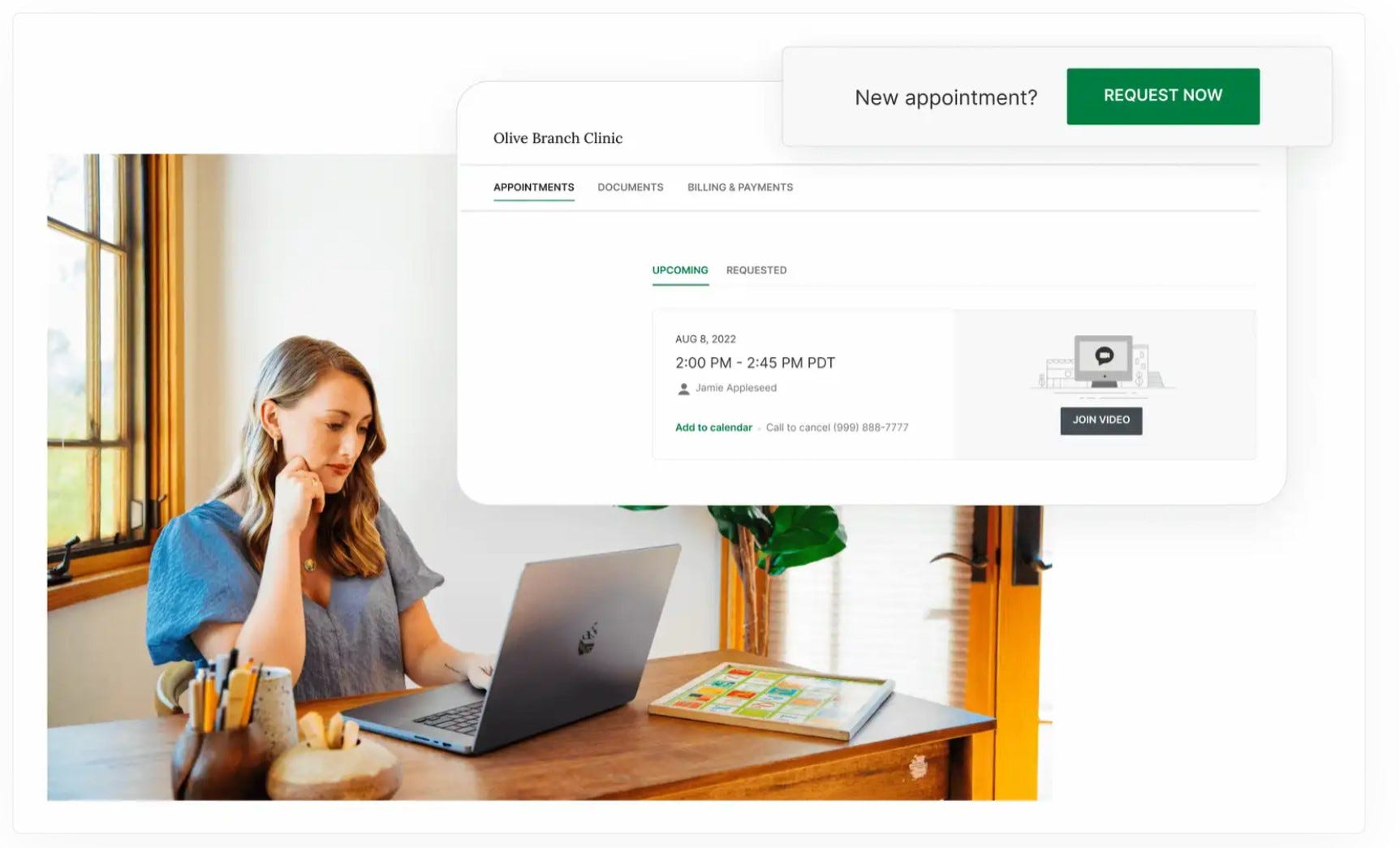
source: SimplePractice/EngageSmart
Introducing EngageSmart
EngageSmart is an SaaS and payments provider operating across four platforms, two segments, and a significant number of end markets.
The company’s four solutions are:
SimplePractice: a practice management and EHR (electronic health record) platform for (mostly) mental health clinicians, which allows scheduling, billing, insurance processing, website management, telehealth services and more;
InvoiceCloud: an electronic bill management and billing system for governments, utilities, and financial services companies;
HealthPay24: a way for medical practices and hospitals to offer self-pay options to their patients;
DonorDrive: a fundraising software platform.
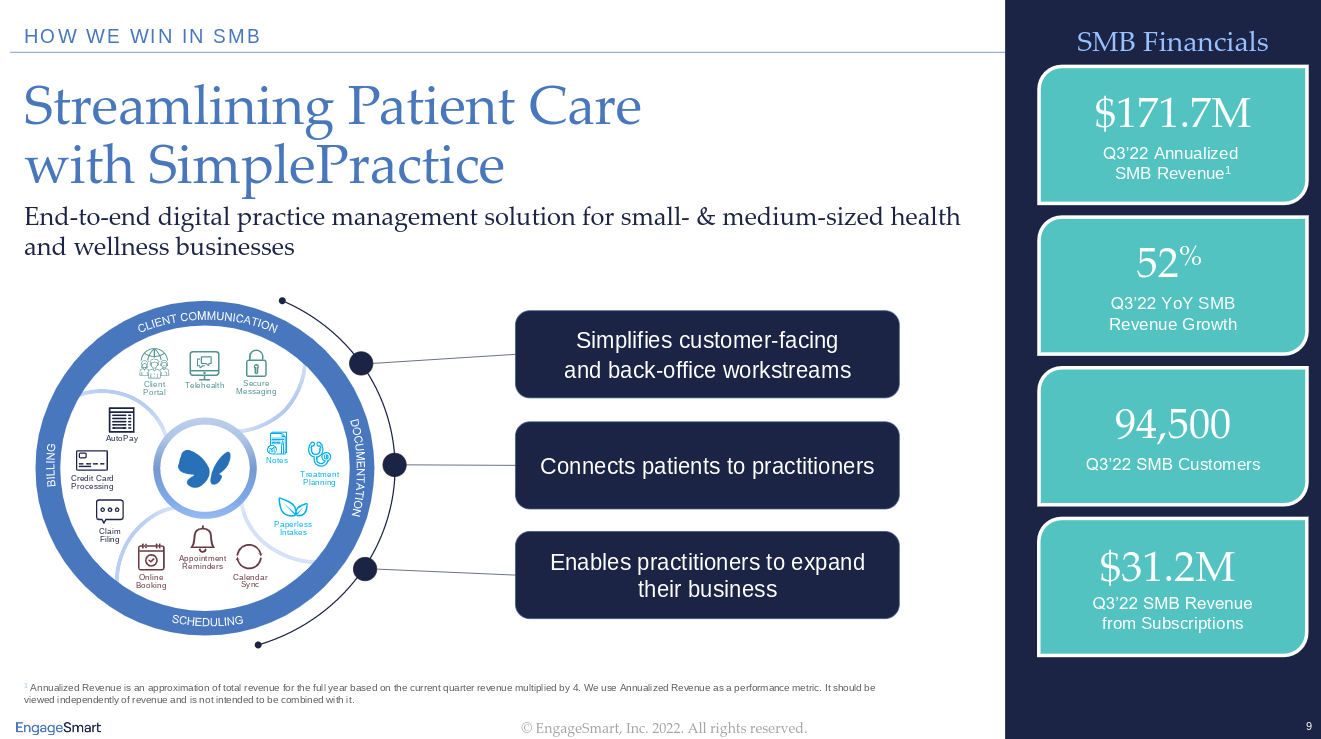
SimplePractice and InvoiceCloud are the real drivers here, accounting for over 88% of revenue in 2021, per the 10-K. The SMB Solutions segment includes the SimplePractice business, which has generated 55% of sales through the first three quarters of 2022; the Enterprise Solutions segment is comprised of the other three businesses.
Source: Company presentation.
In Enterprise, nearly all of the revenue (over 90% year-to-date, per the 10-Q, p. 9) is “transaction and usage-based”. Most often, this comes from fees generated when a utility customer pays a bill online via InvoiceCloud, or a charity uses the DonorDrive platform to raise funds. In contrast, about 70% of YTD revenue in SMB comes from subscriptions (SimplePractice offers three tiers after a pricing change earlier this year), though that business also generates transaction revenues through payment acceptance.
EngageSmart was founded by chief executive officer Bob Bennett, a serial entrepreneur who has said his own frustration with bill payments led to the company’s creation. In late 2018, private equity firms General Atlantic and Summit Partners invested in what was then known as Invoice Cloud; the two investors still own more than 75% of outstanding shares (GA ~60%, Summit ~16%).
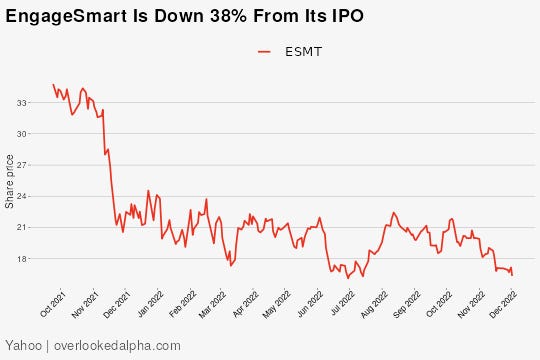
EngageSmart went public last September at $26. The stock closed up 38% on its first day of trading, but a sell-off following Q3 results in November led to an 18% decline. For the most part, the bear market in growth stocks has done the rest. A recent fade leaves ESMT just 2% above an all-time closing low hit on June 30.
An Attractive Story
A number of factors led SaaS stocks to get over their skis, to put it mildly. Low interest rates provided a fundamental basis for buying growth. They also led some investors to reach for returns.
But the stories SaaS companies told played a huge role as well. That was true for the entire space: as private equity CEO Robert Smith famously put it, “software contracts are better than first-lien debt.” And it was true for individual providers as well, who quite often could claim to be revolutionizing the processes used by their customers. At the very least, being “cloud-native” offered an enormous competitive edge1 over incumbents, who had the much more difficult task of converting already-existing infrastructure.
EngageSmart has that kind of story. The company wrote in its S-1 (and Bennett has said the same since) that SimplePractice’s biggest rival is “pen and paper” (if virtual pen and paper such as an Excel spreadsheet). There are competitors such as Therapy Notes and TherapyZen, but the company isn’t going up against a larger, better-capitalized foe. Reviews are somewhat mixed in terms of relative strength, but for the most part SimplePractice seems to be the most comprehensive offering in the space, with features including compliance with the U.S. Health Insurance Portability and Accountability Act, or HIPAA, for its telehealth offering.
InvoiceCloud too seems to have a strong offering, and like SimplePractice isn’t facing a dominant incumbent. HealthPay24 and Donor Cloud seem relatively less attractive, but at ~10% of revenue this year (if that), their contribution to valuation is marginal at this point.
Meanwhile, there’s plenty of room for growth. EngageSmart has estimated its total addressable market at $28 billion, while revenue this year is guided to just over $300 million, barely 1% of that total. TAM estimates have gotten a bad rap (and somewhat rightfully so) here in 2022, and it’s easier said than done to get 5%, let alone 10% market share, but these are not necessarily niche businesses.
That’s particularly true for SimplePractice, the faster-growing of the two businesses. (SMB revenue is +55% year-to-date, Enterprise +30%). The company is expanding from its original focus on mental health providers into adjacent markets such as speech language pathology, physical therapy, massage therapy and acupuncture. ~90% of revenue still comes from mental health, but even that market is only in the “fourth inning”, per chief financial officer Cassandra Hudson on the Q2 2022 conference call. In addition, EngageSmart was named one of the fastest-growing companies in North America on the 2022 Deloitte Technology Fast 500.
Source: Company presentation
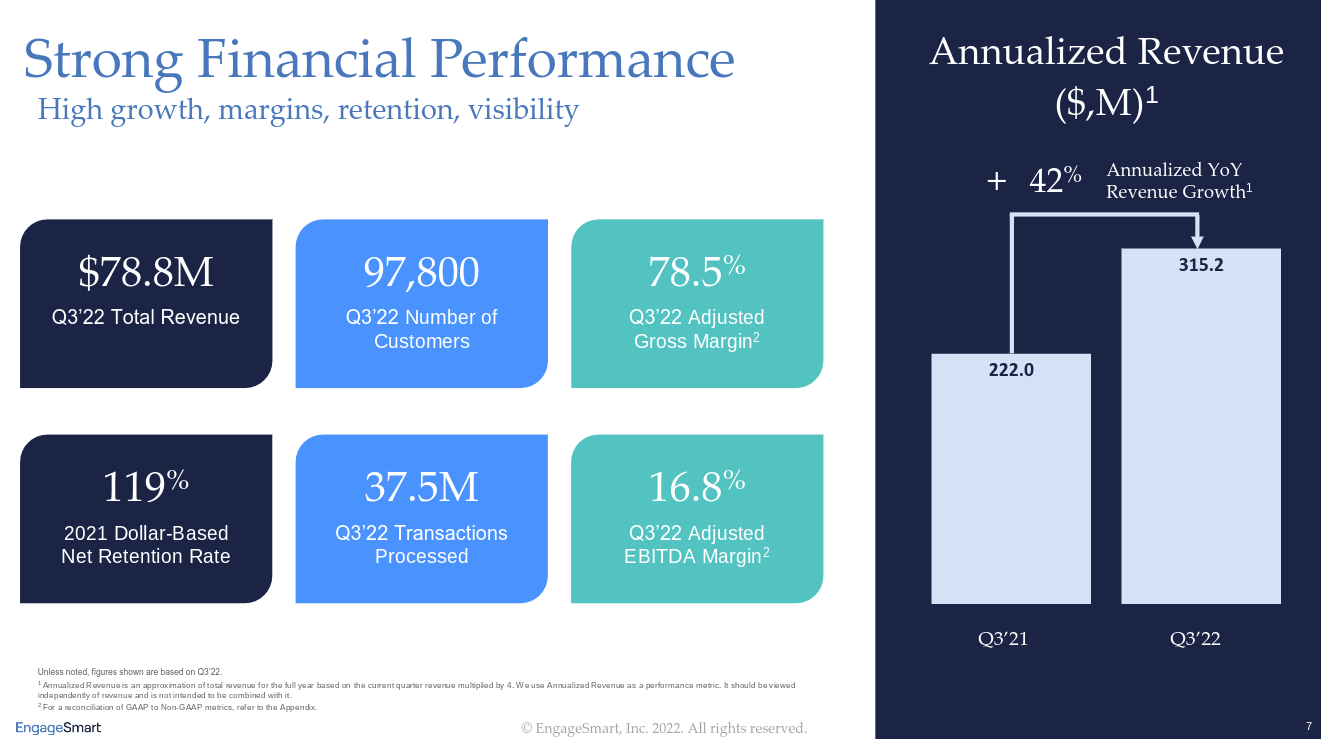
So EngageSmart has the basic SaaS outline of a transformative product, high retention (net dollar-based retention was 119% in 2022), relatively low churn, and a long runway for growth. But it adds something other SaaS providers may not have at the moment: defensiveness.
In both SMB and Enterprise, EngageSmart’s customers have minimal cyclical exposure. Even inflation is a net neutral, per management, given a large proportion of volume-based contracts in Enterprise. Higher energy bills and higher clinician rates can both lead to increased transaction revenue for SimplePractice.
That defensiveness stands in seeming contrast to many SaaS plays at the moment, who are at risk of more cautious spending by their customers. Yet that defensiveness so far has done little, if anything, for ESMT. There are two possible reasons why.
A Hidden Bull Case?
One possible reason is that no one seems to be paying attention. Owing to a broad range of IPO underwriters, ESMT does have decent analyst coverage, but many investors seem not to know the stock even exists.
Volume (a 3-month average of ~$9 million a session) is lower — and in some cases notably lower — than other mid-cap SaaS plays. The ESMT cashtag on Twitter is a ghost town. The June 2023 option expiration has no open interest whatsoever (literally zero contracts). The low float might play some role, but whatever the cause, for a high-valuation SaaS play with a market cap of ~$2.8 billion, ESMT receives relatively little attention.
Meanwhile, for the investors who do review the stock, ESMT at first glance probably doesn’t seem all that attractive. Over half of revenue comes from payments, which in theory should offer lower gross margins (something many investors forgot when investing in that sector in 2021).
Adjusted EBITDA margins as reported are strong in the context of the space, but also haven’t really moved: the midpoint of 2022 guidance implies a 15.6% figure, against 15.0% two years earlier. And, on its face, markets like utility payments and therapist scheduling don’t really get the blood coursing through an investor’s veins. An investor would hardly be forgiven for not wanting to pay more than 8x revenue for that broad profile.
But that profile seems misleading. Even with a heavy proportion of payment revenue, gross margins are strong, at 78% YTD adding back modest stock-based comp.
Flat Adjusted EBITDA margins aren’t a result of 2022 disappointment but 2020 strength. As CFO Hudson noted on the company’s first call last year, EngageSmart had a “temporary pause in spending” amid the pandemic. The company also saw an influx of customers sign up for free trials for SimplePractice to add a telehealth option to their practices, which lowered customer acquisition costs. That aside, margins are moving in the right direction: EBITDA margins should expand ~140 bps year-over-year this year even with incremental public company costs creating a 200 bps-plus headwind. The pandemic also created a difficult top-line compare that EngageSmart has lapped relatively easy.
And, as noted, EngageSmart’s end markets might not be sexy, but they’re large enough against the current revenue base to leave room for years of growth ahead.
Even the decline in the stock might suggest that EngageSmart has disappointed since going public. That hasn’t really been the case. Against its guidance, the company has posted a beat-and-raise report in every quarter to this point. The decline after Q3 2021 earnings aside (and post-IPO dynamics may have played a role there), the stock hasn’t moved after its reports, either: investors have essentially shrugged at each of the last four releases. EngageSmart hasn’t yet blown a quarter out of the water, but it’s largely hewed to the story that existed at the time of the IPO.
As a result, this does seem to be a stock dragged down with the rest of the SaaS group. In the context of where that group was trading in 2021, that alone doesn’t make a bull case. But at this point, particularly with ESMT underperforming over the past few weeks, valuation seems reasonable, at least by growth standards.
Valuation
Fully-diluted, EngageSmart has a market capitalization nearing $2.8 billion. With just shy of $300 million in cash, enterprise value sits right at $2.5 billion.
Post-Q3, full-year guidance sits at $300.5-$302 million, with Adjusted EBITDA targeted to $46.5-$47.5 million. That guidance in turn puts EV/revenue at ~8.3x, and EV/EBITDA at 53x.
That latter figure does need to be adjusted for stock-based comp, the bugaboo of the industry2. But equity comp here is somewhat light, on pace to come in around $14 million this year, less than 5% of revenue.
Admittedly, that still leaves EV/EBITDA in the 75x range. Price to free cash flow clears 100x. But this is a business growing revenue 37% this year, with analysts targeting a high-20s rate next year. The long-term margin target is 30%-plus, and even with investments behind the business there’s room for 100-200 bps improvement annually from the current level.
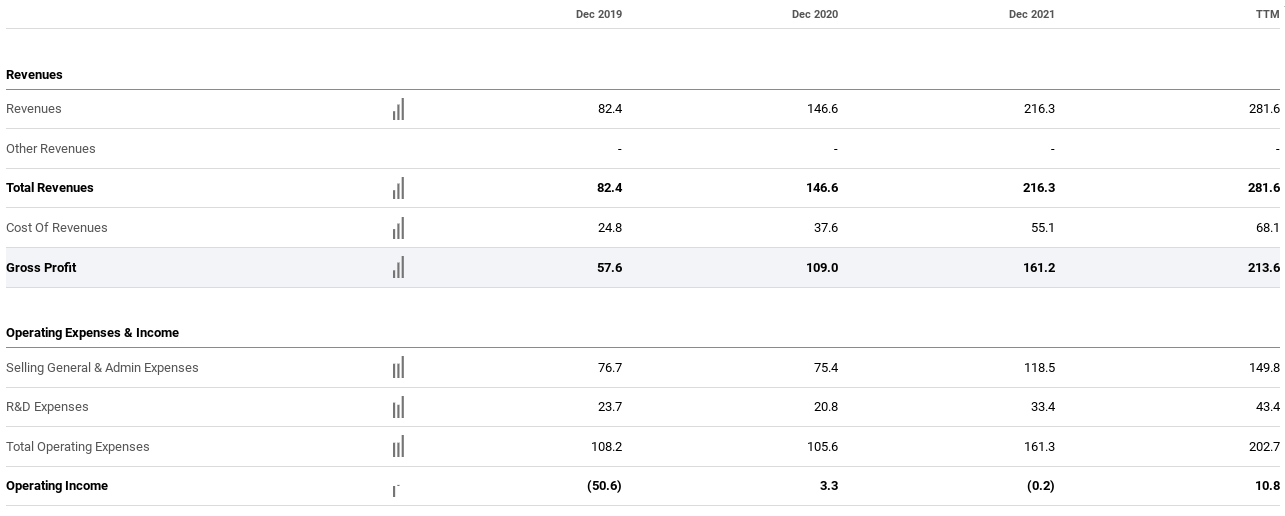
Source: Seeking Alpha
Look out five years and there’s a reasonable path to a double. $750 million in 2027 revenue (20% CAGR) and 21% margins (100 bps annually) get to $158 million in EBITDA. A mid-30s multiple (including stock-based comp, yes) plus cash gets in the range of 100% returns, or mid-teens annualized.
Like so many growth stocks, of course, each of those inputs is up for debate. But analysts see the fundamentals working out: the average price target suggests 70% upside from current levels. And we’re in a range where if the story works, the stock will as well. That has not been the case for many SaaS stocks in recent years, and we’d argue that, particularly when accounting for the impact of dilution, it’s not the case for many such names still.
The Risks to the Story
To close, we’d point to one key reason to believe that this story can work: the importance of SimplePractice.
As noted, SimplePractice is growing faster. But it’s also more profitable. In 2021, Segment EBITDA margins were 32.5% against 13.2% in Enterprise. YTD, the figures are 37.6% and 13.4%, respectively.
ESMT increasingly is a SimplePractice story. And as noted earlier, at the beginning of the year that business changed its pricing structure. Customers were not happy. One Reddit thread3 said a post on the SimplePractice Facebook group had amassed 1,300 comments. A petition on Change.org requesting exemption from the pricing change (for that user, a substantial increase) got over 1,700 signatures. Therapists were up in arms, and many threatened to leave.
On the Q3 call, Hudson did admit to “higher than expected churn” in the first half after the pricing change. But net adds improved sequentially in Q3, suggesting SimplePractice has successfully moved past the controversy, and the pricing change outperformed an original target of a 5% to 10% increase in average revenue per user.
SimplePractice isn’t going to take pricing every year, as Bennett has said. And EngageSmart will face tougher comparisons in the first half of 2023 as a result of the benefit to profits. But the overall success of the new tiers shows a business that customers can’t live without — and that investors should want to pay up for.
As of this writing, Vince Martin has no positions in any securities mentioned. He may initiate a position in ESMT this week.
Disclaimer: The information in this newsletter is not and should not be construed as investment advice. Overlooked Alpha is for information, entertainment purposes only. Contributors are not registered financial advisors and do not purport to tell or recommend which securities customers should buy or sell for themselves. We strive to provide accurate analysis but mistakes and errors do occur. No warranty is made to the accuracy, completeness or correctness of the information provided. The information in the publication may become outdated and there is no obligation to update any such information. Past performance is not a guide to future performance, future returns are not guaranteed, and a loss of original capital may occur. Contributors may hold or acquire securities covered in this publication, and may purchase or sell such securities at any time, including security positions that are inconsistent or contrary to positions mentioned in this publication, all without prior notice to any of the subscribers to this publication. Investors should make their own decisions regarding the prospects of any company discussed herein based on such investors’ own review of publicly available information and should not rely on the information contained herein.
We discussed this edge in our long call on ADBE ADBE 0.00%↑ back in September, as a rationale for the company's acquisition of Figma.
Even the sector’s granddaddy, Salesforce.com CRM 0.00%↑, has a huge problem. The company is guiding for non-GAAP EPS in FY23 of $4.92-$4.94. Incredibly, two-thirds of that 'profit', or $3.26, is coming from the exclusion of stock-based comp.
As we’ve written before, Reddit can be a hugely valuable resource for investors when searching for information and advice concerning the business rather than the stock.
I’d never heard of this company before. Thanks for the engaging and insightful write up. I love hearing about these types of companies that the market is ignoring (for now).
I don't mean to sound critical; it's hard to convey tone via text, but (so here comes the critique lol):
Bennett sold $2.5M of stock ~ $20 a few weeks before the Q3 earnings report following which the stock slid to its current level of ~ $16. I know, insiders sell for many reasons. And the sale was made pursuant to a 10b-5 plan. But as we all know, 10b-5s are a fig leaf for informed insider selling. I'm lazy, and insider selling like this is the lazy investor's first go-to screen.
I'm honestly more tempted by DDOG despite its utterly absurd valuation on the thesis that growth at any price investors will buy sexy high growth market leaders the minute that growth stocks show a pulse and long before more valuation sensitive growth investors scrape the bottom of the barrel for orphaned IPOs like ESME.