
💡 Highlights:
This nationwide pawn shop operator has provided double-digit returns for decades — yet the stock has sold off more than 20% over a couple of months.
Investors sold shares after a first quarter report that looks fine on its face; a June sell-off seems sparked by an overreaction to a pair of external catalysts.
At under 17x earnings, valuation is more than reasonable, with macroeconomic factors now turning in the company’s favor.
At this price, there’s a clear path for the stock to return to double-digit gains.
If there’s one problem with the bull case for FirstCash Holdings FCFS 0.00%↑, it’s that it seems a little too easy. The operator of pawn shops in the U.S. and Mexico has been an excellent stock over time, returning more than 12% annualized since its 1991 initial public offering. Management is long-tenured and solid: chief executive officer Rick Wessel has been with the company for more than three decades, and CEO since 2006. The chief financial officer has been in his seat for more than 20 years.
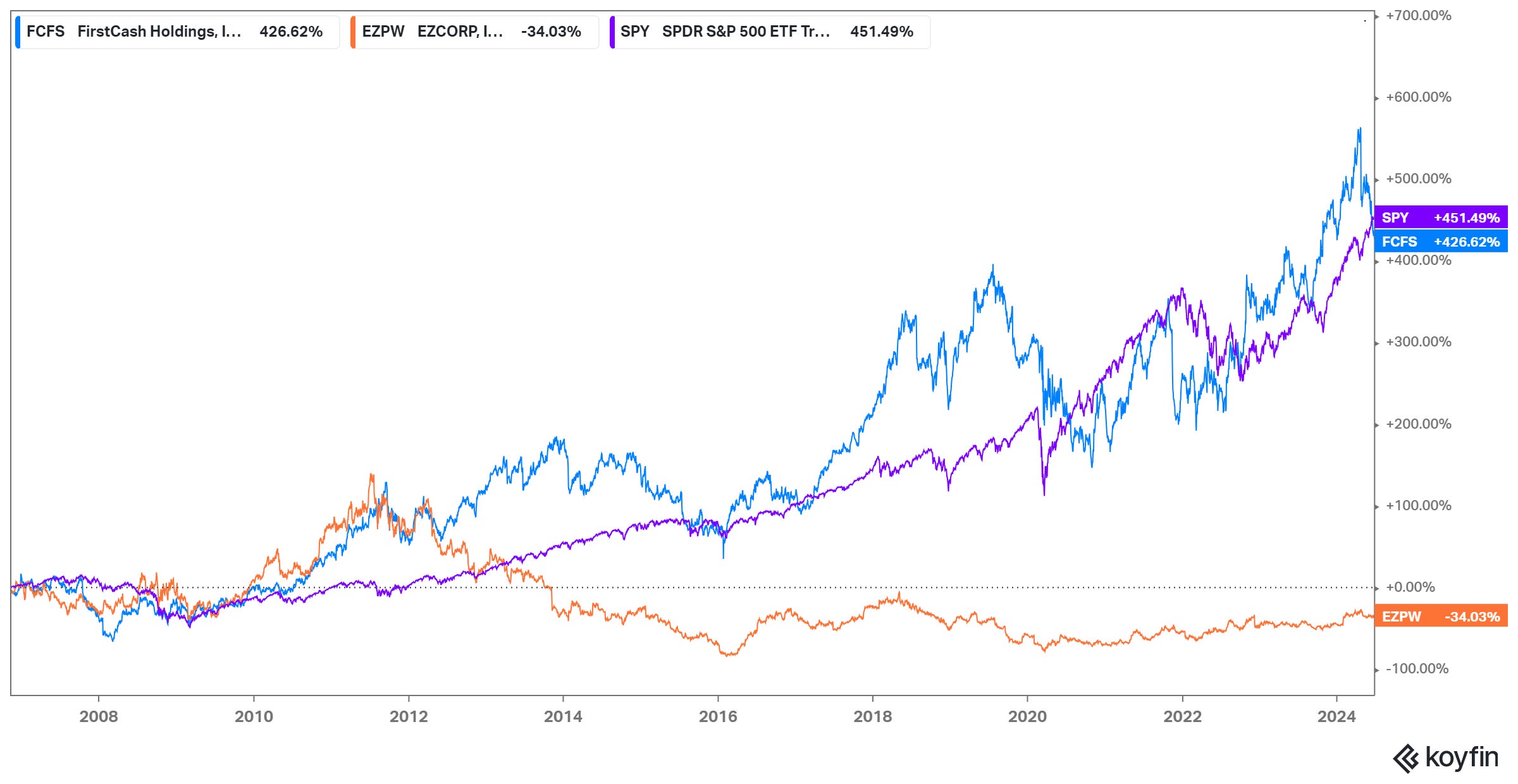
Gains in the stock have slowed under Wessel, but FCFS has still returned 10% annualized, essentially matching the S&P 500 — no small feat for a presumably countercyclical business in a low interest rate environment. A look at rival EZCORP EZPW 0.00%↑ shows that strong performance was far from preordained:
source: Koyfin; chart since November 2006
Looking forward, meanwhile, the external environment seems to be strengthening. Higher interest rates are a benefit for FirstCash. So is normalized inflation, and the end of stimulus payments, both of which contribute to broader challenges facing lower-income consumers. Even the higher price of gold should provide a tailwind.
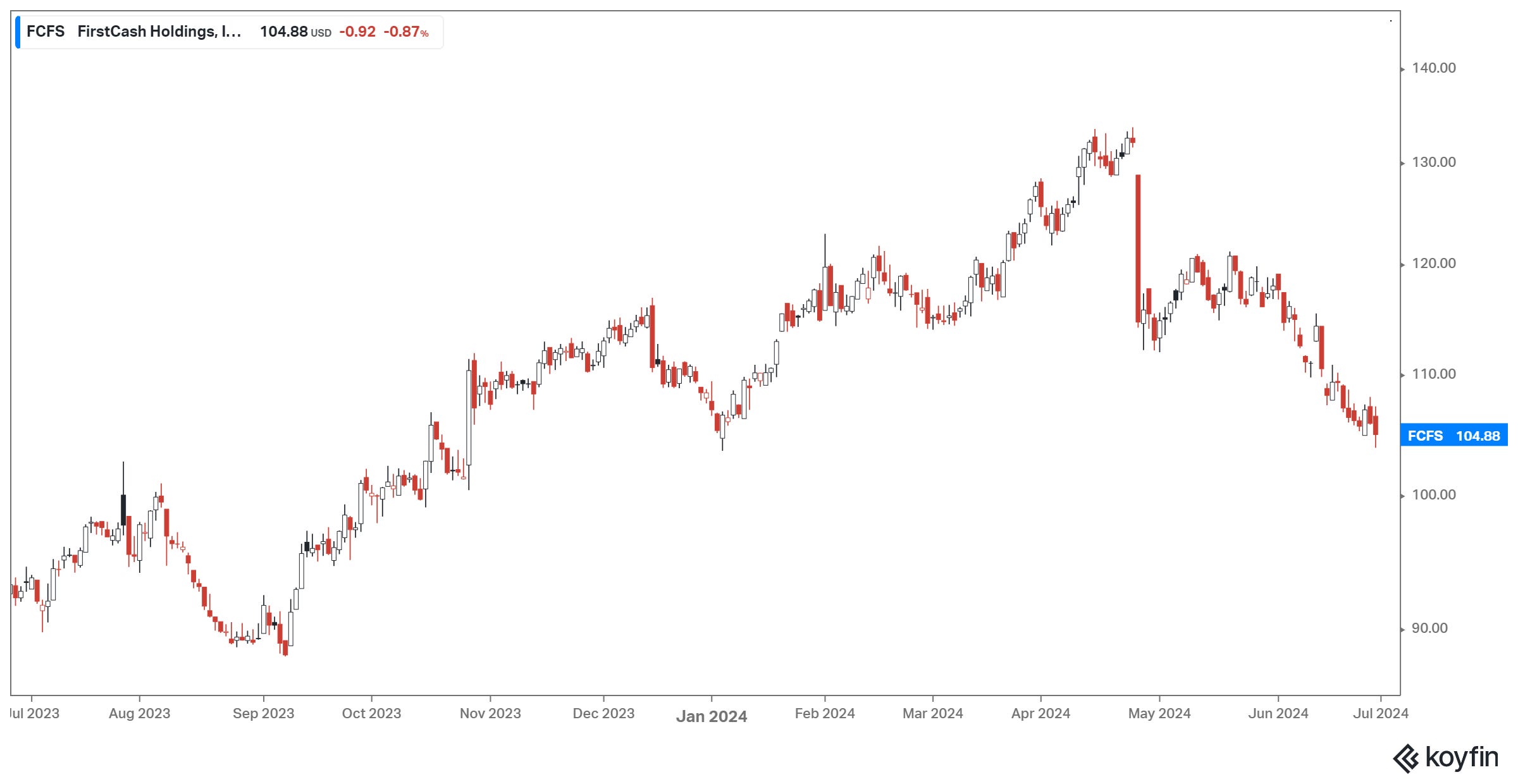
And yet FCFS has struggled:
source: Koyfin
FCFS has pulled back more than 20% since its first quarter release in late April, despite no real sign in the results of any long-term pressures on the business. And while there are two possible catalysts for the decline this month, both seem overblown, to put it mildly. This looks like a questionable short-term sell-off that is creating an intriguing long-term opportunity.

Introducing FirstCash Holdings
In 1988, John Payne opened the First Cash pawn shop in Haltom City, Texas outside Fort Worth. Three years later, with a base of just six stores, First Cash went public. This year, the company opened its 3,000th location.
Almost 1,200 of those locations are located in the U.S., with more than 40% of that total in Texas. FirstCash is the leader in the domestic market, with market share figures seeming to be in the 11%-12% range; EZCORP, which operates mostly under the EZPAWN banner, is in second place, but with less than half as many stores. FirstCash leveled up in 2016, when it acquired more than 800 U.S. stores through an all-stock “merger of equals” with Cash America.
By store count, the company’s bigger business actually is in Latin America. ~95% of those locations are in Mexico, though FirstCash has operations in Colombia, Guatemala, and El Salvador as well. In 2021, FirstCash expanded into the “virtual lease-to-own” market by acquiring American First Finance (‘AFF’) for over $1 billion in a cash-and-stock deal.
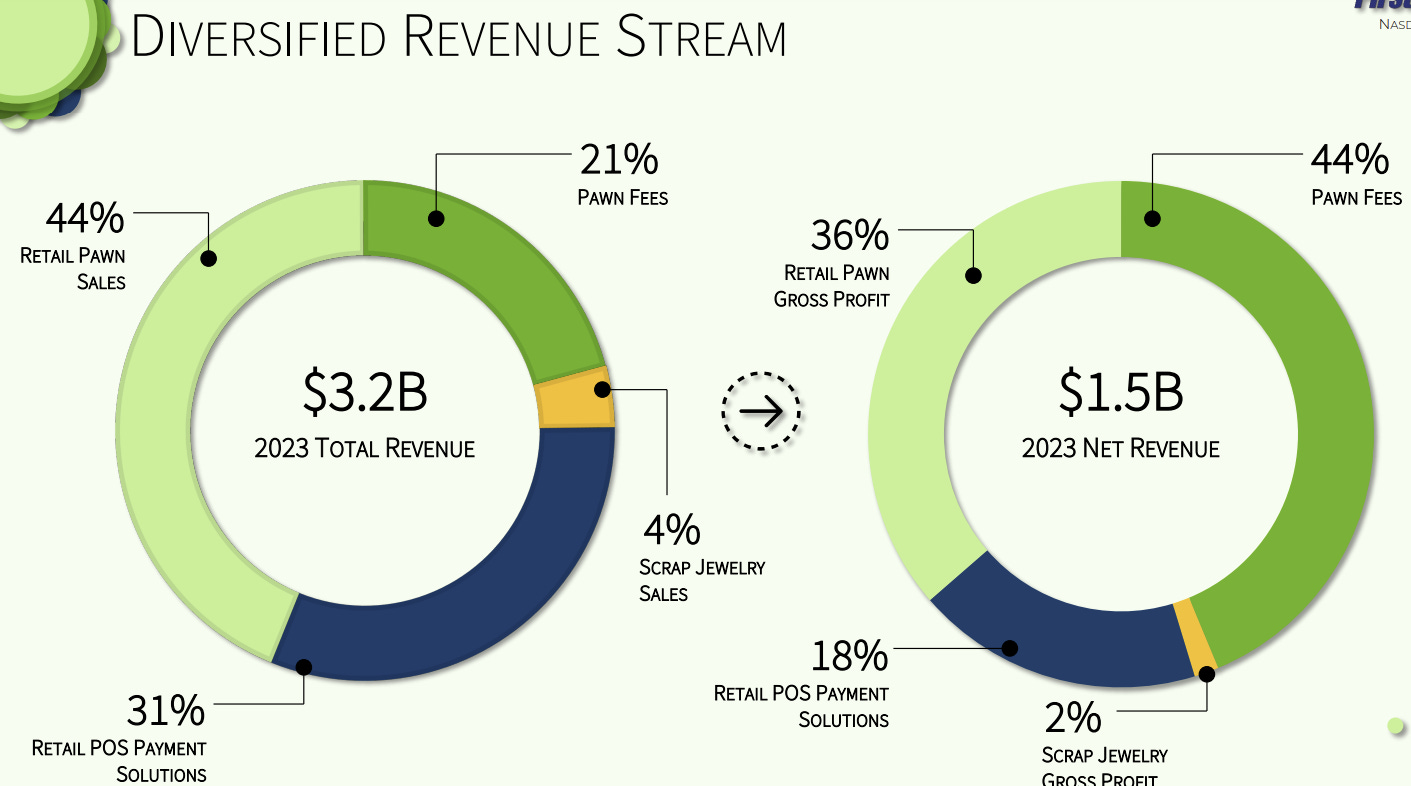
The result is a somewhat balanced portfolio in terms of revenue, though the U.S. operations are still the profit driver (54% of the total in 2023, against 25% for International and 21% for AFF):
source: FirstCash investor presentation, May 2024 (“Retail POS” reflects AFF business)
The pawn model is probably roughly known to most readers. Owners can bring merchandise in for sale — roughly a quarter of customers choose to simply sell the item — or to be used as collateral for a non-recourse loan. Either the customer pays the loan back (FirstCash cites repayment rates of about 75%; the average loan in 2023 was $258), or the item is sold by the pawn shop to cover the balance. There are no credit checks, and no collections.
The interest rates are high. FirstCash’s 10-K cites a range from 4% to 25% per month. Commentary that monthly fees are usually $25-$30, given the average loan balance, suggests the standard rate is in the range of 10% monthly. That seems about in line with “rule of thumb” commentary on the industry, though it does vary by state: Texas allows 20% monthly interest for loans of $240 or under, with the cap dropping to 15% between $240 and $1,600.
Unsurprisingly, those high rates, particularly when expressed on an APR (Annualized Percentage Rate) basis, have made pawnshops the occasional target of regulators and turned off some investors to the space. But pawn customers generally have no other options — many are unbanked, and by definition few have access to credit card debt, which offers sharply lower interest rates — and the industry is almost solely regulated at the state level. Local authorities in fact usually limit pawn shop licenses, so net/net the impact of governmental action is probably a positive for the industry. FirstCash’s three-plus decades of success would certainly suggest as much.
The Bull Case for FCFS
As noted, FCFS has been a strong stock over time. And, as noted, on its face the stock seems like a relatively easy buy at the moment.
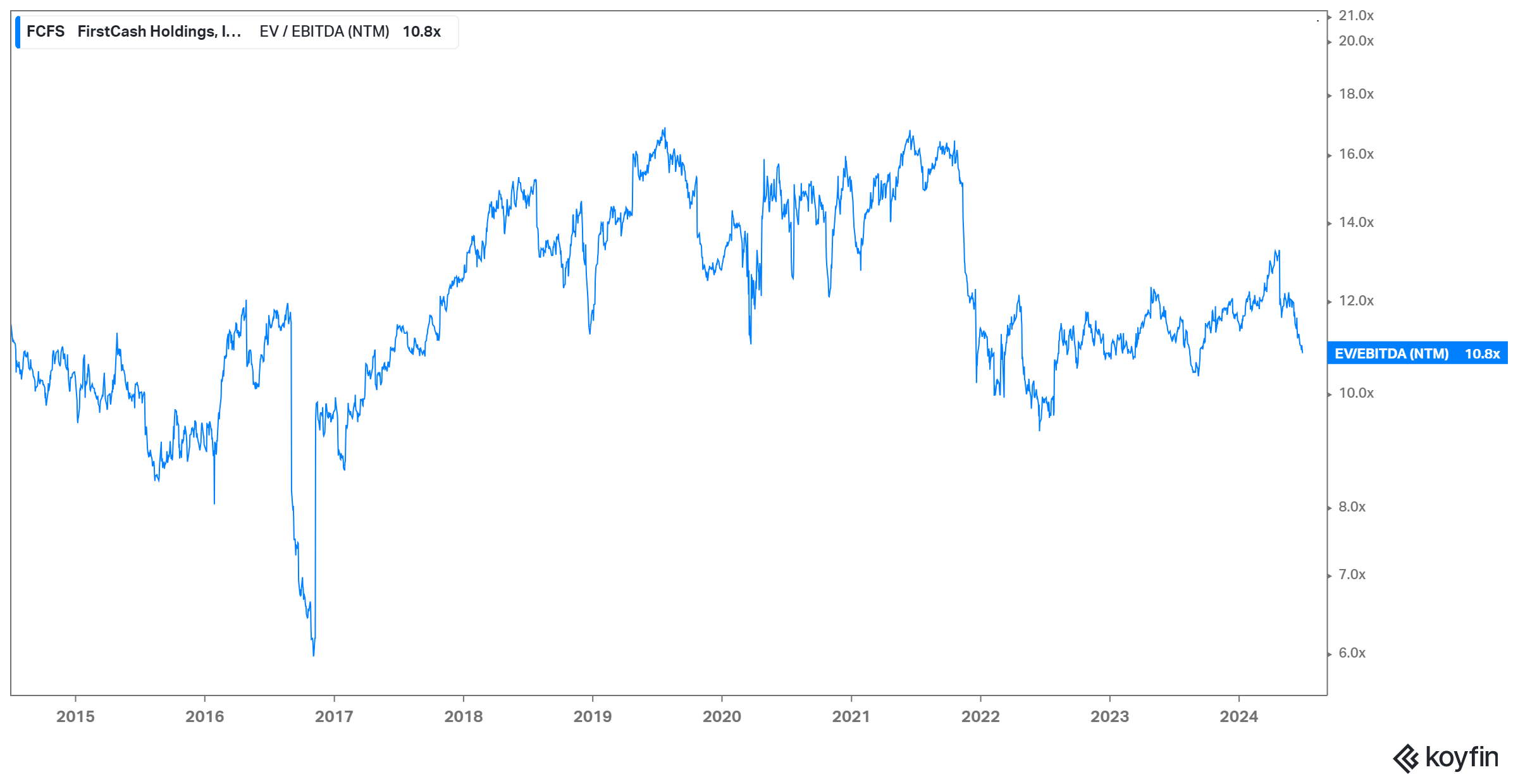
Certainly, valuation seems constructive. On a trailing twelve-month basis, FCFS trades at 16.5x adjusted earnings per share and 11.5x EV/EBITDA. That latter multiple is toward the low end of the company’s historical range:
source: Koyfin
Certainly, we’ve in the past questioned the use of these ranges, noting that businesses probably should see their multiples narrow as they mature. For FCFS, there’s an additional argument that the multiple should compress due to the cycle. In, say, the second half of the 2010s, investors were pricing in the impact of an eventual macroeconomic downturn and/or normalized inflation, neither of which would have been baked into near-term forward estimates. Now, however, FirstCash is presumably closer to the top of its cycle, which unfortunately is the bottom of the cycle for its customers.
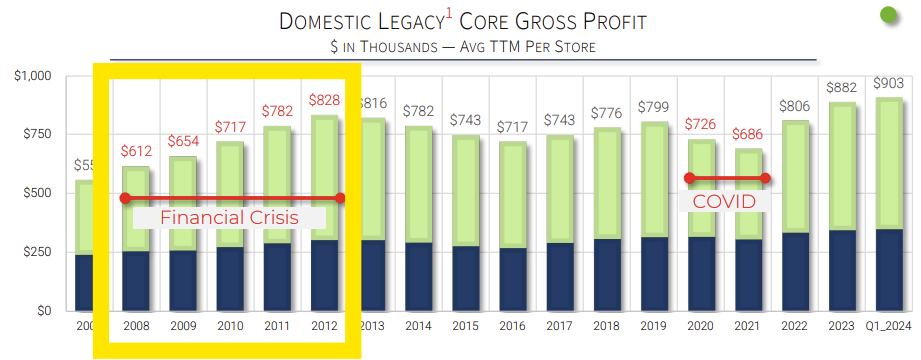
But one important mitigating factor here is that the tailwinds for FirstCash haven’t necessarily arrived yet. Pawn shops, for better or for worse, are the last resort; it takes time for external pressures to get customers into the stores. Even in Q1 2023, with inflation already spiking, same-store pawn receivables were up just 5% year-over-year against exceptionally light comparisons1; Q1 2024 saw 14% growth in the same metric. History suggests the impacts of recent inflation will have an impact for some time to come:
source: FirstCash investor presentation, May 2024 (author highlighting)
It’s possible, perhaps, that FirstCash is in the range of mid-cycle earnings, but even if that’s the case a 16x-plus multiple to earnings (likely to drop closer to 15x over the next three quarters) is reasonable enough. We’d argue the company is actually more likely at the beginning of a multi-year expansion in receivables and profits.
The other important factor to consider in terms of historical multiples is that the multi-decade FirstCash playbook remains open. The company does have market share leadership — but, again, with a low double-digit percentage of the total industry. Even granting that, owing to regulatory factors like interest rate caps, the company may avoid certain markets2, there’s still plenty of room for domestic expansion via newbuilds or acquisitions. Overseas, Latin America seems to have significant room for additional penetration: FirstCash opened 43 stores in 2023, adding more than 2% to its base. And there is the possibility of new countries, along with the possible expansion of the AFF model to the region, something management floated when the acquisition was announced in 2021.
As is often the case, valuation is difficult to pin down precisely, given the number of variables and the macroeconomic volatility of the last few years. But at worst, the multiples look reasonable, and they’re in line with multiples investors have been willing to pay for most of the past decade. Most of those investors did quite well — and that was during a period in which the countercyclical nature of FCFS was never apparent. Given the additional value of the stock as a potential hedge, Friday’s close of $108 looks even more attractive, and easily attractive enough.
April Earnings And An Ugly June
Of course, that is only the case if the sell-off since earnings is unjustified, rather than reflecting catalysts that can upend the optimistic mid- to long-term outlook. And, to be sure, there are at least three potential reasons for the sell-off since the Q1 release.
The first is the release itself. FCFS fell 13% after the quarter. To be honest, it’s not entirely clear why. A run-up into the release likely is a factor: the post-earnings decline simply moved the stock to where it had been before the Q4 report on February 1st. In the Q1 press release (FirstCash doesn’t hold quarterly earnings calls), management did cite soft same-door results for AFF, noting weaker-than-expected sales in furniture (nearly half of the segment’s revenue) and other categories. Overall, revenue missed Street expectations by about a point; it seems likely that it was the non-U.S. pawn business that drove the delta, with the international business posting a year-over-year decline in operating income.
All that said, the U.S. pawn business still performed exceptionally well, and AFF posted a 43% y/y increase in operating profit. Per the Q, the international business struggled with “constrained inventory”. Per the press release, higher costs were an issue as well. Net/net, it’s not a perfect quarter, but it doesn’t necessarily look like a -13% print, either.
The market somewhat agreed with that statement: FCFS ground out a 3% gain over the next five weeks. Here in June, however, the stock has fallen 11% on essentially no news. Even insider selling from Douglas Rippel, the former owner of AFF who has steadily reduced his stake, seems to have stopped this month3.
Mexico And Conn’s
But there are two additional catalysts for this month’s selling. Even though, neither one seems all that material.
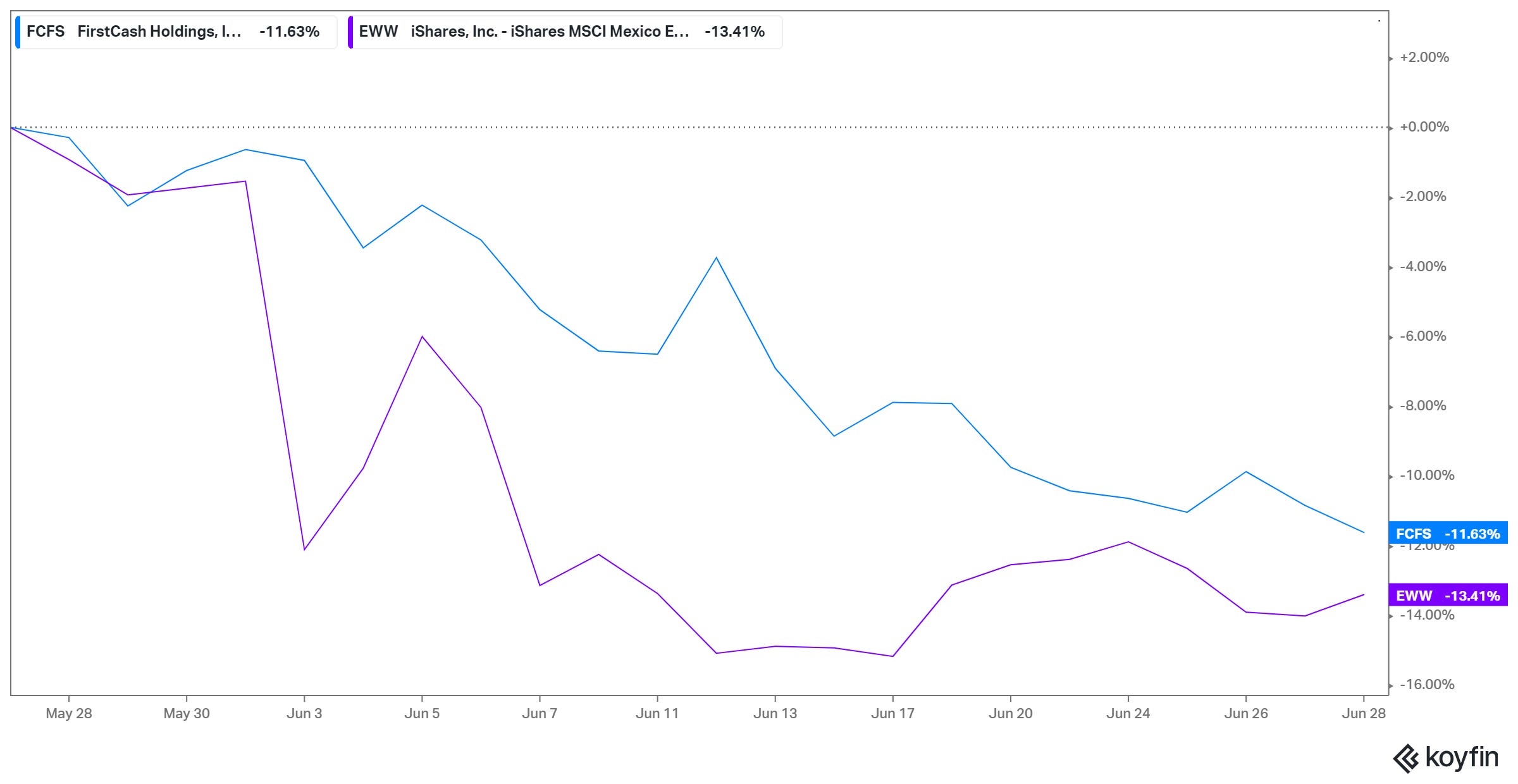
The first potential cause for concerns stems from the elections held in Mexico on June 2. Equity markets reacted exceptionally poorly, and FCFS seemed to track that sentiment:
source: Koyfin
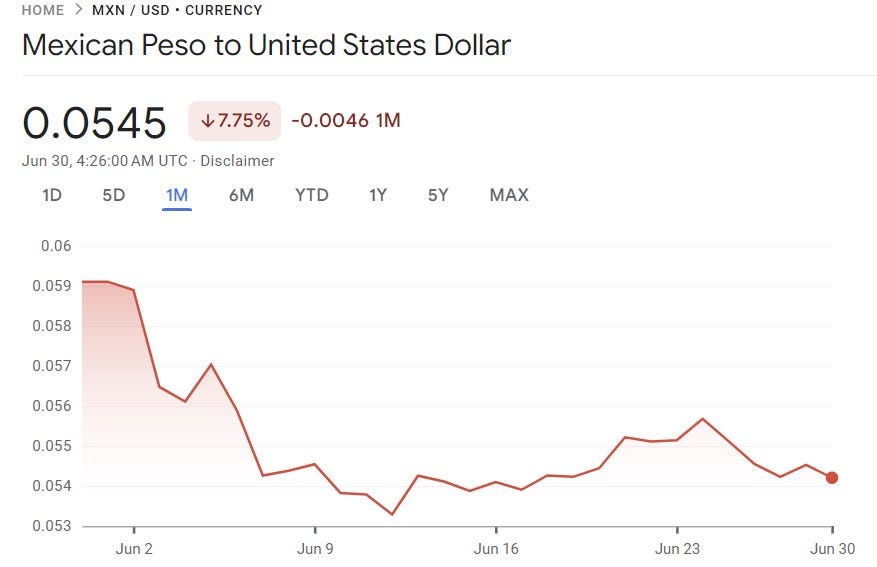
The more direct problem for FirstCash is that currency markets have reacted poorly as well:
source: Google
But the catch here is how a business that drives ~one-quarter of profit can create an 11% decline in equity value. An 8% decline in the currency might create an 8% decline in the dollar-denominated profit stream from the Mexico operations — but that’s a ~3-4% hit to FirstCash’s after-tax net profit4.
It’s possible that fears about the political path coming out of those elections — in which the controlling party, Morena, won a near-supermajority — play a role as well. Under current president Andrés Manuel López Obrador, Morena has been aggressive in providing direct cash transfers to the nation’s poor, and that might suggest some additional pressure on FirstCash’s receivables growth in the country.
But of course FirstCash has been dealing with that external pressure (if it exists) for years; the environment isn’t necessarily getting worse. That aside, Morena’s programs don’t appear to have actually worked, and the broader equity market reaction, and fears of an economic downturn, too don’t seem to pose a risk to FirstCash’s operations in the country. Right now, investors seem to be selling based on the headlines — and perhaps a fear that all foreign corporates may see pressure under the new administration. But there’s no real evidence that FirstCash’s positioning has changed all that much. All told, there simply isn’t cause for an 11% decline coming from the country.