
Welcome to Overlooked Alpha. If this is your first time, subscribe below to get our best investing ideas in your inbox every Sunday morning:
Harley-Davidson HOG 0.00%↑ derives value from four revenue streams:
The core motorcycle business;
Financing through Harley-Davidson Financial Services;
Apparel; and
The Livewire electric motorcycle division.
Breaking down Harley-Davidson in that simple manner highlights the intriguing case for shorting HOG stock. Every aspect of the business seems under potential pressure.
Big-ticket vehicle sales of all kinds appear set for a decline, a core reason why we’ve recommended a short of boating stocks and why recreational vehicle stocks are trading at 6-8x forward earnings.
Harley-Davidson’s financing profits are already declining and are at further risk amid an increase in both interest rates and credit losses. Apparel manufacturers of all stripes are struggling after sales were pulled forward by the novel coronavirus pandemic.
Meanwhile, Livewire is going public via a merger with special purpose acquisition company AEA-Bridges Impact (IMPX). The general track record of so-called de-SPAC mergers and the specific valuation assigned to Livewire in that tie-up both suggest potential downside. That apart, the idea that Livewire much expands the total addressable market for motorcycles — required for a benefit to Harley as a whole — seems questionable.
To some extent, the market is pricing in these pressures. HOG trades at about 9x this year’s consensus earnings per share estimate. But that’s still a premium to most companies facing similar challenges. That premium exists because the stock has had a strong 2022, gaining 9%.
In the context of its various revenue streams, even that modest rally looks questionable. So does that seemingly cheap valuation, given mid- to long-term risks and a reasonably leveraged balance sheet. With the Livewire SPAC due to close this month, and the chart suggesting a near-term top, there’s a solid case for shorting HOG here.

The Case For Harley-Davidson
The bull case for HOG rests on three pillars: the existing business, the potential for improvement, and valuation.
There are things to like about the business as presently constituted. The H-D brand unquestionably is iconic worldwide. In its core categories, notably so-called “cruisers”, the company has dominant market share.
But management believes the company can run better and more profitably. Chief executive officer Jochen Zeitz took over in March 2020; Harley-Davidson would spend that year simply reacting to the pandemic. But the following February, Harley announced its “Hardwire” five-year plan, following the “Rewire” strategy that allowed the company to navigate 2020.
Hardwire represents a notable reversal, in fact what one industry site called a “180-degree turn”. The previous “More Roads Lead to Harley-Davidson” strategy, released in 2018, included the launch of multiple models — some 100 in the course of a decade.
Instead, under Hardwire, Harley plans to focus on categories where it’s already strong, with only a few select launches (such as the Pan America adventure touring bike, which came to market last year). Geographically, Harley plans to focus only on key markets, including the U.S. (~two-thirds of motorcycle revenue in 2021), Japan, China, France, the U.K., and others.
This retrenchment is important for two reasons. First, Harley sees the strategy alone as driving better profitability. Less complexity and a smaller workforce should markedly help margins. At its Investor Day this May, Harley forecast operating margins of 15% in the motorcycle segment by 2025, up from 11-12% this year and just 8.5% in 2018.
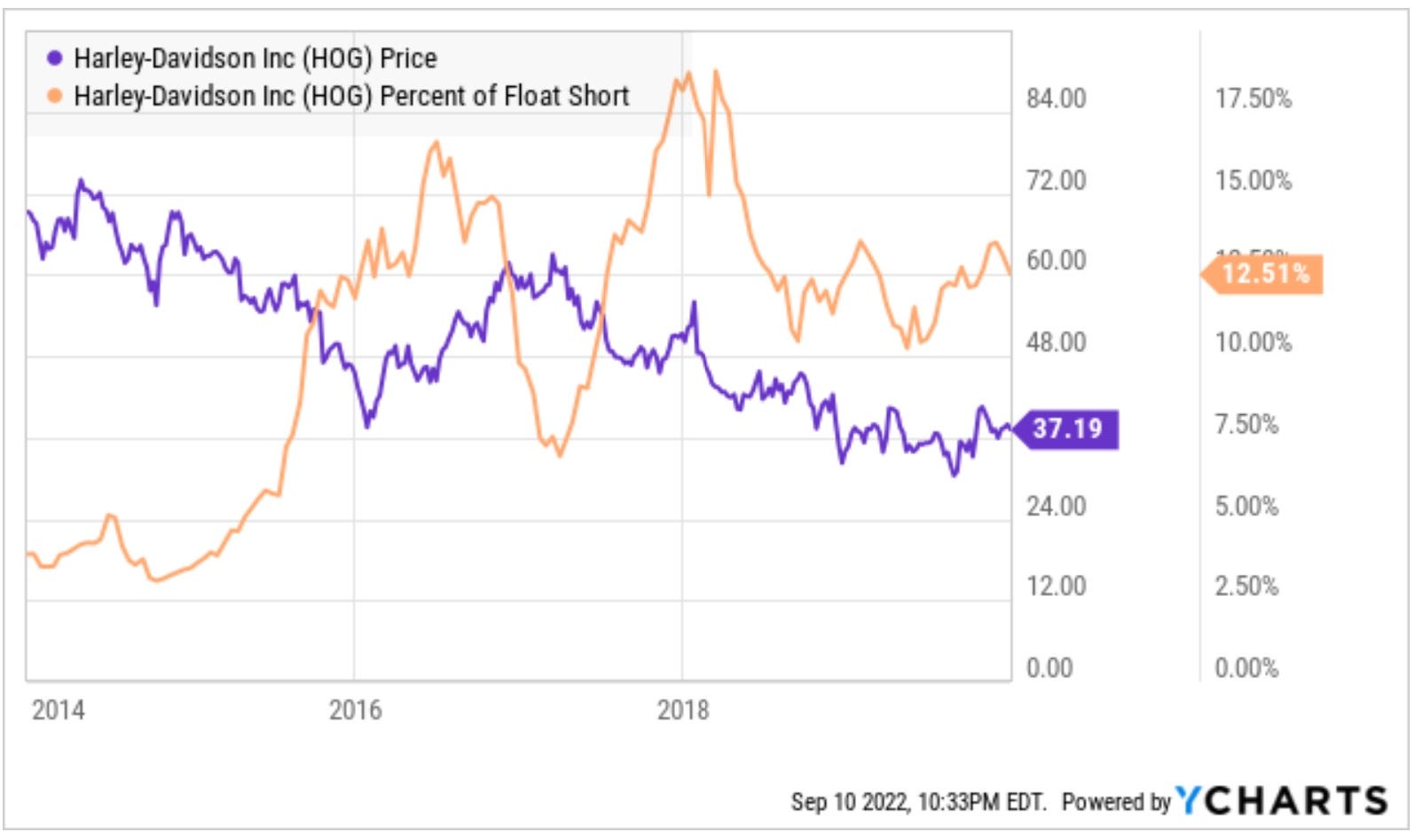
Second, it provides a potential explanation for the weakness in Harley’s profits (and stock price) over the second half of the 2010s. Between the beginning of 2014 and the beginning of 2020, HOG stock fell 46%. The S&P 500 rose 75%.
The core driver of the decline in Harley stock was the decline in Harley earnings. Earnings per share were $3.88 in 2014, and $3.36 (on an adjusted basis) in 2019. That decline in turn fed a narrative that Harley’s brand and demographics both had peaked, making the stock a popular short for much of that period:
source: YCharts
But if Harley were mismanaged at the time, pre-pandemic performance looks rather different. Until 2019, profits had mostly held up despite disruption caused by the trade war (Harley-Davidson was both a literal and symbolic target of European Union tariffs). There’s thus an optimistic reading to be had — that Harley’s brand and demographics were and are good enough, it was management that was the problem.
HOG Is Cheap
That reading suggests a potentially attractive bull case at $41. At 9x this year’s earnings, HOG is being priced as if those long-term worries still exist and the margin improvement driven by Hardwire doesn’t.
But Harley-Davidson is also dealing with supply constraints this year that could potentially hit full-year results. More importantly, even that P/E multiple is inflated by Livewire in two directions.
First, losses from Livewire this year are depressing reported earnings. On the Q2 call, Harley-Davidson management reiterated that its guidance for this year includes projected losses from Livewire (which will be consolidated in Harley results even after the merger). Livewire’s Form S-4 (p.147-148) projects an EBIT loss of $111 million this year, a ~$0.57 hit to Harley’s after-tax EPS. Add that back, and HOG is now trading at roughly 8x this year’s earnings, which should come in around $5.
Even that understates the case, however. Livewire has value not reflected in earnings. In fact, the SPAC merger is going off at an enterprise value of $1.77 billion. Harley will own 74% of the company post-merger, suggesting its stake is worth $1.31 billion, or about $9 per HOG share.
Fully backing out Livewire, then, HOG is a business trading at ~$32 per share yet likely to earn about $5 in EPS this year — a 6.4x P/E multiple. Bulls would argue that if old worries re-appear, they are priced in to some extent. If the Hardwire optimization plan works out, the combination of earnings growth and multiple expansion points to strong upside ahead.
The Motorcycle Problem
Taking a closer look, however, that thesis doesn’t quite hold up. The risk to Harley-Davidson earnings is not what it was pre-pandemic. It’s much, much worse.
Again, the 2010s bear thesis was that Harley-Davidson earnings were peaking, for two broad reasons. One was that competition was rising, notably from the relaunch of Indian Motorcycles by Polaris (PII). But the far more important reason was that Harley was facing a demographic time bomb.
Harley was a ‘baby boomer’ brand, and by the end of the decade Baby Boomers ranged in age from 55 to 73. Millennial preferences, as noted in a 2019 analyst note highlighted by CNBC, pointed away from Harleys. In a response to CNBC, Harley’s PR team didn’t even dispute that finding, telling the network that “there’s nothing new here.”
That mid- to long-term headwind still remains. But particularly at this valuation, it’s not quite enough to support a short thesis.
What can support a short thesis is a post-pandemic reversion to the mean. To be sure, in terms of revenue, Harley-Davidson is not Peloton (PTON). Guidance for a 5-10% increase in sales this year for the HDMC segment (which includes not only bikes but apparel, licensing, and parts & accessories) suggest motorcycle sales will be only modestly above those generated in 2019, and still below 2018 levels. That’s a moderate improvement in trend, certainly, but it’s possible that Hardwire-driven decisions are driving that improvement.
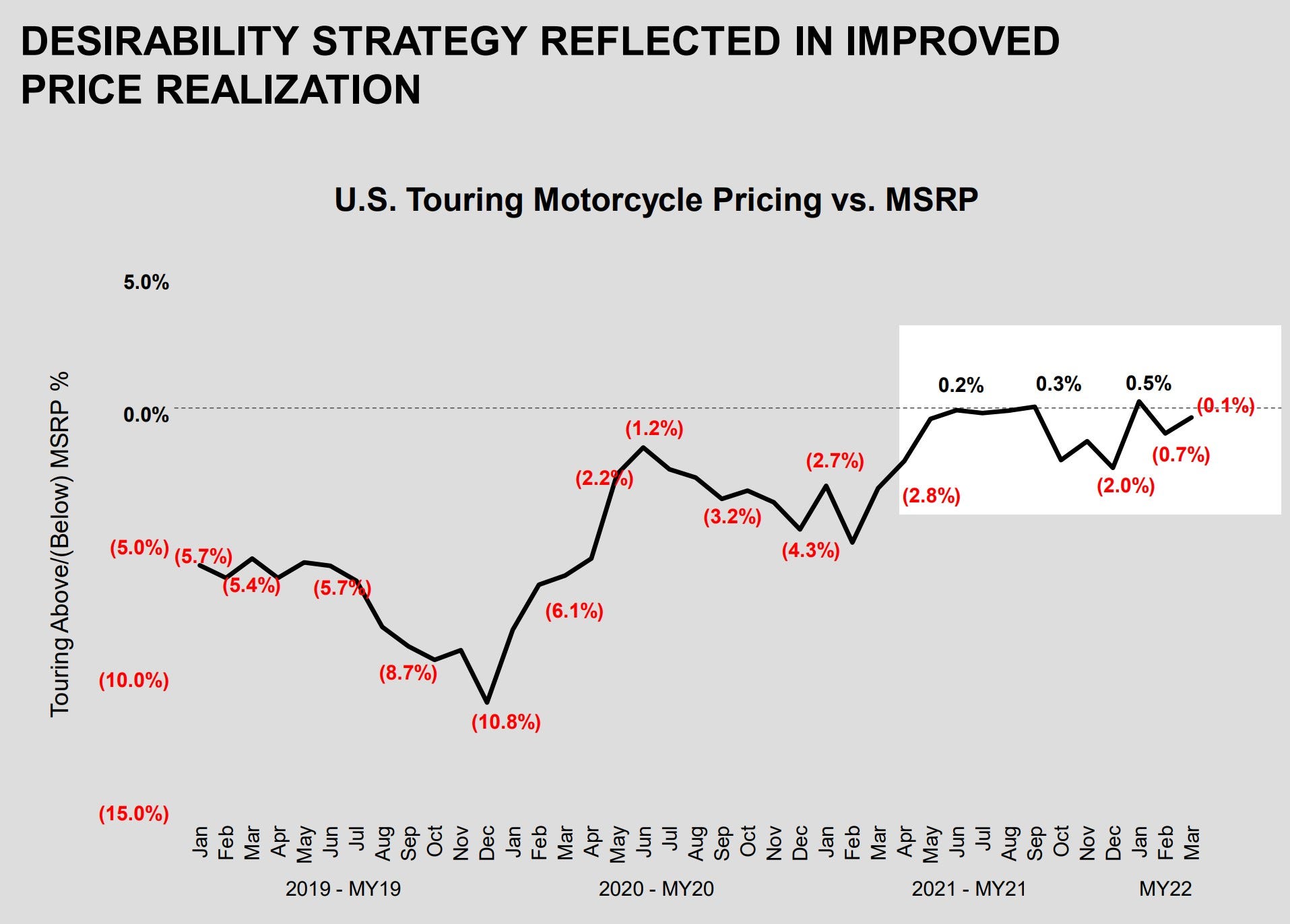
Where the reversion to the mean is a threat is in terms of profit margins. The midpoint of 2022 guidance suggests a 300 bps expansion from levels reached in 2018, and 520 bps from 2019. Harley’s own Investor Day presentation highlights one core reason why:
source: Harley-Davidson Investor Day presentation, May 2022
Management would argue (and has argued) that Hardwire is responsible. In their telling, discounting has been reduced because the company is selling the models its end customers desire.
To some degree, management no doubt is correct. But few, if any, management teams of consumer-facing businesses have attributed recent strength to external factors. (That only happens when the external factors are negative.) At the least, Harley’s pricing strength — which has allowed it to pass on inflationary increases to purchasers, and then some — just happen to coincide with similar strength at nearly every other consumer-facing business out there.
Indeed, one of the arguments against boating and RV companies in the mid-term is that anyone considering a purchase in either industry would have made their purchase over the past two-plus years. It’s difficult to believe that doesn’t apply to Harley-Davidson to at least some extent.
Even assuming the consumer holds up, the stronger dollar alone may force Harley’s hand. Japanese rivals took advantage of the weaker yen to compete on pricing in the mid-2010s. With the yen down 23% over the past year, they have every ability to do so again.
At the very least, Harley-Davidson needs to ramp up advertising in a more normalized environment. Reductions there have been enormously beneficial to margins already. Advertising spend in 2021 was $107.6 million, or 2.37% of motorcycle segment revenue, against $171.4 million in 2019 — 3.75% of sales.
There’s another, more immediate factor at play, however. As an analyst highlighted earlier this year, Harley has reduced dealer margin, in large part because bikes are selling at or even above MSRP (manufacturer’s suggested retail price). That decision alone adds 2.5 percentage points to bike profit margins, likely providing a 100-plus basis point boost to operating margins.
If and when pricing strength fades, however, there’s a potential double whammy on the way. Harley — which under Zeitz already reversed its decision to sell on Amazon.com (AMZN) amid a dealer uproar — might have to reinstitute the prior 20% margin.
Again, Harley is not Peloton. In terms of motorcycle sales, the impact of a return to normalcy actually seems far less than for boats or RVs. Relatively stable parts and accessories revenues can minimize the impact of sales weakness as well.
But, overall, there seems to be a strong case that the quick margin expansion over the past two years is coming from external factors rather than internal improvements. The bearish argument from before the pandemic — that margins and profits had peaked — still has validity after the pandemic.
Apparel Growth
The same argument may well apply to apparel. Harley-Davidson doesn’t give much color on apparel profit margins, but the bottom-line contribution of the category no doubt is material.
In 2021, apparel only accounted for 5% of revenue, and licensing about 0.8%. But margins in both categories no doubt are huge. Dealer margins for apparel appear to be in the range of 40%, which still leaves plenty of room for a huge markup: Harley’s short-sleeve T-shirts sell for $30 to $40. Licensing margins, meanwhile, likely clear 80%, given the lack of operating expense required.
If apparel EBIT margins are 15%, and Licensing 80%, then the two categories probably account for a high-single-digit portion of overall operating income. (Our simplistic and potentially conservative model here suggests the proportion is about 8%.)
Here, too, the pandemic appears to have been a boon. 2022 performance, given strong first-half growth (+21%), should come in ~10% ahead of 2019. But that growth is a marked change in trend: apparel (the category was then named “General Merchandise”) fell 1.8% in 2019, 7.9% in 2018, and 7.7% the year before. The same broad reversal is seen in the licensing category as well.
Admittedly, Harley’s merchandise businesses continue to perform well even at a time when most other merchants already are seeing demand fall off. It’s possible that execution has improved (management doesn’t offer much commentary on either business), or that demand here is more resilient.
But it’s also possible that the category simply is getting a residual benefit from bike sales that are higher than they would be otherwise. New bikes often mean new merch. As with the profit margin improvement for the segment as a whole, this seems the more likely explanation: that what Harley management believes is permanent, structural improvement is actually just a pandemic-driven tailwind that is set to fade.
Financial Services Reversion
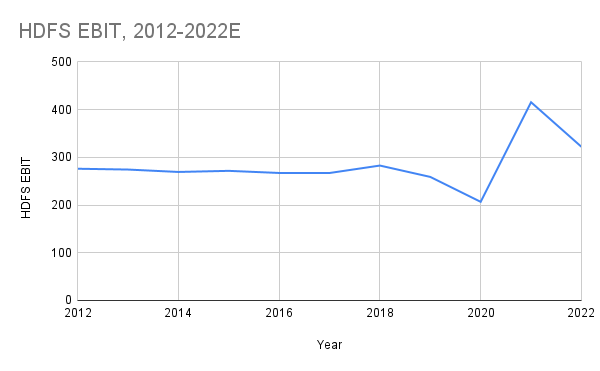
It’s been the financial services business that has been a big contributor to growth from 2019 to this year:
source: author from HOG 10-K filings. 2020 and 2021 exclude restructuring charges. 2022 at midpoint of guidance for 20-25% y/y decline
Historically low loan losses last year, as well as a release of a valuation allowance, drove record profitability in the Financial Services segment last year. Harley expects a 20-25% decline this year — but the figure remains elevated.
More downside seems likely. Unit sales are down. Interest rates are up. A simple return to average performance from 2012-2017 — which, bear in mind, was a beneficial environment, if not to the extent of 2021 — suggests an EBIT decline of $50 million. That alone suggests a $0.26 after-tax hit to EPS, or about 6% of this year’s earnings. Any actual downturn in the economy, or a pile-up from consumers who were overconfident about borrowing in 2020-2021, suggests further downside if HDFS profits move below the past trend.
Does Livewire Really Help HOG?
In 2022, Livewire expects to sell 500 units. In 2026, the projections from the S-4 estimate the figure will rise to 100,961.
At this point, few if any investors put much faith in SPAC projections. But it’s worth putting that 2026 figure in the context of Harley-Davidson’s current unit sales. In 2021, the company shipped 188,494 bikes, 461 of which were electric.
So if the math is that Harley-Davidson’s stake in Livewire is worth $1.7 billion, then that division has to be taking material share from legacy ICE (internal combustion engine) models. Yes, perhaps Livewire can expand the overall market, helping to ease some of Harley’s difficulty in reaching younger consumers. And the company is selling its STACYC electric bike for children, which appears to be driving early unit sales and revenue.
But even accounting for STACYC in the unit numbers, Livewire can’t get to 100K without existing bikers. The idea that tens of thousands of bikes can be sold to customers who would totally ride a motorcycle except for the fuel source is almost ludicrous. Unlike electric automobiles, fuel savings aren’t that material; ICE motorcycles are relatively efficient as is. Electric engines offer benefits in terms of maintenance and repair, a marginal help considering the reputation of Harleys as unreliable (though it’s up for debate as to whether that reputation is justified).
The biggest problem with a motorcycle is that it’s less safe than traditional automobiles and, for most potential customers, not viable as a primary mode of transportation1. An electric bike perhaps can get some new customers into the market, but overall ICE and electric broadly are serving the same market. LiveWire management said as much at their company's Investor Day, emphasizing that "we must win with experienced riders." Some of those experienced riders would otherwise buy Harley ICE models.
And so if LiveWire really is worth ~$1.8 billion, that’s only because it has an opportunity coming from legacy Harley’s growth going forward. If it isn’t, that’s good news for Harley’s mid-term profits, but far less so for a potentially valuable balance sheet asset.
We’d lean strongly toward the latter expectation, but either way there are offsets here. Some of the value Livewire creates has to come from Harley’s ICE business.
Why Short Now?
Overall, then, the profile here looks like a short. 2021 and 2022 profits are elevated against a 2018 baseline — and that baseline is held amid a positive external environment (strong economy, low interest rates both in the U.S. and overseas). Simply returning to that kind of environment seems to get non-Livewire EPS under $4 (~200 bps in EBIT margin compression); any kind of pressure from inflation and/or recession does even more damage.
When and if the pre-pandemic narrative about demographics returns in force, HOG probably still receives a sub-10x multiple to those profits. And so a mid-30s or worse share price seems easily in play.
Admittedly, that’s not huge downside from Friday’s close above $41. This is more of a trade/funding short. But there are two core reasons to see that kind of play as attractive here.
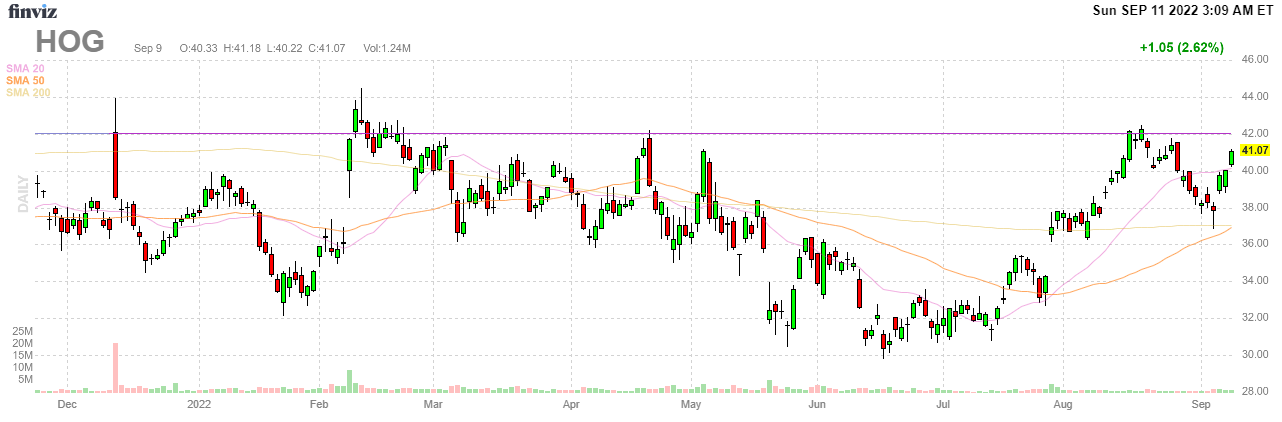
The first is the chart:
source: finviz.com
We’re not regular proponents of technical analysis around here, but resistance clearly has held going back to last year. And in this case, the reticence to pay even a double-digit multiple for the stock suggests a lack of confidence that is meaningful.
The second catalyst is that the Livewire SPAC merger should close toward the end of this month. It’s certainly possible that redemptions are high and what will be LVW stock falls quickly2. Warrant pricing remains relatively weak, and despite a few flurries of optimism, de-SPACs as a whole continue to underperform.
The upside risk here, essentially, is that management is right, that Hardwire is transformative, and that some version of the bull case thus plays out. Market-based risks are less worrisome. The cost to borrow is minimal, and this is no longer the semi-crowded short it once was. (4.37% of the float currently is sold short.) We’ve talked recently about the danger of “meme stock” rallies, but the ‘Boomer’ nature of the brand is probably what makes HOG less likely to join that list of mostly consumer names.
It’s possible management is right. But the management team of every single consumer-facing pandemic winner thought it was their companies’ execution and product that were driving top-line growth and margin expansion. It wasn’t. It was cheap money and a flush consumer.
For Harley-Davidson, it likely wasn’t any different. We will now see what this turnaround looks like without multiple external tailwinds. The history of both Harley-Davidson last decade, and the entire consumer business this decade, suggest it will look far, far worse.
As of this writing, Vince Martin has no positions in any securities mentioned.
Disclaimer: The information in this newsletter is not and should not be construed as investment advice. Overlooked Alpha is for information, entertainment purposes only. Contributors are not registered financial advisors and do not purport to tell or recommend which securities customers should buy or sell for themselves. We strive to provide accurate analysis but mistakes and errors do occur. No warranty is made to the accuracy, completeness or correctness of the information provided. The information in the publication may become outdated and there is no obligation to update any such information. Past performance is not a guide to future performance, future returns are not guaranteed, and a loss of original capital may occur. Contributors may hold or acquire securities covered in this publication, and may purchase or sell such securities at any time, including security positions that are inconsistent or contrary to positions mentioned in this publication, all without prior notice to any of the subscribers to this publication. Investors should make their own decisions regarding the prospects of any company discussed herein based on such investors’ own review of publicly available information and should not rely on the information contained herein.
In many parts of the developing world, two-wheeled vehicles are ubiquitous, but that’s not what Harley is selling or what Livewire plans to sell.
In quite a few cases of late, de-SPACs, and particularly low-float de-SPACs, get an early post-close pop. That is a potential short-term risk, if that pop is priced into HOG stock. Warrant trading in those names generally has dismissed the moves in the equity; it would seem likely that HOG does the same.