
Highlights:
We’ve had some success with deep value plays of late, and Unifi Inc. offers a similar opportunity.
A fiscal year that was likely the worst in Unifi’s history has sent the stock to a 14-year low. But cyclical factors, rather than structural problems, seem the cause.
A cyclical upswing should coincide with two significant catalysts. In a blue-sky scenario, in which management targets are hit, the stock can easily quadruple.
We’ve had some success with deep value plays of late, and Unifi, Inc. UFI 0.00%↑ has much in common with those recent wins.
There’s an echo of Seneca Foods SENEA 0.00%↑, which we pitched in late July. Like Seneca, Unifi is the leader in a tiny and possibly unattractive niche (yarn and fiber manufacturing for Unifi, canned vegetables for Seneca). Despite that leadership, both companies have low gross margins (Unifi has targeted the 14%-15% range; Seneca did 9.0% in its fiscal 2023).
Like AerSale ASLE 0.00%↑, UFI stock has plunged of late, including a post-earnings sell-off. Like we argued with AerSale, there’s a strong possibility that the issues are cyclical rather than structural and secular. Even last Sunday’s deep dive, on Babcock & Wilcox BW 0.00%↑, shares a commonality: a sense that the legacy business, roughly speaking, is reasonably valued, creating potential upside from future growth driven by environmental demand.
That said, there is a bit of trepidation. Deep value has been a mostly unsuccessful investing strategy for much of the past 13 years. It’s possible that recent success has been driven by a factor-driven market (one which, not coincidentally, seems to have rotated out of speculative growth). The Unifi business, firing on all cylinders, probably isn’t as attractive as the others we’ve highlighted. And structural issues may be hiding in plain sight. But, the potential rewards, and the fact this is a story that is easy for the market to misread, make those risks worth taking. UFI has nearly filled the gap after a post-earnings plunge, and there should be more room to run.

source: unifi.com
Introducing Unifi
Unifi is a manufacturer of synthetic fibers, including nylon and polyester. Those fibers are sold to knitters and weavers (known as “direct customers”) who in turn sell fabric and yarns to end users (“indirect customers”) in a variety of industries, principally apparel (which drives roughly two-thirds of Unifi revenue).
Founded in the early 1970s as a polyester producer, the company has had a bit of a roller-coaster history. It managed through collapsing interest in polyester in the 1980s, the collapse of the American textile industry that began a decade later (driven by Chinese competition), and pivoted toward more premium products in the 2000s.
The most interesting — and, at this point, most important — of those premium products is REPREVE, manufactured from recycled plastic bottles. Cumulatively, Unifi has now recycled more than 30 billion plastic bottles into the fiber, which was launched in 2006 and remains a key pillar of its long-term growth strategy.
UFI Hits A 13-Year Low
A week ago Friday (Aug. 24), Unifi stock fell 17% after its fiscal fourth quarter earnings release to close at its lowest level in almost fourteen years.
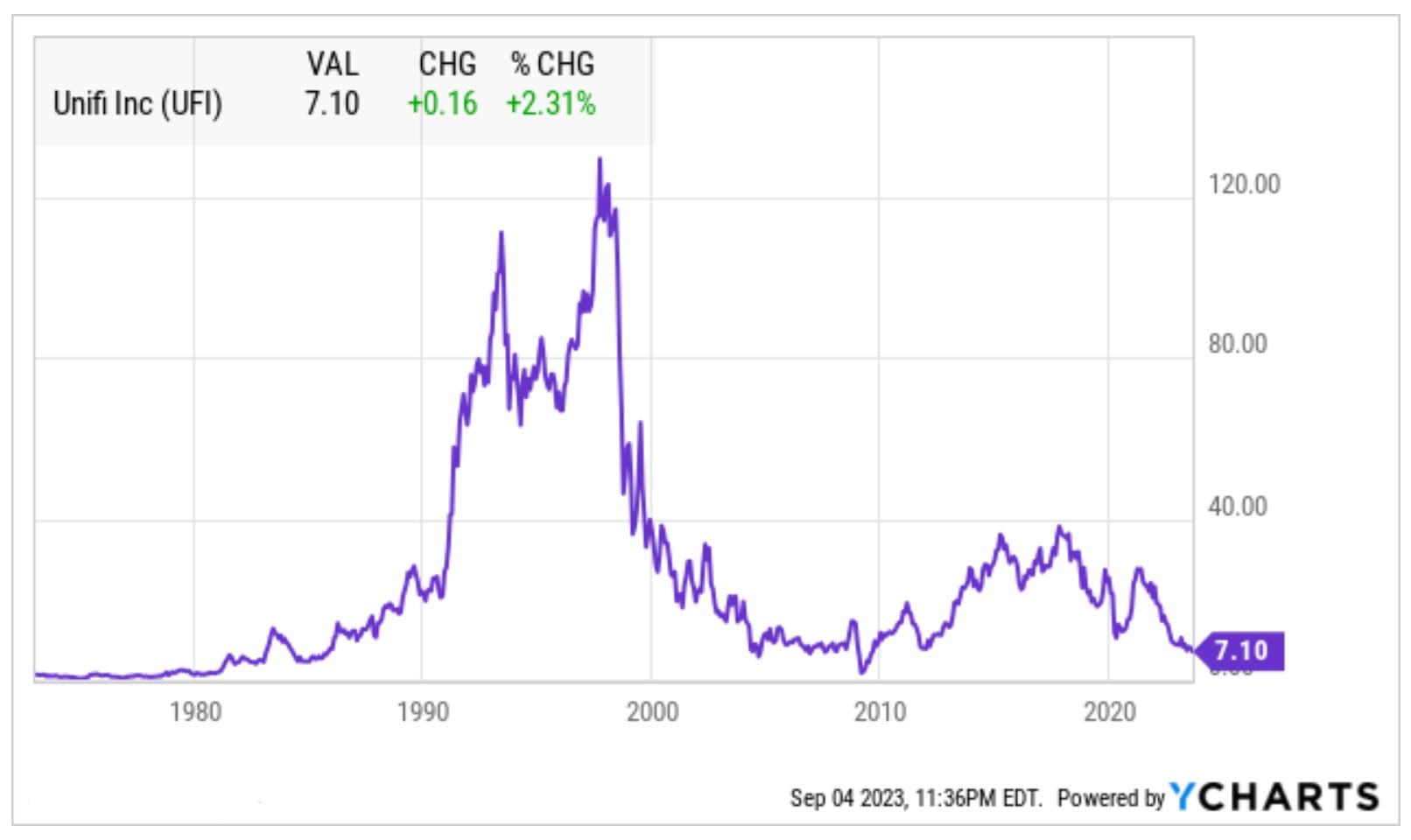
source: YCharts
It’s not difficult to see why investors reacted the way they did: Unifi had a disastrous fiscal 2023.
For the full year, revenue fell 24%, on a 25% plunge in volume. Gross margin was 2.28% (not a typo. The company didn’t have an inventory write-down or other one-time factors. Adjusted EBITDA was negative $4 million.
Even in that context, fourth quarter results seemed disappointing. After Q3, Unifi had guided for “generally consistent” numbers quarter-over-quarter. In fact, on that basis, revenue fell nearly 4%. Adjusted EBITDA was just $1.7 million, against $5 million the period before.
In other words, this is a business that was performing terribly, and by all appearances is still performing terribly. It’s not supposed to get better, either. The outlook for Q1 FY24 is for results “generally consistent” with the prior period.
Even beyond the P&L, there’s not a whole lot to make UFI stock look attractive. Net debt of $94 million is more than 70% of the company’s $131 million market capitalization. Price to book (and price to tangible book) is a seemingly attractive (and deep value-ish) 0.4x, but roughly two-thirds of book value is property, plant and equipment. Given that PP&E is being utilized by a business running gross margins of barely 2%, it doesn’t take an accountant to figure out that the carrying value of Unifi’s assets are probably much higher than their value in practice. And if that’s the case, across pretty much every fundamental metric UFI seems like an obvious, screaming sell.
The Bear Case
As we’ll see, there are reasons to believe that FY23 performance is not representative of Unifi’s actual earnings power. And a strong argument that the story is not that simple. But up front, it’s worth noting the core of the bear case: generally speaking, Unifi’s profits have headed in the wrong direction:
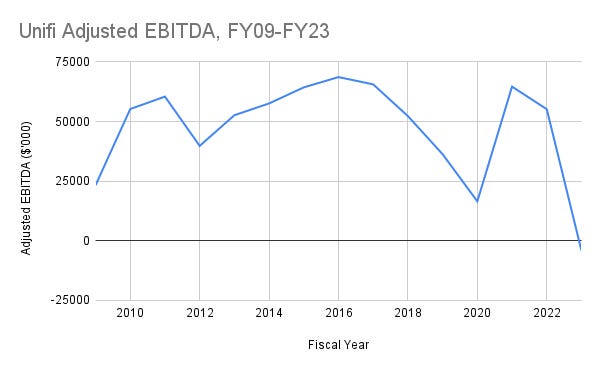
source: author. Adjusted EBITDA from Unifi press releases
Revenue, meanwhile, hasn’t really moved. FY22 revenue was the company’s highest since before the financial crisis, but averaging that year and the following year for post-pandemic effects, Unifi has spent more than a decade running at $700 million in annual sales, give or take. It’s the margin on that revenue that has been the problem: Adjusted EBITDA margins averaged 9.6% from FY10 through FY17, and just 5.2% since then. Even throwing out fiscal 2023 (an outlier by any measure) the five-year average of FY18 through FY22 shows compression of roughly 340 basis points from the eight years previous.
To be sure, there are puts and takes in here: obviously, the pandemic played a role, but so did anti-dumping cases and general macroeconomic trends. Still, bears can reasonaly argue that Unifi’s earnings power has permanently eroded. The company serves an apparel industry (65% of revenue in FY23, 70% in each of the two previous years) that is increasingly challenged. The profits (and profit margins) of apparel manufacturers on the whole appear to be declining; if that’s the case, the profits of the suppliers to those manufacturers should also be fading.
The most skeptical investor would probably agree that the negative Adjusted EBITDA seen in fiscal 2023 is an outlier. But she’d also argue that, directionally, the case is pretty clear. Unifi is a secularly declining business that even at cyclical peaks had EBITDA margins that topped out at 10% and return on invested capital metrics in the same ballpark. Now, with demand normalized, overseas competition remaining, and the balance sheet starting to look unwieldy, profits have given way. Maybe they don’t stay below zero, but they’re not likely to recover to past highs soon.
A Terrible Year
There may be some truth to that bear case. Margins have compressed and this is a tough business. It’s competitive, faces challenges from low-cost imports, and looks increasingly commoditized.
That said, it’s important to put into context just how ridiculously bad fiscal 2023 was. Everything went wrong — and continues to go wrong. Apparel manufacturers are still overflowing with inventory, thanks to supply chain normalization, inflation, and the sheer amount of goods consumers purchased during the worst of the pandemic. Unifi’s input costs started to come down during FY23, but particularly in the beginning of the fiscal year the company was still working through higher-priced inventory, and price increases hadn’t yet caught up. Disappointing revenue (driven by macro factors as well as COVID lockdowns in China) has led to lower fixed-cost absorption, further adding to the pressure.
The combination was literally unprecedented, leading to Unifi’s worst gross margin performance since at least the 1980s. Gross margins were more than twice as high in fiscal 2009, Unifi’s prior low point. The FY20 print of 6.4% was nearly triple FY23’s result.
So bad were the headwinds that Unifi’s Americas segment actually generated a gross loss in fiscal 2023. Margins were negative 3.8% for a segment that accounted for more than 60% of total sales. Simply getting that business to breakeven on a gross basis (hardly a mammoth task) would add more than 200 basis points to consolidated gross margins, and push Adjusted EBITDA back up to $10 million. That’s against a current market cap of $131 million.
More broadly, this is a business that, from FY09 through FY22, averaged gross margins of nearly 11%. At its Investor Day in February 2022, Unifi targeted 14%-15% by fiscal 2025. That target has been pushed out, but management still believes the company can get there. At the very least, there will be some level of normalization in Unifi’s operating environment — and when that normalization arrives, UFI is likely to look reasonably-valued at worst.
Valuing UFI Stock
From FY18 to FY23 (a period after margins started to weaken, and one that included all sorts of external volatility) Unifi averaged $36 million in Adjusted EBITDA. Excluding last year’s results, the average is about $44 million.
Those figures seem reasonable estimates for mid-cycle EBITDA here — and they suggest that at the moment UFI is trading at about 5x to 6x EBITDA. The same range holds assuming Unifi can maintain its current operating expense structure and simply get gross margins back to the 9%-10% level. That level is both the multi-year average (9.1% since FY18 including FY23; 10.5% excluding last year) and the actual prints for the two most normal years of late (fiscal 2019 and fiscal 2022).
To be sure, 5x-6x mid-cycle EBITDA for this business might be in the range of correct. Interest (running at ~$8 million annually) and capital expenditures (likely in the $20-$25 million range going forward) eat up a good portion of that profit. Investors aren’t likely to assign much more of a multiple to a cyclical, low-margin business. Indeed, a year ago, UFI traded at 5x trailing twelve-month EBITDA.
Still, the key point is that valuation is not aggressive, even with last week’s bounce. Simply getting back to recent pre-FY23 performance is enough to keep UFI afloat — and, again, that task should not be all that difficult. Getting the Americas business to positive gross margin alone accomplishes one-third of the needed margin expansion. Normalized production at indirect customers will drive fixed-cost absorption. Unifi simply needs some external help, and that help is almost certainly going to arrive at some point.
But what makes the valuation here intriguing is that UFI is priced only for a return to recent performance. In other words, it’s still pricing in the longer-term bear case, which contemplates permanently lower margins driven by structural factors. If, however, mid-cycle EBITDA is actually closer to the post-crisis average (which was over $50 million before fiscal 2023) UFI stock is cheap. And there are two important catalysts on the way.
The Coming Boost From eAFK EvoCooler
In March, Unifi completed the installation of new texturing machines in its facilities. The eAFK EVO equipment is manufactured by Swiss industrial concern Oerlikon — and the project has been immense. To date, Unifi has spent $75 million in capex on the installations; a final $25 million in spend has been delayed to late next year.
So far, the equipment hasn’t helped margins, but it over time it should:
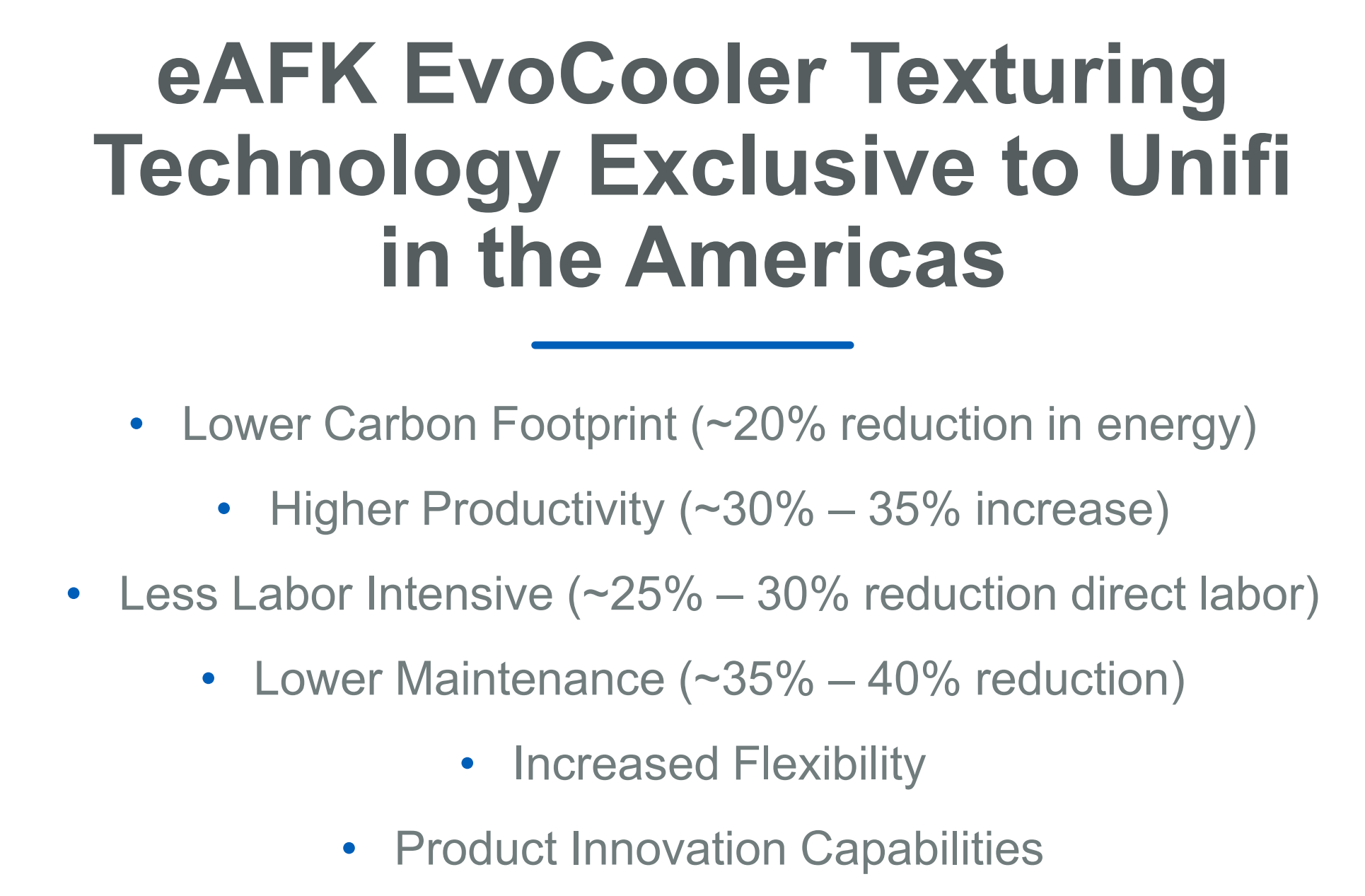
source: Unifi Investor Day presentation, February 2022
Indeed, when Unifi gave its 10% EBITDA margin target at that Investor Day, it estimated that the new equipment alone could provide about 100 basis points of expansion. Against mid-cycle margins in the 6% range, that expansion alone suggests material profit growth. Once the eAFK machines are running at full strength, mid-cycle EBITDA starts to move toward $50 million — and UFI starts to look cheap.
Growing REPREVE
But the truly intriguing opportunity here is REPREVE. At Investor Day, Unifi thought the fiber could grow to be more than 50% of the company’s business, generating annual revenue over $500 million.
source: Repreve.com
Again, that target has been pushed out, and like the rest of the business REPREVE had an awful fiscal 2023, with sales down about 37% year-over-year (based on disclosures from the 10-K). Still, the information we do have suggests that even with that disappointment, sales are growing nicely: FY18 revenue was about $123 million, which rose to $293 million in fiscal 2022 before a plunge to $186 million last year.
Even in a dismal year, REPREVE still accounted for 30% of consolidated revenue. Its margin profile is better than that of Unifi as a whole, because — importantly — the product is not commoditized. Indeed, Unifi is actually spending some money marketing the product, aiming to create a brand known to environmentally-conscious customers.
To be sure, this isn’t exactly Intel INTC 0.00%↑ re-branding the microprocessor, but the strategy makes sense, and the product’s positioning in the current consumer environment seems solid. Unlike other aspects of the broader environmental debate, plastic recycling is not particularly divisive. And Unifi now offers REPREVE-branded apparel with a long list of partners, ranging from Disney DIS 0.00%↑ to Hugo Boss and Tommy Hilfiger to retailers Costco COST 0.00%↑ and Target TGT 0.00%↑:
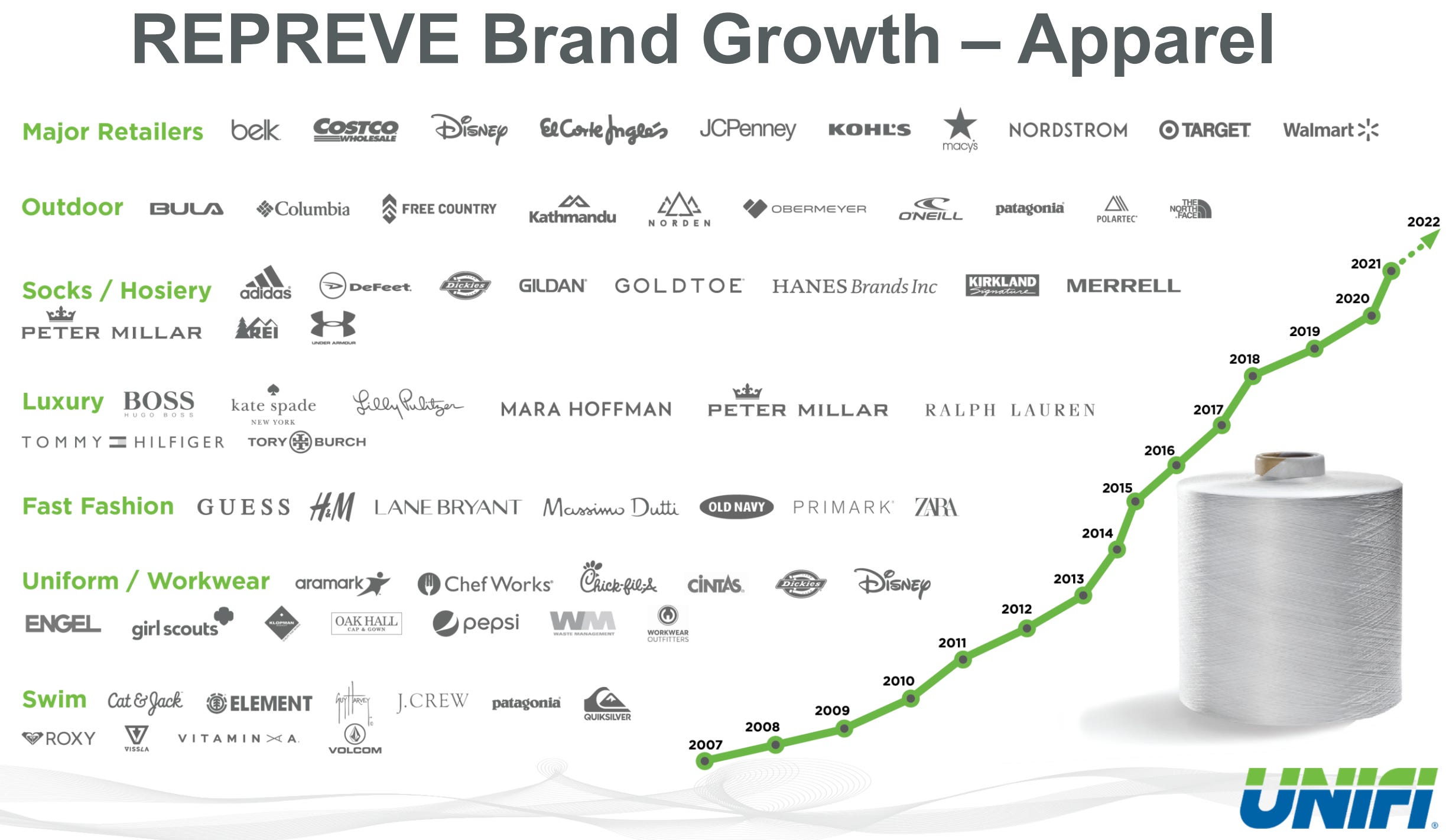
source: Unifi Investor Day presentation, February 2022
Unifi wants to move REPREVE beyond apparel as well. Right now, about 30% of the fiber sales come from non-apparel products, a proportion management aims to grow. The automotive end market seems particularly attractive: the growth of electric vehicle sales and the ‘green’ marketing often employed in those sales makes REPREVE a logical option for interiors.
Even after a tough fiscal 2023, REPREVE is a legitimately attractive product. Sales have increased from zero to almost $200 million and rose at a 19% compound annualized growth rate from FY17 to FY22. FY23 softness seems driven much more by changes in consumer behavior and the macro environment than with any issue intrinsic to the product. A resumption of growth in REPREVE has the ability to not only drive further margin expansion, but change the narrative surrounding UFI stock as well.
A Number Of Ways To Win
Again, a simple cyclical upswing with performance returning toward Unifi’s recent averages is enough to keep the stock afloat. But that leaves the margin benefit from the new machines, and growth in REPREVE, largely unaccounted for with UFI barely above $7. And it’s worth noting a flurry of insider purchases at the end of August:

Insider trades, source: Finviz.
In a blue-sky scenario in which management targets are hit, UFI can easily quadruple. A 6x multiple to the $110 million EBITDA target gets the market cap to at least $600 million against a current $131 million. A higher multiple for higher margins and REPREVE growth suggests even greater gains.
At this point, it’s foolish to assign too much value to those targets. But even falling short, UFI can gain nicely. A 5.5x multiple to mid-cycle EBITDA of $47 million (including about $7 million from EVO efficiencies) moves the stock up about 25% to $9 or so. A return to growth for REPREVE can expand that multiple and drive revenue growth, moving UFI back to the double-digits.
The stock traded above $10 as recently as March. Unifi’s business just needs to get back to where it was for its stock to do the same. What makes UFI really intriguing, however, is the promise of EVO and REPREVE. That could get the business not just back to where it was, but beyond.
As of this writing, Vince Martin has no positions in any securities mentioned.
Disclaimer: The information in this newsletter is not and should not be construed as investment advice. Overlooked Alpha is for information, entertainment purposes only. Contributors are not registered financial advisors and do not purport to tell or recommend which securities customers should buy or sell for themselves. We strive to provide accurate analysis but mistakes and errors do occur. No warranty is made to the accuracy, completeness or correctness of the information provided. The information in the publication may become outdated and there is no obligation to update any such information. Past performance is not a guide to future performance, future returns are not guaranteed, and a loss of original capital may occur. Contributors may hold or acquire securities covered in this publication, and may purchase or sell such securities at any time, including security positions that are inconsistent or contrary to positions mentioned in this publication, all without prior notice to any of the subscribers to this publication. Investors should make their own decisions regarding the prospects of any company discussed herein based on such investors’ own review of publicly available information and should not rely on the information contained herein.
It strikes me that these sorts of low margin value plays... maybe not this stock in particular, but others... could really benefit in a big way once management turns to AI to reduce opex.
I guess the challenge is figuring out how gpt will be used first. What are the easy gpt wins for opex. Sales? customer support? I'm not entirely sure. But definitely it seems like there could be much bigger wins for little companies that can drop opex by 20% than for a behemoth like nvda who may or may not sell more chips in 2024.
Thoughts?