
Highlights:
Investors who view Disney as a ‘blue chip’ underestimate the company’s exposure to cord-cutting; legacy networks are a stunning proportion of total profit.
But the move back toward multi-year lows makes the stock tempting. Disney stock isn’t ‘cheap’, but there is a legitimate fundamental case.
Right now, investors must consider one crucial question: can Bob Iger successfully get the business to the other side?
(Author’s note: This article came out of an interesting discussion in our chat room. As always, if readers have specific names in which they’re interested, feel free to reach out at any time.)
As we wrote back in December, we’ve been bearish on Disney DIS 0.00%↑ for quite a while. The key problem is the company’s reliance on legacy television revenues, predominantly from ESPN but to a lesser extent ABC and other networks. That’s a problem that seems to be excluded from discussion of the stock. Many bulls seem to focus on the Disney ‘brand’, and see DIS as a “blue chip” stock — a perception that fails to recognize just how meaningful the profit drag from linear networks has been and will be.
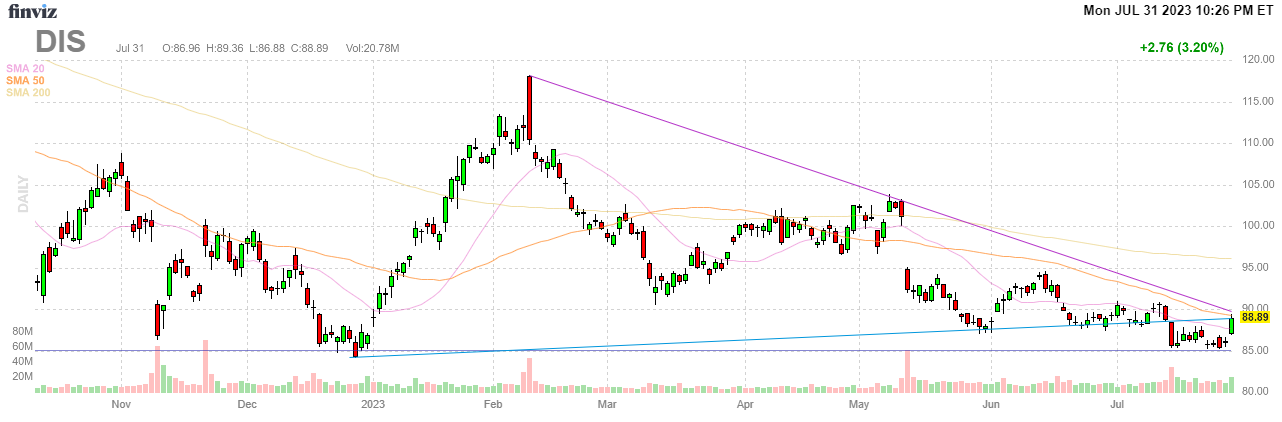
But with Disney stock posting its lowest close since 2014 (excluding a single day in December 2022), it’s hard not to be a little intrigued even with the challenges ahead. That’s particularly true given where valuation sits at the moment.

Disney’s Valuation
Over the past four quarters (through fiscal Q2, the March quarter), Disney has generated operating income of $10.3 billion. That figure excludes a small amount of restructuring and impairment expense, along with other expense (driven by movements in Disney’s ~6% stake in DraftKings DKNG 0.00%↑), and adds income from equity investments (which include the television network A+E). More importantly, it excludes roughly $2.3 billion in non-cash amortization related to the Hulu acquisition.
That $10.3 billion in operating profit implies trailing twelve-month ‘adjusted’ EPS of $3.71 at a 24% tax rate, suggesting a P/E multiple of 24x. Given a $210 billion enterprise value1, EV/EBIT is just above 20x; EV/EBITDA2 is just shy of 16x (notably with net leverage near 4x).
Peer comparisons aren’t great here, and even a sum of the parts argument runs into problems (how do you really compare Disney’s Parks business to, say, SeaWorld SEAS 0.00%↑?). But on their face, those multiples don’t look particularly impressive. In the years before the pandemic (and before streaming), DIS generally got a mid-teens P/E multiple.
But if you break profit down by segment, the fundamentals get much more interesting — particularly understanding the performance of the DTC business, which covers Disney’s streaming efforts. Those efforts have been sharply unprofitable. Losses over the four quarters alone total more than $4.2 billion.
Yet Disney management has said those losses have peaked. Assume DTC simply gets to breakeven, and trailing twelve-month EPS jumps to $5.47. The P/E multiple drops to 16x, with EV/EBITDA under 12x.
Again, it’s tough to find a direct peer, but it seems reasonable for an investor to argue — even pound the table — for owning this business at ~16x trailing twelve-month earnings.
The Fundamental Bull Case
To be sure, a lot of investors are doing that basic math. But it’s worth noting that the ~16x P/E multiple is still somewhat depressed, even with streaming losses being added back.
After all, we’re removing streaming losses — but not accounting for any value at all from that business. Surely, that’s too conservative.
The Content Sales and Licensing (CS&L) business is also running at a (much more modest) loss, with Disney pulling content back from other services. But that business, too, has some value. Even the international side of the Parks business has room for improvement. Trailing twelve-month operating income is roughly half what it was in FY18 and FY19.
In other words, Disney is trading at less than 16x trailing twelve-month earnings even if you ignore value not currently captured by those earnings, primarily in streaming but also in Parks and even in CS&L.
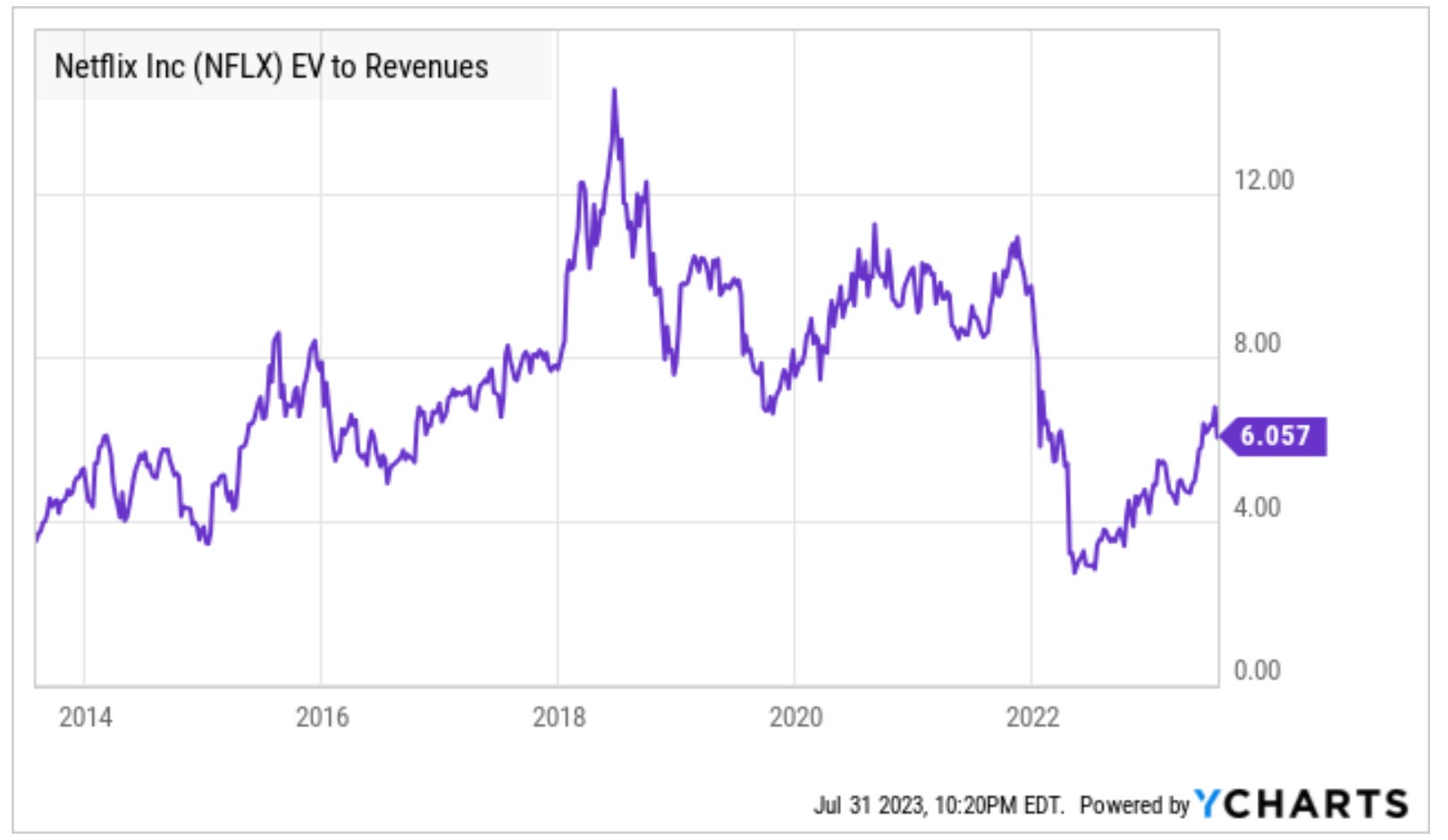
Bear in mind that Disney’s DTC segment has generated over $20 billion in revenue over the past year. After a nice rally of late, Netflix NFLX 0.00%↑ trades at roughly 6x sales, in the middle of its long-term range:
source: YCharts
It’s probably too aggressive to value Disney’s business in line with Netflix’s, but is 3x revenue unreasonable? 4x? Those multiples suggest DTC is worth $60 to $80 billion. Yet that business (in our model that only erases streaming losses) is valued at exactly zero.
Again, investors have done this math too. And that math is a big reason why DIS went to $200 (albeit briefly) in early 2021.
But that math has one big problem.
The ESPN Problem
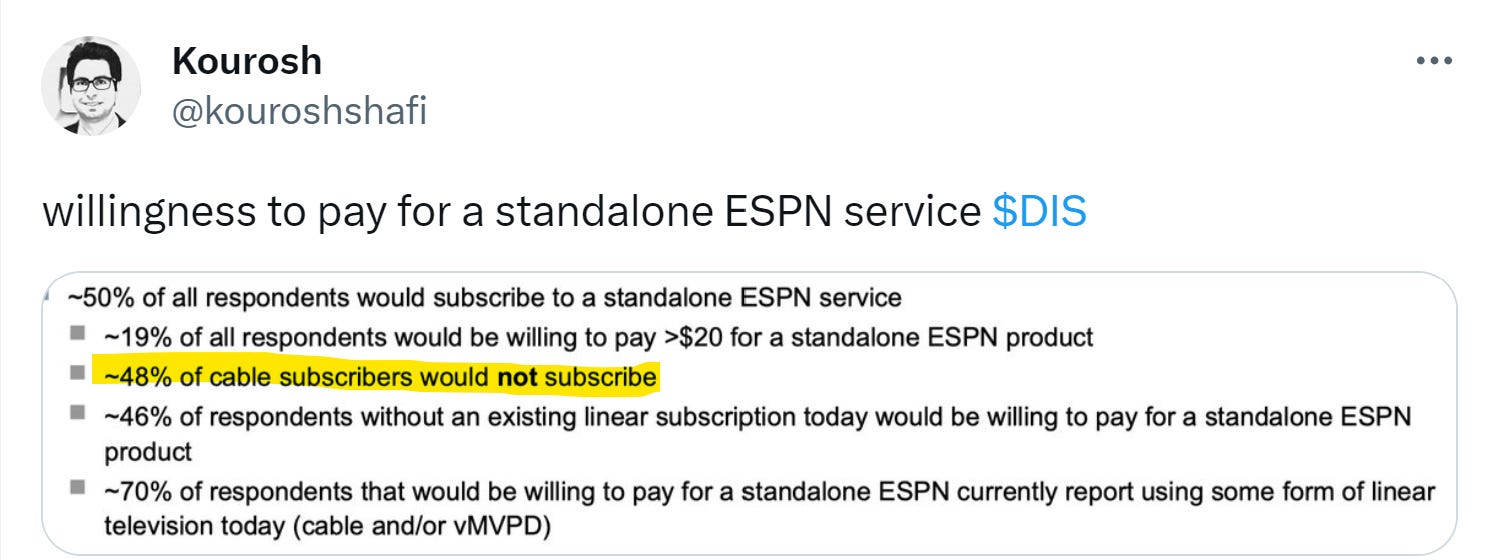
One of the core points we made back in December was that the streaming players who are not Netflix have a big problem: the profits they hope to make in streaming are coming from the same trend that is destroying their legacy businesses.
For Disney, this problem is most clearly acute for ESPN:
source: Twitter (highlighting by author)
ESPN’s legacy business model entailed getting ~$10 per month from every cable subscriber in the country in affiliate fees, even though a sizeable portion of those subscribers never watched the network. The revenues from those subscribers — essentially, free money for Disney — are going away as the cord-cutting trend accelerates. And they’re going away rapidly: Disney’s Linear Networks business had an awful first half in fiscal 2023, with operating profit down 29% (including a 35% plunge in Q2).
So if an investor is going to argue that Disney’s streaming business is worth, say, $60 billion, she also has to project where legacy media profits are going, because to some extent Disney’s streaming profits are coming out of its legacy business.
The drag from the erosion of the Linear Networks business is going to be huge. At the segment level, Disney has TTM operating income of $11.5 billion3. Excluding DTC, with its $4.2 billion in losses, Disney’s remaining segments have posted operating profit of $15.7 billion.
Of that figure, $7.3 billion comes from the Linear Networks segment, the lion’s share of which likely comes from ESPN4. But it’s not like the outlook for ABC or National Geographic is much, if any, different.
In other words, even ignoring streaming losses 46% of Disney’s profit comes from television networks — a business in secular, irreversible decline.
But Still…Interesting, Right?
That cold fact significantly undercuts the bull case. Disney without streaming isn’t ‘cheap’ at 16x earnings if nearly half of its profits would get maybe a 7x multiple as an independent company. (Bear in mind that AMC Networks AMCX 0.00%↑ trades at two times forward earnings at the moment.)
It is almost certain that for Disney ex-streaming, consolidated profits are going to decline. The media business is going to shrink much faster than the parks and consumer products businesses grow (and we haven’t even discussed the cyclical and inflationary pressures on those latter businesses yet). 16x sounds like an attractive multiple for Disney. When you look at what Disney actually is, however, it isn’t.
And yet…the decline to fresh lows does start to make the numbers work:
source: finviz.com
Value the DTC business at $60 billion, or ~3x revenue (a reasonable figure which coincidentally makes our math much easier) and the rest of Disney is worth $100 billion from an equity perspective and $150 billion on an enterprise value basis. (Again, current market cap is $160 billion and EV $210 billion.)
Right now, then, Disney without streaming is trading for 10x net earnings ($10 billion) and 8.6x EBITDA ($17.4 billion). Even with declines in the TV business, there’s probably enough value in the assets to suggest those multiples might be too low, or at least that an investor won’t get hurt too badly by stepping in here.
To our eye, the case really comes down to Iger. Is the CEO the genius who acquired Marvel and LucasFilm on the way to providing 300%-plus total returns in his first decade on the job? Or is he the (insert your own word here) who overpaid for Fox in 2019 and allowed ESPN to completely botch the transition to digital?5.
With so much riding on the next few years, as Disney manages cord-cutting, works through a potentially protracted strike, possibly spins its linear networks, and likely launches a standalone digital ESPN, his strategy and leadership are going to have to be on point. With DIS at $89, the numbers can work if Iger can get it right this time. For now, that still seems like a reasonably big ‘if’.
As of this writing, Vince Martin has no positions in any securities mentioned.
Disclaimer: The information in this newsletter is not and should not be construed as investment advice. Overlooked Alpha is for information, entertainment purposes only. Contributors are not registered financial advisors and do not purport to tell or recommend which securities customers should buy or sell for themselves. We strive to provide accurate analysis but mistakes and errors do occur. No warranty is made to the accuracy, completeness or correctness of the information provided. The information in the publication may become outdated and there is no obligation to update any such information. Past performance is not a guide to future performance, future returns are not guaranteed, and a loss of original capital may occur. Contributors may hold or acquire securities covered in this publication, and may purchase or sell such securities at any time, including security positions that are inconsistent or contrary to positions mentioned in this publication, all without prior notice to any of the subscribers to this publication. Investors should make their own decisions regarding the prospects of any company discussed herein based on such investors’ own review of publicly available information and should not rely on the information contained herein.
Market cap of $160 billion, net debt of $50 billion, including a $9 billion-plus liability owing to Comcast’s CMCSA 0.00%↑ put option for Hulu. Comcast can force Disney to buy its one-third stake at a floor equity valuation for Hulu of $27.5 billion.
Trailing twelve-month depreciation and amortization, excluding the Hulu acquisition amortization, is $2.9 billion.
There’s $1.2 billion in corporate expense not allocated to specific segments, which gets added back to the $10.3 billion figure cited before for segment-level profit of $11.5B.
We will know more about that proportion soon; Disney says it will break ESPN out into its own segment by the end of calendar 2023.
It is staggering how bad the ESPN app and website remain; they are glitchy, poorly-organized, and terrible at surfacing the best content from a company that bills itself, with typical American modesty, as the “Worldwide Leader In Sports”.