
Highlights:
Office stocks are soaring right now. Furniture company MillerKnoll has climbed 42% in less than two months.
There’s a case for further upside: shares still look cheap, and guidance for fiscal 2024 suggests a bottom for earnings might be in.
Looks can be deceiving, however. We see significant short-term and long-term risks to the bull case.
Timing is tough. But traders looking to bet on a reversal of office optimism may consider shorting MLKN instead of more crowded trades in the REIT space.

We’re putting out an extra post this week on a stock that interests both of us. Enjoy!
Office plays are rallying — and it’s not just office REITs. Shares of office furniture manufacturer MillerKnoll MLKN 0.00%↑ are up 42% since June 1.
The rally makes some sense. Investors have decided that reports of the office’s death are greatly exaggerated. Over the past three months, office REIT SL Green SLG 0.00%↑ has rallied 46% and Vornado Realty Trust VNO 0.00%↑ 36%.
Meanwhile, on its way down MLKN stock got cheap. Based on FY23 (ending May) results, shares dipped below 5x EBITDA and bottomed at 7.3x adjusted earnings per share. Even considering external headwinds, MillerKnoll is a clear leader in its space; given such a cheap valuation, it’s not surprising that investors jumped in so aggressively.
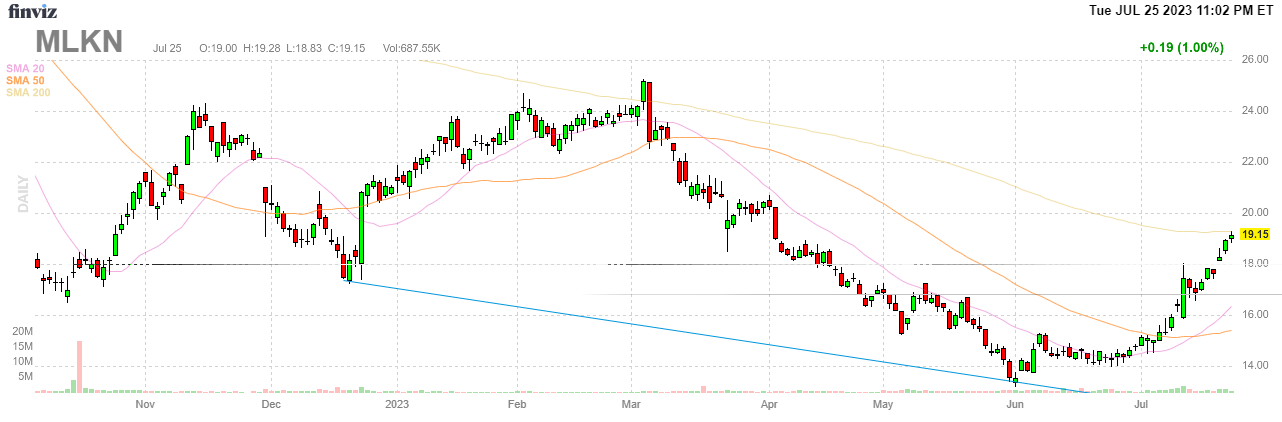
Following the bounce, the same broad case still holds. MLKN is more expensive than it was eight weeks ago but valuation is still reasonable. Guidance for fiscal 2024, given after the Q4 report earlier this month, cheered the market. Excluding the impact of an extra week in FY23, MillerKnoll is actually guiding for earnings to increase slightly year-over-year. Growth of any kind simply isn’t priced in at Tuesday’s close just above $19.
But a closer look at MillerKnoll’s business suggests some caution after this rally. MLKN could become a value trap, particularly after the gains in June and July. In fact, while shorts pile into the likes of VNO and SLG (12% and 24% of the respective floats sold short at the moment), there’s an argument that MLKN is the better, and less crowded, vehicle for betting against recent office optimism.

A Merger Of Leaders
MillerKnoll was created just over two years ago by the merger of Herman Miller and Knoll, a pair of giants in the office furniture world. Knoll was smaller, and perhaps a bit more cutting-edge; its designers included leading architects like Eero Saarinen and Frank Gehry, as well as the company’s namesake, Florence Knoll.
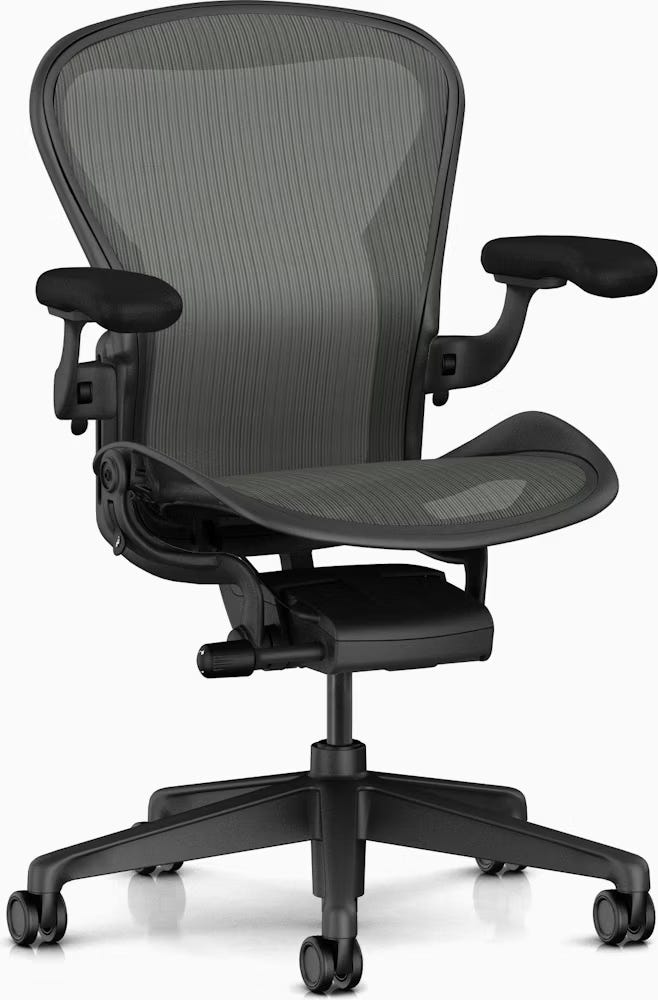
Herman Miller had slightly more of a utilitarian reputation, owing in large part to the fact that the company invented the cubicle in the late 1960s. (Herman Miller called it the “Action Office system”.) But it had its design chops as well. The Eames Lounge Chair (seen in the photo above) has been called “possibly the most famous piece of American furniture ever made”; the Aeron desk chair is instantly recognizable as well:
source: MillerKnoll
The combined company is the world’s largest office manufacturer — but it’s not just an office manufacturer. The company’s Retail segment accounted for just over one-quarter of sales in fiscal 2023. The core of that segment is Design Within Reach, which Herman Miller acquired in 2014, though Knoll had made some more limited forays into serving the high-end retail market as well.
Moving In The Wrong Direction
In fiscal 2023 (ending May), MillerKnoll generated revenue of $4.09 billion and Adjusted EBITDA of $474 million.
When Herman Miller and Knoll announced their merger in April 2021, pro forma combined revenue was just $3.56 billion, though Adjusted EBITDA was disclosed at $552 million. $100 million of the latter figure came from expected cost synergies; MillerKnoll has twice raised that target, and said after Q4 that it had achieved $131 million in synergies.
In other words, in the past two-plus years since the merger announcement, revenue has increased 13%. Adjusted EBITDA, however, went from $583 million (including the full $131 million in savings actually achieved) to $474 million, a drop of 19%.
The mixed performance in FY23 relative to pro forma figures given two years earlier seems, well, mixed. The fact that MillerKnoll grew sales at all seems like a positive for the stock. There are still-lingering effects from the pandemic and the shift to remote work. For those employees still in offices, corporate belts clearly began to tighten in calendar 2022, a trend that has lasted into 2023.
Conversely, the decline in profit is a disappointment. But perhaps understandable in the context of external challenges. The most obvious of those challenges in inflation, and for MillerKnoll input costs like steel and leather have risen at an even faster rate than broader prices as a whole.
To be honest, what exactly the recent trend means is still unclear. This has been an exceptionally volatile environment for most companies, and even more so for MillerKnoll. As a result, there’s very much a “is the glass half full or half empty?” approach to viewing post-merger results. MillerKnoll has at worst survived — and that might be saying something.
The Post-Pandemic Period
But we can get a bit more information by going back earlier, and comparing MillerKnoll to Herman Miller and Knoll in 2019 (we’re using trailing twelve-month results for Herman Miller as of February 2020). From that perspective, the trend becomes much more concerning.
Revenue over the period is basically flat, declining less than 1%. But Adjusted EBITDA (adding the realized $131 million in synergies to the companies’ combined ~2019 profits) fell 27% from $647 million to $474 million. Margins compressed nearly 400 basis points to an 11.5% print in FY23. Put another way, the MillerKnoll merger created $131 million in costs savings — and the combined businesses still were less profitable in FY23 than they were in CY19. Given guidance, that’s almost guaranteed to still be the case in FY24.
Even that negative trend understates the performance of the office side of the business. Unsurprisingly, MillerKnoll’s retail business was a big winner of the pandemic, as flush consumers built out high-end home offices. Herman Miller’s retail revenue for the four quarters ending February 2020 was about $400 million. In FY23, MillerKnoll’s Retail segment generated more than $1 billion in sales.
MillerKnoll reworked the segment last year, so those figures aren’t entirely apples to apples; FY23 included some contribution from legacy Knoll products whose sales were assigned to other segments the year before.
But based on commentary from filings, it appears organic growth in the retail business was about $450 million — or 12 to 13 percentage point’s worth of top-line growth for MillerKnoll as a whole. Adjusted operating profit in retail went from a $5 million loss as of TTM February 2020 to a $39 million profit in fiscal 2023. That, too, suggests that retail alone should have driven low double-digit growth in consolidated EBITDA.
Overall numbers aren’t good — and that’s with help from retail. Looking solely at the office business, between FY19 and FY23, the combined businesses saw sales decline at least 15%. Adjusted EBITDA plunged by roughly one-third.
Looking Forward
Of course, that downward trend in the office market shouldn’t be a surprise. 2019 was an excellent year for the sector. Sales grew, margins expanded, and stock prices rose: that year.
Since then, the pandemic and its aftereffects have reduced the in-office employee population, pressuring demand. And it’s in that context that FY24 guidance for “slightly lower” sales and flat earnings seem like a positive.
The market saw it that way too: MLKN jumped 6.2% the day of earnings. A rally into the report has continued after it:
source: finviz.com
The optimism toward the fiscal 2024 outlook seems to make sense because that outlook suggests that MillerKnoll has been able to find a bottom. We know, and the market knows, that earnings have declined since 2021 and since 2019; neither drop is all that surprising in the context of the pandemic and inflation. And if the worst is actually behind MillerKnoll, then the stock still looks interesting.
At Tuesday’s close, MillerKnoll has a market cap of $1.5 billion and an enterprise value of $2.7 billion. FY24 adjusted EPS was guided to $1.70-$2.00; the midpoint of $1.85 would be exactly flat to the FY23 print, when the company (as noted) generated Adjusted EBITDA of $474 million.
At ~$475 million in EBITDA and $1.85 in EPS, MLKN trades at under 6x EBITDA and barely 10x adjusted EPS. At those multiples, as long as earnings can grow after FY24, MLKN at $19 should still be a reasonably solid investment.
And there is an argument that MillerKnoll should be able to drive growth in FY25 and beyond. Corporate belts have been tightened in recent quarters, most notably in tech (a 2010s-era strength for Knoll, in particular). Uncertainty around managerial policies and employee demands may be keeping some potential customers out of the market. That’s going to help reignite growth if/when they return.
Meanwhile, the go-to-market benefits of the merger still haven’t been fully realized. As John Michael, president of the Americas Contract business, noted on the Q4 earnings call, it’s only been a year since domestic Herman Miller and Knoll dealers have been able to cross-sell. Overseas, many international dealers still haven’t switched to MillerKnoll branding.
Meanwhile, MillerKnoll is continuing work done across the industry in the 2010s to diversify away from lumpy, large contract manufacturing deals for office furniture. The DWR acquisition by Herman Miller was a reflection of that strategy, but the company (before and after the merger) has targeted less-cyclical verticals like healthcare as well.
And, importantly, just because workers don’t work in an office doesn’t mean they don’t need office furniture. Budgets will be tighter for those remote workers funding their own setups, but many companies are providing a budget for in-home furniture for hybrid and remote workers. In a truly hybrid environment, there’s even an argument (a thin one) that MillerKnoll should benefit, as workers will need systems both in the office and in the home.
The Risk To Guidance
We’re not unsympathetic to that broader view. The bear case is probably not as simple as “office space is going to sit empty so office furniture companies are in trouble”. MillerKnoll has been dealt an awful hand over the past three-plus years. And there is a world in which, in retrospect, investors realize that essentially everything had gone wrong at once: the pandemic, corporate cost-cutting, broader uncertainty, spiking input costs. As each of those trends reverses, it becomes clear that FY23 indeed was the bottom — and the current $19 price, let alone the $13 handle seen in early June, looks ridiculously cheap.
But the bull case coming out of the Q4 release seems to have two big drawbacks.
The first is in terms of the reaction to guidance. Again, the market’s interpretation seems to be that the outlook for flattish full-year earnings is a win, which may signal the end of the multi-year pressure on profits and margins. That may not be the case.
All else equal, MillerKnoll should actually be growing earnings per share this year by double-digits simply from synergy benefits. As of Q1 FY23, the company was claiming it had achieved only $80 million in cost savings on an annual run-rate basis; it’s added another $51 million in the three quarters since.
Even assuming no further synergies this year (the company does seem to be near the end on that front), FY24 pre-tax earnings should benefit from an incremental ~$24 million by our rough math1, or about $0.25 per share after-tax.
To be fair, there are some offsets here. Incentive bonuses are being reset after being largely eliminated in FY232. The extra week last year likely added a couple pennies’ worth of EPS. Still, excluding cost savings, the operating business still seems guided to a modest decline year-over-year.
There’s another issue. MillerKnoll itself said after Q4 that the guidance is weighted to the back half in terms of earnings. That’s clear from the Q1 outlook: adjusted EPS of $0.18 to $0.24 against $0.44 the year before; at the midpoint, sales are expected to decline 16%.
A sharply lower backlog (down 25% year-over-year heading into the quarter) is one factor, certainly. But MillerKnoll also expects a more beneficial external environment in calendar 2024 (ie, fiscal Q3 and Q4). Per the call, that optimism comes from improving measures of consumer and executive confidence which have been leading indicators in the past.
The worries, however, are a) in this macro environment, six months is a very long time and b) it is not remotely clear that confidence and contract manufacturing spend are correlated now in the way they were before the pandemic. Historically, corporate confidence went up, they hired employees who needed workstations, and Herman Miller and Knoll benefited. Now, if corporate confidence is up, are there necessarily more employees in the office3?
More broadly, a company in a decline almost always believes the good times are just a couple of quarters away. Quite often, they’re wrong. And after this rally, even with ‘cheap’ headline multiples, if MLKN whiffs on the FY24 outlook, the stock is going to fall, and it wouldn’t be stunning to see the stock threaten the early June low.
The Long-Term Problem
The broader issue is not that MillerKnoll’s profits are below where Herman Miller and Knoll stood on a combined basis in 2019. What’s truly concerning is that the business is not that far ahead of where it stood in 2000. That year (using Herman Miller twelve-month results through February 2001), sales were $3.4 billion. At that time, the companies had essentially no retail business. Thus, office channel sales (about $3 billion in FY23) are likely down in the range of 10% over the 23-year period.
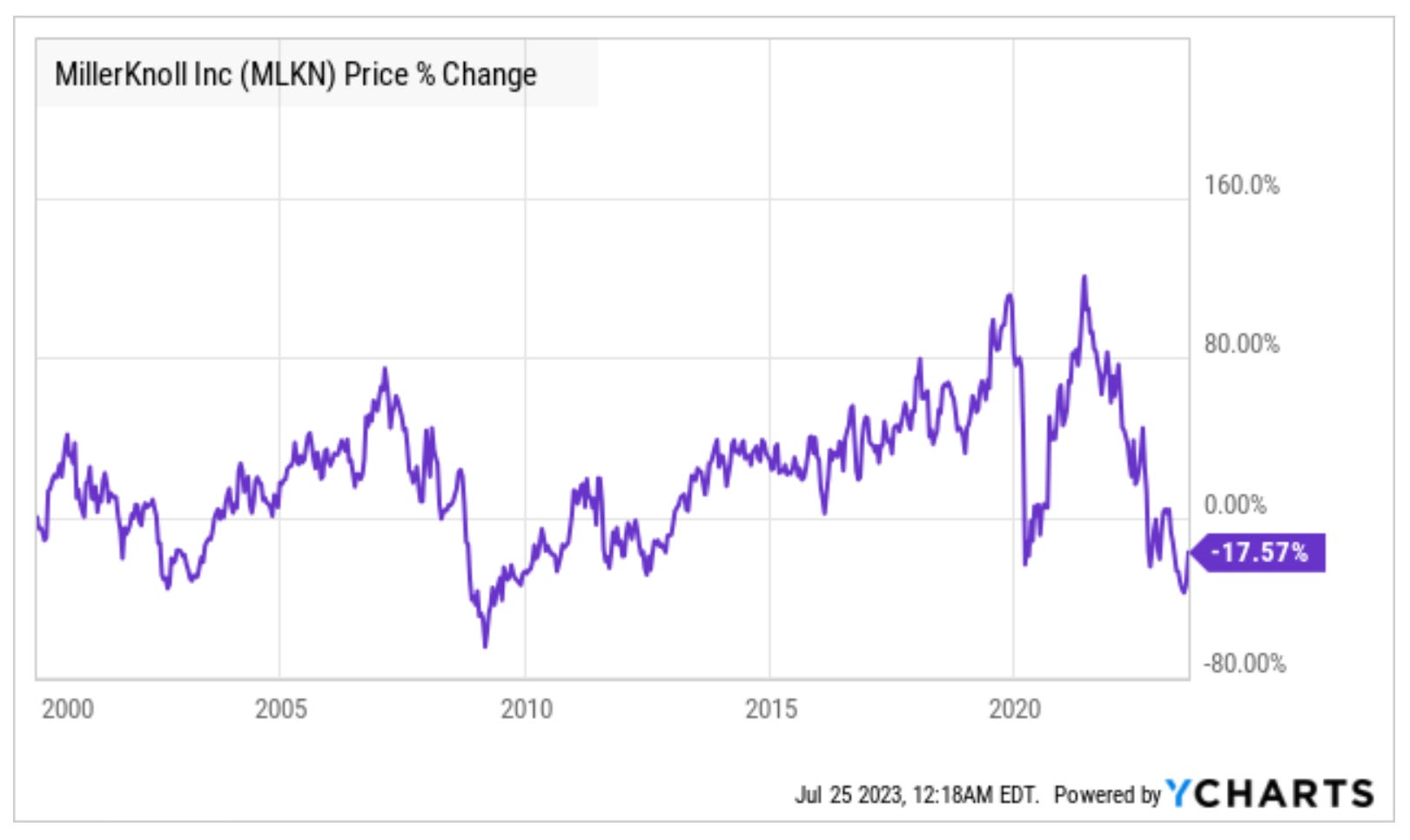
As with the 2019 comparison, the starting point is a bit unfair; the late 1990s were a boom for the industry. Still, a 10% decline over more than two decades is the sign of significant long-term challenges. And there’s also this:
source: YCharts; chart of Herman Miller stock before MillerKnoll merger in 2021
Including dividends, MillerKnoll/Herman Miller stock has returned 15% total since the beginning of the century. Even at the end of 2019, over two decades total returns were about 4.3% annually — more than half of which came in the last year of the period.
What undercuts the bull case at $19 is that before the pandemic two core secular trends were working against the industry. The first was the long rise of the “open office” plan, which meant, essentially, less furniture on a per-worker basis. And the second, in a trend echoed in so many other industries, was the ability of smaller rivals to take market share. This included imported rivals on the low end, but just as often more specialized, more nimble designers on the high end.
In short, even before the pandemic Herman Miller and Knoll operated in a difficult industry. Investing in the sector was just as difficult. The group did rally sharply off 2009 lows, but many cyclicals did far better over that stretch. By the second half of the 2010s, Herman Miller was mostly dead money (again, excluding the spectacular 2019), Knoll was a roller-coaster (including a plunge in 2017-2018 amid weakness that came basically out of nowhere), and Steelcase SCS 0.00%↑ was a perennial tease.
Neither challenge necessarily seems fixed. Even assuming the population of in-office employees is resetting at a new, lower level, the impact of competition and the diminution of seven-figure installations keeps the office furniture industry difficult. The addition of retail to the mix adds its own set of problems.
Fading The Office Optimism
If the internal dynamics of the industry haven’t really changed, that in turn creates a potential short with two ways to win.
The first is that the recent optimism toward improved office utilization fades. From that perspective, relative to office REITs, MLKN looks like the better way to bet on that optimism reversing.
Indeed, we’d rather short MLKN than most REITs. The high short interest in names like SLG and VNO is one issue; the market clearly is targeting high short interest stocks at the moment. (Less than 4% of MLKN’s float is sold short, though that figure may be rising.) But another is that the more popular office shorts are highly exposed to major cities (SL Green and Vornado are Manhattan landlords, for instance) while MLKN has much broader and even worldwide exposure.
But even if office bears are wrong, and office demand is better-than-feared, the historic inconsistency of the office furniture industry, or a simple FY24 miss relative to guidance, can provide returns from the short side. Bear in mind that valuation is less attractive than headline multiples suggest. Even before the pandemic, the group generally traded at no more than 12x-15x earnings, and MillerKnoll’s balance sheet (net debt is 2.5x EBITDA) is more leveraged than it was before.
To be clear, this is not a short trade we’d consider right now. This is not a market that rewards trying to time the top. Nor are the rewards from a short quite that attractive. MLKN’s early June print was the lowest for MillerKnoll/Herman Miller stock since 2009; it would take a return to that 13-year low for a short to make 30%. In this market, there are probably greater rewards elsewhere from the short side.
But more aggressive traders might see it differently. There’s enough leverage here that it becomes a concern to the equity valuation in the event of a disappointing FY24 print; a miss means net leverage starts moving toward 3x EBITDA, and a stagnant business can see its valuation weighed down by that sort of debt.
All told, there’s a lot that can go wrong here. Owning the world’s largest office furniture manufacturer is obviously risky after a global pandemic. That risk is amplified by the fact that owning these businesses wasn’t that great even before COVID arrived.
As of this writing, Vince Martin has no positions in any securities mentioned.
Disclaimer: The information in this newsletter is not and should not be construed as investment advice. Overlooked Alpha is for information, entertainment purposes only. Contributors are not registered financial advisors and do not purport to tell or recommend which securities customers should buy or sell for themselves. We strive to provide accurate analysis but mistakes and errors do occur. No warranty is made to the accuracy, completeness or correctness of the information provided. The information in the publication may become outdated and there is no obligation to update any such information. Past performance is not a guide to future performance, future returns are not guaranteed, and a loss of original capital may occur. Contributors may hold or acquire securities covered in this publication, and may purchase or sell such securities at any time, including security positions that are inconsistent or contrary to positions mentioned in this publication, all without prior notice to any of the subscribers to this publication. Investors should make their own decisions regarding the prospects of any company discussed herein based on such investors’ own review of publicly available information and should not rely on the information contained herein.
$51 million in incremental annual savings for Q1 is ~$13 million for the quarter; that figure drops to ~$7 million in fiscal Q2 and ~$4-$5 million in Q3.
Some readers may have heard about this already. In April, MillerKnoll CEO Andi Owen went viral when a recorded portion of a video message to employees was posted to Twitter. In it, Owen told her employees to “leave Pity City” and stop asking about bonuses. The original Twitter post claimed, falsely, that Owen had taken a $6.4 million bonus herself. Owen later apologized.
There’s also an intriguing argument that MillerKnoll is a second-order “AI loser”. The theory is that generative artificial intelligence will most aggressively and most quickly displace middle-class white-collar workers. The kind, you know, who often work in cubicles.
MLKN shareholders celebrated July 4 in Pity City. But the jury is still out: can they live there?