
In the past twelve months, artificial intelligence and GLP-1 agonists have moved the market in ways that few trends historically have. But in a more normal year, we’d likely be talking about PDD Holdings PDD 0.00%↑ unit Temu as one of the market’s biggest influences.
Temu and its ‘fast fashion’ counterpart/rival Shein are quickly reshaping the U.S. retail industry. The companies’ hugely aggressive marketing spend may be affecting the online advertising market as well, providing a much-needed boost to giants Apple, Meta and Alphabet. What makes Temu so fascinating is the potential range of outcomes for the business over the next few years.
source: Temu
How Temu Works
Most readers are likely aware of Temu. Pinduoduo launched the platform in the U.S. in early September 2022, and backed it with an incredibly aggressive marketing strategy. The company just spent at least $21 million on ads for this month’s Super Bowl, which informed viewers of the proper pronunciation (it’s ‘teh-moo’). It has a ubiquitous online presence as well: Goldman Sachs has estimated that in 2023 Temu spent $1.2 billion simply with Meta Platforms META 0.00%↑. That’s part of an overall marketing budget whose estimated size ranges from $1.7 billion to $3 billion simply on digital advertising spend.
Behind the marketing blitz is a relatively simple platform. Temu basically uses its app and website to connect shoppers with Chinese manufacturers, who “drop-ship” exceptionally cheap products directly to consumers worldwide:

source: Temu home page
In the U.S., those manufacturers benefit from an aspect of customs law known as the “de minimis” rule, which exempts packages worth $800 or less from tariffs. This actually provides a competitive edge for Temu: larger retailers do pay tariffs, since they of course are importing goods in larger quantities with values much higher than $800.
Thanks to that regulatory advantage (which exists in other countries as well) and aggressive marketing, Temu’s growth in the U.S. has been breathtaking. By most estimates, the company generated in the range of $15 billion in gross merchandise value1 in 2023, with growth near 100% expected in 2024.
To put that into context, Dollar Tree DLTR 0.00%↑, which operates over 16,000 stores in the U.S. and Canada, should see FY24 (ending January 2025) sales of about $32 billion. At Forbes in December, Lauren Debter wrote of Temu’s growth that “some say it’s the fastest rise in retail history”.
Is Temu A Fad Or A Trend?
Of course, that doesn’t necessarily mean that Temu is here to stay. Cut-rate prices and aggressive marketing can combine for explosive growth — but not necessarily a sustainable business.
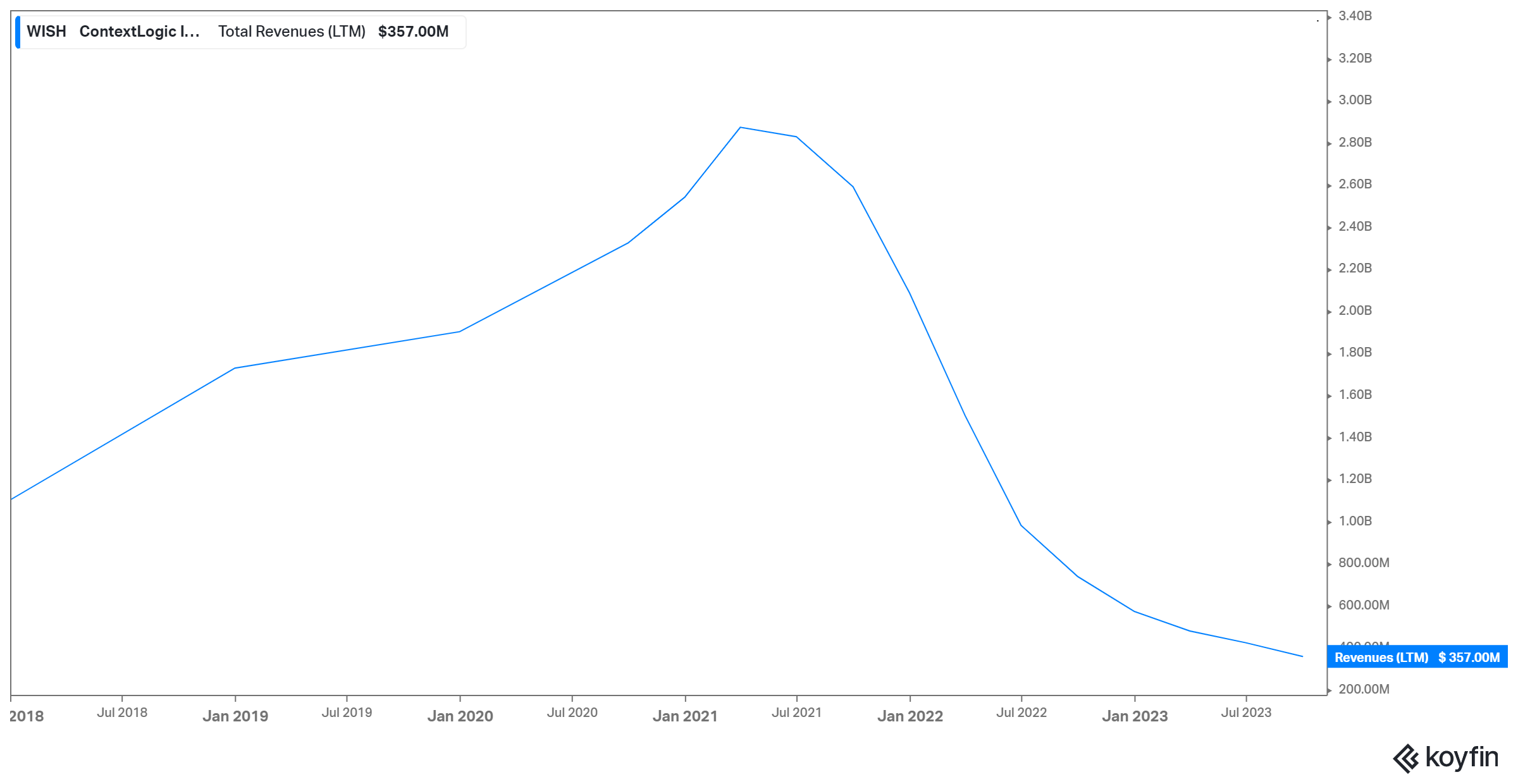
Indeed, we’ve seen something similar recently, in Wish.com, a platform operated by ContextLogic WISH 0.00%↑. Wish also offers ridiculously cheap prices on items manufactured in China and shipped directly to overseas customers. And Wish, too, saw explosive growth driven by enormous marketing and promotional spending. The bottom quickly fell out:
source: Koyfin
Indeed, as we discussed on Twitter this week, ContextLogic just sold Wish for a price in the range of zero dollars, and possibly less.
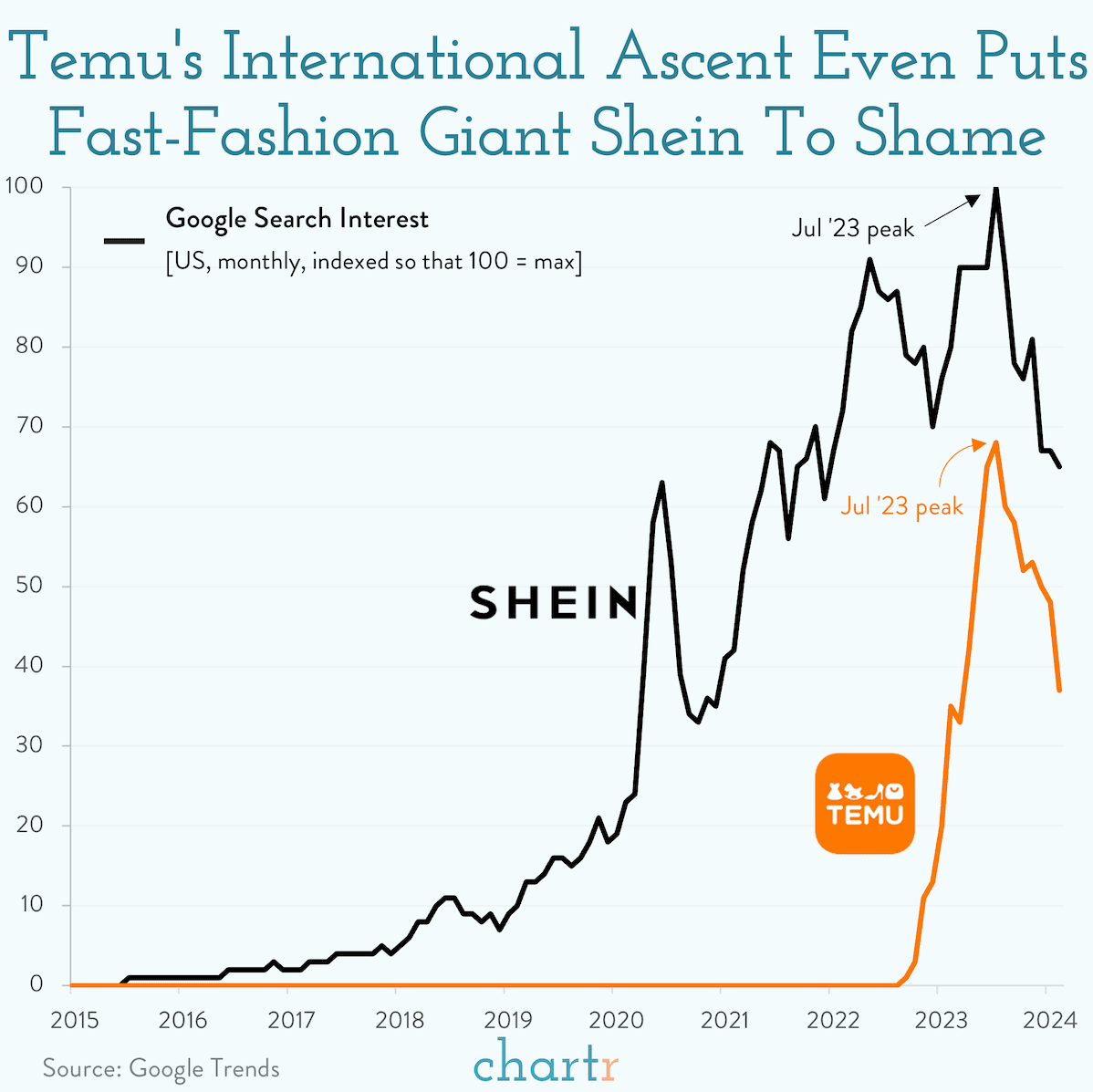
And there are some modest signs that customers are already seeing bit of fatigue with the Temu offering. One in-country report said 2023 GMV was $14 billion, which actually came in modestly below an early-year target of $16 billion. Google searches have declined as well (other than a Super Bowl-driven spike, the negative trend has continued as of this writing):
source: Chartr
There are clear risks to the business model. In a short report on PDD in September, Grizzly Research argued that the Temu app was malware, and noted that the app already was pulled from the Google Store. The company has come under regulatory fire for sourcing products potentially made by forced labor, and running afoul of U.S. law in the process. Even suppliers have concerns.
All that said, the company is giving U.S. consumers what they want: cheap imported goods. A divided Congress may not be willing to simply shut down the app, no matter the justification. (Concerns have been raised, and congressional hearings held, about TikTok as well.) And even reducing the de minimis threshold to $150 (where it was just a few years ago) probably doesn’t affect Temu all that much, given most orders likely come in below that level.
Perhaps most importantly, this is probably not a management team investors should be betting against. Thanks in large part to its strategic focus on smaller cities and the social aspect of its app, Pinduoduo has taken a tremendous amount of market share in China from both Alibaba BABA 0.00%↑ and JD.com JD 0.00%↑.
This is a company founded in September 2015, which is probably generating more than half a trillion dollars in GMV this year2. The domestic business of PDD is, without exaggeration, one of the most impressive stories in the history of e-commerce. And while management has been reticent about the strategy behind the overseas efforts, one message has been consistent: the business remains in learning mode.
At some point, Temu is going to focus on profitability; it’s not just going to randomly toss good money after bad. Wish clearly did that once its business peaked (and note that it peaked before the arrival of Temu on the scene), in large part because it had no other choice. ContextLogic was Wish. In contrast, Pinduoduo is not just Temu; there’s still a domestic business worth more than $100 billion.
What Temu Means For PDD
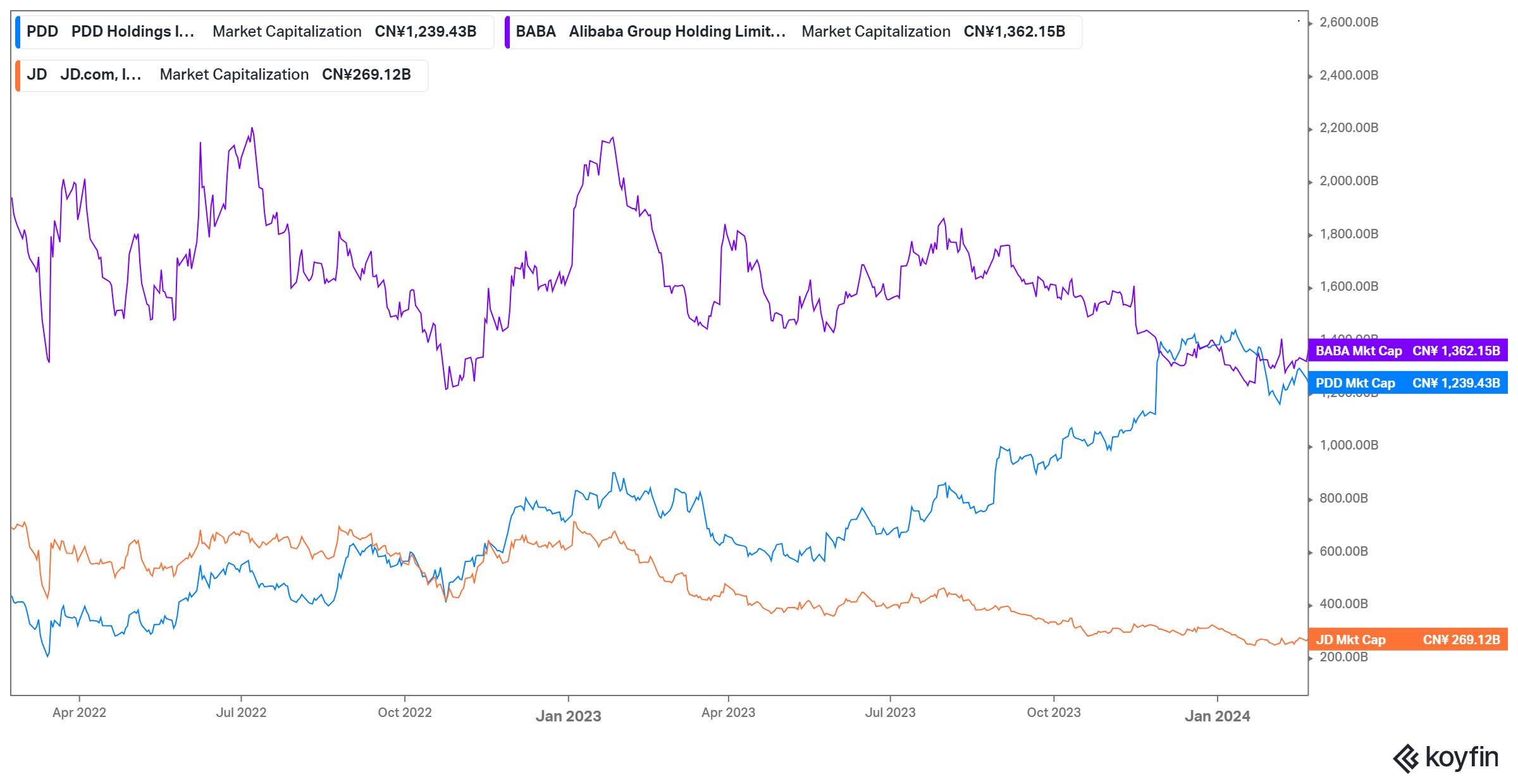
PDD stock has soared over the past eighteen months, and incredibly caught up to rival Alibaba BABA 0.00%↑ in terms of market capitalization:
source: Koyfin
But it’s an interesting question as to how much of the gains in PDD are attributed to Temu, and how much are coming from clear market share gains in Pinduoduo’s home country. And one of the reasons the question is interesting is because there are so many questions about Temu itself.
PDD management has given exceptionally little direct information on Temu’s performance, despite being asked on each of the last four earnings calls3. We know that Temu is being booked as third-party revenue, meaning PDD only recognizes its share of fees from a sale as revenue, rather than the entire sale. But other than that, management has been exceptionally quiet; Temu was mentioned once on the Q3 earnings call and not at all in the Q3 earnings release.
This does seem odd, but PDD management historically has been quite tight-lipped about its domestic business. As Grizzly Research noted in its short report, the company actually has disclosed fewer metrics as it’s become larger, rather than more.
Given that investors are guessing about Temu’s metrics, they’re likely guessing about the platform’s valuation as well. Given that PDD currently has a market cap just shy of $180 billion, it’s hard to argue that Temu has been the primary driver of the recent rally. But the offering no doubt matters.
How much is up for debate. Even the sell side seems conflicted. JP Morgan has projected Temu can drive operating profit of $3.5 billion in 2027; a Goldman estimate cited by Grizzly Research is for roughly $400 million. Bernstein analysts have called the site “a force to be reckoned with globally”. Last month, Morgan Stanley questioned whether growth had already peaked.
Barclays has valued Temu at $50 billion, not terribly out of line with the reported $80-$90 billion valuation Shein is seeking in a potential IPO. JP Morgan’s $3.5B EBIT target for 2027 probably suggests a current valuation in the range of $50 billion, discounted back4. In September, Goldman was at $43 billion for Temu plus cash plus grocery, implying a much lower valuation for Temu itself (likely $10-$15 billion). Morningstar appears to be an outlier: it cited Temu in raising fair value by nearly $100 per ADS5, suggesting the platform is worth in the range of $130 billion.
Can You Short PDD Here?
What’s interesting about the various targets is that they get to one broad conclusion: the way to bet on Temu fading is not necessarily to short PDD. An absolute collapse of Temu does hit the stock, but even bulls see less than 30% of the current market cap coming from the platform. Since we know Temu is running huge losses now, there’s a growth tailwind for PDD on the way no matter what. Either Temu starts to scale and its losses narrow — or it fades and its losses narrow.
And even with those losses, it’s not as if PDD is an expensive stock. Shares trade at 17x forward earnings — with those estimates, again, suggesting a drag from Temu. It’s impossible to precisely quantify that drag, but most reporting suggests the platform is losing ~$2 billion this year, suggesting a $1 billion-plus hit in 2025, likely 10%-plus of estimated EPS.
And so this plan doesn’t quite seem to work:

source: Twitter
Even if a short is right on Temu, that doesn’t necessarily crush the stock. The bigger issue is that this doesn’t seem like a company to bet against.
Again, what Pinduoduo has done in China is incredible. Its performance there is the flipside of the long-running ‘value’ argument for BABA, which looks incredibly cheap for a company still perceived as the ‘Amazon of China’. Many BABA bulls argue that the problem is that investors don’t trust Chinese entities, or that the market is betting on the economy in that country to implode.
Those are factors in the long decline in Alibaba stock. But so is Pinduoduo: it has eaten its rival’s lunch. No less than Jack Ma, Alibaba’s founder, has said as much.
It’s tempting to look at Temu and assume that the model will fade quickly. That there’s no way the business can grow selling a hodgepodge of short-lived products of questionable quality. But no-one thought a company that began as an online fruit seller could ever threaten Alibaba.
That’s exactly what Pinduoduo has done. And that history suggests that Pinduoduo can find a way to create value from Temu — even if the business model, right now, seems to have an awful lot of flaws.
As of this writing, Vince Martin has no positions in any securities mentioned.
Disclaimer: The information in this newsletter is not and should not be construed as investment advice. Overlooked Alpha is for information, entertainment purposes only. Contributors are not registered financial advisors and do not purport to tell or recommend which securities customers should buy or sell for themselves. We strive to provide accurate analysis but mistakes and errors do occur. No warranty is made to the accuracy, completeness or correctness of the information provided. The information in the publication may become outdated and there is no obligation to update any such information. Past performance is not a guide to future performance, future returns are not guaranteed, and a loss of original capital may occur. Contributors may hold or acquire securities covered in this publication, and may purchase or sell such securities at any time, including security positions that are inconsistent or contrary to positions mentioned in this publication, all without prior notice to any of the subscribers to this publication. Investors should make their own decisions regarding the prospects of any company discussed herein based on such investors’ own review of publicly available information and should not rely on the information contained herein.
The total value of products shipped through Temu; the company will only recognize its share of that value as revenue.
GMV is one of the figures the company no longer discloses.
Three times management was asked directly. The question on the most recent call, following Q3, was a bit more oblique, with the analyst noting 94% year-over-year revenue growth and asking “what do you think contributed to this growth?”
20x EBIT at a 12% discount rate gets to almost exactly $50 billion.
American Depositary Share