
Highlights:
For close to a decade, skeptics have predicted the imminent end for PLNT. They’ve been consistently proven wrong.
Valuation, at 16x EBITDA, has come in sharply from historical levels.
A move into Europe and potential pricing changes, offer catalysts for significant share price performance.
This seems a little weird:
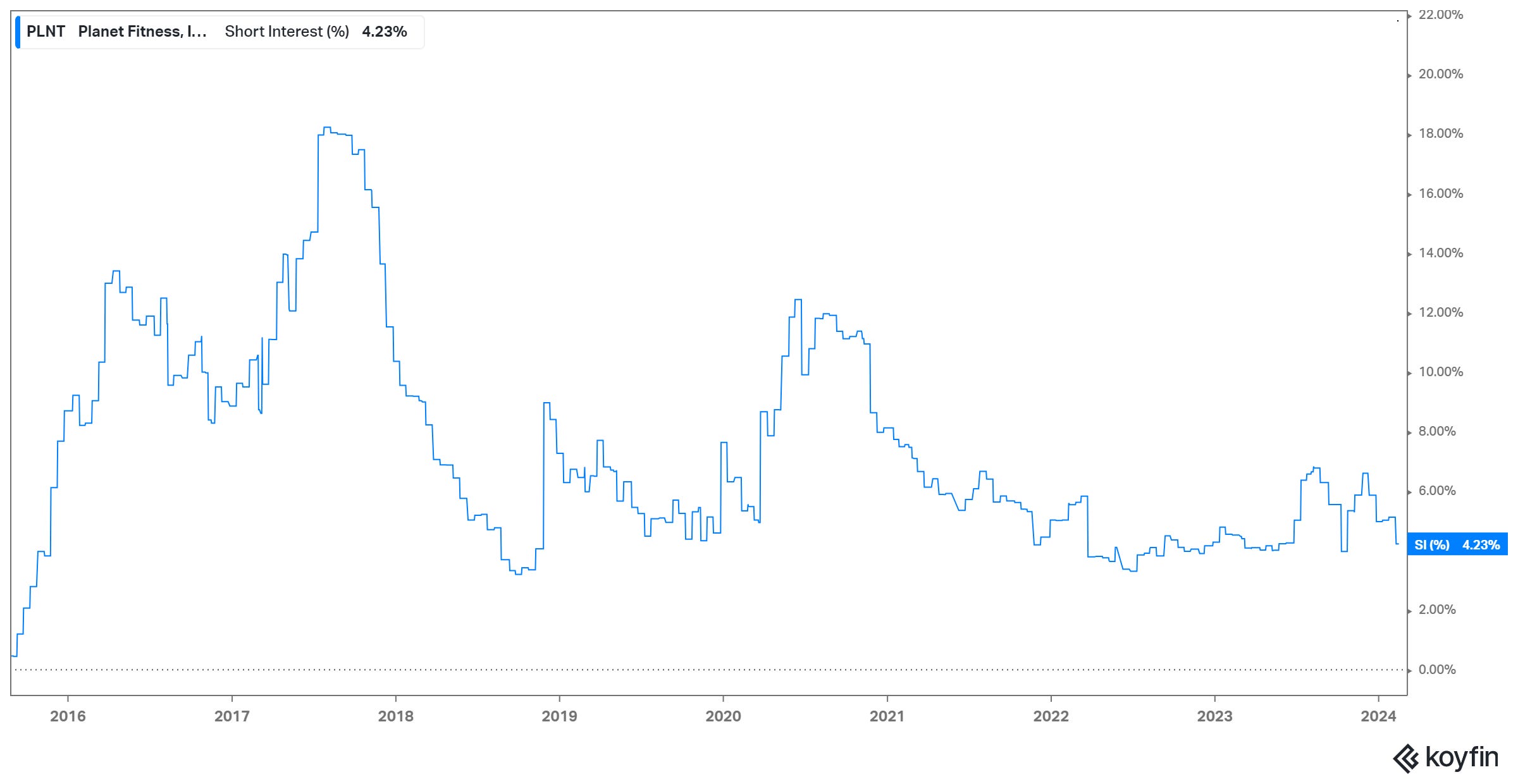
Short interest for Planet Fitness stock. source: Koyfin
Planet Fitness PLNT 0.00%↑ has been a popular short target since its 2015 initial public offering. Yet at the moment short interest is at the lows, at the same time the short case would seem to be the strongest.
After all, there is no shortage of obvious downside risks here. Rising inflation has not only pressured Planet Fitness customers, but its potential franchisees, driving up the cost of newbuilds that provide important fees to PLNT corporate. Higher interest rates suggest increased interest expense as $1 billion of debt matures in 2025 and 2026, and further pressure on franchisees. The rise of GLP-1 agonists provide a secular threat to demand; a macroeconomic recession looms at some point. And the company’s chief executive officer departed abruptly last year, under circumstances that remain unclear.
Those perceived risks have sent PLNT down about 13% in 2024. But those risks look overblown. As a result, a historically successful business is available at a rather attractive price.
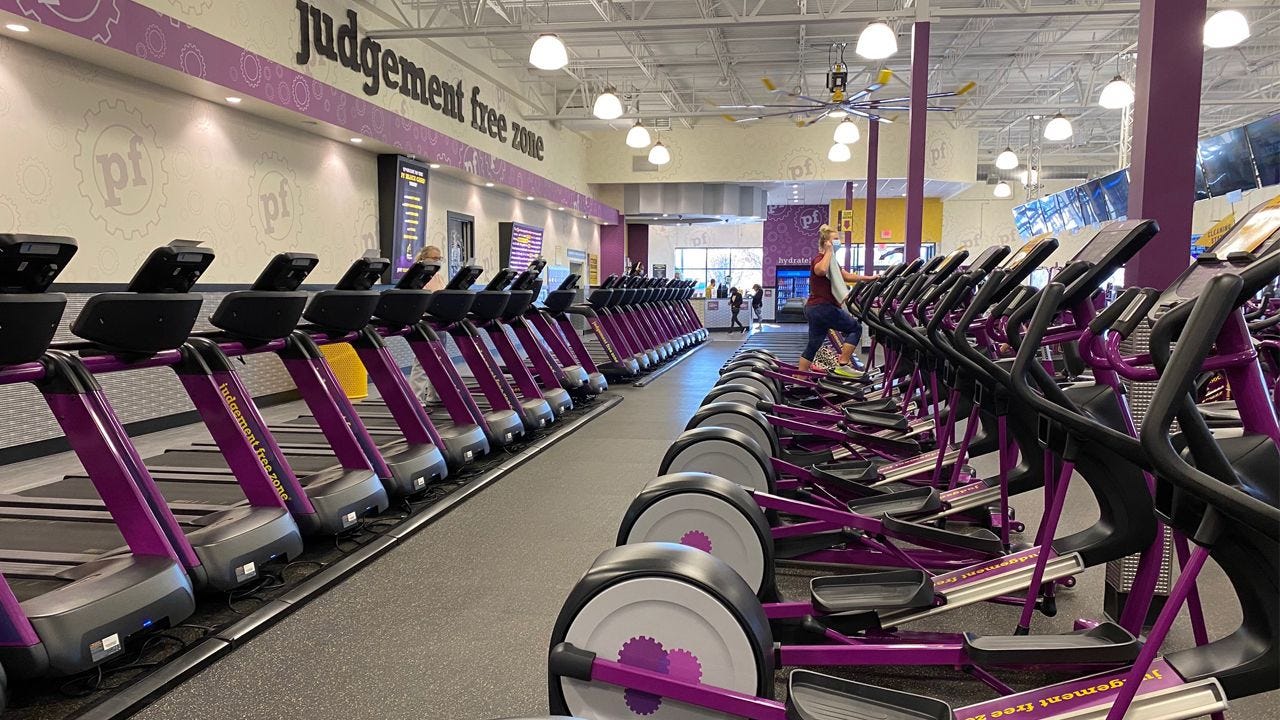
source: Spectrum News
Introducing Planet Fitness
In 1992, brothers Mike and Marc Grondahl took over a Gold’s Gym franchise in Dover, New Hampshire. Not unusually for the industry, the Grondahls had to fight simply to keep the business above water. But after a few years, a focus on a more casual environment, low pricing, and the name “Planet Fitness” — acquired from a business in Florida — led to success. Within a little more than a decade, the business had grown to four clubs, and Planet Fitness began franchising.
What followed was breathtaking growth. The 100th club opened in 2006; the 500th in 2012; the 2,000th in 2019. The branding and strategy that drove that growth is somewhat counterintuitive.
In an industry that typically has pushed physical improvements for its highest-frequency users, Planet Fitness has instead focused on more casual customers with little, if any, emphasis on results. Until the pandemic, the company’s gyms famously offered pizza once a month. In 1997, the company launched the concept of a “No Judgement Zone”; gyms also have a “Lunk Alarm”, which goes off when a customer is working out too loudly or aggressively. The focus on lower-intensity customers was backed by a sharply lower price point: just $10 per month for the base plan, with the company’s “Black Card” offering more features at a still-reasonable price.
In 2012, Planet Fitness sold three-quarters of its business to private equity firm TSG Consumer Partners. TSG took the company public in 2015 and exited its stake two years later. (Interestingly, the firm then backed a franchisee, which sold its locations back to Planet Fitness corporate in early 2022.) At the end of 2023, Planet Fitness had 2,575 locations, more than 90% of which were franchised, in 50 states, the District of Columbia, Puerto Rico, and four additional countries.
Constant Skepticism
Over time, this has been an excellent business:
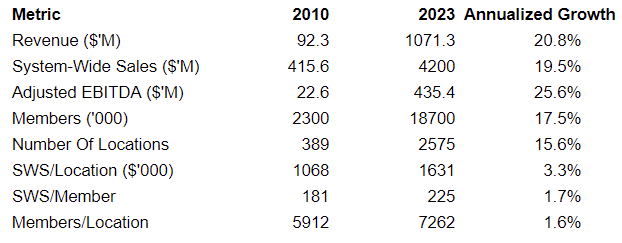
source: author. 2010 data from IPO prospectus; 2023 from Q4 release (10-K not yet filed)
That’s an important thing to keep in mind at the moment, when concerns seem to be swirling, because there hasn’t really been a time when concerns didn’t seem to dog this business.
Again, short interest has been pretty solid for most of the company’s history on the public markets. Bears had plenty of points to make. Competition was one obvious threat: there really weren’t any barriers to entry to the industry, and so any potential rival could similarly buy a box, fill it with exercise equipment, and charge a low fee. More than a few did, including Crunch, Anytime Fitness, and Snap Fitness.
There’s been a longstanding conviction that, eventually, customers would wise up. A 2022 article from CNN Business, reprinted on Planet Fitness’s own website, notes that about 60% of members never visit a gym in a 30-day period. That figure doesn’t seem to have changed much over time. The skeptical explanation was that the $10 monthly price was basically “too cheap to cancel” — but, eventually, customers would depart. Of course, those customers are the highest-margin customers — the cost of serving members who don’t actually visit obviously is quite low — so that trend would lead to margin degradation on top of revenue declines.
There’s been some dubiousness towards the company’s eventual reach, given the importance (particularly soon after the IPO) of upfront fees to overall franchise revenues. But, more broadly, there is a not-unjustified skepticism toward any business in fitness, an industry that is maybe second to airlines in terms of destroying investor capital.
We’ve recently seen F45 Training, Peloton PTON 0.00%↑ and Bowflex BFX 0.00%↑ (formerly known as Nautilus) implode. Before the pandemic there was Town Sports International, owner of the New York Sports Club and Lucille Roberts imprint, and Nautilus again; before that, into and out of the financial crisis, there were bankruptcies filed by Bally Total Fitness (twice!) and Crunch.
None of those bearish predictions truly came to pass, however. Instead, Planet Fitness simply kept growing. And while that doesn’t mean the company will continue to do so in the future, at some point there simply needs to be an acceptance that this actually is an excellent business.
Post-Pandemic Growth
PLNT has also been an excellent stock — though not in the post-pandemic environment:
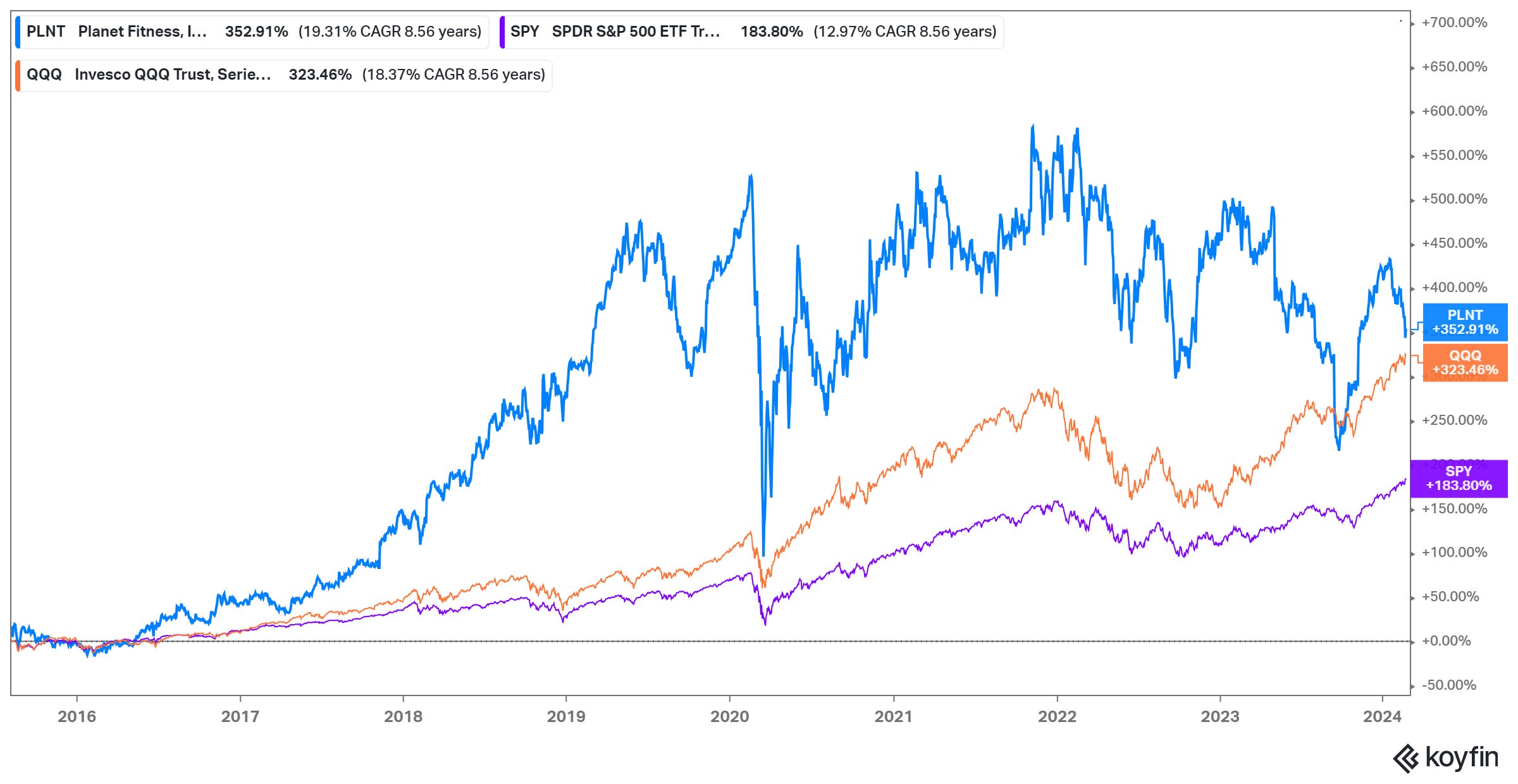
source: Koyfin
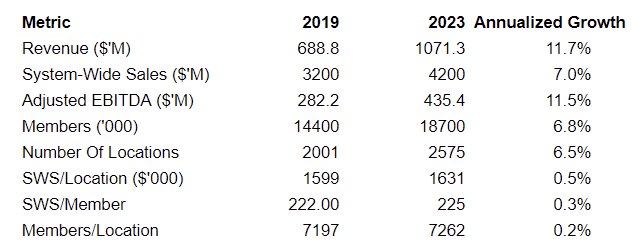
PLNT is down 15% since the end of 2019. But the business is still performing well:
source: author
Per-member and per-location figures have flatlined, perhaps unsurprisingly. This is a business that has been franchising for 20 years; locations in older markets are nearing saturation, while newer markets are often smaller. But Planet Fitness is still adding new locations, despite pressures from the post-pandemic environment (notably, the permitting process has slowed dramatically in many markets). After Q4, the company raised its target for eventual U.S. footprint to 5,000 locations from a previous 4,000.
It’s possible to have some skepticism toward that updated target, but it does make some sense. The 4,000-location estimate was done at the time of the company’s IPO back in 2015. As management has discussed of late, the potential for new store layouts (including smaller offerings for smaller markets) increases the potential reach. But a simpler explanation is this: Planet Fitness raised its long-term target by 25% after 25% of gyms nationwide shuttered for good in 2020/21. It seems logical that there’s more room for a national chain after so many local operators were pushed out of business by the pandemic.
And so there’s still plenty of room for expansion — at least a decade’s worth at least, at the current pace. The near-term outlook seems fine as well: guidance given for 2024 is pretty much in line with the recent multi-year average, with revenue expected up 6% to 7% and Adjusted EBITDA climbing 10-11%. This still seems like a business in excellent shape, even if the stock chart might suggest otherwise.
Countering Lowered Growth Expectations
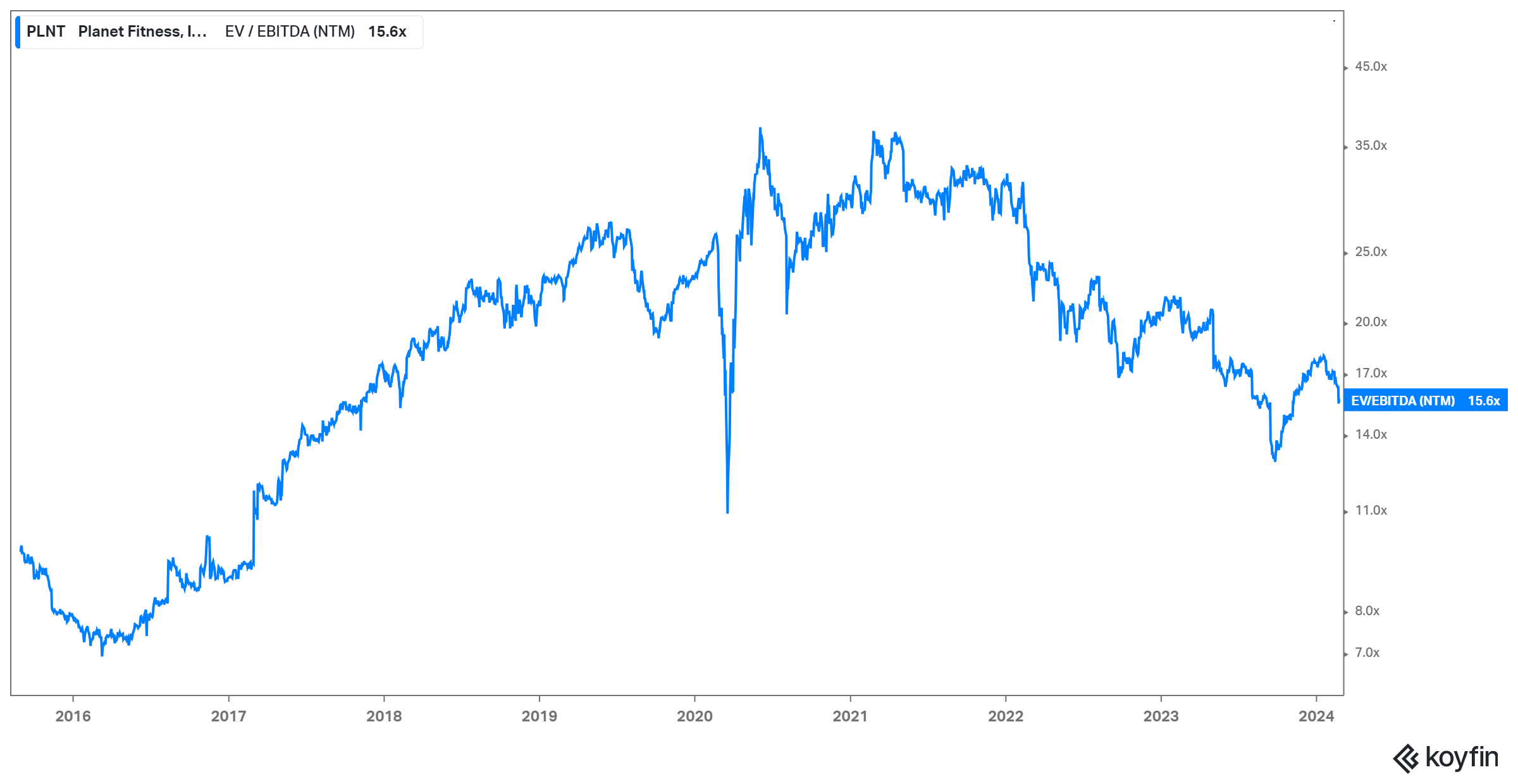
To some extent, investors are still paying up for quality here, at least in the context of the market as a whole. Based on guidance, PLNT trades for about 26x earnings per share and 16x Adjusted EBITDA, with a net leverage ratio above 4x1. But in the context of PLNT’s history, EV/EBITDA stands out:
source: Koyfin
That’s a significant contraction in the forward multiple against even late 2010s levels2, given that the multi-year outlook remains relatively strong. Relative valuations don’t really work here — PLNT doesn’t have a workable peer3 — but franchisors historically get rather high multiples. Back in 2022, we recommended a short of European Wax Center EWCZ 0.00%↑; that stock at the time traded at 19x EBITDA and is still valued at nearly 13x 2024 estimates (though we still believe those estimates are too high).
Given the opportunities for growth on both a same-store basis and from newbuilds, 16x seems reasonable for Planet Fitness. But where the story gets interesting is in two potential opportunities that could boost the multi-year growth profile.
The first is an entrance into Europe. Planet Fitness’s international business to this point is quite small: just under 2% of total locations4. But the company has long-term hopes for markets like Mexico and Canada, where expansion obviously was interrupted by the pandemic. In Spain, management sees a path toward potentially 300 locations, more than 10% of the current store base. And the same logic in that market — that Planet Fitness can compete with local chains like Basic-Fit (BFIT.AS), which has ~200 gyms in the country — should translate elsewhere on the Continent and possibly in the United Kingdom as well5.
Planet Fitness is going to own the Spanish locations itself, instead of using a franchisee, so the effort is not going to help the P&L upfront. But if the company sees success early, it can then franchise existing locations and potentially new opportunities as well. And if that success arrives, it means an expanded peak footprint, which for a franchisor almost always means an expanded earnings multiple as well.
The more interesting catalyst, however, is on pricing. Planet Fitness’s basic membership has had the same $10 per month price for 30 years. But, starting with the third quarter call in November, management has floated the idea about possibly changing that.
The direct impact actually isn’t that high. Black Card penetration is just shy of 62%, so about 7.1 million members are on the basic plan. Assuming a $2 per month increase, total system-wide sales would jump about $170 million. Something like $17 million of that would come from the corporate-owned stores, with Planet Fitness keeping 100%. It would also get another ~$11 million in royalties (7% of the remaining $153 million in increased pricing). That’s a total increase of ~$28 million, a ~6% boost to 2024 EBITDA guidance6, though there’s potentially some offset from customer losses driven by the price hike. If Planet Fitness can get closer to $5 per month per customer, the impact becomes more material — but the benefit of a price hike isn’t necessarily targeted to the franchisor in this model.
Franchisee Concerns
Per the Q3 2023 call, the total capex across a 10-year franchise agreement (cost to build plus new equipment spend plus remodels plus maintenance) is up nearly 70% from where it was ten years earlier. This in turn leads to one of the bearish arguments now made toward PLNT: that the unit economics no longer work for franchisees.
Higher interest rates make the cost of debt used to fund newbuilds more expensive. Higher capex adds another pressure point. Meanwhile, EBITDA growth isn’t keeping pace, meaning cash-on-cash returns for franchisees are shrinking rapidly, and potentially nearing a point where newbuilds simply aren’t economical7. That point is obviously quite a problem for Planet Fitness at the corporate level. A sharp deceleration in newbuilds would mean a sharp deceleration in corporate profit growth, and almost certainly a decline in PLNT stock.
This concern is why pricing is such an important issue for PLNT: not necessarily because of its impact at the corporate level, but because of its impact at the franchisee level. Planet Fitness already has launched a new franchise model, which has a number of significant changes:
agreements are extended to 12 years from 10 years;
the initial franchise fee of $20,000 is moved to the end of the agreement, rather than upfront;
timelines for purchasing new equipment will be extended for some locations (though this change is quite modest from a new policy set at the end of 2021);
after quite a bit of flexibility during and after the pandemic, grace periods for franchisees under area development agreements to open new stores will be ended.
But, without a price increase, these changes aren’t enough. Indeed, it seems likely that the weakness in PLNT so far in 2024 is driven by pricing worries. Planet Fitness has run tests in multiple markets, going to different price points for the basic membership, and then pulling back.
The fact that the company hasn’t instituted a price increase yet drives some concern. That concern has been amplified by weak traffic in the sector during January, as well as news and analyst reports that PLNT pulled back on its price testing in response to those traffic problems.
That said, if you go back to the original discussion after Q3, it’s quite clear that Planet Fitness management was not planning for the price tests to end in February with a clear result. On the Q4 call, chief financial officer Tom Fitzgerald said emphatically that the narrative that PLNT rolled back price increases because of traffic concerns was inaccurate.
Instead, it seems quite likely that there will be a price increase. It’s possible that Planet Fitness is the outlier in an inflationary environment, and that a move from a $10 base to $12 or $14.99 simply crushes demand. That seems exceptionally unlikely, however. The idea that this model suddenly collapses when the current base price, measured in 2015 dollars, is $7.69 per month simply beggars belief.
And for all the hand-wringing about pricing right now, we’d highlight the fifth key change of the franchise model: a shift from franchisees paying a fixed per-member fee for those who join online to a flat percentage of a all member dues. On the Q3 call, Fitzgerald explained the logic of the change: “This new structure allows us to participate in the upside on potential future price increases.”
The GLP-1 Question
source: Twitter
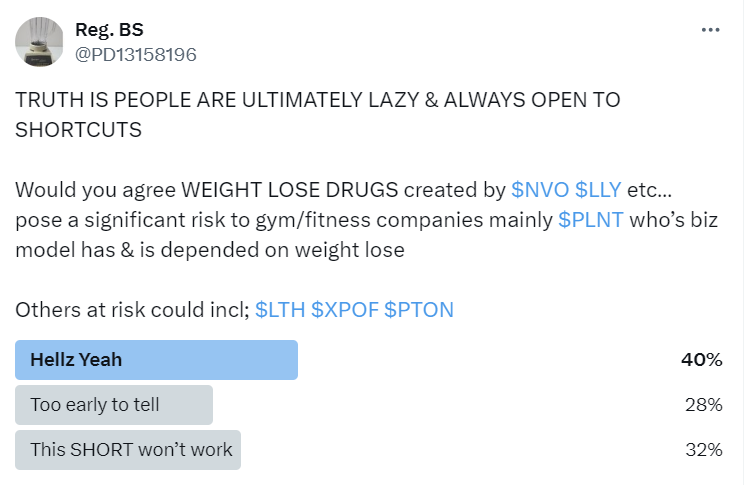
Twitter polls aren’t exactly scientific (and no, we don’t know why “weight loss” is written as “weight lose”) but the distribution here probably mimics the market as a whole. PLNT sold off sharply in the fall as investors got to grip with news about GLP-1 agonists like Ozempic.
But the stock also roared back into year-end, because the more sober analysis at this point is that GLP-1s provide a modest boost for Planet Fitness. Certainly, that’s been management’s contention (though, obviously, they would say that). But there is some evidence for that optimism.
A peer-reviewed study from November said that moderate exercise was essential in concert with GLP-1 drugs. Other studies appear to show a potentially significant loss of muscle mass as weight is reduced.
The idea that PLNT is a slam-dunk short because of Ozempic seems far too simplistic. There will be benefits from the drug and likely negative impacts as well. It’s up to management to lead the company through this new environment.
Under New Management
On September 15, Chris Rondeau stepped down as Planet Fitness CEO. The news was completely unexpected. Rondeau had been atop the company for a decade, and there was no sign of tumult or any discussion of succession. Indeed, the company remains led by an interim CEO, which speaks to just how abrupt the decision was.
To this point, the company still hasn’t explained what happened. There’s been some speculation (and some particularly wild speculation to which we won’t link), but the more outlandish theories seem contradicted by the fact that Rondeau remained on the company’s board of directors. That is, until last week, when he resigned, upset about layoffs at PLNT headquarters and the board’s willingness to make “very large decisions” ahead of the hiring of his permanent replacement.
There is a sense, however, that the company perhaps needed new blood. Certainly, on the Q3 call in November — the first without Rondeau — interim CEO and board member Craig Benson seemed somewhat frustrated with the company’s marketing strategy, promising changes on that front. Among them is a focus more on branding at the national level versus promotions at the local level. As GLP-1 usage grows, those users (some of which will be current or former Planet Fitness members) will need to be targeted as well. In that context, the arrival of a new CEO and new CFO — Fitzgerald is retiring this year, though his departure appears to be under far pleasant circumstances8 — seems like good news, rather than a risk.
Whatever the cause, at this point it no longer looks like Rondeau’s departure was the sign of some crisis brewing within the company. That was clearly the sense at the time: PLNT plunged 16% on the news, hitting its lowest level since April 2020. But in retrospect, that seems like a huge overreaction. 2024 guidance is solid, growth continues, and strategic changes are being made.
Were The Bears Right, But Just Early?
It’s possible that the bearish takes on PLNT eventually prove to be correct. Inflation-driven penny-pinching may put a lid on price increases, or prevent those increases from being instituted at all. Competition and franchisee returns could lead to disappointing new unit growth, and a business growing EBITDA mid-single-digits instead of low double-digits probably sees some multiple compression. If growth disappoints, there’s a path back below $50.
But it’s worthwhile to take the long view here. For eight-plus years since its IPO, there have been threats to the Planet Fitness business. Reasons it would fail, and arguments that the business model was some version of a ticking time bomb. The bears for the most part have been wrong. This in fact has been an outstanding business with consistent growth — even through a global pandemic that crushed its industry.
At a certain point, that history should take precedence over the reasons for skepticism. And if that history repeats, PLNT should be a winner from here.
As of this writing, Vince Martin has no positions in any securities mentioned.
Disclaimer: The information in this newsletter is not and should not be construed as investment advice. Overlooked Alpha is for information, entertainment purposes only. Contributors are not registered financial advisors and do not purport to tell or recommend which securities customers should buy or sell for themselves. We strive to provide accurate analysis but mistakes and errors do occur. No warranty is made to the accuracy, completeness or correctness of the information provided. The information in the publication may become outdated and there is no obligation to update any such information. Past performance is not a guide to future performance, future returns are not guaranteed, and a loss of original capital may occur. Contributors may hold or acquire securities covered in this publication, and may purchase or sell such securities at any time, including security positions that are inconsistent or contrary to positions mentioned in this publication, all without prior notice to any of the subscribers to this publication. Investors should make their own decisions regarding the prospects of any company discussed herein based on such investors’ own review of publicly available information and should not rely on the information contained herein.
Fully-diluted market cap of $5.7 billion (note that PLNT actually owns the operating LLC; about 3.1% of units in the business are still held privately); net debt just under $2 billion; guidance suggests Adjusted EBITDA of ~$480 million this year.
Obviously, the expansion in 2020 and 2021 was driven in part by earnings that investors perceived, correctly, as temporarily depressed by the pandemic.
Planet Fitness’s peer group used for executive compensation includes Beachbody BODY 0.00%↑, Peloton, Domino’s Pizza DPZ 0.00%↑, a bunch of restaurant chains, hotel operators, and WW International WW 0.00%↑. None of those names provide a logical comp.
46 as of the end of 2022; the figure doesn’t seem to have been updated yet, but will be when the 2023 10-K is filed.
The U.K. market does seem to have more competition: combined, The Gym Group (GYM.L) and privately held PureGym have nearly 600 locations already.
To be clear, this is rather rough math here. There may be differing Black Card penetration between franchised and corporate-owned stores, and it’s not clear how pricing might change in overseas markets.
This issue is compounded by the fact, highlighted by the example of TSG earlier, that a good chunk of franchised locations are owned by P-E funds (or businesses owned by P-E funds), which have their own leverage concerns in a normalized interest rate environment.
Fitzgerald is 63, and the decision was communicated last week, with the CFO staying on an additional six months amid a comprehensive search for his replacement. It does seem like a retirement, rather than a “retirement” driven by board considerations.