
Highlights:
PLBY has gone from being one of the biggest de-SPAC winners to one of its largest losers; shares are down 97% from early 2021 highs.
In response to the plunge (and a stretched balance sheet) PLBY has essentially abandoned its entire strategy.
The decision has some logic, but there’s one key problem: the same CEO tasked with executing the prior strategy remains in charge of planning going forward.
With a share price under $2 and an enterprise value under $300 million, there’s real value here. But is there enough to buy the stock?
It’s challenging enough coming up with 50 investment recommendations a year. But what’s more difficult is coming up with those ideas 50 weeks a year. Attractive ideas don’t always arise on such a consistent timeline.
This week, we’re taking a step back. With the S&P 500 officially in a bull market, and the Russell 2000 up 6% in a month, valuations aren’t quite as attractive as they were a few weeks ago. As a result, we’re highlighting an interesting story that offers potential for upside even if we’re not ready to buy it right now.
PLBY Group PLBY 0.00%↑, owner of the Playboy brand, has been absolutely crushed over the past few years. Strategic decisions and execution failures are a key reason why.
The good news, however, is that the strategy has been overhauled. The bad news is that the leader in charge of that strategy remains. If and when that changes, PLBY could be a huge winner. We think it’s wise to understand that story in advance so that we’re ready for when the catalyst occurs.
The History Of PLBY Group
PLBY Group traces its roots to 1953, when Hugh Hefner founded Playboy magazine. The publication quickly became a transformative force in American culture; it’s often credited with (and sometimes criticized for) a role in the “sexual revolution” of the following decade.
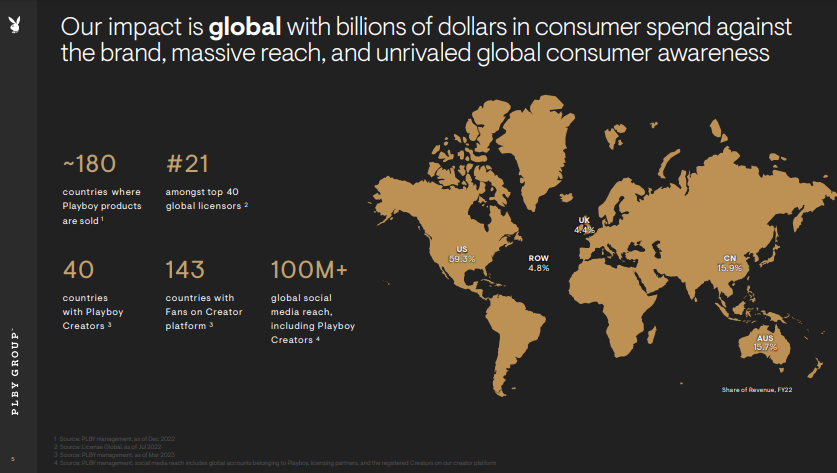
In 1971, Playboy Enterprises went public. Over time, the Playboy brand expanded beyond the magazine into pay television, live entertainment, and licensed merchandise. Those efforts went global. By 1998, the magazine was distributed in roughly 50 countries, and video programming in “approximately 150 countries and territories.”
For a time, investors thought the company would be a digital winner. Playboy Enterprises stock soared during the dot-com bubble. As a result the company planned a spin-off of its online business (that effort was pulled in late 2020). But despite those online efforts, the net impact of widespread Internet adoption on Playboy was clearly negative. Between 1993 and 2008, magazine revenue dropped by more than one-third. Consolidated operating profit went from modestly positive in the mid-1990s to rather sharply negative by the second half of the 2000s.
Coming out of the financial crisis, there was some brief optimism toward a turnaround. But Hefner instead decided to buy the ~30% of the company he didn’t own, taking Playboy Enterprises private in early 2011 with the help of private equity firm Rizvi Traverse. The go-private valued Playboy, including debt, at a little under $300 million. In nearly 40 years on the public markets, Playboy stock posted a return of negative 48%.
Despite that history, Playboy returned to the public markets a decade later. In February 2021, Playboy Enterprises merged with a relatively small special purpose acquisition company, Mountain Crest Acquisition. The merger raised $109 million in proceeds. As part of the transaction, Mountain Crest (the surviving entity) changed its name to PLBY Group, Inc.
The First Bull Case For PLBY Stock
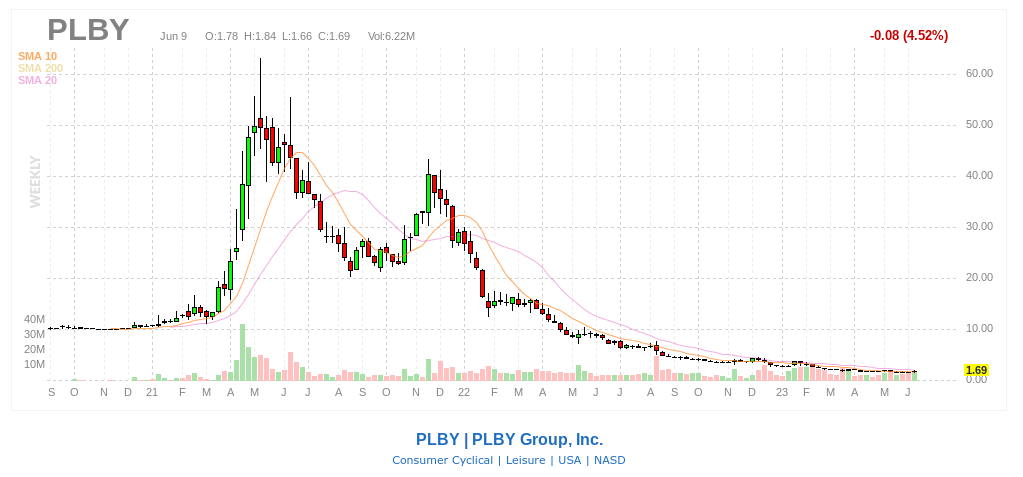
Out of the gate, PLBY stock was a massive winner:
source: Finviz.
Shares touched $60 in early May 2021. Even below $50 toward the end of the month, PLBY was the best-performing SPAC merger of the 239 such deals closed over the previous 18 months. Given the massive gains in speculative de-SPACs like Virgin Galactic SPCE 0.00%↑ and DraftKings DKNG 0.00%↑, that was no small feat.
Certainly, broader enthusiasm toward SPACs played a role. The company’s planned entry into the NFT (non-fungible token) and CBD (cannabidiol) markets also drove the stock higher. But in fact there was some logic behind the gains as well.
PLBY argued that the Playboy brand was far more valuable than American investors might have presumed, with particular strength in Asia. Billions of dollars in Playboy-branded merchandise is sold every year. And chief executive officer Ben Kohn — who had been a partner at Rizvi Traverse, becoming Playboy’s CEO in 2016, initially on an interim basis — posited that the company had a huge opportunity to increase its profits by shifting licensed merchandise to in-house production.
M&A was part of this strategy as well. PLBY had already acquired online lingerie retailer Yandy in 2020. It planned to make further deals to expand its reach and build out an owned business across several sexual wellness markets.
Fundamental-minded investors bought that bull case. Hedgeye’s Brian McGough, a respected analyst in the retail space, argued for a long-term market capitalization of more than $10 billion, suggesting a share price above $250. David Einhorn and Greenlight Capital took a flyer last year. And in mid-2021, I personally owned the stock, albeit briefly.
It’s tempting to look at the Playboy brand and the PLBY stock chart and see 2021 trading as simply an artifact of the ridiculous bubble that year. There is some truth to that — but it’s not the whole story.
PLBY Weakens, Then Collapses
During 2021, PLBY began to execute on its expansion strategy. The company made three more acquisitions that year. In retail, PLBY bought brick-and-mortar chain Lovers for $25 million and then made a huge splash with high-end lingerie retailer Honey Birdette for nearly $300 million ($233 million in cash).
In digital, PLBY paid $34.4 million (though more than half of that in contingent consideration) for Dream, which would back PLBY’s Centerfold digital offering. Centerfold was pitched as a competitor to OnlyFans, a platform primarily used by creators to offer adult content, and had a beta launch in December 2021.
The foundation of the strategy seemed to be in place. And there seemed to be potential for growth. The individual parts clearly had the ability to amplify one another by, for instance, selling Playboy- and Honey Birdette-branded products in Yandy and Lovers or by bringing Centerfold customers through to other business units. The company could move the iconic Bunny logo — which Kohn compared to the Nike NKE 0.00%↑ ‘swoosh’ — into new licensing markets, while ending less-profitable licensing deals and bringing those products in-house with increased operating profit dollars1. Centerfold was an intriguing swing given that OnlyFans was looking to raise capital at a valuation over $1 billion. CBD and NFTs also had promise.
There were skeptics toward that strategy, certainly: PLBY historically has had high short interest. Currently, nearly 18% of the float is sold short, and the figure has been in the double-digits almost without exception since the company went public. But, again, there was legitimate reason for optimism from investors who understood the story.
The problem as 2021 rolled on was that the results weren’t quite what bulls had hoped. (Indeed, it took only one quarter for me to exit my position at a loss.) Given M&A, that was particularly true on the bottom line, with Adjusted EBITDA of $31 million against $24 million the year before. Management attributed the results to external factors including supply chain problems and incremental public company costs.
After Q4, PLBY then gave a seemingly solid outlook for 2022: Adjusted EBITDA of ~$55 million, with Honey Birdette posting organic growth and new stores, while Lovers and Yandy increased sales and the company’s nascent owned e-commerce business at playboy.com continued to scale.
But 2022 proved to be an absolute disaster. For the year, Adjusted EBITDA was a loss of $6.6 million. Revenue at Yandy fell off a cliff due to the effects of inflation on its lower-end customer and the impact of privacy changes from Apple AAPL 0.00%↑ on marketing efficiency. The NFT business went to zero. Lovers struggled. Licensing revenue fell 8%. In the middle of the year, Centerfold had to pause onboarding of creators owing to technical challenges. Honey Birdette margins weakened.
Simply to avoid a restructuring, PLBY had to sell $50 million in preferred stock. In January of this year, the company then sold 6.36 million shares at $2, and a rights offering the following month led to the issue of 19.6 million more shares. The company still closed Q1 — a quarter which itself looked soft, with results badly missing consensus estimates — with net debt over $170 million against a market capitalization of $124 million.
Given that PLBY has burned $91 million in cash over the last five quarters, the financial picture here remains precarious, to put it mildly.
PLBY Hits ‘CTRL-Z’
The response from Kohn to those results has been, without exaggeration, one of the wilder things we can remember seeing from a public company CEO: simply reversing pretty much everything PLBY has done since it went public.
The whole pitch about bringing merchandise sales in-house? That is completely gone. Instead, as Kohn detailed on the Q4 call, “we are changing our business model and moving to a capital-light model”. Not only is PLBY not looking to end licensing deals, it’s now outsourcing the e-commerce business run through playboy.com. A newly created joint venture will manage the company’s licensing business in China.
Yandy was sold for $3 million. (PLBY bought the business at the end of 2019 for $13.1 million.) Lovers is being divested. Moelis MC 0.00%↑ has been hired to sell Honey Birdette (as late as the Q4 call in March, Kohn was insistent that the brand would be an integral part of the business going forward). PLBY plans to be the licensing business and Centerfold, and that’s about it.
It’s a staggering reversal. It’s all the more staggering because the exact same CEO remains in charge. One can imagine fresh eyes looking at the strategy and throwing past leadership under the proverbial bus. To our memory, it’s unprecedented for an exchange-listed public company to make such a dramatic change in strategy. It’s essentially impossible to have a more dramatic change than this one under the same top executive.
The Logic To The Shift
Unprecedented or not, the question is whether this strategic shift makes sense. And, to be fair to Kohn, it actually does seem to be the right move.
Of course, that’s partly because it’s likely the only move. PLBY has to move to a capital-light model because it doesn’t have enough capital to fund inventory, capital expenditures, and operating losses (management has said that, in 2022, the owned playboy.com business ran a ~$7 million deficit).
That aside, however, this decision still makes sense. The decision to bring some licensed products in-house was framed, at the time, as due to the fact that the existing licensing agreements weren’t very good. There are easier ways to fix that problem, however. And the heavy short interest in PLBY from the jump showed that a lot of smart investors quickly identified the flaw in the plan to create owned apparel and merchandise businesses.
Yandy was an absolutely terrible business, a fact which was camouflaged somewhat by pandemic growth but made clear by performance following Apple’s changes. As even Kohn has admitted of late, Yandy sells low-quality products at low-margins via aggressive online advertising. Over time, the infrastructure of the site might have proved a useful framework for more Playboy-branded material — but, again, PLBY doesn’t have that kind of time.
Lovers was acquired for ~5 times EBITDA, a multiple which itself shows the quality of that business. The idea to use playboy.com as an e-commerce outlet probably was wise; the decision to try and scale that business in-house, perhaps not so much.
The sale of Honey Birdette seems a bit more questionable. Management has mostly insisted, at least until recent quarters, that the business was doing well: through Q3 of last year, PLBY framed licensing and Honey Birdette as doing well by serving higher-end/higher-income customers, while Yandy and Lovers struggled on the lower end. But given balance sheet challenges, a sale, even at a loss, isn’t unforgiveable.
The Second Bull Case For PLBY Stock
Indeed, if PLBY had hired a new chief executive officer, and she had led a similar strategic reversal, the market’s response might be very different. Street analysts would tout “bold changes” made by “fresh eyes”, and a logical response to the macro and market environments and the balance sheet challenges.
In that scenario, investor attention might well turn to the fundamentals — because there is an exceptionally intriguing case for PLBY below $2, at least on paper. The company’s enterprise value is just shy of $300 million, and it doesn’t seem at all difficult to build a model in which PLBY has much more value than that.
The licensing business alone seems to get in the ballpark. 2023 revenue should near $60 million. Segment-level operating margins were in the low 70% range in 2020 and 2021, before dipping to 68% (adding back a non-cash impairment charge) last year. Corporate costs in 2022 were $32 million, but PLBY has talked up cost savings and with a much slimmer portfolio that figure should drop substantially.
There’s still a world in which a public, licensing-only business is generating something like $20 million in annual operating income (think $55 million in licensing revenue at 65% margins, with corporate costs halved to ~$16 million). Even with minimal growth, a 10x multiple values the licensing stream at $200 million. That number gets some support from the Q4 call, on which Kohn noted that PLBY had $346 million in guaranteed revenue contracted through 2021. That figure came down with the launch of the China JV, which lowered guarantees, but it also doesn’t include any new efforts or licensing revenues above the minimum.
Lovers was acquired for $25 million, and management has said EBITDA is roughly where it was at the time of the purchase. A sale there might be bring in $15 million.
Valuing Centerfold is difficult, admittedly, given the business remains in its early stages. It’s still possible Centerfold is a zero, but fixed costs are only ~$6 million a year. With a 20% take rate and what seem to be high-single-digit processing costs, Centerfold probably needs platform spend to reach ~$50 million a year.
GMV is at a ~$25 million annualized rate at the moment, and for now is growing at a decent clip. If that can get to, say, $100 million, free cash flow gets to ~$5 million or so. There’s absolutely a scenario where Centerfold provides material value.
Honey Birdette, at the time of acquisition, was generating Adjusted EBITDA margins of 38%. New chief financial officer Marc Crossman said after Q1 that margins were “a little bit below where they've been historically.” Revenue in 2022 was $84 million; 2023 top-line performance seems likely to be worse as PLBY has said it’s pulling back on promotions.
Still, this is probably still a ~$15-20 million EBITDA business ($70-$75 million in sales, 20-25% margins), which in turn means there’s the hope of a sale garnering over $100 million.
It’s probably too aggressive to expect that PLBY can pay off all of its debt with sale proceeds. But Lovers and Honey Birdette should remove solvency concerns. Meanwhile, some $300 million in net operating loss carryforwards protect the remaining licensing profits from U.S. taxes for years to come.
There’s a way to model a double here. PLBY gets $15 million for Lovers, $125 million for Honey Birdette, getting net debt to ~$25 million. The market prices the licensing business at $250 million-$300 million (12x-15x EBIT, not out of line for a licensor given margins and stability) and/or assigns value to Centerfold. But even a pretty conservative model can still get PLBY up toward $2: $200M from licensing, $100M from Honey Birdette, $10M from Lovers gets to $1.90.
The Management Problem
Of course, there’s a pretty significant problem here: Kohn remains in charge. Quite clearly, investors have zero confidence in his ability to catalyze that paper value, and with good reason.
The distrust isn’t based just on the stock chart, either. Kohn took over PLBY in 2016. Four years later Kohn is talking about all the changes his company has to make to its licensing deals. He bought Yandy at the end of 2019, only to say nearly three years later that “the brand itself is not clearly differentiated within the market.” He bought Dream, only for Centerfold’s rollout to come essentially to a halt because the technical team wasn’t able to keep pace.
It bears repeating: Kohn has completely reversed the strategy he spent two years talking up. And in the process, he has very publicly undercut what negotiating leverage PLBY might have had in selling Lovers or Honey Birdette, after painting his company into a financial corner that essentially requires the businesses to be sold. It’s impossible to own this stock with Kohn in charge.
Hedgeye’s McGough, however, has offered a somewhat different perspective:

source: Twitter
The reference to the “mysterious $25 million” comes from the company’s Q4 presentation, in which it modeled $25 million in Adjusted EBITDA assuming restructuring efforts (including the divestitures and cost savings plans) had been instituted at the start of 2022. But the broad point McGough is making is that either Kohn’s new strategy shows some success, or the CEO will be removed.
But there are two problems there. The first is that, by that point, PLBY might be too far gone. A poor deal for Honey Birdette, in particular seems like a risk. So does a disclosure in, say, the Q3 report in November that offers weren’t high enough, and so Kohn and PLBY are just going to keep that asset instead. In both cases, balance sheet concerns re-emerge instantly.
The second issue is that the board is going to give Kohn as long a leash as possible. Again, Kohn is a former managing partner at Rizvi Traverse — and that firm still owns one-quarter of the company. Its co-founder, Suhail Rizvi, has one of five board seats; Kohn has another.
It’s certainly possible that Rizvi Traverse will lose enough patience that it will ask its former partner to leave. But, after the board’s response to the last two years, it seems more likely that the P-E firm (PLBY’s sole 5% shareholder) believes Kohn deserves even more time to get this situation fixed. After all, the firm is backing Kohn amid perhaps the most dramatic strategic reversal we’ve ever seen. At this point, it almost has to give the CEO a few quarters to see his strategy through.
The concern is that PLBY (and PLBY shareholders) doesn’t have that kind of time. And even if Kohn is one bad quarter away from finally losing his job, it seems wiser to wait for that quarter to arrive than to rush in on the hopes that it won’t.
There is real value in PLBY. It’s just difficult to believe that Kohn is the CEO to unlock that value.
As of this writing, Vince Martin has no positions in any securities mentioned.
Disclaimer: The information in this newsletter is not and should not be construed as investment advice. Overlooked Alpha is for information, entertainment purposes only. Contributors are not registered financial advisors and do not purport to tell or recommend which securities customers should buy or sell for themselves. We strive to provide accurate analysis but mistakes and errors do occur. No warranty is made to the accuracy, completeness or correctness of the information provided. The information in the publication may become outdated and there is no obligation to update any such information. Past performance is not a guide to future performance, future returns are not guaranteed, and a loss of original capital may occur. Contributors may hold or acquire securities covered in this publication, and may purchase or sell such securities at any time, including security positions that are inconsistent or contrary to positions mentioned in this publication, all without prior notice to any of the subscribers to this publication. Investors should make their own decisions regarding the prospects of any company discussed herein based on such investors’ own review of publicly available information and should not rely on the information contained herein.
Obviously, the shift from licensed to owned production would significantly lower operating margin percentage, but PLBY believed it could get 15% or more of the sales price, as opposed to licensing deals that in some cases provided just 3% or 4%.
Maybe pull up a chair at RICKs and play it again as time goes by?
An excellent writeup & I have largely similar concluding sentiments, however while you note it's impossible to own with Kohn, that's why the liquidation alpha opp. exists.