
A May win for a successful activist has borne fruit, with an underachieving CEO departing and the international business being sold off.
That sale deleverages the balance sheet, de-risks the story, and provides another strong data point in favor of the stock’s valuation.
Investors reacted well last week, driving the stock 13% higher. But with the rally only returning shares to September levels, there should be more room to run.
In a market like this, it’s easy to fall into the trap of believing that post-earnings opportunities are most likely to come from moves to the downside. But often, the trend works in reverse.
Big post-earnings gains can create an attractive entry point if a) the quarter legitimately changes the story and b) the gains aren’t big enough. For water delivery leader Primo Water PRMW 0.00%↑, that seems to be the case right now.
PRMW gained nicely after its third quarter release, with a rally of 10% on Thursday and another 1.8% on Friday. But those big gains leave the stock trading where it was just seven weeks ago. Q3 looks solid and, more importantly, a significant transaction improves the story and provides more evidence that the stock is undervalued.

Introducing Primo Water
Primo Water is a leading provider of large-format (3 gallons1 or greater) water. Primo sells its dispensers across some 10,000 locations, and then in a classic razor/razorblade model provides refills. Customers can have water delivered (which Primo refers to as Water Direct), buy pre-filled bottles at retail (Water Exchange), or refill the bottles themselves (Water Refill). There are some ancillary businesses as well: Primo provides coffee services, and in the United Kingdom owns coffee-focused Aimia Foods as well as roaster Farrer’s (reputedly the country’s oldest).
Until 2020, Primo was known as Cott Corporation, which at the time had a larger footprint in coffee and tea. In January of that year, as part of a strategic decision to focus on large-format water, Cott agreed to acquire Primo Water (a roll-up which at the time was publicly traded) and took the target’s name. A few weeks later, it sold the coffee and tea business to Westrock Coffee WEST 0.00%↑. Last year, it exited the single-use retail business as well.
Primo now offers its water under multiple brands, including Primo, Crystal Springs, high-end Mountain Valley, Sparkletts, Hinckley Springs, and others. The company operates in 21 countries, though in 2022 North America accounted for 76% of revenue. Growth comes both organically and inorganically: between 2014 and 2022, Cott/Primo made 127 acquisitions, including 21 last year. That ‘tuck-in’ strategy continues: Primo has spent another $25 million through the first three quarters of 2023, though it has not detailed exactly how many purchases it has made.
Primo hasn’t broken out its share of home versus office revenue, but the portfolio appears to lean toward consumer. The 2016 merger of the legacy Primo Water business and Glacier gave the company dominant share in refills, and overall the core competitor seems to be ReadyRefresh, owned by Nestle until its sale to private equity in 2021.
PRMW Entering 2023
Admittedly, this does not seem like the most exciting business. And over the past few years, it certainly has not been the most exciting stock:
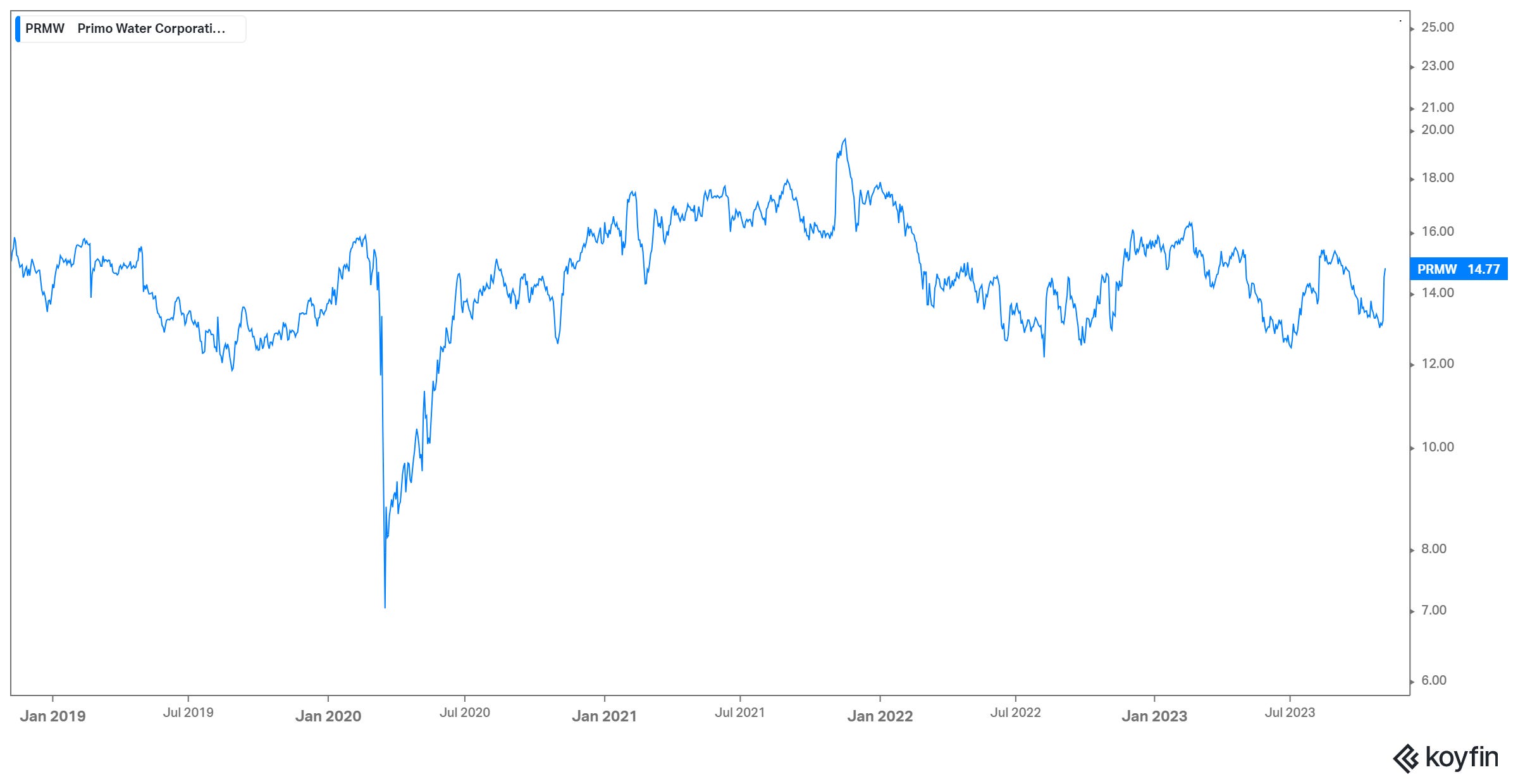
source: Koyfin; 5-year chart
Given the mergers and divestitures, there are a lot of moving parts, but the core problem for the stock is that the business largely stalled out. Revenue did increase more than 20% between 2018 and 2022, but M&A and pricing seems to be the main driver. Cott’s Adjusted EBITDA in 2018 was $312 million; guidance this year suggests a print of ~$470 million, but the company paid for a chunk of that growth through stock issuance and debt.
PRMW did at least look cheap: it began 2023 at a little over 8x the consensus Adjusted EBITDA forecast for this year. But net debt was also ~3x EBITDA. Given weak growth, balance sheet and inflationary fears, neither a muted EBITDA-based valuation nor an ~18x price to earnings multiple seemed out of line.
Not even sell-side analysts appeared all that enthused about the stock:
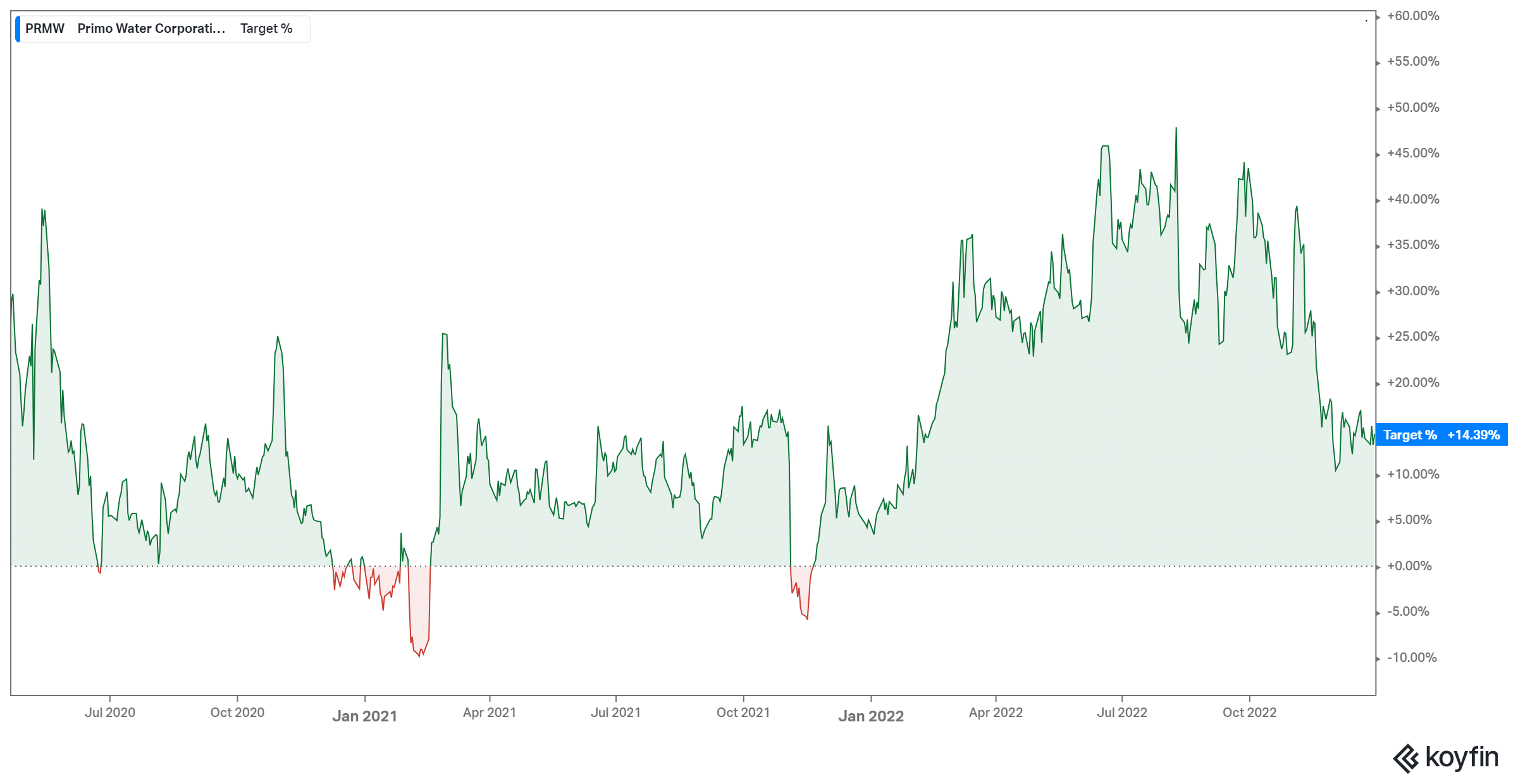
source: Koyfin. chart from April 2020 to the end of 2022; chart shows premium of average analyst price target versus stock price
Coming into this year there didn’t seem a ton of reason to believe the next 4-5 years would be much different than the previous 4-5. Investors would be forgiven for believing that is still the case.
The Activist Arrives
But in March, activist Legion Partners announced a 1.5% stake in Primo in a blistering letter. The fund cited a “stale Board [of Directors] that lacks the skills required to drive significant performance improvement” and substandard returns on invested capital, while estimating that organic customer growth had been essentially zero for several years. Legion nominated four directors to the Primo board. After a somewhat messy proxy fight, it would eventually settle for two.
Legion’s involvement is important for two reasons. First, it provides some context, and some justification, for the relatively weak operating performance over the past several years. In the fund’s telling, the problem is not the industry or its outlook. Given failing municipal water infrastructure in the U.S., home water delivery should have a tailwind. As Primo itself has repeatedly pointed out, overall bottled water growth has continued on an uninterrupted march higher, and in terms of both total cost of ownership and environmental impact, large-format sales should be preferable to many consumers.
Rather, Primo simply hasn’t executed. Capital expenditures have spiked above previously given guidance for efforts like improving digital growth — but without any sign of success. As the fund noted in a later presentation, when legacy Primo merged with Glacier, management talked up the potential to cross-market Water Exchange and Water Refill, but retail location count has risen only modestly. In that presentation, Legion also revealed it had learned that multiple marketing executives had left the company — and, at least at the time, not yet been replaced.
Legion’s telling is important because the activist knows Primo quite well. The fund held a 9.1% stake in legacy Primo, before its sale to Cott. Then, too, Legion saw an attractive business with a troublesome board. In fact, the fund argued this year that even though the Cott deal came at a premium, it still felt the sale undervalued the legacy business.
Change Happens Quickly
The second reason why Legion’s involvement is important is that significant change already has arrived. Primo and Legion settled on May 3. Just four weeks later, the company’s chief executive officer announced his plan to retire at the end of the year.
It’s possible that announcement was coincidental. Legion wound up with just two board members of ten, not nearly enough to take total control. Harrington was 65 at the time as well. But on the Q2 call, Primo said it would pull back capital expenditures by $20 million in each of 2023 and 2024 — seemingly a direct response to one of the activist’s core criticisms. Harrington cited an “investor perception study” in delivering guidance on adjusted free cash flow giving more granular detail surrounding the metric. And the board authorized a $50 million share repurchase authorization just days before the existing authorization was set to expire.
It seemed pretty clear from the call that Primo was trying to be more responsive to investors, which itself was a clear win for Legion. But what happened after Q3 was far more transformative. Alongside the quarter, Primo announced the sale of most of its international business to Culligan for $575 million.
This is not quite a transformative deal for Primo — but it’s significant. The sale is coming at an 11x multiple, which itself provides a key data point for the idea that the rest of the business is sharply undervalued. At the midpoint of 2023 guidance, Primo trades for 7.9x EBITDA; pro forma for the transaction, the multiple drops to 7.5x2.
Certainly, Culligan likely expects some cost savings on its end, which in turn impacted its willingness to pay 11x. But the European assets, at least based on the price differentials of all kinds of consumer assets between the U.S. and the Continent3, should have a lower valuation than the U.S.-facing business, all else equal. And indeed the European business in recent years has had much lower profit margins.
The deal should have benefits for the business as well. Some of the proceeds will go to pay off Primo’s revolver, which had a balance of $153 million at the end of Q3. Given a current interest rate near 7%, that paydown alone suggests annual interest expense will drop by more than $10 million, roughly a $0.05 after-tax boost for a business generating ~$0.78 in earnings per share this year.
In terms of overall earnings and free cash flow, management believes it can patch the rest of the hole through cost savings in the existing business. And, notably, there’s another ~$40 million in overseas EBITDA which can bring in more cash as those businesses are sold next year, as currently planned4. Some of that cash no doubt will be returned to shareholders: Primo plans to increase its buyback by $25 million, and the company will likely increase its dividend for a third consecutive year in February. But Primo will also have dry powder for more acquisitions — with the seemingly improved board of directors hopefully providing tighter control over that process.
A Solid 2023
To top the story off, Primo actually has performed rather well so far this year. The full-year outlook for revenue and Adjusted EBITDA was increased after the second quarter; adjusted free cash flow guidance was hiked after both Q2 and Q3.
Year-to-date, revenue is up 4.7% even with 2.4 points of headwind from last year’s single-use exit, and another point of pressure from currency and Primo’s withdrawal from the Russian market. Admittedly, that growth is coming from pricing, but management continues to forecast organic increases in the customer base by year end. Notably, dispenser sales have been strong, and those sales unsurprisingly represent a leading indicator for overall revenue:
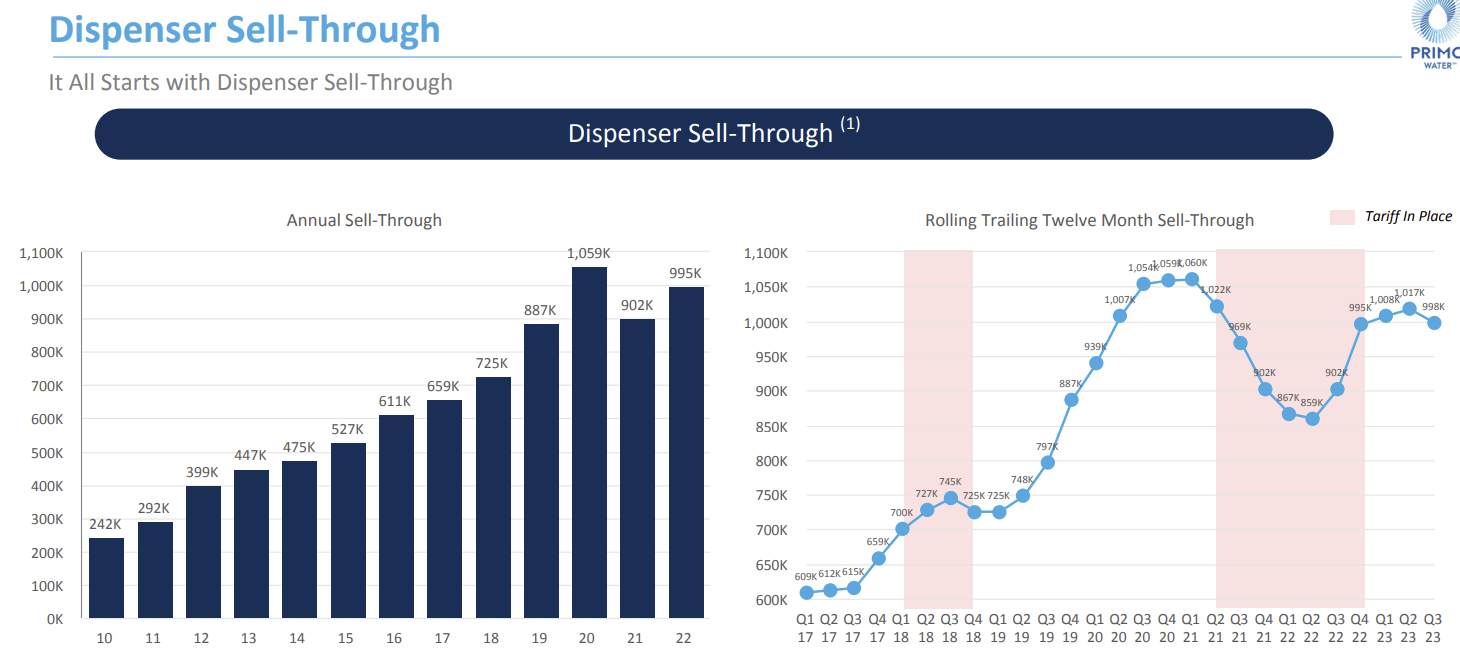
source: Primo Water Q3 investor presentation
To be sure, Primo still has to execute. Activist or no activist, the company has promised for a few years that growth is just around the corner, and excluding M&A that hasn’t been the case. (Legion estimated that the organic customer base hasn’t grown since 2017.)
But delivery retention remains solid at 86%, which seems to assuage some fears that inflation would lead customers to cut back on the service. A partnership with Costco COST 0.00%↑ — marketed online at costcowater.com — seems to be off to a solid start, and could be material. The retail giant has well past 100 million members; Primo has a little over 2 million direct delivery customers.
Conversion of Costco members doesn’t have to be that high for the partnership to grow Primo’s Water Direct base nicely. And while (unsurprisingly, given Costco’s focus), the price offered Costco customers will be discounted, those customers will map onto existing delivery routes. Primo can thus serve those customers quite profitably, and it’s no surprise management sees some optimism on this front heading into 2024.
With the changes driven by Legion, the stock is starting to look compelling.