
⚡ Highlights:
RBA’s bid to acquire IAA in November met initial resistance — but in the end the deal was closed.
But the post-merger RBA looks risky. The company levered up to make what looks like a financial rather than a strategic transaction.
There isn’t quite enough to turn bearish. But a short RBA trade should at least go on the watchlist.
In November of last year, heavy equipment marketplace Ritchie Bros. Auctioneers RBA 0.00%↑ announced its plan to acquire auto salvage specialist IAA Inc. Seemingly everyone was unhappy. RBA stock plunged 18% on the news. That plunge became a problem for IAA, which had just accepted an acquisition offer that was nearly 80% in stock. IAA stock wound up falling 2% on the day, not the kind of trading usually seen for an acquisition target.
As we detailed on Twitter in February, major shareholders on both sides of the transaction came out against it. And yet, thanks perhaps in part to a shareholder bribe special cash dividend paid after the close, RBA got the deal across the finish line. Neither vote in fact was particularly close: 85% of RBA shareholders voted in favor, and IAA’s victory was nearly as comprehensive.
But the nature of the merger does make RBA a potential short target. The bid to gain
support for the IAA deal became so screwy that RBA itself, fighting back against one of its major shareholders, wound up creating a PowerPoint slide detailing its history of missed revenue targets. The special dividend, and its funding, looks questionable. Valuation on a pro forma basis is not terribly attractive, particularly with legacy RBA facing potential cyclical pressure, while secular concerns loom for IAA.
There’s not quite enough to get over the hump, particularly with what looks like a solid Q1 earnings report on Wednesday evening. But there’s enough to at least take a look at the story here and to keep a short of RBA on the watchlist going forward.

How Good Is This Business?
On paper, the RBA-IAA tie-up makes a bit of sense. The acquisition isn’t necessarily strategic, as the two companies serve quite different markets with different business models. But RBA has argued that there are enough similarities for the tie-up to work:
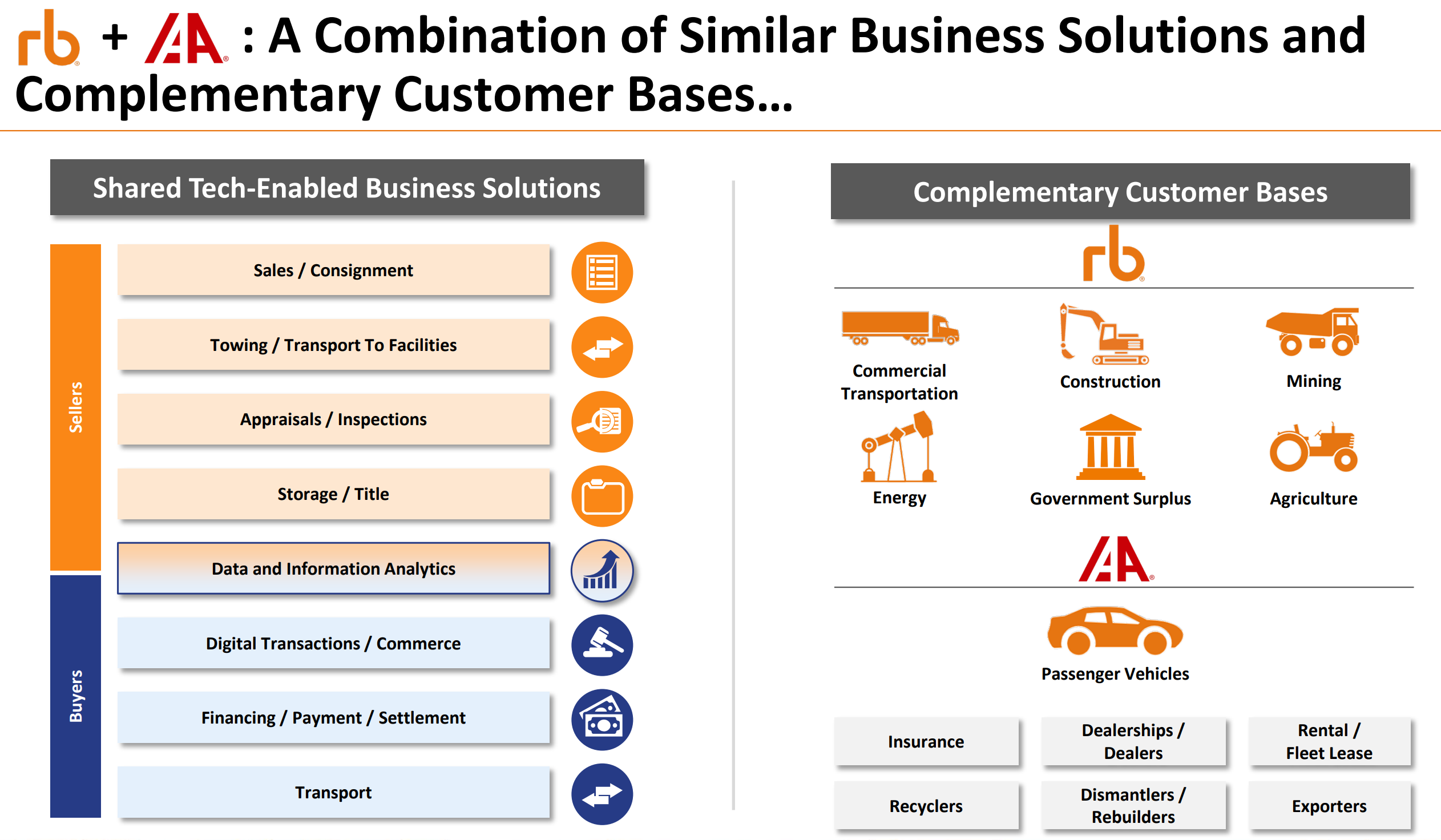
source: RBA presentation, November 2022
There’s the ability to share yard networks; to run tech across the two businesses; and, notably, to save on costs. RBA has estimated $100 to $120 million in annual synergies by the end of 2025.
That said, it’s hardly a complementary acquisition. To our eye, RBA has never successfully clarified the inherent logic of the deal. Much of the case seems to be based on the idea that owning two businesses is better than one (synergies, public company costs, etc.), along with the fact that IAA is non-cyclical1. And in that context, it does seem strange that RBA management was so hellbent on getting the merger done — and willing to take on some risks to do so.
One obvious risk is that the merger isn’t exactly a marriage of companies firing on all cylinders. Ritchie Bros. itself has been promising growth for years, pointing to “evergreen” growth targets for GTV (Gross Transaction Value). When major shareholder Luxor Capital argued that those targets suggested RBA shareholders would be better off on their own (with no dilution and no shared investment) RBA helpfully pointed out that it had repeatedly missed those targets anyway2:
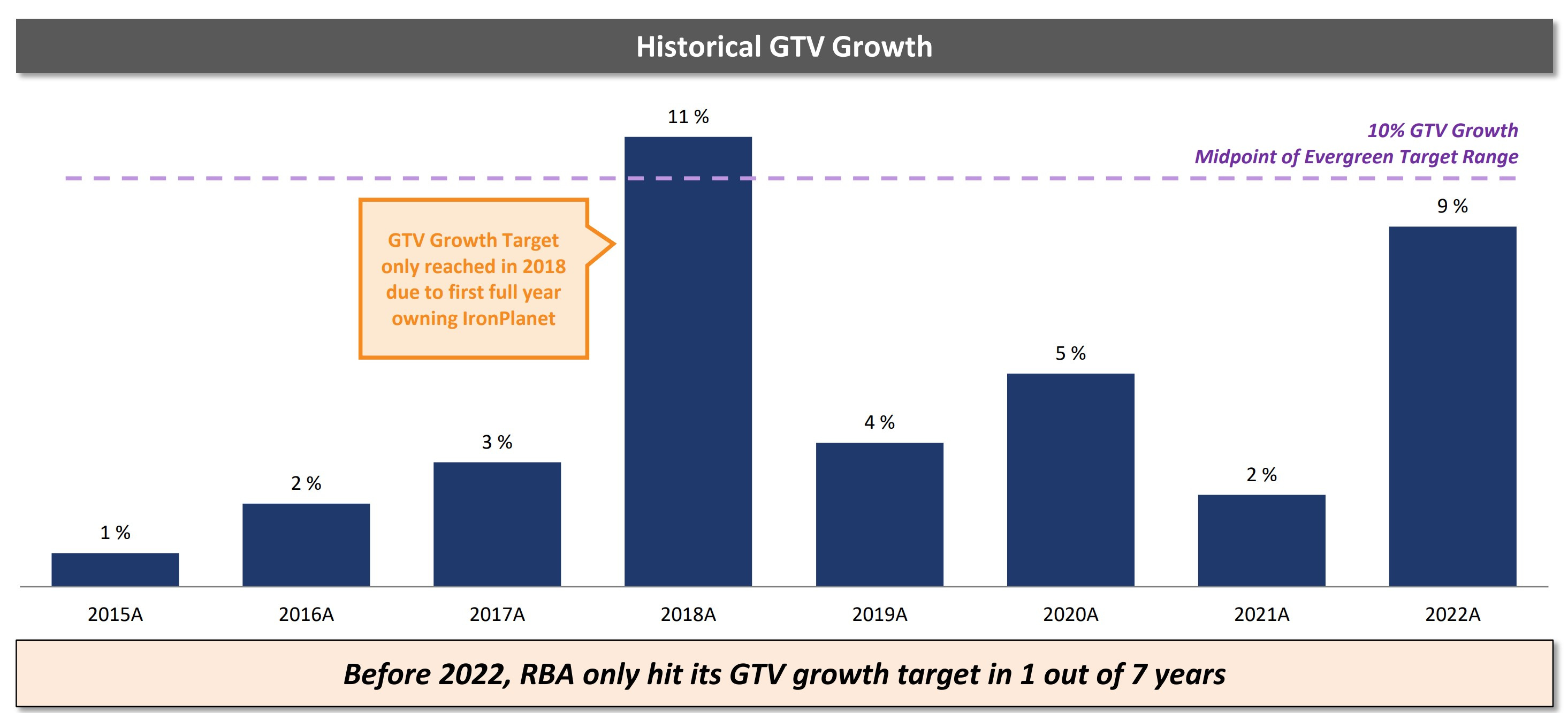
source: RBA presentation, February 2023
We’re being a bit cheeky here. To be fair, RBA has been a solid stock, outperforming the market over pretty much every time period (+1100% since its 1998 IPO, just over double the S&P 500 Total Return). But, again, that’s Luxor’s point: RBA is the better business (“fantastic on a standalone basis”, the fund wrote in its own February presentation), and as importantly it’s the business that RBA shareholders wanted to own.
IAA? Perhaps not quite as much.
The Risks To Owning IAA
One core concern we see post-merger is that RBA did not, to our eye, make a convincing strategic case. Rather, it made more of a financial argument. And it’s an argument based on owning what is clearly the second-best business in the space.
The best-in-class operator clearly is IAA’s rival, Copart CPRT 0.00%↑. The two companies share a duopoly, but Copart has bigger market share, better profit margins, and a sharply higher valuation. IAA stock went essentially nowhere in the three years after its spin-off from KAR Auction Services KAR 0.00%↑ in 2019. Meanwhile, CPRT has been one of the best stocks in the entire market, with a 10-year return just over 800%.
Luxor argued that the divergence in stock prices owes to a clear divergence in market share:
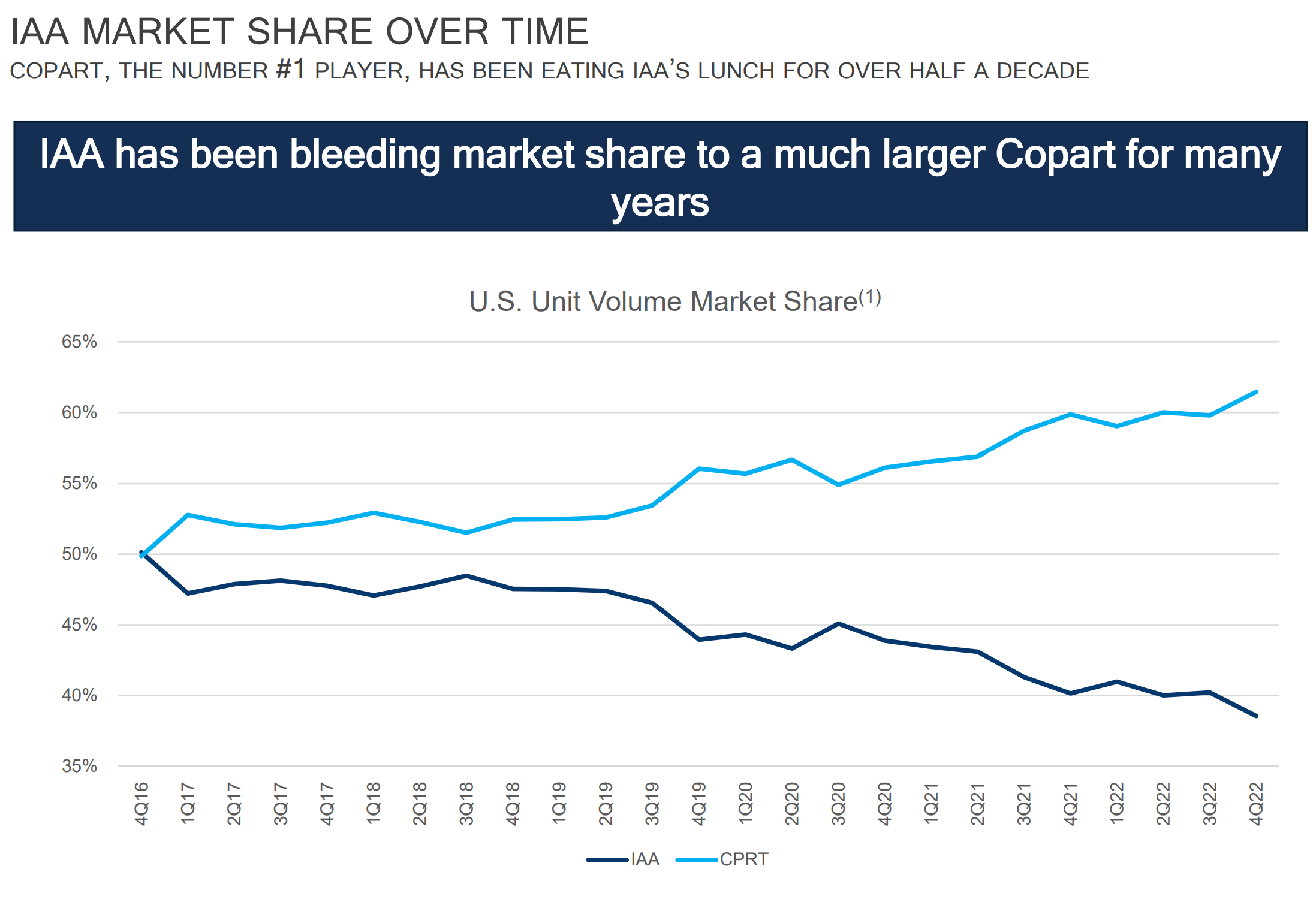
source: Luxor Capital presentation, February 2023
One of the big problems for IAA has been the loss of a key customer: Berkshire Hathaway unit GEICO. Luxor pointed out that IAA spent several years telling investors share losses at that insurance giant were over, only to be proven wrong again and again. Meanwhile, Copart managed to poach much of the business by simply providing better service3:
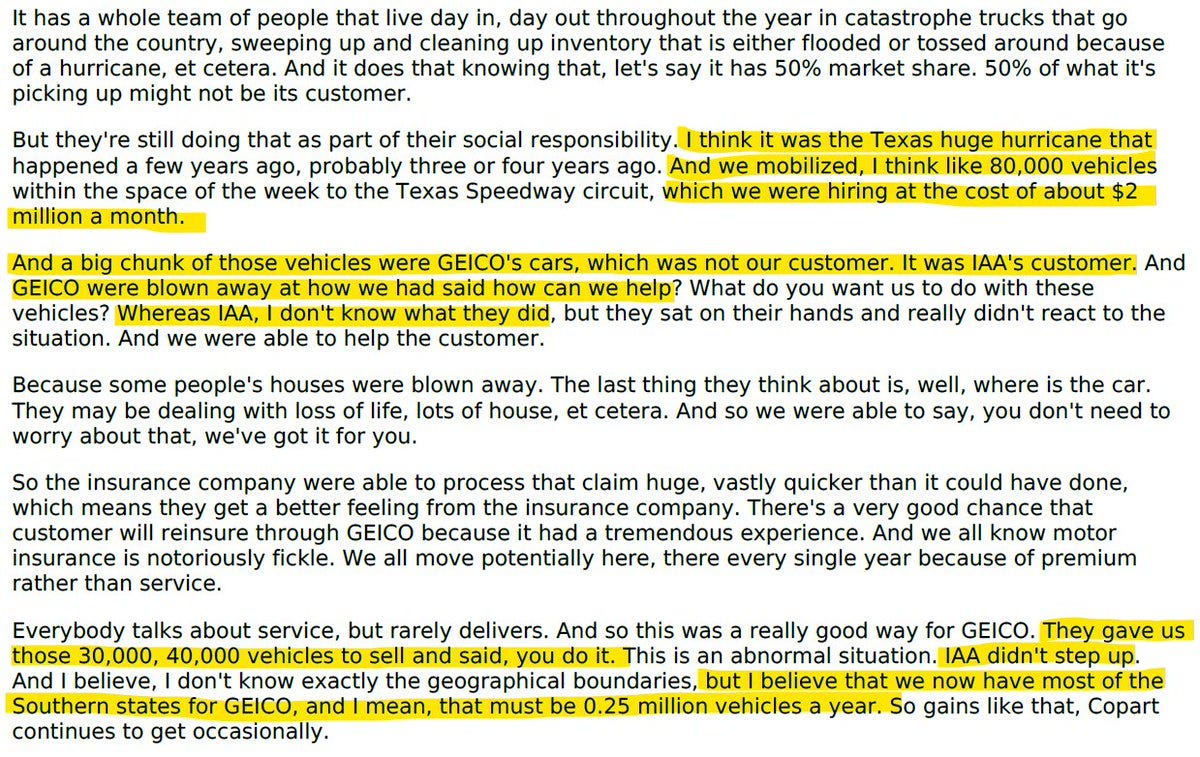
source: Tegus via Twitter
Yet RBA seems to argue, essentially, that the loss of GEICO business simply gave the company the ability to buy IAA at a better earnings multiple:
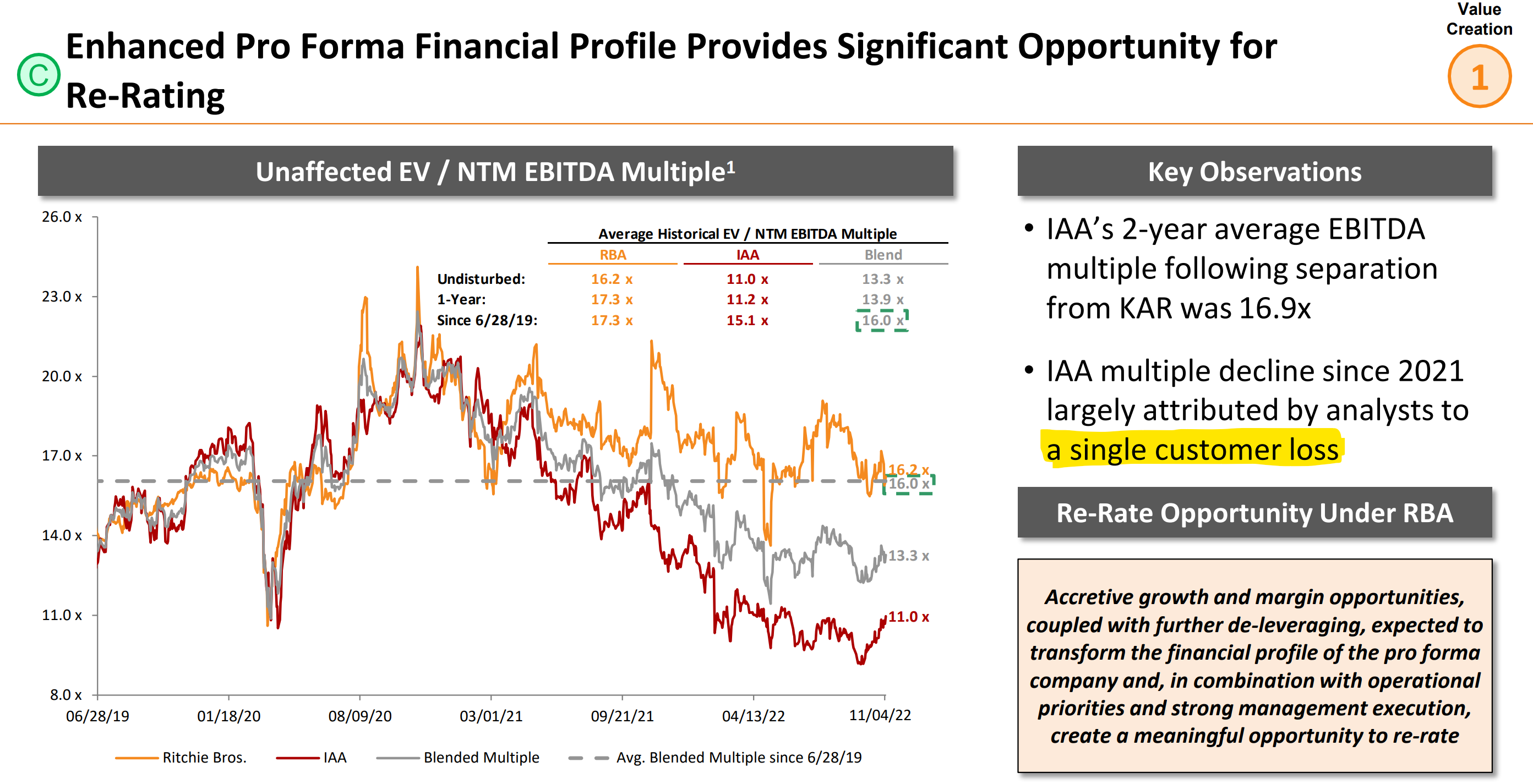
source: RBA presentation, February 2023 (highlighting by author)
This is not quite as bizarre as RBA management pointing out its own history of missed targets — but it’s a strange argument nonetheless. Once again, we see a financial argument rather than a strategic one. In this case, RBA is saying that it’s buying a turnaround play. IAA traded at ~17x EBITDA in 2020-2021; RBA now can get it for ~13x EBITDA pre-synergies and 11x post because of “a single customer loss”.
Indeed, one can imagine precisely this slide coming from the presentation of an existing shareholder in a public IAA, arguing that the market is overreacting to missteps around GEICO and ignoring the company’s ability to improve operations going forward.
But this seems exceptionally dangerous. And the irony is that no one should understand that better than Ritchie Bros. In the Luxor presentation from February (slide 19, where the firm is talking up how great RBA is rather than how weak IAA is) appears a quote from RBA chief executive officer Ann Fandozzi during an interview with CNBC’s Jim Cramer in December 2022. “We are the biggest by a factor of ten,” the CEO told the host. “It is a magical place to be.”
Copart admittedly is not the biggest by a factor of ten. But in marketplace businesses, being the biggest by a factor of two itself provides a competitive edge. RBA has that edge. IAA may not.
Valuation, The Cycle, And The Short Case
The IAA acquisition is not quite a “bet the company” deal for Ritchie Bros. But it is a big move — in large part because, at least in 2022, IAA was the more profitable of the two businesses. Last year, IAA generated $540 million in Adjusted EBITDA. The proxy statement suggests roughly flat performance year-over-year (and after Q1, RBA chief financial officer Eric Jacobs said that projection was “essentially our budget” for this year.) RBA posted Adjusted EBITDA of $465 million, with what looks like low- to mid-single-digit growth this year, in part because of spending required to manage sales increases going forward.
Fully diluted (this includes a $485 million preferred stock issuance to Starboard Value from February), RBA has a market cap of $11.1 billion. Net debt post-Q1 is $2.68 billion; Adjusted EBITDA this year should be a touch over $1 billion, after the two companies combined for $1.006 billion in 2022.
EV/EBITDA then looks to be about 13.7x. Give credit for the $120 million in synergies and the multiple drops about a turn and a half.
Those multiples can definitely work. Peer comparisons aren't hugely useful, admittedly. Even the proxy only offers CPRT and KAR as peers, along with a few precedent transactions. CPRT is at ~20x 2023 Adjusted EBITDA, KAR looks to be in the range of 9x, and RBA itself traded at 15x-17x before the merger was announced, and paid ~13x4 for Iron Planet back in 2017. An investor can cherry-pick any of those comps depending on her perception of the combined business.
To our eye, 13x pre-synergy and 12x post isn’t terrible for RBA — a good, dominant business — and IAA, a second-tier player but in an attractive and defensive duopoly. It’s probably low enough to incorporate some of the concerns seen post-IAA, and seems definitely low enough to keep us on the sidelines for now. Ritchie Bros. seems a strong enough business with a big enough moat that we’re not thrilled about betting against it, even if the stronger half of the business is only, at this point, half of profit.
But the multiple here is also high enough that RBA can tumble if some of the risks play out. We’d note that RBA on its Q1 call kept up IAA’s tradition of insisting that share losses at GEICO were over. Margins likely compress this year. Ritchie Bros. continues to increase take rates, which one bear has argued is opening the door to rivals to compete on pricing. There are clear cyclical risks, which RBA keeps tacitly admitting as it talks up the non-cyclical nature of IAA (including on the Q1 call).
More broadly, M&A is historically fraught with problems. And that history includes many transactions with a more obvious, more compelling strategic rationale than this one. RBA has diluted its shareholders and levered its balance sheet because it believes, apparently, that it’s getting IAA on the cheap. But, to our eye, IAA looks an awful lot like a possible value trap rather than a value play. It’s that sense that could provide the foundation for a short case at some point soon.
As of this writing, Vince Martin has no positions in any securities mentioned.
Disclaimer: The information in this newsletter is not and should not be construed as investment advice. Overlooked Alpha is for information, entertainment purposes only. Contributors are not registered financial advisors and do not purport to tell or recommend which securities customers should buy or sell for themselves. We strive to provide accurate analysis but mistakes and errors do occur. No warranty is made to the accuracy, completeness or correctness of the information provided. The information in the publication may become outdated and there is no obligation to update any such information. Past performance is not a guide to future performance, future returns are not guaranteed, and a loss of original capital may occur. Contributors may hold or acquire securities covered in this publication, and may purchase or sell such securities at any time, including security positions that are inconsistent or contrary to positions mentioned in this publication, all without prior notice to any of the subscribers to this publication. Investors should make their own decisions regarding the prospects of any company discussed herein based on such investors’ own review of publicly available information and should not rely on the information contained herein.
Vehicle salvage is mostly due to accidents, which have limited correlation to the macroeconomic
We hope readers enjoy the irony of the disgruntled shareholder resting its analysis on management targets, while executives apply the skepticism that is usually the province of precisely those disgruntled shareholders.
RBA tacitly supported this interpretation by detailing in its February presentation how IAA’s catastrophe response had improved from a pre-2017 approach.
The proxy cites a much higher 22x multiple, but RBA said when the deal was announced in August 2016 that it was paying 13x 2017 Adjusted EBITDA.