
Highlights:
Manufacturers of outdoor recreation products have been hit hard by a cyclical turn in recent quarters, with boat manufacturers the highest-profile losers.
This manufacturer has seen similar pressure: revenue dropped 11% in its fiscal 2023 and another 17% in the first half of FY24.
Taking the long view, valuation looks attractive. A current EV/EBITDA multiple of 13x is near a trough, and shares trade at a discount to tangible book value.
Timing and catalyst are clear concerns, but the name has a strong “buy it now and leave it alone for three years” type of case. Upside should arrive once the cycle turns again.
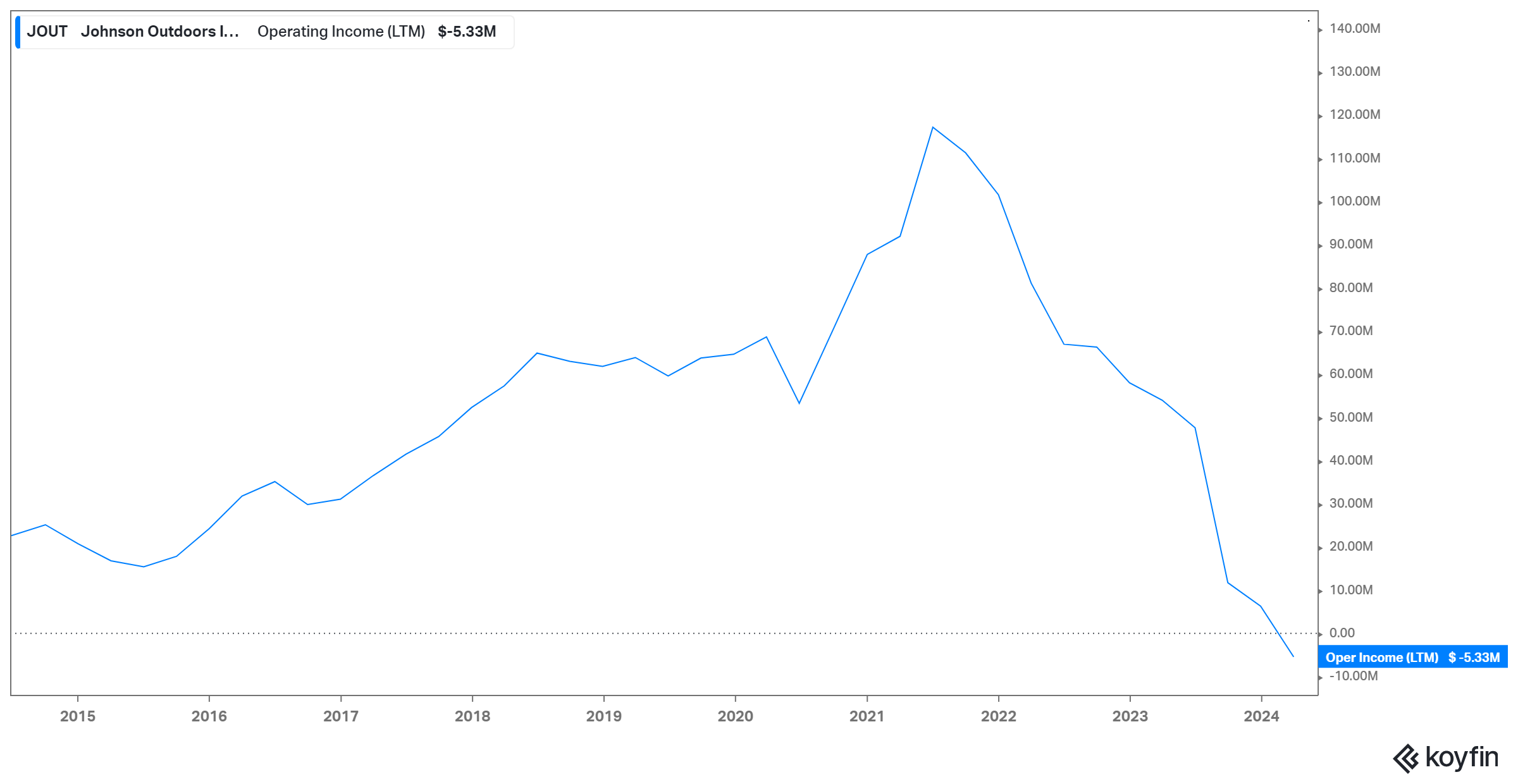
On its face, outdoor recreation products manufacturer Johnson Outdoors JOUT 0.00%↑ looks like an easy “buy this today and don’t look it at for three years” kind of play. The downward turn in boating and other outdoor activities has crushed the company’s results: revenue fell 11% in fiscal 2023 (ending September) and is down another 17% in the first of FY24. Meanwhile, operating income has been obliterated:
source: Koyfin
Of course, the company operates in an industry whose historic cyclicality was exaggerated by the novel coronavirus pandemic and its aftermath. It’s not a surprise that results have tanked. Nor do those results imply that this is somehow a worse business than it was in 2021, or for that matter in 2018.
The market seems to be interpreting recent results that way, however: JOUT hit a seven-year low this week. With the stock now at an exceptionally attractive valuation looking at both assets and past earnings, it does seem like the selling is an overreaction.
Even if a long position here is early (and, to be honest, it most likely is), looking out three or five years there’s a reasonable path for the stock to double. That may require riding out a few more ugly quarters, but the asset base provides some level of downside protection even if results stay weak.
Introducing Johnson Outdoors
Johnson Outdoors is a manufacturer of outdoor products used in multiple activities, but fishing is at the core of the company’s business. The Fishing segment accounted for 75% of revenue over the past four quarters, and 88% of segment-level operating profit1. The core products here are Minn Kota trolling motors, battery chargers and anchors, along with Humminbird fish finders and navigation equipment.
The Diving segment is the second-largest, at 13.4% of trailing twelve-month revenue. Johnson offers a complete line of equipment — ranging from weather and fins to buoyancy compensators and dive computers — targeted toward the higher end of the market.
The Watercraft Recreation segment (5.5% of TTM revenue) manufactures canoes and kayaks under the Old Town brand. Camping is a little over 6% of sales, but that figure will come down: in last year’s fourth quarter, the company began to wind down its Eureka! brand of tents and camping stoves. All that will remain is Jetboil, a manufacturer of lightweight camping stoves.
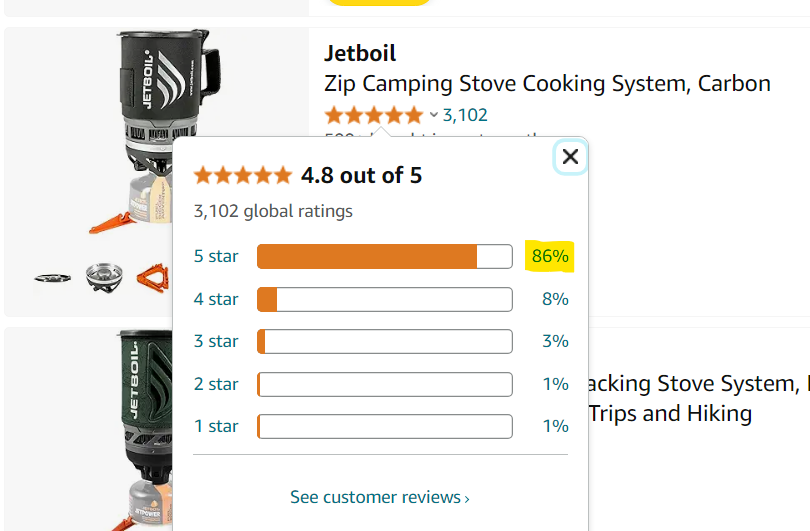
Overall, it is a solid, if not necessarily spectacular business. Both the Minn Kota and Humminbird brands are well-reviewed, even if neither is the most expensive product on the market. Johnson’s Scubapro brand has an excellent reputation in diving, and Jetboil (acquired in 2012) is an innovative product with highly satisfied customers:
source: Amazon (author highlighting)
Family Ownership
But Johnson Outdoors is also a somewhat weird company. Johnson is led by chief executive officer Helen Johnson-Leipold, who has been in the post for a quarter century. Johnson-Leipold is a direct descendant of Samuel Curtis Johnson Sr., who founded cleaning products giant S.C. Johnson & Son in the late 1800s. That business still is family-owned, and has made the Johnson family the seventh-wealthiest in America, by a Forbes estimate, with a total fortune clearing $38 billion. Adding to that total, Johnson-Leipold’s father founded Johnson Financial Group, which has over $10 billion in assets.
In that context, Johnson Outdoors seems almost like an afterthought2. The Johnson family controls the company, but mostly through dual-class stock (which gives it the right to elect six of nine current directors on the board). Across both classes, the family owns about 53% of outstanding shares. That stake is currently worth just over $200 million. If the Forbes estimate is correct, that’s ~0.5% of the family’s fortune.
The relative unimportance of the stake to the wealth of the Johnson family, and almost certainly to that of Johnson-Leipold (her husband is also the majority owner of the National Hockey League’s Minnesota Wild, a franchise worth over $1 billion), would seem to create risk for minority shareholders. The Johnsons might use the business as a personal piggy bank, or the company largely runs on autopilot with no sense of urgency.
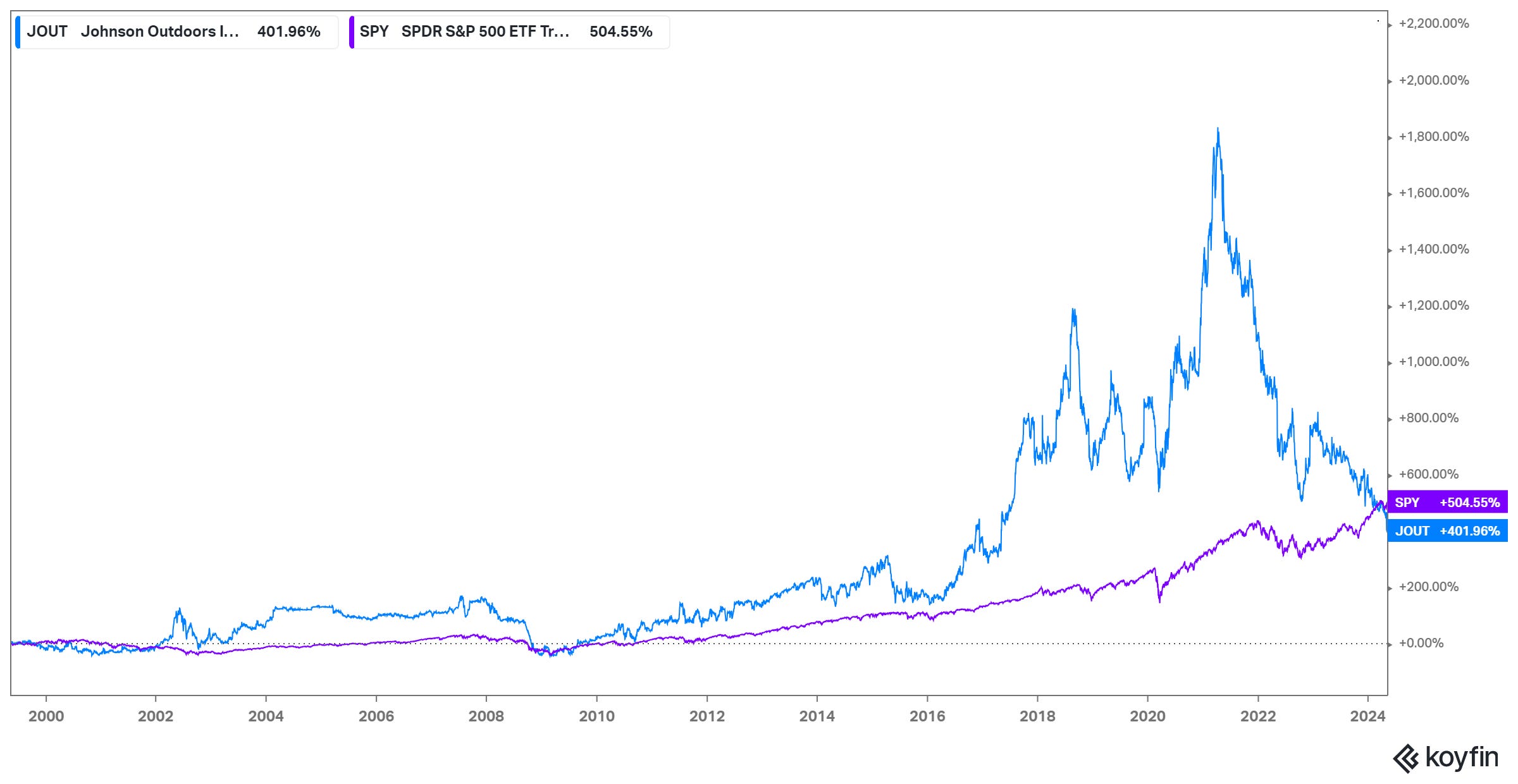
But in fact neither seems to be the case. Johnson-Leipold’s total compensation is relatively reasonable (and has come down in the past two years along with the stock price). And under her leadership, JOUT had outperformed the S&P 500 — often handily so — until about two months ago:
source: Koyfin; 25-year chart
It’s worth noting that the period of sharp outperformance began around early 2016, well before the pandemic boosted demand for outdoor recreation. What happened then is that the fishing business simply made a series of great products. That included the launch of i-Pilot, an innovative wireless system that integrated Humminbird fish finders and GPS with the Minn Kota trolling motor and anchor.
So there actually is a history of solid execution here over time, and an emphasis from the Johnson family and from Johnson-Leipold on creating shareholder value. In that context, it’s not hard to wonder if the Johnson family will react if they see the stock as undervalued. They’ve done so before.
Two decades ago, Johnson-Leipold led an effort to take the company private, originally offering $18 per share. That price was raised to $20.10, but the go-private did not receive the required approval from two-thirds of shareholders. With the CEO now 67 years old, there does seem to be a scenario where the Johnson family tries again. It might be time to allow a next-generation leader to run the business outside the spotlight of the public markets — or, if those leaders would prefer to run the far more valuable businesses, to sell Outdoors and focus on the biggest wealth drivers3.
The Margin Problem
Of course, Johnson-Leipold has also been CEO during a period in which JOUT has posted its worst performance since the financial crisis: shares are down three-quarters from their April 2021 peak. And so the key question is to what extent that decline has been driven by external factors, both in terms of the operating business and the equity market.
Unquestionably, the cycle is a major issue. Demand exploded in the 2020-2021 period, which pulled forward sales. We highlighted the potential pressure on the boating industry nearly two years ago in recommending a short of boating stocks; while we were somewhat early on that call, the bust clearly has arrived. Trailing twelve-month revenue for Brunswick Corporation BC 0.00%↑, which spent years building out its parts and accessories business to create a less cyclical business4, is down more than 12% as of Q1 2024.
Smaller boat manufacturers are doing even worse. Sales at MasterCraft Boat Holdings MCFT 0.00%↑ are down 33% in four quarters. For Malibu Boats MBUU 0.00%↑, the figure is 24%, and its biggest dealership is in significant financial trouble and has sued the boat maker for, essentially, channel stuffing.
Johnson is not quite the same business as these peers, given its focus on motors and equipment, plus the ~25% of revenue that comes from other outdoor markets. But it’s not immune to the pressures on the industry, or the effects of pulled-forward sales generated in calendar 2020 and 2021. Management has discussed the problem facing so many consumer-facing manufacturers: end retailers are slowing purchases to mitigate their own inventory issues. In the context of the broader environment, simple common sense would dictate that the cycle is driving recent weakness to at least some extent.
The key question is whether there are other issues at play. One obvious problem for Johnson right now is profit margins:
source: author from JOUT filings
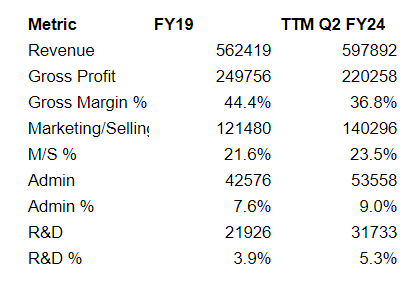
Trailing twelve-month revenue is relatively close to where it was in fiscal 2019. Yet margins are far worse. In FY19, operating margins were 12%. Even excluding the impact of ~$4.8 million in costs to wind down the Eureka! brand, trailing twelve-month operating income is basically zero.
What’s Going On With Johnson’s Margins?
Again, the simple answer would seem to be that the cycle is at fault. No doubt, it’s played a huge role.
Given pressures across the industry, the selling environment has become highly promotional: chief financial officer David W. Johnson5 said on the Q2 call that the 17% year-over-year decrease was driven more by pricing than by unit volume. Longer-term, the CFO still sees a path for gross margins to return to the 40%-plus level, once the industry normalizes. But on the Q2 call, Leipold-Johnson seemed to argue that the promotional environment was here to stay.
Below the top line, Johnson is trying to find cost savings to lower opex, but a massive reduction at this point seems unlikely. Johnson-Leipold has said repeatedly that the company needs to continue investing in new products. There’s been zero indication the company plans to change that strategy. In the context of an inflationary environment, none of the opex lines actually have grown that fast: on an annualized basis since FY19, marketing spend has increased 3%-plus, admin 5%-plus, and R&D a perhaps more concerning 8.6%.
The problem instead is that revenue growth simply hasn’t kept pace. Again, the easy explanation is that the cycle has turned, but there is a sign that there may be other issues on the top line. Notably, competitor Garmin GRMN 0.00%↑ has called out relative strength in its Marine segment. Revenue excluding an acquisition declined just 3% in 2023; Johnson’s fishing segment over the same period fell 16%. Organic revenue in Garmin’s Q1 was actually +3%, Garmin’s management has talked up taking market share in recent quarters, and it does seem like they have taken share from Johnson.
Beyond Garmin, getting a sense of the competitive environment is difficult. Rival products from Brunswick are a tiny portion of that company’s ~$6 billion in sales, and the remaining market entrants are private. The read from other outdoor manufacturers suggests that Garmin is outperforming the market, rather than Johnson significantly underperforming it. Still, the gap in results between the two companies does raise concerns that Johnson’s execution may be an issue as well.
The other question is what margins are supposed to look like. Operating margins have compressed more than 1100 basis points since FY19. But the second half of the 2010s also showed a marked increase in profitability from historical levels:
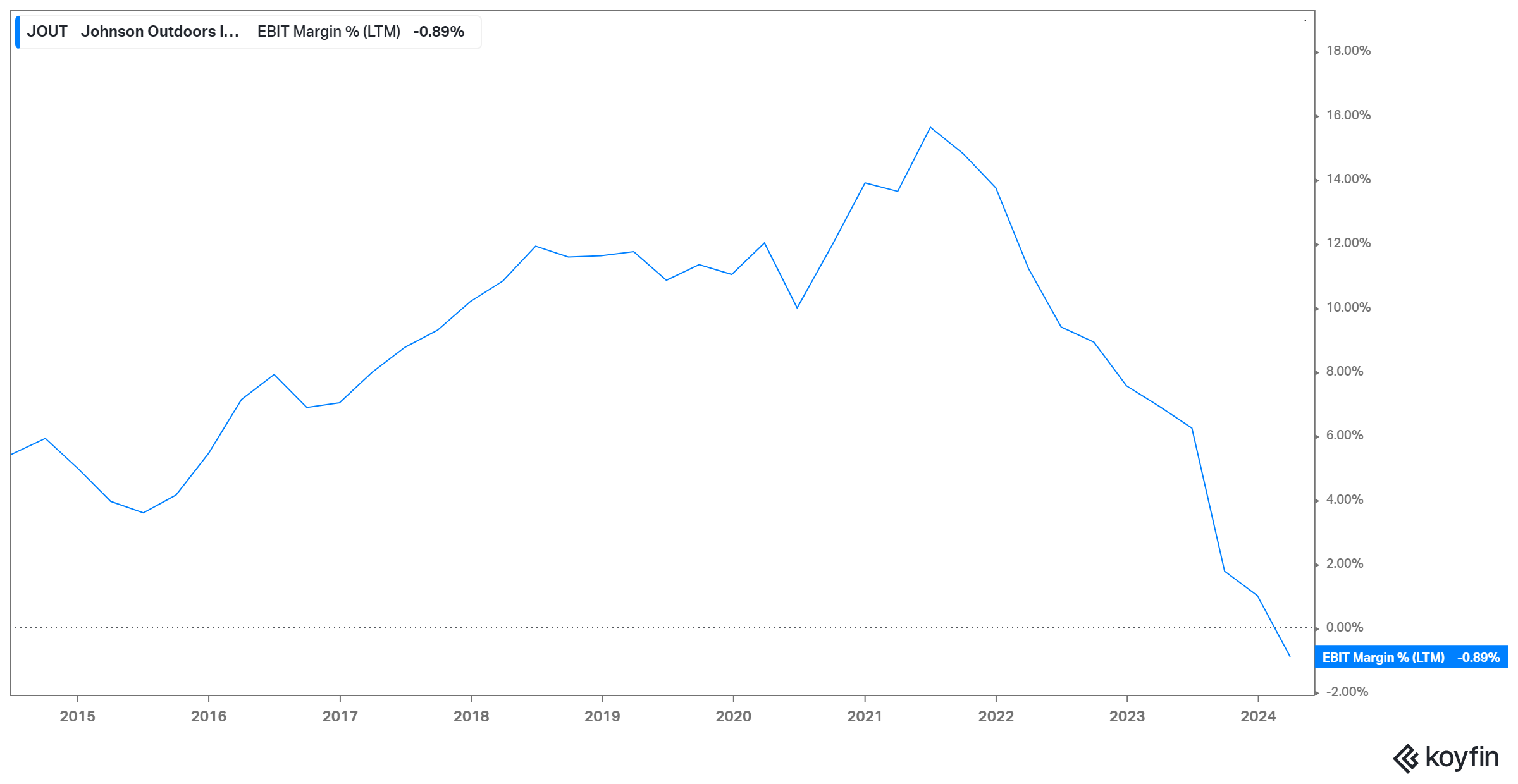
source: Koyfin
Even before the pandemic, there was a concern that Johnson might be overearning to some extent. Boat demand was strong thanks to a solid economy and low interest rates. The impact of new products helped pricing and thus gross margin, and it was that line that drove essentially the entire expansion in operating margin.
So there are two company-specific risks here. First, that Johnson isn’t quite as good a company as it appeared to be before the pandemic. Second, that the aftereffects of the pandemic and its pull-forward demand aren’t quite all that’s affecting the income statement.
Both seem to undercut the aforementioned simple case: that Johnson, when the cycle inevitably turns, will bounce back to its FY19 profitability and valuation. That simple case suggests triple-digit upside: JOUT finished 2019 at $76.70, more than 100% above Friday’s close, and the stock trades at less than 6x net income from FY19. But if FY19 margins were in fact elevated, and if the promotional environment is the new normal, that case falls apart in a hurry.
The Market Question
The other question is whether cyclical opportunities exist in the same way it used to. Does the market really leave out these seemingly ‘easy’ opportunities anymore?
Perhaps the explanation is different: the market is correctly pricing in underlying weakness that coincides with the cycle, rather than being driven by it. And that analysis is what is creating the decline in JOUT, while higher-profile, higher-quality (and much larger) cyclicals like HD avoid knee-jerk selling based on soft headline results.
Valuation And The (Long-Term) Bull Case
Those risks are real, and worth considering. But with JOUT closing below $38 on Friday, valuation has moved to a point where Johnson almost has to be a significantly weaker business than it was previously for the stock not to work on a multi-year basis.