
Highlights:
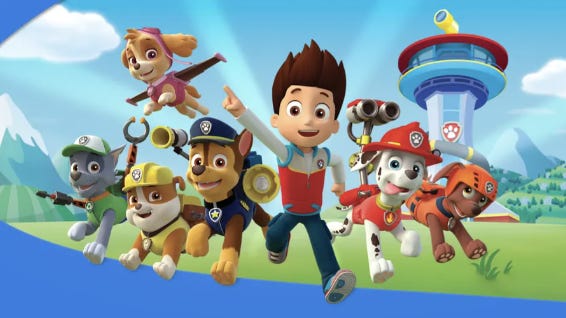
Ten years after its release, PAW Patrol remains one of the most popular children’s shows in the world.
Yet shares of its producer, Spin Master, are actually negative over the past five years.
That contradiction isn’t explained by underlying business performance — and the stock now trades under 6x EBITDA.
I now live in a PAW Patrol house. I don’t mean that literally (not quite, anyway), but we have dozens of toys based on the children’s cartoon, an app on my phone, and a regular stream of requests to watch various versions of the show, or movies, pretty much from morning to night.
Other parents in my suburban town are in the same situation. And yet, for PAW Patrol developer Spin Master (TOY.TO / $SNMSF), the franchise hasn’t done much for the stock of late. With valuation low and trading not quite matching the performance of the underlying business, there does seem to be an intriguing opportunity here — with one hugely important caveat.
source: Spin Master
Introducing Spin Master
Spin Master was founded in 1994 by two childhood friends; a college classmate joined soon after. The Canadian’s firm first product was the Earth Buddy, which “grew” hair using grass seeds that laid on a bed of pantyhose-wrapped sawdust:

source: Spin Master
The following year saw a bigger hit, at least for people like myself who attended liberal arts colleges on the East Coast in the late 1990s. The company launched Devil Sticks, a set of three batons used to perform tricks. The ‘spinning’ motion of those sticks provided the company with its current name.
More success followed including the Sky Shark, a model plane propelled by compressed air. In 2003, Spin Master won the potentially lucrative license for the Wiggles, at the time likely the biggest child-focused music group in the world. That year, per the corporate website, sales had reached $300 million.
Over the next decade, Spin Master saw continued success and developed brands that continue to this day: Air Hogs (based on the Sky Shark), Marshmallow indoor furniture, Moon Sand (now known as Kinetic Sand) and anime franchise Bakugan.
The company moved into licensed products through agreements with the IP holder for Yo Gabba Gabba! and with DreamWorks and Disney DIS 0.00%↑ for multiple films. The company made small acquisitions1 as well — and had a few misses (including an entry into the fashion doll space). Overall, during this period Spin Master looked much like a younger version of Mattel MAT 0.00%↑ or Hasbro HAS 0.00%↑, with a diversified portfolio of products whose results ranged from long-term successes to relatively quick failures.
In 2010, after the success of Bakugan, Spin Master wanted its own intellectual property. It chose to focus on the preschool segment, and reached out to several producers in the category. Keith Chapman, who had created the popular Bob The Builder, responded with a pitch for a show about puppies performing rescue missions. In August 2013, PAW Patrol was released on Nickelodeon in North America. The response was so immediately positive that the launch of licensed products was moved up by nearly a year to meet demand.
Over the next six years, PAW Patrol generated $8 billion in retail sales worldwide. In 2019, it was the most popular brand among children six and under, ahead of any Disney brand. The show’s appeal does not seem to have waned: in 2022, PAW Patrol was the most watched pre-school show on Netflix NFLX 0.00%↑ globally, which is all the more impressive considering Netflix does not own the U.S. rights2. The show airs in over 170 countries and more than 35 languages. The IP has launched two movies and several live stage shows, along with an endless array of toys.
Buoyed by the show’s immediate popularity, in July 2015 Spin Master went public on the Toronto Stock Exchange at a price of C$18. Shares have nearly doubled since then, providing annualized returns of over 8%, though TOY has underperformed both the S&P 500 and the NASDAQ 100 over that period.
Spin Master Stock Stalls Out
(Author’s note: Spin Master is based in Canada, but reports in U.S. dollars. All use of ‘$’ refers to U.S. dollars; Canadian dollars, when referenced, will be signified with ‘CAD’.)
More recently, Spin Master stock has not just underperformed, but posted negative returns:
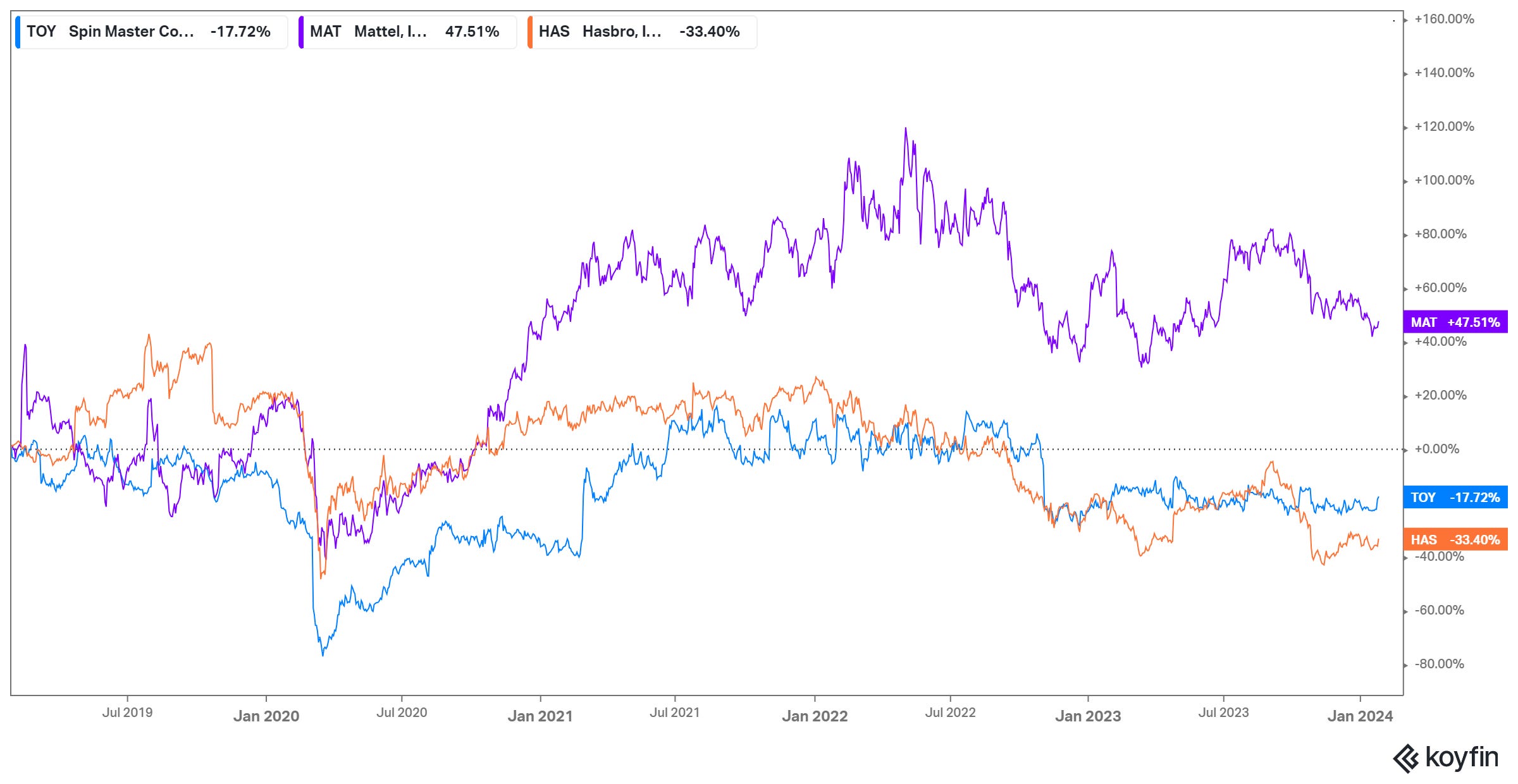
source: Koyfin; chart of total returns
As the chart shows, toy stocks haven’t done particularly well. Even a worldwide hit with the 2023 film Barbie has left Mattel MAT 0.00%↑ basically flat on a three-year basis, while Hasbro HAS 0.00%↑ shareholders are down by about one-third.
But for Spin Master, there’s a fairly obvious inflection point at play, in which the company shifted from a growing business to a more mature one:
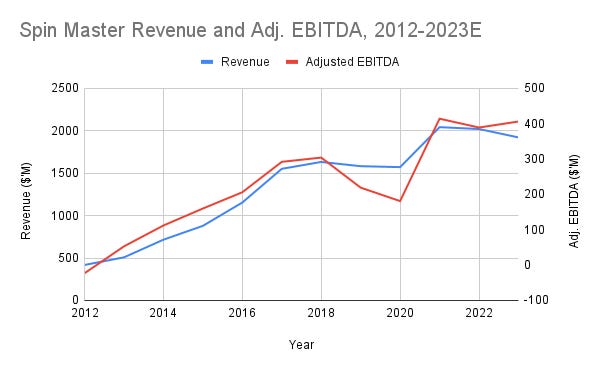
source: author from Spin Master annual reports
But the chart of the business and the chart of the stock don’t seem to quite line up. If you described Spin Master’s business to an investor, and then showed her the stock chart, she would probably guess that the business, and PAW Patrol, had flatlined.
Obviously, that’s not the case. Yet TOY.TO has traded as such — and certainly seems priced as such. At Thursday’s close of 35.47 CAD ($26.34), the stock trades at ~5.4x the consensus EBITDA estimate for the year. Post-Q3, the company had $650 million in cash, more than 20% of its $2.83 billion market cap, and no debt. Balance sheet concerns don’t explain the light multiple. Nor does sector sentiment: based on 2023 consensus, MAT is at 9x and HAS nearly 12x EBITDA.
The valuation and trading seem somewhat strange. This is a business that is growing, seemingly on an organic basis. Spin Master has been acquisitive, but it’s not like it’s buying growth: over the past six years and three quarters (as of the end of Q3), the company had spent a little over $600 million in cash on acquisitions. In that context, organic profit growth might be modest3, but it’s still positive.
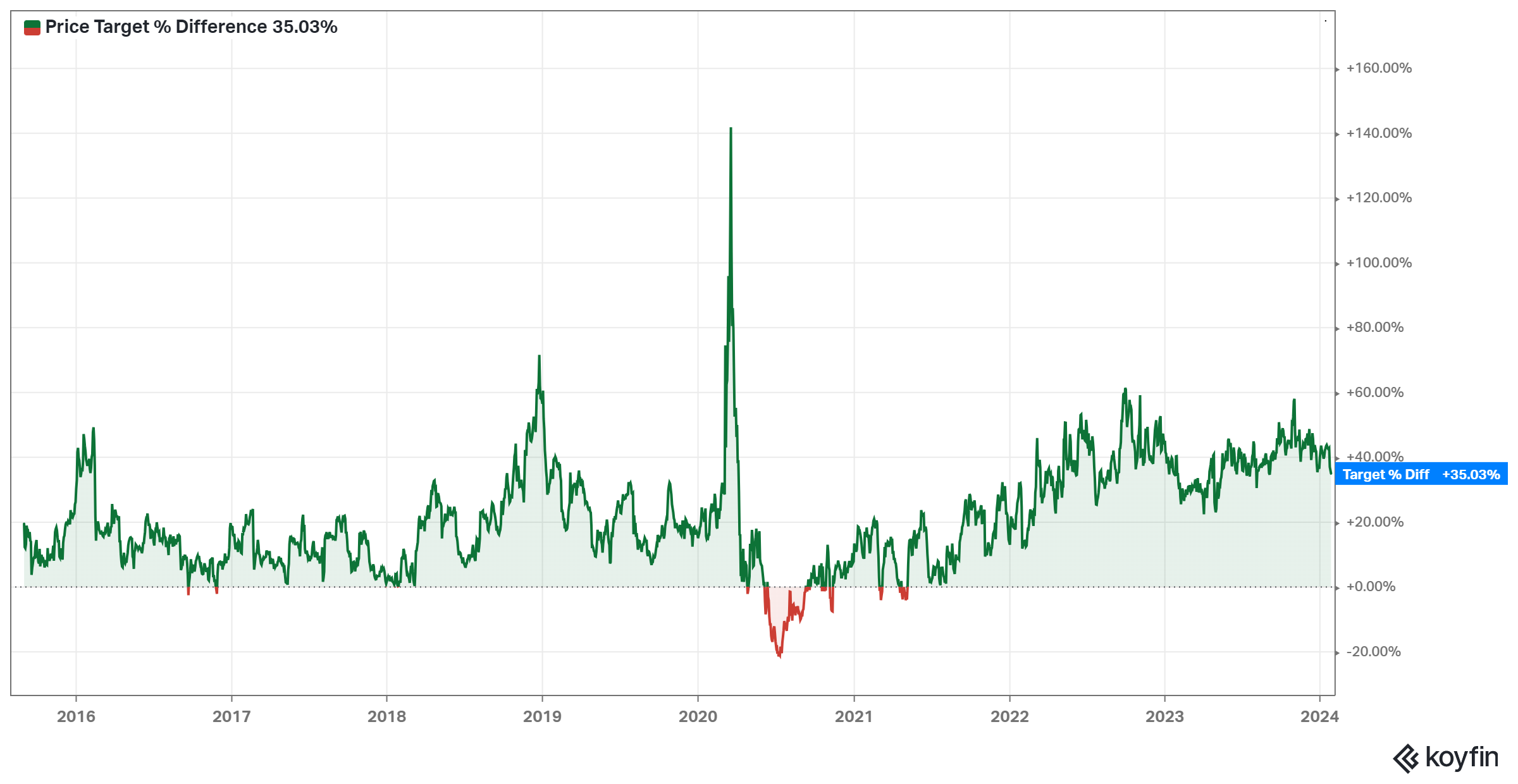
Despite that, investors are giving the company very little credit for future growth. Even analysts seem to be noticing. The gap between the consensus price target and the share price has steadily increased over the past several years:
source: Koyfin
The gap for TOY is larger than either HAS (20%) or MAT (25%), suggesting that analysts (though it’s worth noting they’re not necessarily the same analysts) see Spin Master as the better buy, at least for now.
Why Does TOY Get A Discount?
The question is why TOY trades at a discount to two ostensible peers. Size and scale is one potential explanation, but that should be offset by the fact that both Hasbro and Mattel have reasonably levered balance sheets.
The size of Spin Master’s entertainment segment relative to the business as a whole does skew EBITDA a bit, since the segment generates high amortization of development costs. But, overall, Paw Patrol’s capex plus purchase of intangible assets has run at generally a mid-20s percentage of EBITDA. That’s higher than the usually mid-teen-ish proportion for Hasbro and Mattel, but not quite enough to justify such a significant gap in multiples. Meanwhile, the importance of entertainment and a growing digital gaming division (about 15% of total EBITDA) might suggest a higher multiple relative to pure-play toy companies.
The consistent investment in acquisitions is another possible concern for investors, one that in theory should have been amplified in October. That month, Spin Master announced it was paying $950 million for Melissa & Doug, a manufacturer of wooden toys for preschoolers. But the market actually liked the deal, as TOY shares rose on the news.
It’s worth noting as well that even the post-synergy multiple there is 8.1x EBITDA, which too raises the question of why TOY continues to trade at less than 6x. If anything, Melissa & Doug should have raised the consolidated multiple. At $950M, that business accounts for ~30% of Spin Master’s pro forma enterprise value.
From a quantitative perspective, there doesn’t seem to be a compelling explanation. TOY just looks too cheap.
Is The Business Good Enough?
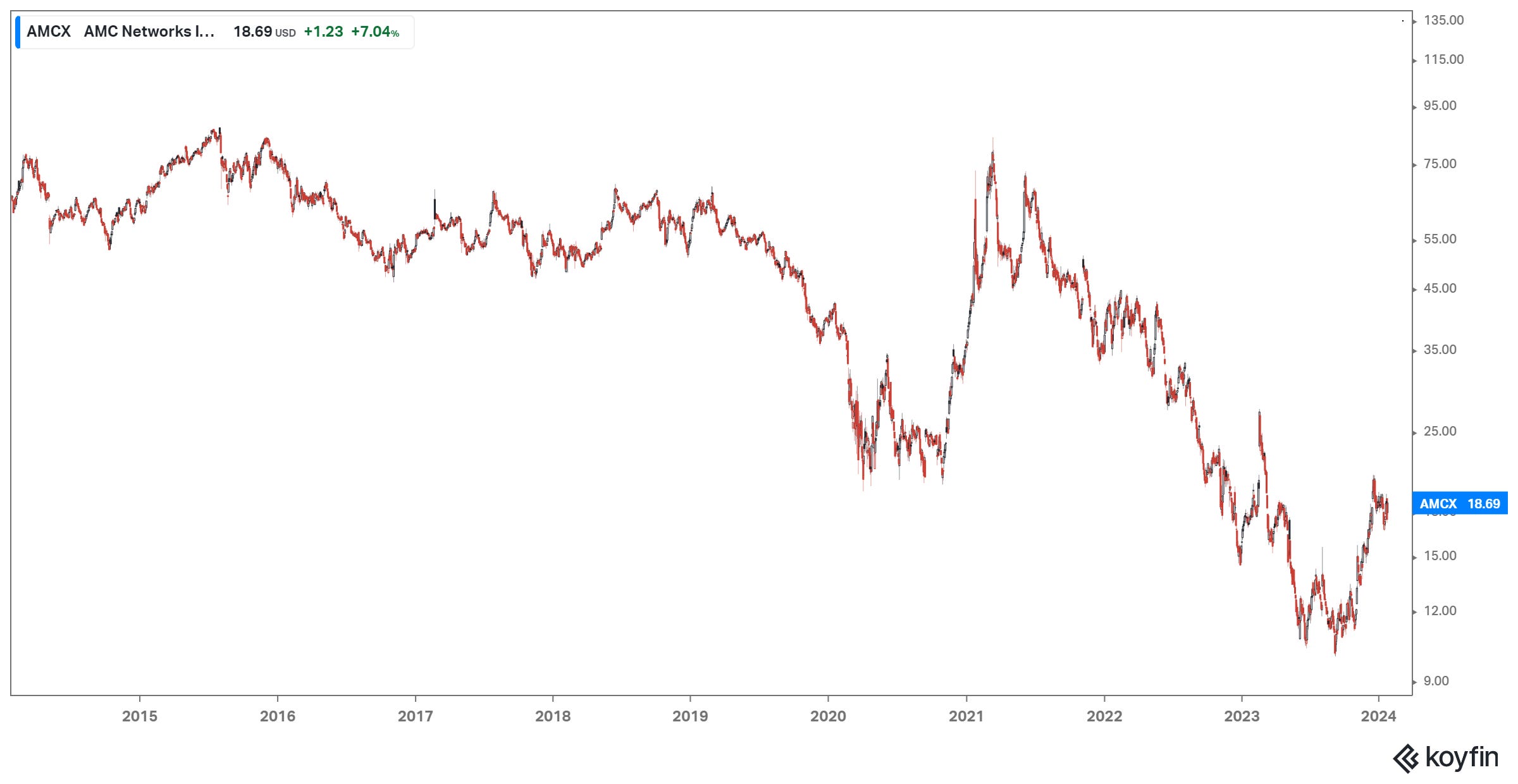
For years, AMC Networks AMCX 0.00%↑ looked ridiculously priced from a fundamental perspective. Shares traded at less than 4x EBITDA, and then less than 3x EBITDA, even as bottom-line figures were generally headed in the right direction. All along, however, AMCX proved to be a vicious value trap:
source: Koyfin
The core problem with AMCX was that the business was heavily reliant on its major franchise, The Walking Dead. And when that franchise inevitably grew stale, profits would plunge, which in combination with a leveraged balance sheet would collapse equity value.
But there was another, less-obvious, problem: AMCX didn’t have a second hit. As in, pretty much ever. Most readers will know that the network aired Mad Men, Breaking Bad, and Better Call Saul — but, unlike Dead, it didn’t own those shows. Even today, AMC’s second-biggest owned show is probably something like Catch And Halt Fire; a well-regarded program, to be sure, but not necessarily a lucrative one.
AMCX provides an interesting analogue to TOY. Spin Master, too, seems heavily reliant on PAW Patrol. Neither company breaks out the exact proportion of revenue from either show (media companies are notably tight-lipped), but for Spin Master, PAW Patrol might be responsible for half of total EBITDA, and perhaps more than one-third of free cash flow4.
And, like AMC, there’s a real question about what the second-best product is. Spin Master produces licensed toys for DreamWorks property Gabby’s Dollhouse (we own all of those too), but that aside the second-best owned brand is maybe skateboarding brand Tech Deck, or possibly Air Hogs. The fact that the answer isn’t obvious, as with AMC, is an important part of the answer.
There are some differences, however. Spin Master’s balance sheet is much better, with net leverage under 1x even after the Melissa & Doug acquisition. The children’s entertainment business isn’t seeing fragmenting viewership to the extent linear television did in the late 2010s5.
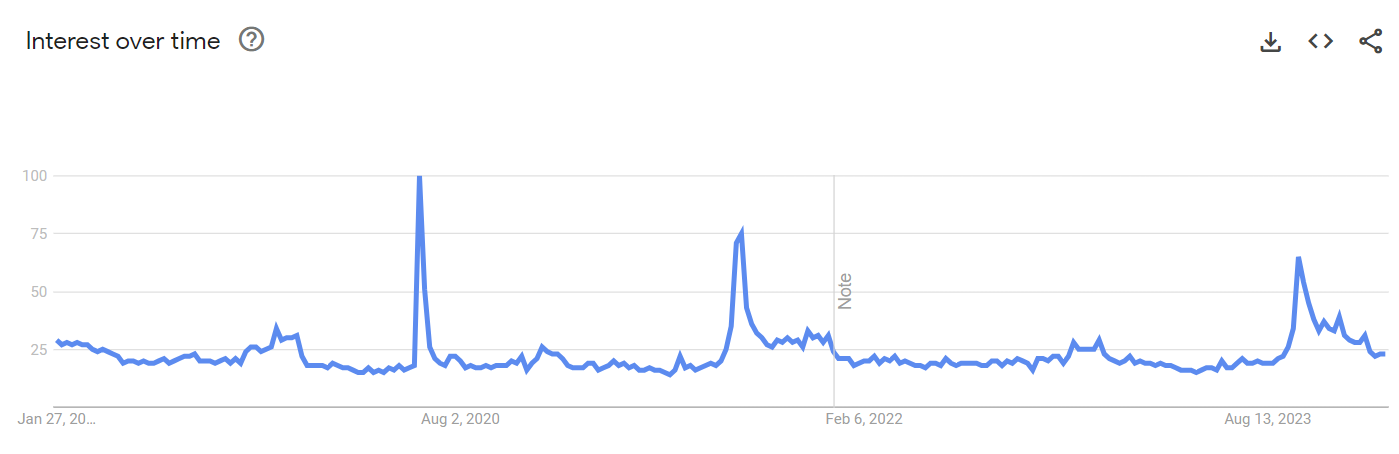
But the biggest difference is that it’s not necessarily clear that PAW Patrol is going to follow the same trajectory as The Walking Dead, or indeed as the average adult show does. Ten years after its launch, the franchise still looks strong, at least based on the available data. Google searches for “PAW Patrol” look fine:
source: Google Trends
PAW Patrol: The Mighty Movie, released in 2023, did $202 million in worldwide box office. The first film, PAW Patrol: The Movie, came out in 2021 and generated $151 million. Post-pandemic behaviors might provide some tailwind to the more recent picture, but here too there is no sign that the franchise is actively weakening.
Meanwhile, children’s programming can have exceptionally long lifespans. (So, for that matter, can anything animated; see The Simpsons and Family Guy.) And Spin Master management has made an effort to launch new imprints within the PAW Patrol series, such as Aqua Pups and Jungle Pups. New characters have been added as well. A cynic might argue that these additions are created simply to sell more toys6, and that might well be true, but the universe (for lack of a better term) is expanding as well.
It does seem probable that pressure arrives on PAW Patrol eventually, if only because the odds are that at some point there will be the next big thing for children ages 2 through 6. But even a gentle decline is more than manageable in the context of the current valuation, particularly if Melissa & Doug winds up being a solid buy. And there’s a tailwind built into 2024 from the acquisition and additional revenue and profit for the second film.
In this market, it’s exceptionally difficult to own these kinds of names. But if the market does start to appreciate the story, TOY stock can be a winner. At the least, shareholders can rest assured knowing that my family is doing our part to get the stock higher.
As of this writing, Vince Martin has no positions in any securities mentioned.
Disclaimer: The information in this newsletter is not and should not be construed as investment advice. Overlooked Alpha is for information, entertainment purposes only. Contributors are not registered financial advisors and do not purport to tell or recommend which securities customers should buy or sell for themselves. We strive to provide accurate analysis but mistakes and errors do occur. No warranty is made to the accuracy, completeness or correctness of the information provided. The information in the publication may become outdated and there is no obligation to update any such information. Past performance is not a guide to future performance, future returns are not guaranteed, and a loss of original capital may occur. Contributors may hold or acquire securities covered in this publication, and may purchase or sell such securities at any time, including security positions that are inconsistent or contrary to positions mentioned in this publication, all without prior notice to any of the subscribers to this publication. Investors should make their own decisions regarding the prospects of any company discussed herein based on such investors’ own review of publicly available information and should not rely on the information contained herein.
One clear strategy has been to buy up old hits. Spin Master now owns the Rubik’s Cube, Etch A Sketch, Shrinky Dinks, and plush toy manufacturer Gund, founded in 1898.
In the U.S., PAW Patrol airs on Paramount property Nickelodeon (I’d guess about 80 hours a week based on my experience in hotels) and streaming platform Paramount+.
Adjusted EBITDA this year still should be up over $100 million-plus from the 2017 level. Either organic growth is positive, or Spin Master has acquired these businesses at a very attractive weighted-average multiple of less than 6x EBITDA. There’s some good news in there somewhere.
The franchise no doubt drives the overwhelming majority of Entertainment revenue, which is ~one-third of EBITDA on a trailing twelve-month basis. It’s likely a huge contributor to Toys as well: Preschool and Dolls & Interactive was more than 40% of Toy segment revenue in 2022.
The audience for The Walking Dead peaked above 17 million, a number that now is pretty much unfathomable outside of live sports.