
I’m a fan of Sonic. For several years, I lived in Oklahoma City, where the drive-in chain is headquartered. As I was then still young enough to eat at a fast-food restaurant without needing a three-hour nap immediately afterwards, and Sonics were (and are) everywhere in the city, I visited often.
When my family and I moved a little over a year ago to our new home, I was happy to discover there was a Sonic just about within walking distance (on the way there, anyway). I go more than I probably should at this age. And the experience, almost without exception, is close to awful.
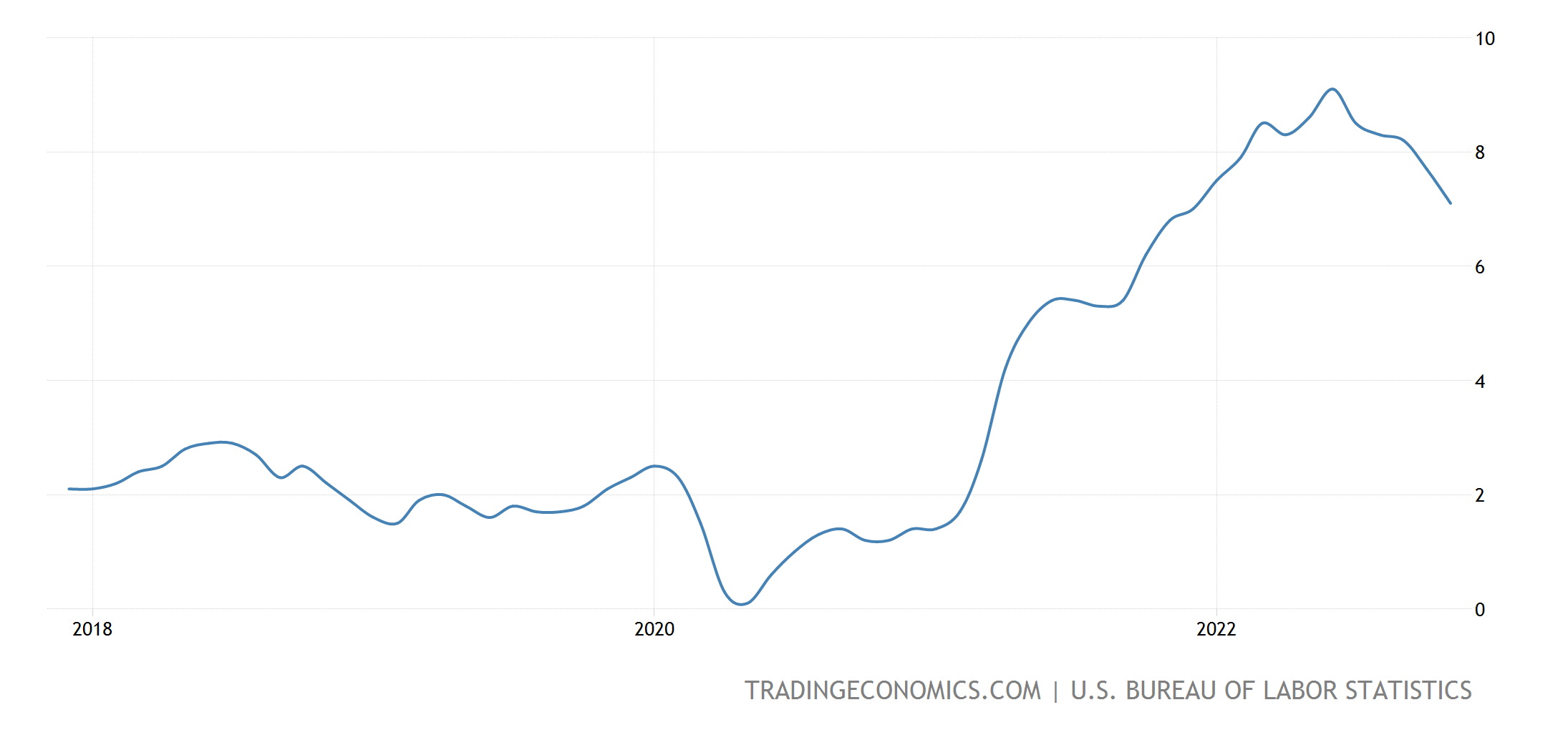
Inflation Arrives
source: Trading Economics
There are many drivers of the inflation that accelerated in the U.S. beginning in the second half of 2021. Given that the trend has become a political football as well as a source of economic discussion, the nature and size of those respective drivers is up for significant debate.
But, very broadly speaking, we’d argue that a significant cause is that the pre-pandemic model for the U.S. economy model simply broke. That model — which led to four decades of minimal inflation and, as a result, a concurrent bull market in bonds — looked like this:
Heavy imports, notably from China, deflated prices of lower-cost goods.
A shift to a “just in time” supply chain strategy minimized storage and breakage costs, providing further downward pressure on products at nearly every price point.
The cost of services was depressed by stagnant real wages, particularly for the lowest-wage workers.
To varying degrees, each of those pillars has been damaged over the past two years. Soaring container costs led to a marked increase in the price of imported goods. The “just in time” strategy led to massive shortages; in many cases, gluts soon followed:

As a result, by one survey nearly half of chief financial officers are moving away from “just in time” and returning toward more resilient, if higher-cost, strategies.
In the services space, too, the world seems to have changed. Figures from the U.S. Chamber of Commerce show that leisure and hospitality has the highest quit rate of any industry, with the rate staying above 5.4 percent since mid-2021. But over that stretch it’s also had the highest hiring rate — which has hovered between 7 and 9 percent.
As a result, as of October ~60% of job openings in the industry went unfilled. In wholesale and retail trade, the figure is ~70%. The class of workers on which the service economy was built simply isn’t big enough anymore.
Why Sonic Wasn’t Any Good Last Time
To be clear before we go on, the point here is not to complain about the service workers who are doing their jobs in the moment. I personally worked those types of jobs, mostly as a waiter, in my younger years and I retain a tremendous amount of respect for anyone who works with the public (particularly in-person).
It’s not to complain about those who aren’t working, either. We’re skeptical of the narrative that the labor shortage is being driven by laziness. (Here’s a link to a fun Twitter thread highlighting the history of “they don’t want to work anymore”, which goes back over a century at least.) Even the Chamber of Commerce — an organization which represents business, not labor — cites demographic factors, early retirements by “baby boomers”, and childcare concerns as the likely, albeit not definitive, core causes. (One would think that “long COVID” probably plays a role as well.)
Rather, as the Chamber itself points out, we simply don’t have enough employees. If every single unemployed person (ie, in the workforce but not currently working) were hired, as of October the U.S. would still be about 4 million workers short.
That shortage is not the fault of the front-line workers at Sonic, or the chain’s store managers, or the company’s executives. Each is playing the respective hand she was dealt. Given the nationwide labor shortage, the choice increasingly seems to be either pay a sharply higher wage which would require price increases that customers won’t accept — or offer service that customers won’t be thrilled with.
What Is Wrong With You?
At this point in the discussion, some readers likely are asking why I am claiming that a) the service at Sonic is not great and b) the service at Sonic is unlikely to get better and then still visiting the restaurant semi-regularly. There are two answers.
The first is that, sometimes, after a long, difficult, day, a grown man needs a blue raspberry slushie to unwind. I make no apologies for that.
The second answer, to be honest, is that I personally haven’t quite come to terms with the new reality. For my entire adult life, the U.S. economy has been built around giving me more choices with more convenience.
That’s not an exaggeration — at all. From the rise of Amazon.com AMZN 0.00%↑ in retail to the explosion of "fast casual" restaurant concepts to the proliferation of craft beer, the four-decade trend in America has been more, better, faster and (mostly) cheaper. It's been a trend dedicated almost entirely to serving the customer, with little attention paid to those doing the serving.
Increasingly, it appears that trend is over. That’s not necessarily a bad thing — it simply takes some time to get used to. Part of the reason I’ve visited Sonic so many times this year is that when, for example, it takes 19 minutes1 to place and receive my order, I’m still somewhat surprised. I'm supposed to get what I want, how I want it, when I want it. For a few decades now — and particularly for the ten or so years leading into the pandemic — that was the deal for Americans as fortunate as myself.
It’s not the deal anymore, or at least not to the same all-encompassing extent. To reiterate, that’s not a complaint, but it’s something that is taking some time to get used to for me as a consumer. And I wonder whether the same is true for executives in the industry.
Retail and Restaurants
Before the pandemic, many observers pointed out the U.S. was “overstored”. In April 2019, Forbes, citing work by Cowen & Company, highlighted the staggeringly disproportionate amount of retail space in America relative to other Western countries. The U.S. had 23.5 square feet of retail space per person, against 16.4 for Canada, 4.0 for the United Kingdom, and 3.8 for France. Americans had more than six times as much per capita retail space as did the French.
Cowen, Forbes, and many others argued that, particularly with the rise of e-commerce, a “retail apocalypse” was on the way. Traditional malls and department stores were the most obvious victims, but the sheer size of the country’s retail footprint suggested the damage would go beyond that.
The pandemic accelerated the trend, but quite clearly didn’t create it. With Party City PRTY 0.00%↑ the most recent brick-and-mortar chain to declare bankruptcy, that 23.5 square foot per person figure is likely to shrink further going forward.
There were some arguments, though fewer, that the U.S. had a similar problem with restaurants. In 2017, the New York Times made its case. The Times blamed “Wall Street” for the oversaturation, and pointed out that the number of restaurants in the U.S. was growing at a rate twice that of the population as a whole. But even insiders agreed: the following year, Restaurant Business Online said the industry was at “a saturation point” in terms of the number of locations.
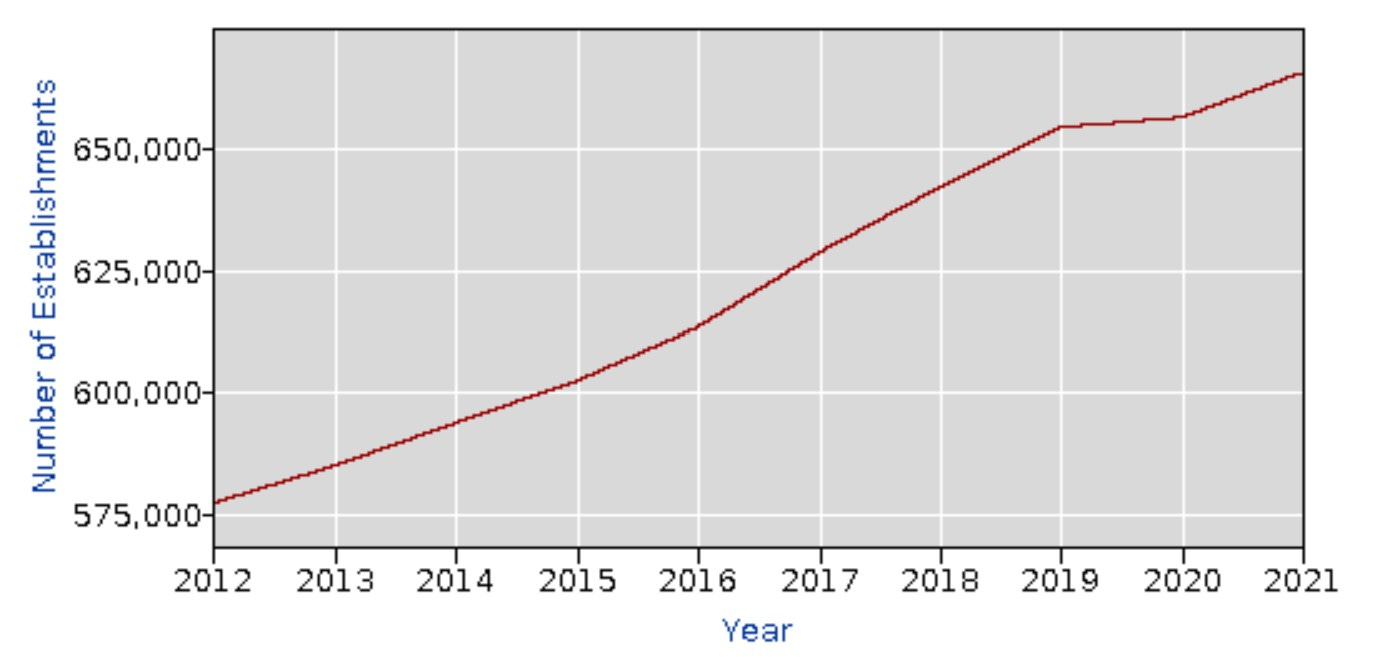
That, of course, was before the pandemic, before the pressure on labor markets, and before another ~10% increase in the number of eating and drinking establishments in the U.S.:
source: U.S. Bureau of Labor Statistics
Does The Retail Short Come For Restaurants Next?
The problem, as highlighted in that Times piece, is that oversaturation hurts the entire industry. Marginally profitable, or even unprofitable, locations siphon earnings from nearby restaurants, all of which run a business model that is based heavily on incremental profit margins. Cut a restaurant’s revenue 10% and profits quite often will plunge.
The same, of course, is true for brick-and-mortar retail. As a result, it’s not at all surprising that at the same time it was becoming clear that the U.S. was “overstored”, shorting brick-and-mortar retail was a highly successful trade.
Obviously, there are some correlation/causation problems there; it’s equally possible that people realized the U.S. was overstored and that retail stocks were good shorts because of the rise of Amazon and its ilk. But the sheer number of stores — which, by the way, appears still too high — no doubt added to the pressure on profit margins, in particular, in the sector.
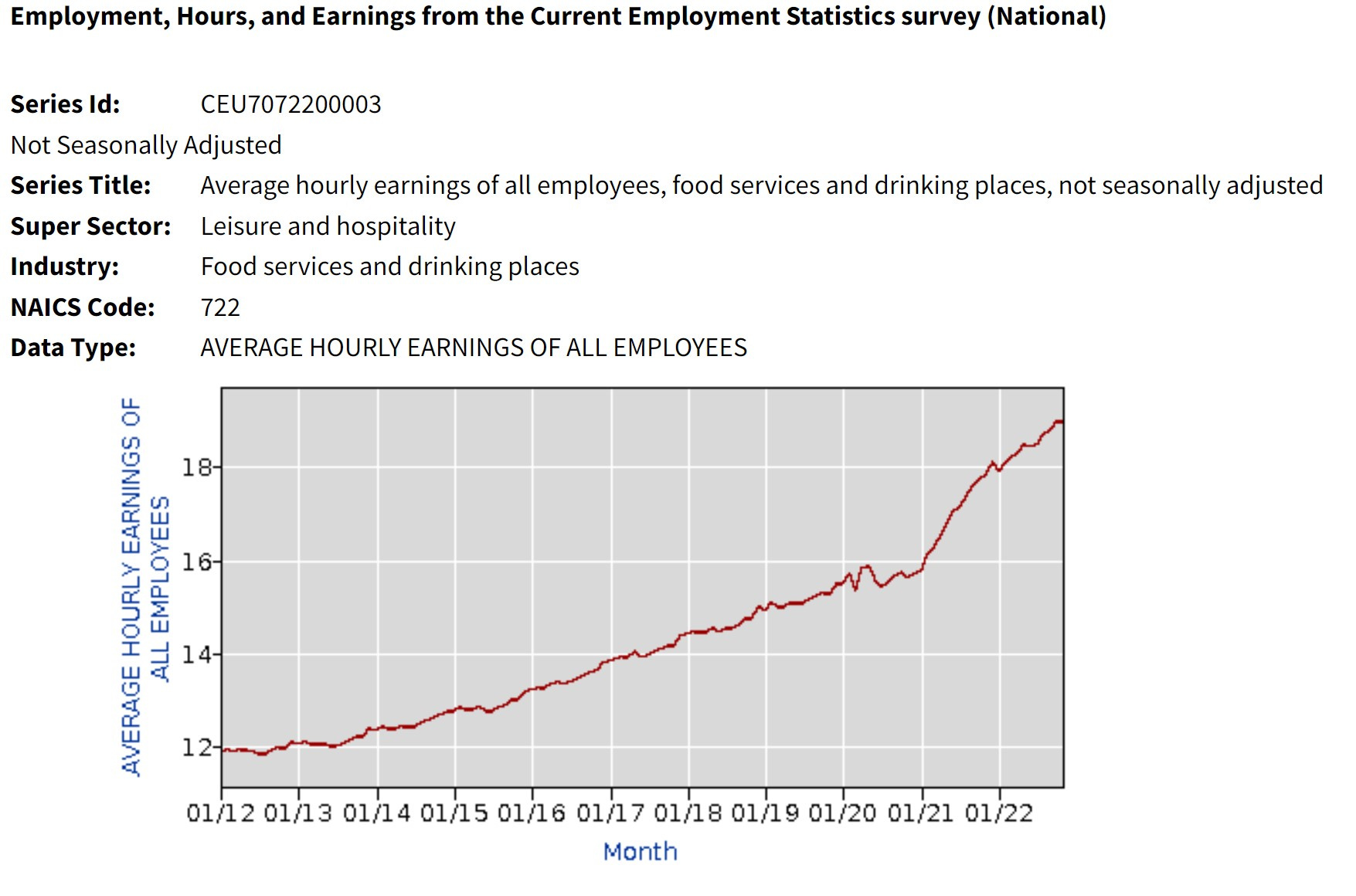
The question in 2023 is whether that case from (roughly) 2014-2016 has come back around again. There are a number of reasons to believe that it has. Wage pressure is a big deal for a generally low-margin business model, and wages in the space have soared in recent years:
source: Bureau of Labor Statistics
In two years, the average wage in the sector increased 21.6%. And it’s worth reiterating: those higher wages aren’t close to enough.
So far, U.S. restaurants have been able to survive higher wages and lesser service because U.S. consumers have returned to dining out at the same rate they did in the past:
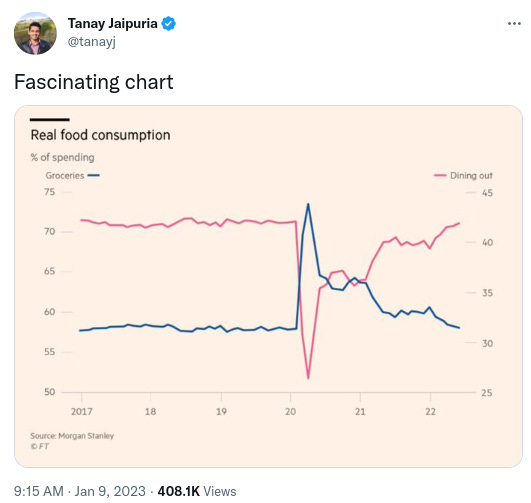
For public companies, there’s likely some market share gains as well, as many independent operators simply weren’t able to survive through 2020 and 2021.
But the return of demand is a bit of a double-edged sword, given the oversupply of locations and the undersupply of labor. Despite reports of rising misbehavior, most consumers still are reasonably understanding with an industry that has dealt with unprecedented turmoil over the past three years. Many are probably like myself, and haven’t quite gotten around to changing their behavior in response.
Patience will run out, however, and expectations will adjust. Right now, it seems like a lot of chains, in particular, are acting like that won’t be the case.
Potential Short Targets
It’s possible this broad thesis is incorrect. Betting against Americans spending on anything is probably a risky trade. The retail short worked at least in part because spending moved away from brick-and-mortar rather than drying up altogether; there isn’t a third option between cooking at home and getting food from outside. A recession may create some much-needed slack in the labor market (though in that scenario I’m personally not convinced there’s enough movement from other industries to fix the industry’s employee shortage).
The labor pressures may lead to market share gains for scaled chains versus independent, ‘mom and pop’ competitors. And we must admit here that our one restaurant idea to this point, a short of Texas Roadhouse $TXRH, has performed abysmally.
For those reasons and others, the way to play this thesis is not to short a basket of restaurant stocks2. Rather, it's probably to target the stories that either rely on future footprint expansion or that aren't succeeding at the moment to begin with.
One obvious candidate, though it may be too late, is Sweetgreen SG 0.00%↑. The chain ended Q3 with 176 restaurants; it still has plans to get to 1,000 by 2030. It's exceptionally difficult to see how that roadmap plays out from a labor and competitive standpoint. And while the stock is 80%-plus from an all-time high in November 2021, the company still has a market cap above $1 billion and SG has bounced 20% in the last three weeks.
BRC Inc. BRCC 0.00%↑, which operates Black Rifle Coffee, isn't a pure-play on its stores (called "Outposts"). Most of revenue and profits comes from a direct-to-consumer business, along with retail sales.
But the company sees a roadmap to over 1,300 Outposts, and is citing 40% cash-on-cash returns from its initial group of stores. Per the most recent 10-Q, however, revenue from existing Outposts declined over the first three quarters of the year, and the company said on the Q3 call it needs 35 to 40 employees for each new store. BRCC has a decent short interest and, like SG, is down sharply from its highs (the stock went nuts after its de-SPAC merger for reasons that remain unclear). Should management talk about ramping up Outpost growth, that would be a strong pillar in a short case.
Dutch Bros. BROS 0.00%↑ is another popular short (23% of the float), and its model appears to be a bit less labor-intensive than most. But that company also continues to open new stores with abandon: it said at this month's ICR conference that store count would go from 671 at year-end 2022 to 800 by the first half of this year to more than 1,000 by 2025. With more than half of stores company-operated, labor and service issues both represent a clear threat.
At the moment, for varying reasons, none of these stocks necessarily look like compelling shorts just yet. (Shake Shack SHAK 0.00%↑ can probably be thrown into this group as well.) But for these types of stories, when the footprint story breaks, the stock breaks. And there seems at least a good chance that one or more of these companies is going to run into that kind of trouble as they ramp their store counts.
There’s also the argument for simply pressing the short on weaker names already struggling with restaurant-level margins. El Pollo Loco LOCO 0.00%↑ , for instance, saw contribution margin plunge to 12.4% in Q3 2022 from 18.6% in Q3 2019. Chili’s owner Brinker EAT 0.00%↑ has recovered to an eight-month high, despite years of margin pressure. An outright short of EAT isn't the most attractive trade in the market, perhaps, after some of the goofy rallies we've seen early in 2023, but I've sold calls and call spreads on that underlying many times in the past and might look to do so again at the $40 strike from here.
Again, all of these names are down to some extent already. But we’d argue they’re down due to short-term worries about the macro cycle, rather than a realization of the more structural challenges looming. It’s the potential combination of the two that can really change the sector, and lead to growth stories breaking and middling businesses falling off the table.
As of this writing, Vince Martin has no positions in any securities mentioned.
Disclaimer: The information in this newsletter is not and should not be construed as investment advice. Overlooked Alpha is for information, entertainment purposes only. Contributors are not registered financial advisors and do not purport to tell or recommend which securities customers should buy or sell for themselves. We strive to provide accurate analysis but mistakes and errors do occur. No warranty is made to the accuracy, completeness or correctness of the information provided. The information in the publication may become outdated and there is no obligation to update any such information. Past performance is not a guide to future performance, future returns are not guaranteed, and a loss of original capital may occur. Contributors may hold or acquire securities covered in this publication, and may purchase or sell such securities at any time, including security positions that are inconsistent or contrary to positions mentioned in this publication, all without prior notice to any of the subscribers to this publication. Investors should make their own decisions regarding the prospects of any company discussed herein based on such investors’ own review of publicly available information and should not rely on the information contained herein.
To be clear, I wasn’t actually counting the minutes. I texted my wife when I got there to see if she wanted anything, and again when I left, and compared the timestamps. I’m not a monster.
Somewhat surprisingly, there isn’t an ETF to play. The only pure-play restaurant ETF, AdvisorShares Restaurant ETF EATZ 0.00%↑, has total assets of about $2.5 million.
Net income margins are definitely decreasing. High-end hasn't had trouble raising prices and consumers accepting them in my area, but I would wager the rest of the U.S. is in a different scenario. With consumers hurting a bit, and having labor costs rising, anyone not currently making 10% will probably get squeezed out.
Although, I know quick service places are just running the skeleton crew they can't get. This means record bottom line for some. Hard to say if consumers will change preferences in a huge way. I'm well aware that fast food isn't fast anymore. I'll order ahead online personally, but maybe I do go less now that I know the headache of waiting. (In a broad stroke, a competitive industry whose competitive advantage tends to be good service suddenly can't provide that... Maybe it isn't good for them after all.)
On the other side of this, companies may look for automation tech instead of shutting down due to lack of employees. AI to take orders, increased automation in fast food and quick service. I'd be more interested in investing on that side of the market. It happened to unskilled factory labor. I think we'll see it in unskilled food service, especially when they're expensive and unskilled. The tech is there, and as long as they can afford the financing it will be cheaper in the long run for them. Japan has done this, although they did it probably primarily for cultural differences. I may try to bring some of their tech over myself.
I'm still bullish on specialized and thematic concepts. I own shares in a poke company. I've also been looking at RAVE it seems they are turning around, but I'm not sure if the risk reward is good enough.
For some numbers at a high end concept in South Florida, net income was ~26% in 2020 and 2021 now that we have staff and spent on capex we're around 14%. We'll probably level out to 18%, we don't pay for the space, but we raised prices almost 30% across the board on food 10% on booze and nobody blinked.
Another instance of declining living standards? And/or a foreshadowing of ongoing bifurcation in the restaurant (and other service) industry(ies) between affordable low-service and luxury high-service?