
Cirrus Logic: Halfway Right In Q3
Our recommendation of chipmaker Cirrus Logic CRUS 0.00%↑ last month had two pillars. The first was that CRUS was selling off amid concerns about the company’s heavy reliance on Apple AAPL 0.00%↑, despite little evidence that the relationship had deteriorated. The second was that Cirrus Logic had the opportunity to jumpstart growth in its business ex-Apple.
In two sessions after Tuesday’s report, CRUS has gained 19%. But it’s really only the first pillar that played out. Q3 crushed analyst expectations, and guidance for the fourth quarter looks solid as well (including on gross margin, suggesting continued pricing power with Apple). As we noted, the worry heading into the quarter, at least based on some headlines, was that iPhone unit sales were heading south, but for now that fear is dispelled.
The second pillar of the case, however, did not materialize in Q3. Overall revenue increased 5% year-over-year, and Apple’s share of revenue actually increased a point to 89%. But the ex-Apple case is a mid- to long-term play, and on that front there was plenty of good news, particularly around the move into laptops.
Cirrus Logic was added to the reference design for Intel’s upcoming Lunar Lake CPU, giving a big leg up in that market. The company got its first win in laptop power conversion as well, and there have been some nice wins in haptics. Cirrus Logic is also in the Apple Vision Pro, which can add to revenue over time.
Those wins add to the sense that Cirrus Logic can steadily expand over time into new markets, since it’s shown success on that front so far:
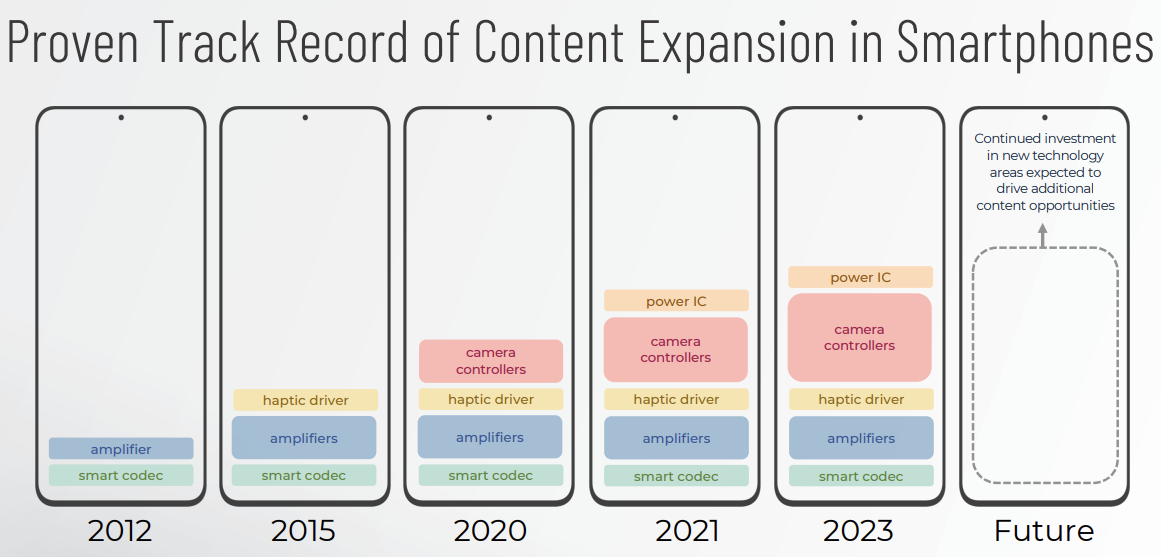
source: Cirrus Logic Q3 presentation
As yet, those wins haven’t translated into numbers, and even CRUS management isn’t quite sure what those revenue streams are going to look like in fiscal 2025 and beyond. But certainly the quarter strengthens the bull thesis we laid out, and at Thursday’s close of $93, CRUS still has nearly 20% upside to its early April high. If the narrative becomes “Apple is fine, and they can grow ex-Apple”, the gains of the last two sessions absolutely can continue.
Tenable Holdings: Are Shorts Too Tough?
Over the past six months, we’ve recommended fewer short ideas1 (and I’ve had a much lower short exposure in my personal portfolio). Given broad market performance that downshift has been wise, and Tenable Holdings TENB 0.00%↑ perhaps shows why.
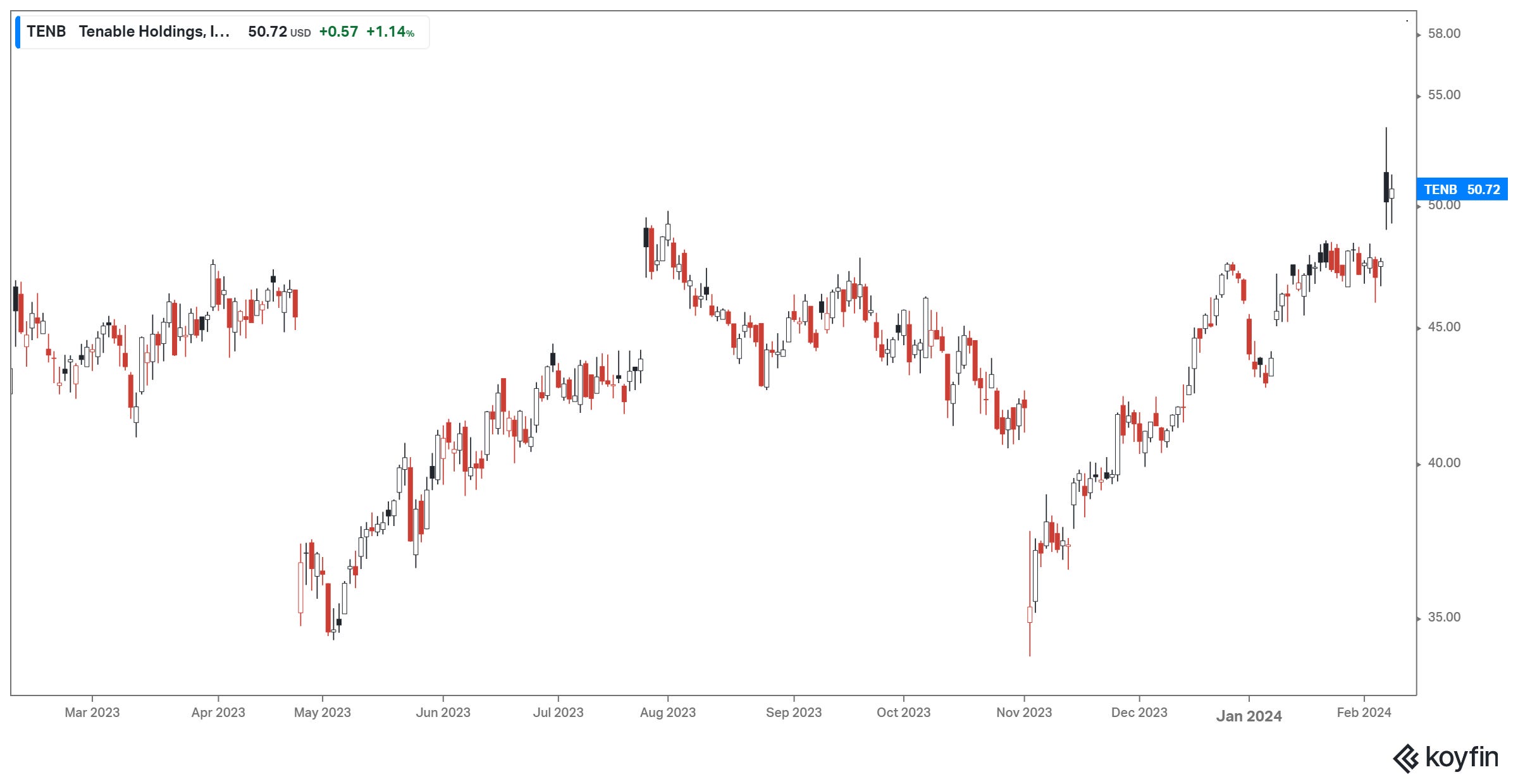
We called out TENB as a short in early December, based on the thesis that the company’s new unified platform, Tenable One, was boosting near-term growth, while growing competitive threats put the longer-term outlook at risk. TENB now has rallied 23% since publication. Quite honestly, it’s hard to see what has driven those gains, other than ebullient sentiment in cybersecurity and in tech more broadly.
Indeed, there is absolutely a scenario in which TENB should have tanked after this week’s fourth quarter release. To our eye, this looks like a bad release — full stop. Tenable is laying off 5% of its workforce, though management framed that more as housekeeping than cost savings. More notably, full-year billings guidance for 2024 suggests 13% growth. On the Q3 call in early November, Tenable (somewhat unofficially) projected a “mid-teens” increase for the year. TENB fell 16% after that release, but gained 5% after Q4, moving to a 19-month high in the process.
source: Koyfin
It does seem like Tenable One is doing well (and figures suggest some acceleration in that product during Q4 after a somewhat stagnant Q3). But an analyst on the call made the same point we made in December: despite management’s positivity about that offering and Tenable’s capabilities more broadly, its growth rates are basically in line with those of direct competitors. Yet TENB stock is still receiving a sharp premium to those peers.
Meanwhile, Tenable has spent several quarters saying that disappointing top-line performance in 2023 was due to macro conditions that were delaying deals (management specifically called out the March failure of Silicon Valley Bank, for instance).
The question with a short like this is whether the thesis is wrong, or just early. We lean strongly towards the latter explanation, and I personally see this is as a better idea than it was at publication. But we also acknowledge that, from the short side, being wrong and being early usually wind up in about the same place.
Coherent: An AI Winner Can Keep Winning
Last April, we recommended Coherent COHR 0.00%↑ as a value play with exposure to multiple secular trends. COHR is up 84% since then, in large part because the market seems to have come around to that longer-term bullishness:
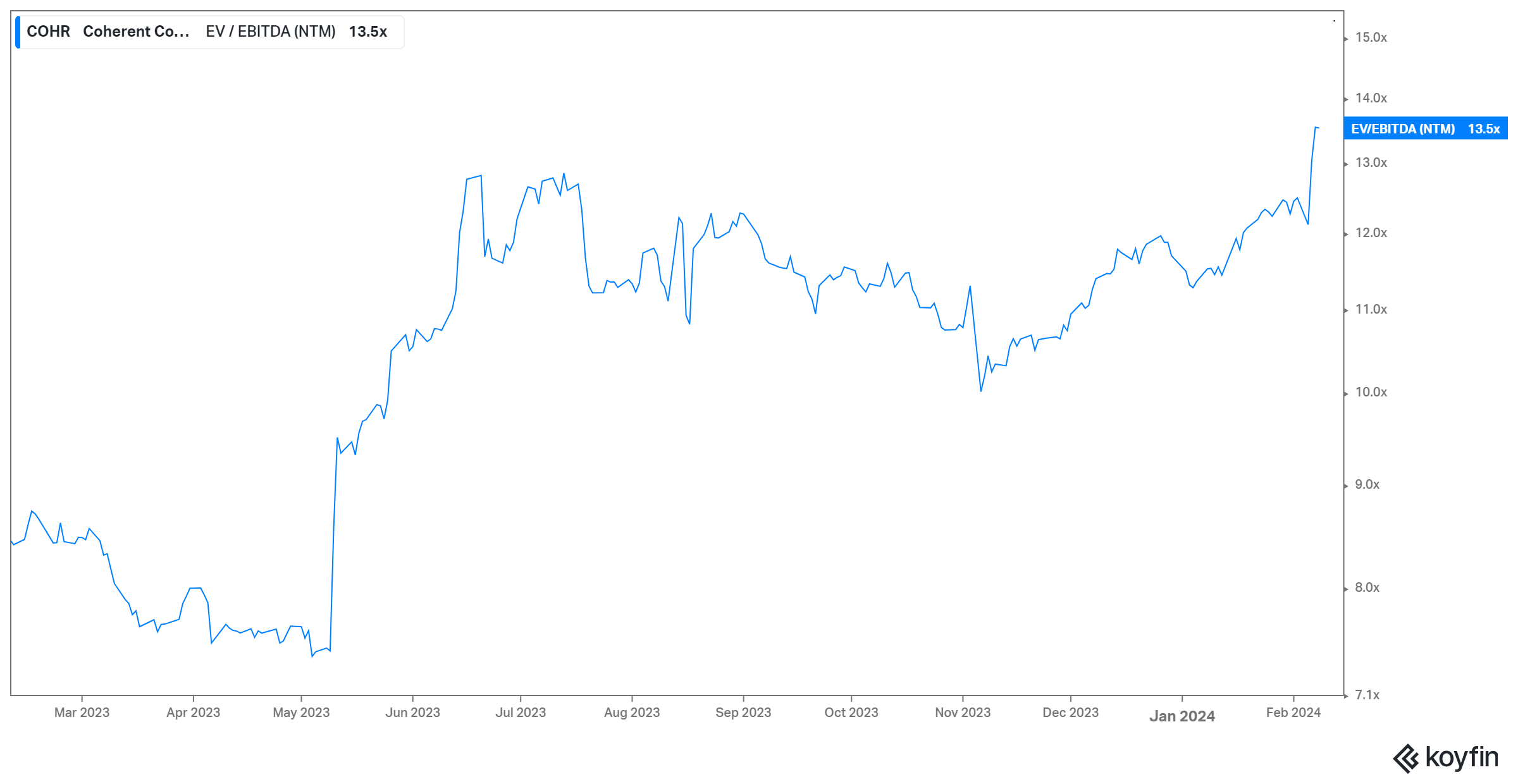
source: Koyfin; chart of next twelve month EV/EBITDA multiple
The catalyst, unsurprisingly, is artificial intelligence. Coherent said that revenue from its 800G transceivers used in AI and machine learning more than doubled quarter-over-quarter, and neared 10% of total sales.
But there’s more going on than just a broader trend: fellow 800G player Lumentum LITE 0.00%↑ plunged after earnings this week, and gave pretty minimal color on its performance in the space. It seems like Coherent is taking share, and that business now is big enough to move the needle.
What’s interesting, however, is that the other parts of the Coherent business remain relatively soft, at least from a near-term perspective. We were much more interested in Coherent’s opportunity in silicon carbide substrates, used to develop chips for electric vehicles. That opportunity was validated in October, when a pair of Japanese manufacturers invested a combined $1 billion for just 12.5% of Coherent’s SiC business. But, so far, SiC has been somewhat disappointing. Optimism toward EV demand more broadly seems to be fading, and SiC plays Aehr Test Systems AEHR 0.00%↑ and Wolfspeed WOLF 0.00%↑ are down 42% and 50% respectively, since we recommended COHR.
That said, the $8 billion valuation implied by those investments represents ~60% of Coherent’s current enterprise value, and demand continues to exceed Coherent’s ability to supply SiC substrates and epitaxial wafers. The AI opportunity is big. Coherent’s laser business is nearly one-third of revenue and serves other major trends (think additive manufacturing and medtech).
In that context, valuation hardly seems demanding. That’s all the more true given that, overall, Coherent is probably closer to the bottom of its cycle (like so many suppliers, it’s dealing with the effects of inventory corrections by its customers) than to the top. This has not been a market in which to let go of anything related to AI. That aside, COHR still looks attractive even after a big rally.
NETGEAR: Change Is Good
In July, we called out networking play NETGEAR NTGR 0.00%↑, which had just become a net net2. The idea in investing in these kinds of names is that the margin of safety is enough that it’s worth it to simply wait for an upside catalyst to occur.
So far, it hasn’t. NTGR is down 2.6% since we published in August. But the asset-based bull case actually has strengthened. Cash is now 72% of the company’s market cap, against 59% in July. Net current asset value (current assets less total liabilities) is up about 4%, while the market cap is down a little over 3%. The balance sheet should get better still: NETGEAR guided for “meaningful” cash flow in Q1.
Shares sold off Thursday after downside guidance, which management attributed to inventory corrections in its own industry. But multi-year performance has been weak; there’s more going on here than just a single quarter. For NETGEAR, something needs to change.
The good news is that something big already has. Last month, the company announced that Patrick Lo, NETGEAR’s founder, chief executive officer, and chairman, would step down. Importantly, Lo is leaving the board, and because of steady stock sales he only owns about 3% of the company. That in turn seems to open a path toward potentially significant changes.
Clearly, recent performance has not been strong enough. Nor has capital allocation: it’s not a good thing that this business has 70%-plus of its market cap in cash. This is not an industry where big M&A is going to be a factor and so the decision to let cash build up on the corporate balance sheet simply doesn’t make a lot of sense. But with fresh leadership (Lo leaves for good in July), there is an opportunity for NETGEAR to improve both operational execution and shareholder returns.
To be sure, that opportunity has existed for some time, yet NETGEAR simply hasn’t capitalized. Networking overall has been a brutally difficult sector, and minimal enterprise exposure only makes that problem worse. The point of owning stocks with these kind of numbers, however, is reflected in the old adage: “take care of the downside, and the upside will take care of itself.” At some point, something is going to change, and that opens the door to significant gains.
As of this writing, Vince Martin is long COHR.
Disclaimer: The information in this newsletter is not and should not be construed as investment advice. Overlooked Alpha is for information, entertainment purposes only. Contributors are not registered financial advisors and do not purport to tell or recommend which securities customers should buy or sell for themselves. We strive to provide accurate analysis but mistakes and errors do occur. No warranty is made to the accuracy, completeness or correctness of the information provided. The information in the publication may become outdated and there is no obligation to update any such information. Past performance is not a guide to future performance, future returns are not guaranteed, and a loss of original capital may occur. Contributors may hold or acquire securities covered in this publication, and may purchase or sell such securities at any time, including security positions that are inconsistent or contrary to positions mentioned in this publication, all without prior notice to any of the subscribers to this publication. Investors should make their own decisions regarding the prospects of any company discussed herein based on such investors’ own review of publicly available information and should not rely on the information contained herein.
If you’re curious: 3 of our last 27 recommendations were bearish, against 20 out of our first 62; the rate has dropped to 11% from over 30%.
A ‘net net’ in our definition means current assets less total liabilities equals a sum greater than the company’s market cap.