
Highlights:
Chart Industries (GTLS) soared 66% in two months. As the company re-establishes confidence, we’re betting on more upside head.
Gibraltar Industries has rallied nicely as well. Our optimism going forward is a bit more muted, but the stock still looks set for double-digit annualized gains.
MeridianLink plunged back to where it was when we recommended a short in January; that case might be stronger than it was.
Investors gave Spirit AeroSystems another chance, but it disappointed badly.
It feels like a quiet earnings season so far. At the top of the market, the biggest loser has been Tesla TSLA 0.00%↑, now 19% off its 52-week high. But that stock has still doubled so far in 2023. Well-known names like Snap SNAP 0.00%↑, Chipotle CMG 0.00%↑, and Spotify Technology SA SPOT 0.00%↑ gapped down after earnings — but, like TSLA, those names have crushed the bull market year-to-date.
There have been a few big winners. As we discussed on Twitter earlier this week, warehouse robotics play Symbotic SYM 0.00%↑ roared after earnings on Monday. Data center supplier Vertiv VRT 0.00%↑ jumped on Wednesday. But, to our eye, there isn’t really a thesis-changing blowout (or miss) report that feels anything close to, say, the fiscal Q1 release from Nvidia NVDA 0.00%↑ two months ago.
But for names we’ve covered so far, there was a surprising amount of news this week. Four different releases moved in directions that we predicted. Lest readers think we are sounding too full of ourselves, we’d point out that a) before this week, two of the trades moved badly against our recommendations and b) it was six days ago that we were discussing our big whiff from the long side on The Shyft Group SHYF 0.00%↑.
Given a relatively quiet period elsewhere, we’ll take the opportunity to enjoy what we’ve gotten (mostly) right, and project what might lay ahead in those four names.
The Post-Plunge Opportunity In GTLS
Back in November, we laid out the bull case for Chart Industries GTLS 0.00%↑ , which to our eye looked relatively simple. The manufacturer of industrial equipment including bulk tanks, vaporizers, and fueling tanks offered investors a solid business, with multiple secular tailwinds. Notably, Chart is a significant beneficiary of LNG (liquefied natural gas demand), and more broadly should see growth from an increasing focus on ‘green’ solutions as well as heavy support from the U.S. federal government.
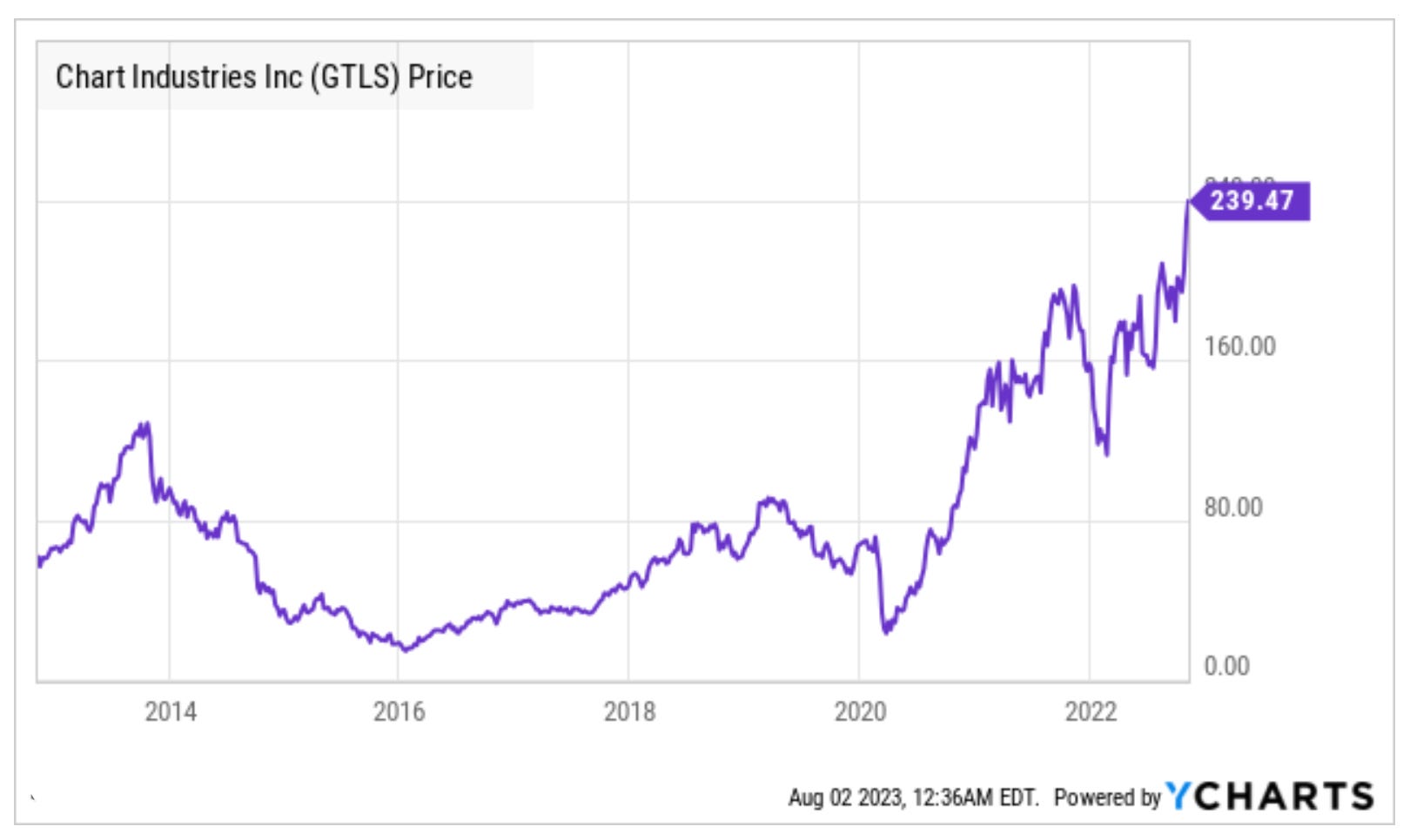
And until that month, investors largely believed in the bull case. GTLS roared out of third quarter earnings, closing out an impressive multi-year rally by hitting an all-time high on November 8:
source: YCharts
But the next day, Chart announced the $4.4 billion acquisition of fellow industrial play Howden. To say the market hated the deal would be an understatement. As we wrote at the time, Chart in just eight trading sessions incredibly lost $5 billion in market capitalization off a $4.4 billion deal.
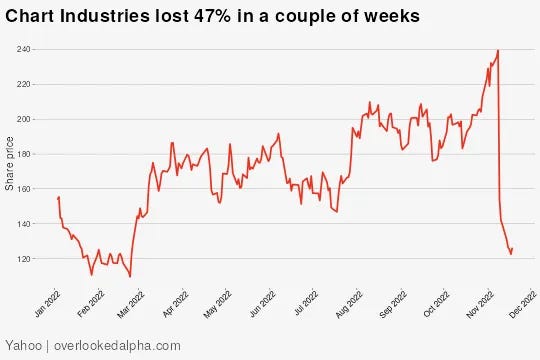
Admittedly, the acquisition had some risk. Simply to fund the purchase, Chart had to issue both debt and equity (the latter at a discount; the common shares went off at almost exactly half the November peak for the stock) and divest smaller businesses. The acquisition levered the balance sheet over 4x, and valued the private equity-backed Howden at ~13x EBITDA; it had been sold in 2019 for just a 9x multiple. As we wrote, some kind of sell-off probably made sense; our argument was simply that a nearly 50% haircut was far too much.
GTLS Rallies
Even with the risk, the deal did seem to make some sense. And as Chart moved toward its March close of the acquisition, more good news followed. Fourth quarter results in February were solid; Chart reiterated its standalone outlook for 2023. In the Q1 release, with Howden officially on board, Chart gave more detailed guidance for this year, forecasting adjusted EPS of $5.50-$6.70. And, notably, Chart stuck with its 2024 outlook for $1.3 billion in Adjusted EBITDA, which it had provided when the Howden deal was announced last year.
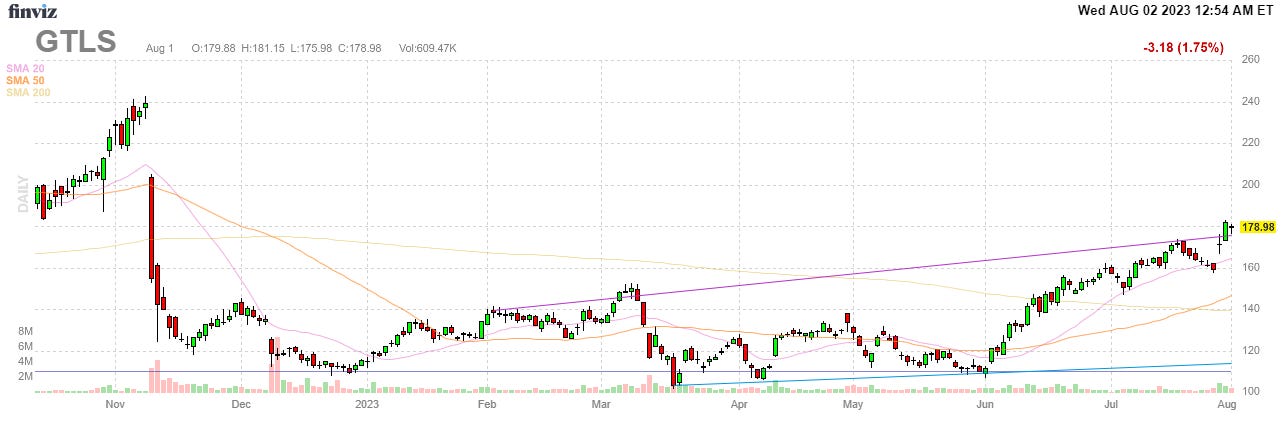
Simply put, the market didn’t care. GTLS got a brief bounce after the Q1 release, but faded back below $120:
source: finviz.com
There, its fully-diluted market cap1 sat around $6 billion, and its enterprise value $10 billion2. That latter figure was about 8x the 2024 EBITDA target. Bear in mind that at the November peak, Chart traded for more than 20x 2023 EBITDA guidance.
Clearly, investors didn’t think the merged business was nearly as attractive as standalone Chart — and, to be fair, Chart’s own outlook at the time of the merger suggested Howden would actually reduce the company’s consolidated revenue growth rate.
But sentiment changed in recent months. Between May 31 and July 31, GTLS rallied 66%, including an 8% jump on Friday following the Q2 release.
What’s interesting about the response to earnings is that, essentially nothing really happened. The quarter was mixed relative to Street expectations. The only change to fiscal 2023 guidance was a modest boost to the bottom end of the adjusted EPS range (now $5.70-$6.70 vs $5.50-$6.70). The FY24 EBITDA target remains in place.
Because sentiment was so poor following the November plunge, ‘nothing really happened’ is actually quite good news. The market cut the GTLS market price by more than 50% because it expected the acquisition (and perhaps the legacy business as well) to tank. But it has been so far, so good.
There could be some technical reasons (like short covering) supporting the increase. But re-instilled confidence in the Chart story suggests a continuing rally, likely toward (or through) the 2022 peak just shy of $240.
The Market Is Starting To Believe
It does seem likely that the narrative here is starting to change. And what makes GTLS an exciting long here (the stock now is actually my largest position) is that, fundamentally, there’s still a strong case for upside going forward, which can reinforce the market’s improving sentiment.
Even now, GTLS has a fully-diluted market cap below $9 billion, and an enterprise value of roughly $13 billion. That’s 10x 2024 EBITDA — half the multiple Chart received nine months ago — and high-20s 2023 free cash flow for a business that, pro forma for the merger, increased its top line ~11% in the first half (per the 10-Q) and has multi-year growth potential going forward from government stimulus, synergies and deleveraging.
The path to upside, then, is relatively simple. Chart needs to just do what it’s done in recent quarters, and stay on track. There’s clear room for multiple expansion: 13x the 2024 Adjusted EBITDA target (with net debt coming down $500M-plus by the end of next year) suggests almost 50% upside from here.
Even those gains would only put GTLS about 7% above the November peak. That’s precisely the point: as long as Chart Industries keeps regaining the market’s confidence, its stock has solid upside ahead. It’s hard to argue with what the company has done so far.
(Mostly) Good News From Gibraltar Industries
Our March bull case for Gibraltar Industries ROCK 0.00%↑ had two core pillars. First, investors were mistaking the cyclical impact on the core building products business. While the market fretted about a housing slowdown, it missed the fact that ~80% of revenue in that business is repair-related, and that unprecedented inflation had wreaked havoc on Gibraltar’s cost structure. In other words, unlike for other sector plays, a normalized environment was good news for Gibraltar’s bottom line.
Second, there was potential upside from the company’s ancillary businesses, including solar racking, greenhouses, and infrastructure products, given strong stimulus from the U.S. federal government. In that context, a sub-15x multiple to the midpoint of GAAP earnings per share guidance seemed far too low.
ROCK has gained 54% since then, and the building products pillar of the thesis seems nicely intact. Adjusted operating profit in the Residential segment has risen about 4% year-over-year, with profit margins down only modestly year-over-year.
Elsewhere, however, there’s a bit more concern. In Q2, the Renewables segment saw revenue drop 24% year-over-year. Gibraltar continues to cite tight supply of modules, owing to the Uyghur Forced Labor Prevention Act — but other industry participants are managing much better. NexTracker NXT 0.00%↑, which generated 68% of fiscal 2023 (ending March) sales from the U.S. (the company hasn’t disclosed the June quarter figure), posted 19% revenue growth in the same quarter.
After Q1, Gibraltar said its AgTech project pipeline was at an all-time high — but cited “project delays” in explaining a 20% decline in revenue in the second quarter. Given the struggles in controlled environment agriculture, including the bankruptcy filing by AppHarvest $APPHQ last month, one wonders whether the “delays” will prove to actually be delays.
Moderating Expectations
Net/net, however, the news here still looks good. Gibraltar has been able to boost margins and profits in both of the declining segments, and the 100%-plus first-half growth in Infrastructure adjusted profit seems like just the beginning. Valuation remains reasonable: with adjusted EPS guidance increased to $3.90-$4.10, ROCK is trading at about 18x this year’s earnings. 2025 targets look intact, and we argued earlier this year they suggested a path toward $100-plus.
That target would suggest 35%-plus upside from current levels, and while that’s probably a bull case, year-to-date performance is de-risking that case. The opportunity in August at $73 is not what it was at $48 in March, but this is still a business I’m happy to own and a stock we’ll continue to recommend.
The Problem With Shorting
Two stocks we’ve recommended as shorts reported this week — and, to be honest, on both fronts I personally blew it. I looked at each stock into the release, saw a pretty clear path to downside after material rallies, and then backed off, only to see each fall 20%-plus on Wednesday.
In my defense, it’s a difficult environment in which to short right now. This week, Dan Loeb of Third Point Capital told his investors that he was pulling back on single-stock short bets. Loeb wrote:
…the short selling environment is much more challenging than it has been historically. Fundamental analysis is increasingly taking a back seat to monitoring daily option expiries and Reddit message boards…While have not abandoned short selling, we continue to reduce our single name short exposure…
Given his fund’s size, Loeb is dealing with much larger companies (hence the reference to daily option expiries), but broadly speaking we’re sympathetic to his complaints. It absolutely is a more challenging environment, and to our eye in one key way: the plan to simply short ‘bad’ businesses hasn’t really worked out all that well.
That said, there is a bit of an echo in Loeb’s letter and the video from Andrew Left of Citron Research in late January 2021. After getting run over by Redditors in GameStop GME 0.00%↑ and other names — while facing death threats and harassment in the process — the veteran activist short-seller publicly announced he and his firm would no longer publish short reports.
Left’s announcement came on January 29th; within weeks, the Q4 2020/early 2021 mania had peaked, and so began the most fruitful period of shorting ridiculously overvalued, substandard businesses seen in over 20 years. We’re skeptical Loeb’s letter will look quite the same way in retrospect, but it’s hard not to wonder if Third Point’s capitulation proves to be its own contrarian signal.
MeridianLink
In the meantime, I’m kicking myself for MLNK.
Back in January, we recommended a short of financial software developer MeridianLink MLNK 0.00%↑. MeridianLink offers a suite of services (data verification, loan decisioning, account opening, etc.) to financial institutions with a specific focus on credit unions. But the nature of its revenue model, which includes a heavy dose of usage-based fees, suggested a weak 2023 amid, most notably, a big decline in mortgage originations and refinancing. Just below $17, that decline did not seem at all priced in.
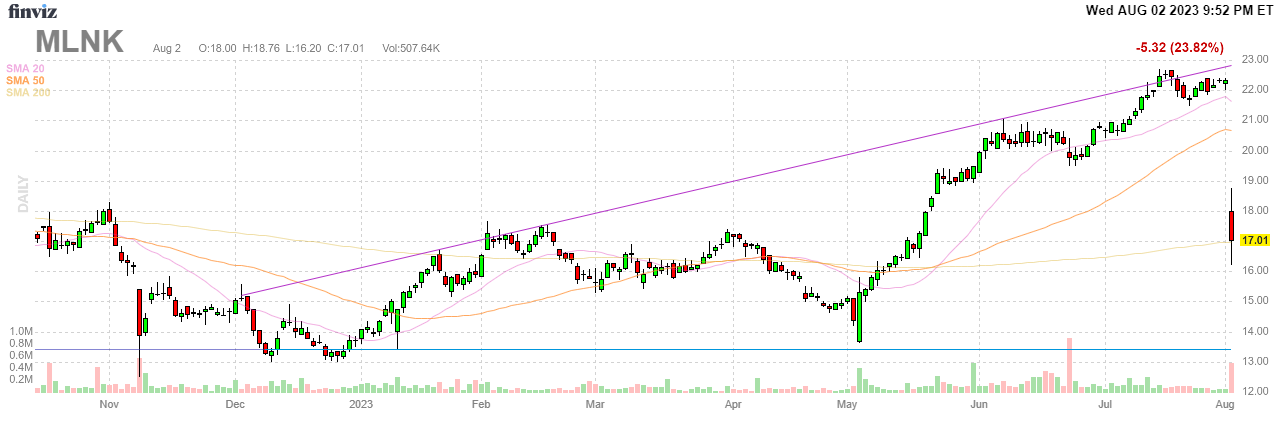
The stock didn’t do much through its first quarter report in May, which looked in line with our expectations (and the Street’s as well). But out of the report, MLNK took off:
source: finviz.com
It seems likely that improving sentiment toward middle-market banks helped; there may have been an artificial intelligence angle as well (which MeridianLink itself tried to push). Neither of those factors, however, seemed to change the underlying story much, if at all.
At least as far as 2023 goes, that perception was correct. MeridianLink’s second quarter revenue, reported Tuesday afternoon, missed its guidance given after Q1. Adjusted EBITDA barely clipped the low end, though excluding the impact of a “commercial dispute”, the quarter would have been right in the middle of the forecasted range.
But even disregarding that impact, the company modestly pulled down its full-year guidance. MeridianLink is looking for mid-single-digit revenue growth and a year-over-year decline in Adjusted EBITDA. In response, MLNK plunged 24% on Wednesday.
Can You Still Short MLNK?
Wednesday evening quarterbacking aside, the intriguing question is whether MLNK is still a short going forward.
There’s a case to be made, certainly. The stock closed Wednesday 1% above where it was when we made our bearish recommendation. EV/EBITDA, based on guidance, is about 16x; add back stock-based comp and the multiple moves up to 22x or so.
Those multiples don’t sound unreasonable, but we argued in January that there is evidence that MeridianLink’s aggressive M&A is actually R&D spending in disguise. The November acquisition of OpenClose provides a perfect example. Figures from MeridianLink’s 10-Q suggest that business generated just $3.5 million in revenue in the first quarter of 2022, with a net loss of $1 million.
MeridianLink paid $63 million for OpenClose, a “leader in mortgage lending technology,” which sounds like what MeridianLink itself is supposed to be. The thin fundamental profile of the deal suggests that the motivation was to acquire the technology, not the revenue. That in turn implies that MeridianLink’s internal R&D efforts — much of which are outsourced overseas — aren’t sufficient.
Along those lines, the company spent another $28 million for StreetShares earlier last year, plus a $30 million potential earnout placed into escrow. MeridianLink said after Q2 that the business lending platform had not achieved that earnout. It hasn’t given pro forma results because StreetShares’ revenues are too low. (That’s even excluding the fact that StreetShares was responsible for the dispute that drove the revenue reduction of $2.3 million.)
On the top line, too, there are concerns. Not only does MeridianLink generate usage-based fees, but its customers generally align their minimum commitments to minimize those fees (the higher the minimum, the lower the excess fees, of course). Per chief financial officer Sean Blitchok on the Q2 call, “the majority of our non-mortgage lending customers continue to see volume growth above their [minimum] commitments”. That suggests a not-immaterial portion of customers likely to reset their commitments in non-mortgage lending revenue (~64% of total revenue in Q2), plus a likely large base in the remainder of the business.
All told, even after Wednesday’s sell-off the short case here looks an awful lot like it did in January — and perhaps stronger, since the possibility of a surprising 2023 performance is pretty much off the table now. Whether that’s enough to actually put on a short in this “challenging environment”, as Loeb put it, is likely in the eye of the individual investor.
Spirit AeroSystems Does It Again
In the very first paragraph of our short call on Spirit AeroSystems SPR 0.00%↑, published May 7, we wrote that “it’s exceptionally difficult to view the SPR story as anything but broken.” A few sentences later, we summarized the bear pitch [emphasis in original]: “our case is based on the idea that any remaining bulls are finally going to lose patience, and rightfully see this challenged, overleveraged cyclical as simply too difficult to own.”
At the time, we thought that bulls would continue to flee after an ugly first quarter report, which came a couple weeks after Spirit disclosed a “quality issue” in certain fuselages built for Boeing BA 0.00%↑, of which Spirit originally was a part.
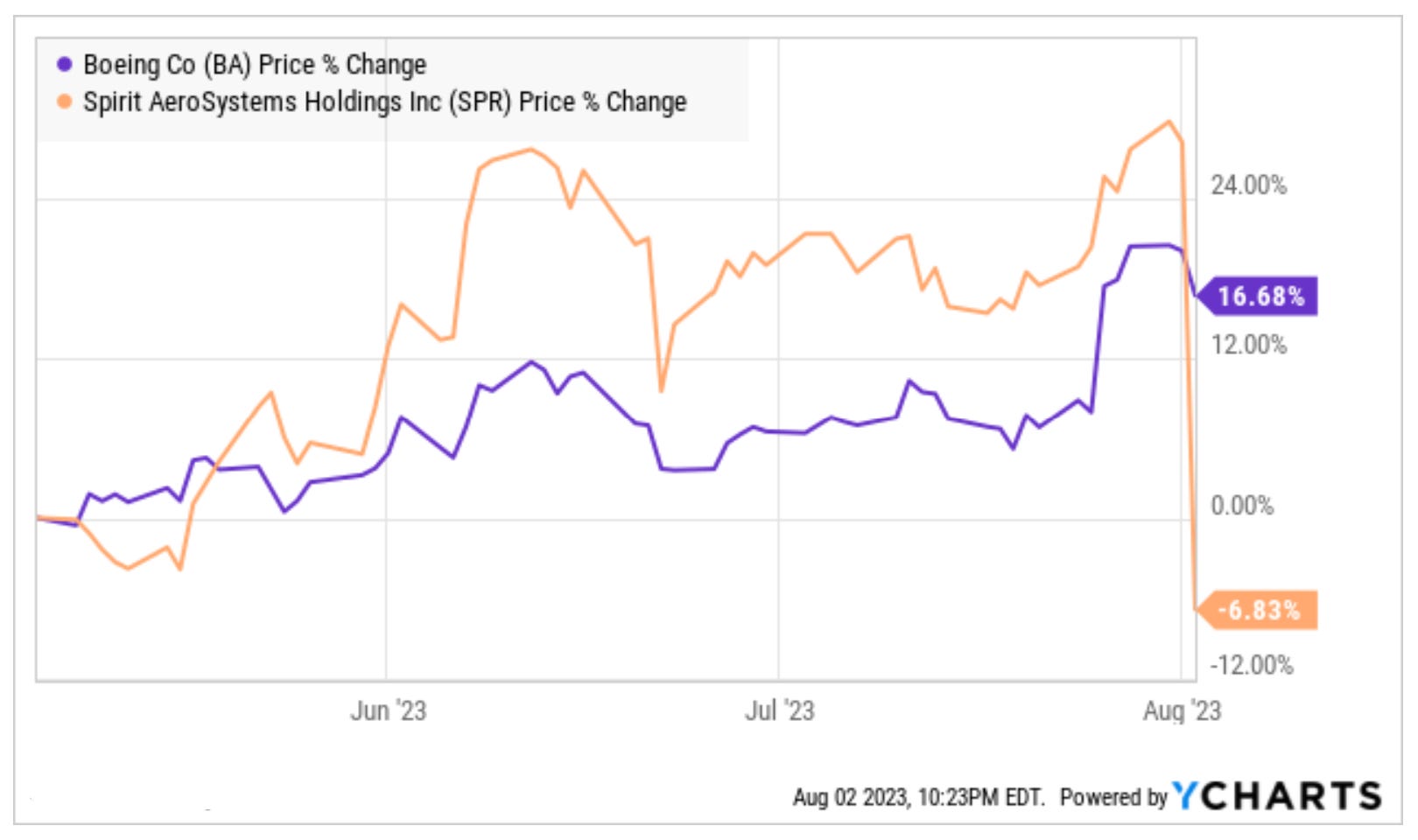
They did not. SPR in fact rallied sharply from there, and it’s not hard to see why. Amid rising optimism toward the aerospace industry, investors gave Spirit one last chance. So did analysts. Goldman Sachs put SPR on its “Conviction Buy” list ahead of the release, writing that if Boeing “has upside to deliveries in its outlook for this year, that all flows directly to Spirit”.
BA would rally as investors projected exactly that upside to deliveries, and as a result the more heavily-leveraged SPR did even better:
source: YCharts
But, for now anyway, Spirit has squandered the opportunity. The Q2 report was ugly, with an adjusted loss per share of $1.46 some 56 cents worse than consensus. The outlook for free cash flow usage for the full year went up by $100 million, to a range of $200-$250 million.
On the Q2 call, management tried to blame a machinists’ strike for the lowered outlook (Spirit also expects fewer shipments for the year), but that explanation fell flat, probably with good reason. The strike lasted for only one week toward the end of June.
Instead, this looks like a company that is indeed as ‘broken’ as we argued three months ago. This time around, investors seem unlikely to look past that problem. With SPR stock down a little over 7% from our call — but its enterprise value off by only about 3.5% — here, too, a reasonable short case seems to remain, even after a 27% plunge on Wednesday.
As of this writing, Vince Martin is long ROCK and GTLS, and short TSLA. He has no positions in any other securities mentioned.
Disclaimer: The information in this newsletter is not and should not be construed as investment advice. Overlooked Alpha is for information, entertainment purposes only. Contributors are not registered financial advisors and do not purport to tell or recommend which securities customers should buy or sell for themselves. We strive to provide accurate analysis but mistakes and errors do occur. No warranty is made to the accuracy, completeness or correctness of the information provided. The information in the publication may become outdated and there is no obligation to update any such information. Past performance is not a guide to future performance, future returns are not guaranteed, and a loss of original capital may occur. Contributors may hold or acquire securities covered in this publication, and may purchase or sell such securities at any time, including security positions that are inconsistent or contrary to positions mentioned in this publication, all without prior notice to any of the subscribers to this publication. Investors should make their own decisions regarding the prospects of any company discussed herein based on such investors’ own review of publicly available information and should not rely on the information contained herein.
Including convertible debt and mandatory convertible preferred stock on an as-converted basis, plus warrants and options, Chart has roughly 50 million shares outstanding on a fully-diluted basis.
Net debt was, and is, roughly $4 billion excluding the convertible notes, which again we’re treating as equity on an as-converted basis. They convert at just $58.725 per share; Chart has hedged the convert to remove dilution above ~$72 per share.
Looks like some good news in MITK too?
Amazing stuff. I was meaning to short MLNK but somehow lost track of things. The almost straight line rally from May felt strange at the time and it looks even stranger now. I need to do a better job of keeping up with these moves.