
Highlights:
Clean energy optimism has faded in 2023, and the solar industry has been a clear victim of the change in sentiment.
As a result, ENPH has been the worst performer in the S&P 500 in 2023 — but at the lows, the bull case still has two major holes.
AMSC saw an unjustified short-term rally, but has an intriguing long-term case as a turnaround takes hold.
We take a look at two clean energy plays that have pulled back of late — admittedly, for very different reasons.
Enphase Energy: From First To Worst
Both on this site and in our personal portfolios, we generally steer away from the large-cap space. As the name of this platform suggests, we see opportunities as being more plentiful and more fruitful in the small- and large-cap categories.
But even with that guardrail, it’s hard not to be intrigued by Enphase Energy ENPH 0.00%↑. This is a stock that over a five-plus year stretch almost certainly was the best in the entire market.
From 2017 lows to a 2022 all-time high, ENPH returned 47,687 percent. Its market cap went from under $100 million to $45 billion. So impressive has been that run that the involvement of T.J. Rodgers, who took a sizeable stake in ENPH near the bottom, now is boosting investor enthusiasm for Enovix ENVX 0.00%↑, a battery manufacturer of which Rodgers is the chairman.
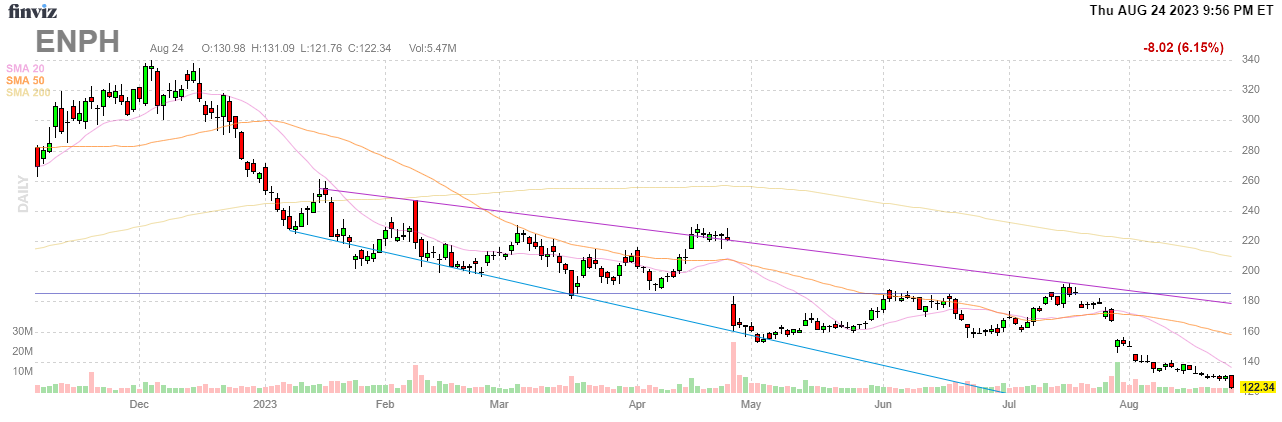
That all-time high was reached only in early December. Since then, ENPH has plunged by nearly two-thirds. Year-to-date, the stock has been the worst-performing constituent in the S&P 500, and far and away the biggest decliner among stocks that still have a market cap of $10 billion or higher. The pressure has only accelerated of late: ENPH has been negative in 17 of the last 21 trading sessions, including a no-news 6% decline on Thursday:
source: finviz.com
What’s Going On Here?
To some degree, it’s sector pressure that is weighing on Enphase stock. The Invesco Solar ETF TAN 0.00%↑ is down 24% year-to-date. Among 14 stocks in the sector with a market cap over $300 million, the average YTD decline is 26%.
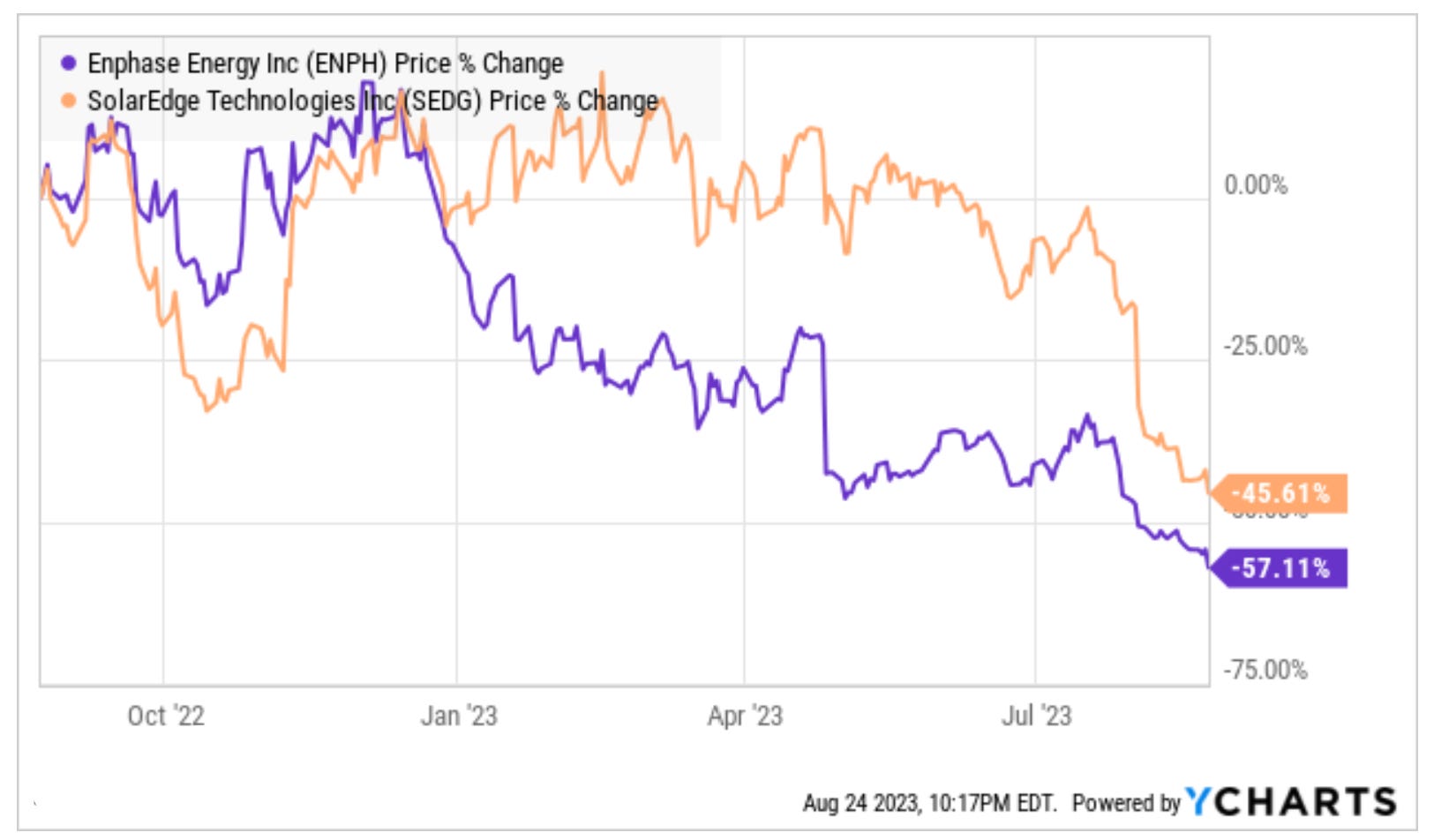
Obviously, ENPH has underperformed that group, but one piece of good news is that it hasn’t really underperformed its primary competitor:
source: YCharts
Enphase and SolarEdge Technologies SEDG 0.00%↑ dominate the U.S. residential market for inverters, which convert the DC (direct current) output of a solar panel into AC (alternating current). The two companies’ products are slightly different: Enphase develops microinverters, semiconductor-based systems which convert energy to AC at the individual panel level, while SolarEdge’s power optimizers send DC to a string inverter. The essential functions are the same, however, and the differences in practices between the products are relatively minor.
Given that SEDG is struggling as well, the culprit here seems to be broader weakness in solar. That weakness is real. Higher interest rates have effectively increased pricing in a solar industry dominated by financing. Changes to the energy policy in California, known as Net Metering 3.0, have reduced rates for energy returned to the grid by roughly 75%. According to one estimate, NEM 3.0 extends the payback for a solar installation from 5-6 years to 14-15 years.
As Enphase chief executive officer detailed (repeatedly) on the Q2 conference call, the quick decline in demand followed a banner 2022, driven by easing supply chain issues around panels and a rush to take advantage of NEM 2.0 rules. Enphase thought the dip in demand would be relatively brief, but it was wrong; as a result, the company shipped too much inventory to distributors in the first half of the year.
In Q3, Enphase is rectifying that issue by dramatically lowering shipments, to allow distributor inventories to normalize. Per management, that decision largely explains guidance for the quarter that looked absolutely disastrous: revenue of $555 million to $600 million against consensus estimates of $749 million. For its part, SolarEdge seemed to confirm that Enphase’s outlook was not the result of lost market share: that company, too, issued guidance that was markedly below expectations, for largely the same reasons.
The Case for ENPH At The Lows
That explanation seems to suggest that Enphase stock should be exceptionally attractive after this sell-off. As a result of what appear to be largely short-term fears, valuation has come in substantially: ENPH now trades at less than 19x forward earnings. Yet there are years, perhaps decades, of growth ahead. There’s also little sign of lost market share to SolarEdge; and an asset-light model that limits capital needs. ENPH in fact trades at 24x last year’s free cash flow, and a low 30s multiple adding back the boost from stock-based compensation.
Certainly, the Street sees it that way. The average price target is $207, suggesting 69% upside from Thursday’s close. Only one other S&P 500 constituent has a higher gap between the consensus price target and the current price: SolarEdge, for which analysts on average see a stunning 95% upside.
And it’s possible there’s simply been some mean reversion here. Solar stocks on the whole did reasonably well last year: the Invesco Solar ETF was off barely 5%, and ENPH itself gained 44%. The S&P lost nearly 20% in 2022. A nervous market was paying up for perceived safety last year (see packaged food companies, for instance). It might sound insane to call solar stocks anywhere close to safe, given the industry’s nearly unbroken, century-long record of capital destruction. Given incentives created by the Inflation Reduction Act, however, there likely was a sense that the industry’s time had come, and that government support would leave solar demand less macro-sensitive than it had been in the past.
Is Enphase Actually Losing Share?
That overall case does seem tempting. But, perhaps counterintuitively, it’s a case that probably was stronger with ENPH at $140 following SolarEdge’s report in early August than it is with ENPH at $123 right now. It’s one thing to argue that the market is overreacting to ugly short-term guidance immediately after a quarterly report (or, in this case, a pair of quarterly reports). It’s another to argue that the market is still overreacting as the sell-off accelerates.
And there are two big stumbling blocks to the fundamental bull case. The first relates to the argument that market share hasn’t gone anywhere. It does seem like Enphase’s positioning relative to SolarEdge hasn’t changed, and in recent years those companies have owned 85% or more of the market (depending on the source and the timeframe). But there is a new threat: Tesla TSLA 0.00%↑.
A white paper issued by Tesla at the beginning of the year argues that its inverter is both cheaper and more effective than alternatives from Enphase and SolarEdge. And that product is no longer available only through installations by Tesla itself.
Indeed, the first question on the Q2 call centered on spot checks that showed more aggressive discounts from Enphase in response to competition by Tesla. Enphase chief executive officer Badri Kothandaraman largely dismissed the threat of pricing pressure, saying that his company’s products still led the market and that volume-based pricing was simply part of the business model.
But Barclays has argued that Tesla is taking market share — and that its gains are actually tied to NEM 3.0 adoption in California. The issue here is that, under NEM 3.0, storage becomes a more much important component of the residential system; lower credits for excess energy mean storing that energy is more cost-effective. That gives an edge to Tesla, who has leadership in batteries, where Enphase is still playing catch-up. And if Enphase is indeed ceding market share, and not just seeing short-term pressure from a short-term buildup in channel inventory, the case at the lows gets much weaker.
Is This Time Different For Solar?
The second issue we highlighted back in April, when we took a brief look at ENPH. As we wrote then, on the Q1 conference call the term “interest rate” or “interest rates” was used thirteen different times. Most concerningly, Kothandaraman said then that “demand will unleash only when the interest rates are back to normal.”
Of course, current interest rates are more normal than the zero/near-zero rates seen for most of the post-financial crisis period. And if Enphase itself is saying that industry demand can’t handle a 5%-plus Fed Funds rate, then maybe this time isn’t different for solar after all. Perhaps residential solar is (at least for the mid-term) yet another example of market distortion created by years of zero-interest-rate policies, and thus set to disappoint as it has done so many times in the past.
At the time, we argued that Kothandarman’s commentary was part of an argument for pressing a short in ENPH, which looked badly overvalued in December and still expensive in April. Admittedly, we passed on that argument1. We would still pass now. A short here begins to center on betting against the industry as a whole, and there are simply better targets elsewhere in the sector.
But that risk also matters in the near term. Quite clearly, the optimism toward solar that existed in 2020-2022 has been significantly damaged, if not completely wiped out. And when a CEO as influential as Kothandaraman is calling out interest rates as a headwind, and given that NEM 3.0 has barely been rolled out to this point, it’s hard to see a catalyst. All told, ENPH is getting interesting, but not yet interesting enough.
American Superconductor Gets A Bump
Last month, the story of LK-99, a purported room temperature superconductor, went viral. In response, investors/traders2 piled into American Semiconductor AMSC 0.00%↑, a penny stock with no connection of any kind to LK-99 and (probably) no real prospects on its own.
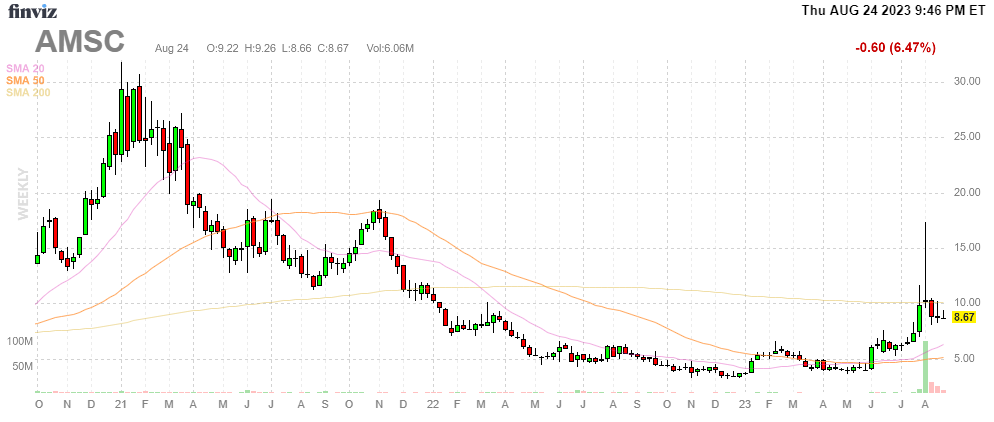
The properties of LK-99, however, appear to have been overstated. Not coincidentally, AMSC has pulled back in recent weeks, and it would seem likely the reversal will continue until the stock returns to the $4-$5 range that held for nearly a year:
source: finviz.com
Or at least that is the story that I presumed was the correct one. In fact, the long-term case for American Superconductor is more solid and more interesting than the chart might suggest, even if the cause of the recent rally remains rather questionable.
The Obvious Parallel
The risk to AMSC is highlighted simply by the history of both the company and the stock. After fiscal first quarter results this month, management talked up the ability to reach cash flow breakeven in fiscal Q2. That’s good news in the near-term context — but it’s taken American Superconductor a long time to get to this point.
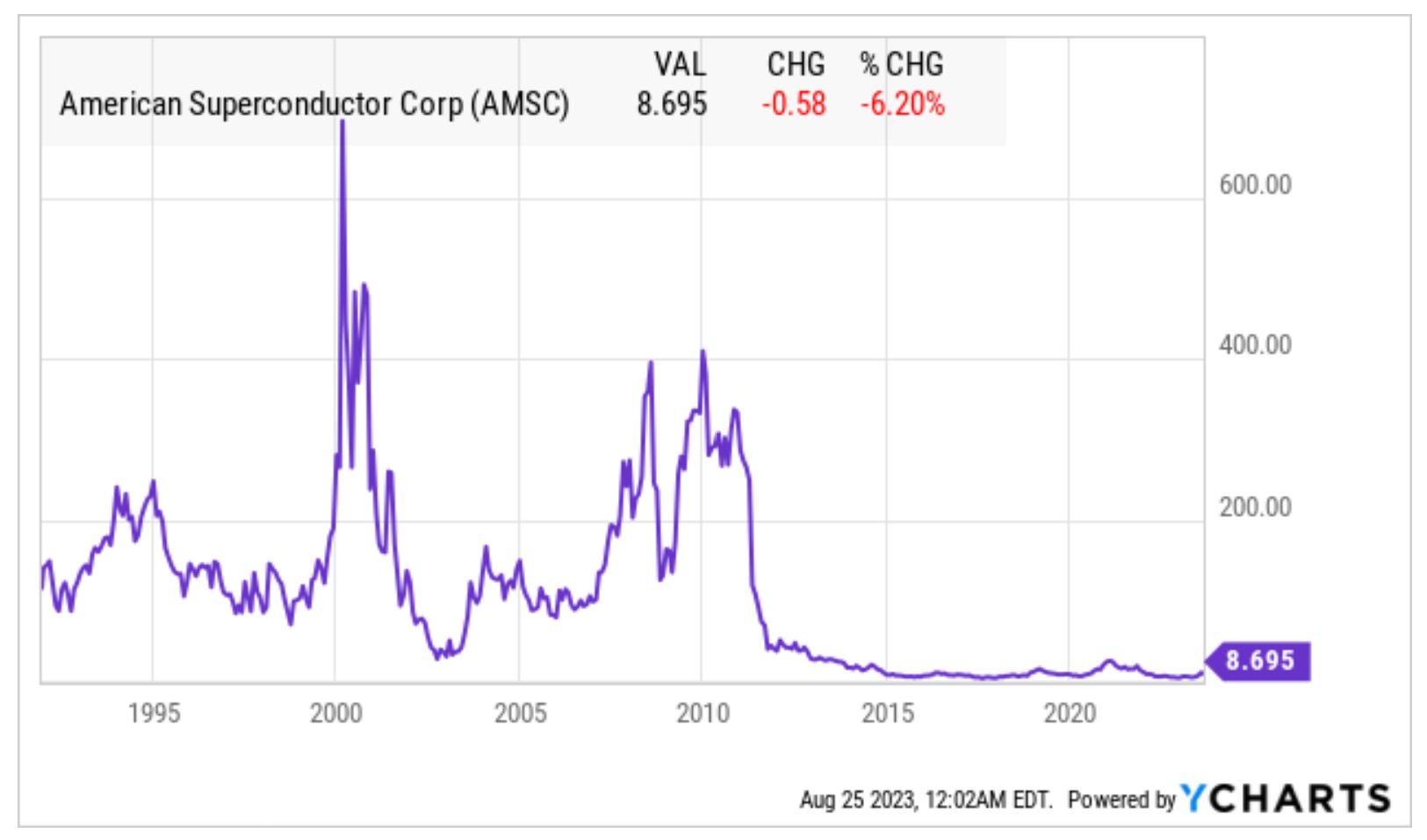
This is a company that was founded in 1987. It went public in December 1991. Since then, AMSC stock has been an almost uniquely awful investment:
source: YCharts
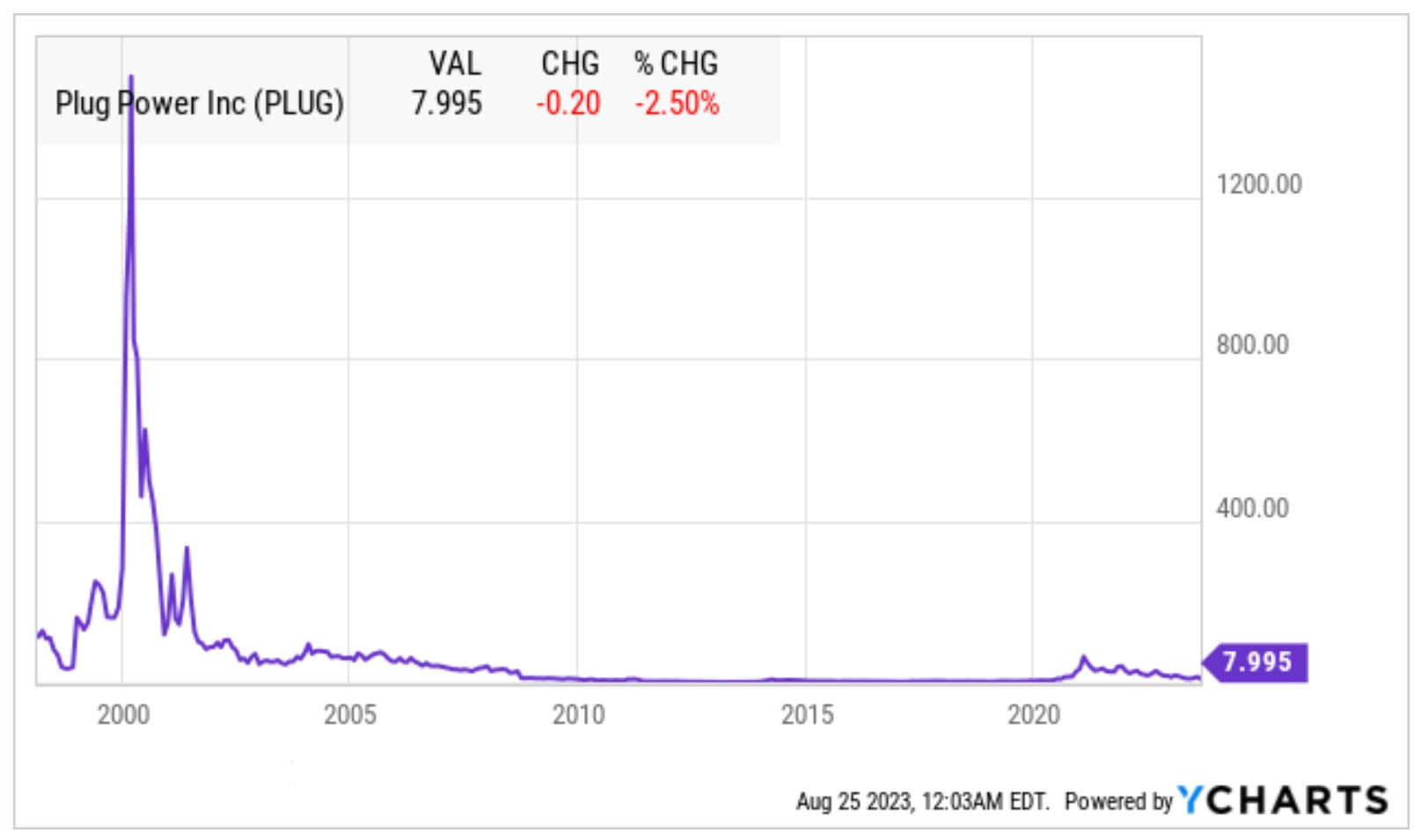
We write “almost uniquely awful,” however, because AMSC is reminiscent of another, more popular, clean energy stock:
source: YCharts
For both American Superconductor and Plug Power PLUG 0.00%↑, the bear case is exceptionally simple: the underlying technologies haven’t worked yet, and likely never will. Each has a checkered history, going public in the 1990s and providing cumulative returns worse than negative 90 percent. American Superconductor’s accumulated deficit is $1.06 billion; Plug Power’s is $3.56 billion. Each has tantalized on occasion over the past three decades; neither has really delivered on its promise3.
But each, at least on paper, has the potential for absolutely massive returns. If Plug Power can make hydrogen a critical component of the global energy industry, its current ~$5 billion market cap is going up tenfold at least. Similarly, if American Superconductor can be part of the transition to renewable energy, AMSC stock would be one of the best in the entire market.
Again, investors have been making those uber-bullish arguments for a few decades now. Nearly all of those investors exited their stakes at a loss.
The Sinovel Scandal
But that high-level view ignores perhaps the most important event in American Superconductor’s history, one from which the company is still recovering.
AMSC was founded in 1987 to manufacture superconducting wire, which it currently produces under the product name Amperium. Amperium is high-temperature superconductor wire used for applications such as electrical cables and current limiters. But in 2006, the company acquired a wind turbine supplier, and that business grew nicely. The company’s biggest customer was Sinovel, a turbine manufacturer based in China.
A few years later, Sinovel had to retrofit its turbines to meet new government standards. To do so would have required enormous licensing payments to AMSC. So, with the help of an Austrian national on AMSC’s payroll, the company simply stole the software.
The impact on American Superconductor was staggering. In fiscal 2010, Sinovel accounted for 68% of the company’s revenue. The next two years, the figure was zero. AMSC wound up laying off more than two-thirds of its workforce. Even when Sinovel was convicted of theft in a U.S. court in 2015, the benefit was modest. AMSC wound up receiving less than $60 million. Prosecutors estimated losses of over $1 billion.
The Bull Case Now
Slowly but surely, American Superconductor has managed to recover. The wind business is essentially decimated, accounting for just $11 million (and 11%) of FY23 revenue. Nearly all of those sales come to a single customer in India, whose purchases are down sharply from their peak:
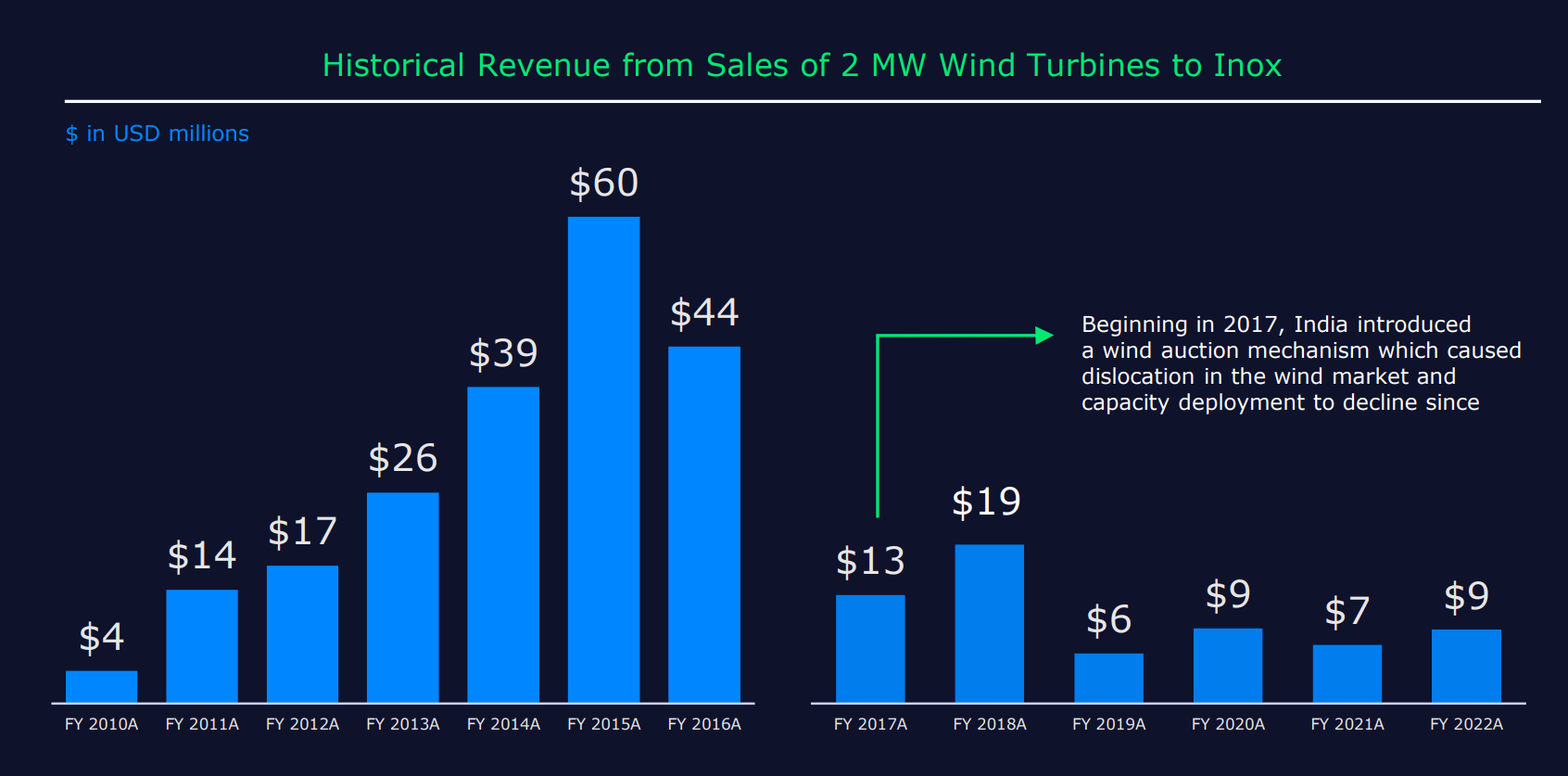
source: American Superconductor presentation, July 2023
But those declines have obscured impressive performance in the company’s Grid segment. Revenue there nearly quadrupled between FY17 and FY23 (albeit with some help from acquisitions). AMSC has won a contract with the U.S. Navy for so-called “degaussing systems”, which provide protection against sea mines. Orders from renewable energy firms are picking up pace. More broadly, the clear need for trillions of dollars in investment in the U.S. electric grid — demand which will be supported by federal infrastructure spending — means AMSC might have years of growth ahead.
In FY23, AMSC generated just over $100 million in revenue. Orders are running at nearly $40 million per quarter at the moment, suggesting the potential for impressive top-line growth (revenue increased 33% year-over-year in Q1). Even margins should improve, with price increases taken and lower-margin backlog being worked through at the moment. Even the wind business has shown signs of life.
In recent quarters, this has started to look like a turnaround nearing, as management has put it of late, an inflection point.
Hoping For A Pullback
All that said, it’s difficult to get too excited. AMSC has more than doubled since late May. Not all of that rally can be attributed to LK-99; interest in the topic didn’t pick up until the middle of last month. Still, there’s a sense that retail interest pushed the stock up for no logical reason. In fact, the LK-99 news, were it real, would suggest that AMSC stock should plunge rather than rally; it would suggest an existential risk to the company’s high-temperature superconductor offering.
But we have seen these kinds of rallies not only reverse, but leave the stock in worse shape than it was before. In that scenario, AMSC gets interesting. The revenue multiple is moving under 2x, free cash flow for FY2025 might be positive, and long-term growth drivers are intact. So while investors might have bought AMSC for the wrong reason in July, they might be buying it for the right reasons in the near future.
As of this writing, Vince Martin is short Tesla. He has no positions in any securities mentioned.
Disclaimer: The information in this newsletter is not and should not be construed as investment advice. Overlooked Alpha is for information, entertainment purposes only. Contributors are not registered financial advisors and do not purport to tell or recommend which securities customers should buy or sell for themselves. We strive to provide accurate analysis but mistakes and errors do occur. No warranty is made to the accuracy, completeness or correctness of the information provided. The information in the publication may become outdated and there is no obligation to update any such information. Past performance is not a guide to future performance, future returns are not guaranteed, and a loss of original capital may occur. Contributors may hold or acquire securities covered in this publication, and may purchase or sell such securities at any time, including security positions that are inconsistent or contrary to positions mentioned in this publication, all without prior notice to any of the subscribers to this publication. Investors should make their own decisions regarding the prospects of any company discussed herein based on such investors’ own review of publicly available information and should not rely on the information contained herein.
In our defense, we pointed readers to installer Sunrun RUN 0.00%↑, which has done even worse.
In situations like these, it’s a fascinating, if unanswerable, question whether these are “investors” or “traders” — or, more broadly, if the people buying these stocks are rational actors.
On its face, buying a stock with “Superconductor” in the name because of a questionably-supported development in the space makes little sense. But we’ve seen so many instances of similar rallies that savvy traders might well be getting in first — or even well after first, betting (often correctly) that the rally will be long enough for them to exit once it turns.
Plug Power is guiding for well past $1 billion in revenue this year, but first-half gross margins are negative 31 percent.