
TLDR:
We highlight four ideas from other investors: LYFT converts, activist shorts on EVA and ASTS, and a long call on LC.
The LYFT converts look like a particularly intriguing idea in this market environment, though the case for LC is surprisingly strong.
EVA and ASTS could be good shorts, though timing and valuation look paramount.
“Good [investors] copy. Great [investors] steal.” - Pablo Picasso
There is a staggering amount of investment content on the web. As we saw in 2020 and 2021, much of that content is perhaps not all that useful; some of it proved to be outright dangerous.
But filtering through the noise, there are good, and occasionally great ideas, out there, in many cases for free. (Hopefully, we’ve even published a few of them.)
In this week’s edition of Research Notes, we’re going to highlight four intriguing ideas we’ve seen of late, digging into the original pitch and providing some of our own commentary along the way.
1. Lyft’s Busted Converts


This idea — to own Lyft’s 1.50% convertibles, maturing May 2025 — isn’t quite as good as it was three weeks ago. The bonds have moved to last trade at 88.5, dropping the yield-to-maturity more than a point to 6.46%.
That said, it’s still an intriguing idea both in terms of the specific trade and the underlying logic.
As for the trade itself, the spread to the 2-year Treasury (a reasonable approximation given that these bonds have 30-plus months to maturity) is a touch over 200 basis points. That doesn’t sound all that attractive given that Lyft remains an unprofitable company that’s a relatively distant second place to Uber. (Lyft seems to have roughly 30% of the market, depending on where you look).
But as Salt(y) notes in a short thread, the Lyft converts have a couple of points in their favor. First, existing cash easily covers the debt. Lyft ended Q2 with ~$1.8 billion in cash and short-term investments. There are $748 million in converts outstanding.
Lyft does have $122 million in other loans maturing in the meantime (though under revolving facilities that likely could be easily extended). And the company did burn $230 million in the first half of 2022.
That burn rate should slow. Lyft is guiding for $700 million in free cash flow in 2024. Even falling far, far short of that goal implies a sharp improvement from YTD results. Salt(y) points out that Lyft’s “faux-BITDA”, which is goosed by the exclusion of share-based compensation (almost 18% of revenue in the first half!) works out just fine for debt holders.
Even assuming that a) Lyft repays its non-convertible debt and b) the 1H 2022 burn rate holds, Lyft would only have to issue $300 million in equity to cover the converts. That’s less than 6% of the company’s current market capitalization.
As is, the odds of bankruptcy seem exceptionally low. That leaves two big risks. The first is the return of the coronavirus pandemic (or something different): Lyft in 2020 burned almost $1.5 billion, against less than $300 million the year before. That risk alone doesn’t seem to justify a 200 bps spread, particularly given that a bankrupt Lyft would likely have some recovery value for bondholders.
The second risk — one well-known to investors who buy equity of companies with net cash — is that Lyft makes a large, dumb acquisition1. But just two days ago, the company’s President and co-founder reiterated that the company would stick to transportation. And there doesn’t really appear to be a high nine-figure deal in the space available, even if Lyft wanted to make a deal.
Simply as a credit instrument, the converts seem reasonably attractive. But as Salt(y) notes, there’s some value in the conversion option as well. Not a lot of value, mind you: the conversion price is $38.39, which requires 160% upside from Wednesday’s close.
But the January 2025 35 call is bid at $1.21; assume the convert option value is worth ~$12 and that's $26 in value on a $1,000 par bond (which can convert into 26 shares), or ~3% of the purchase price. It's also worth noting that, somewhat oddly, just this week three $1,000 trades have closed, two at 84 and one at 83. It might be possible for individual investors to juice the YTM by putting out a low bid.
Salt(y) closes the mini-pitch with:
That general sense is worth considering as well. Back in June, we wondered if the proper historical analogue for this market was not 2000-2001 or 2007-2009, but the 1970s. That decade saw a long and brutal market. As we highlighted in that piece, from 1969 to 1982 real returns in equities were negative 11.6 percent.
This rally of late looks potentially like another bear market rally, and that 1970s-style scenario seems to still be on the table. This is the kind of idea that fits well with the nimble trading required to survive, let alone thrive, in that kind of market: getting a modestly above-market return while keeping risks low and (if necessary) powder dry.
2. Short Enviva
Back in September 2016, I bought shares of National Beverage (FIZZ), best known as the manufacturer of LaCroix sparkling water. Two days later, activist short seller Glaucus Research took aim at the stock, which promptly plunged more than 10% intraday.
Since that sell-off, National Beverage stock is up more than 150%, better than doubling the returns in the S&P 500. As I wrote at the time, Glaucus’s case, though well-written, simply wasn’t that strong when looked at in detail. I averaged down in response, and made a nice profit in the process.
This is not meant to be, as the kids say, a humblebrag. Indeed, I sold the stock way too early (if memory serves, FIZZ doubled in less than a year after my exit3). Rather, the point is that activist short sellers are worth listening to, because they can create opportunities even if they’re wrong.
The activist short report on Enviva from Blue Orca Capital is reminiscent of the Glaucus piece on FIZZ. It's well-written. It seems compelling. But, to my eye, it doesn't quite get there. So far, the market agrees: at Wednesday’s close, EVA has recaptured all the entirety of the 13% decline seen on the day the report was released.
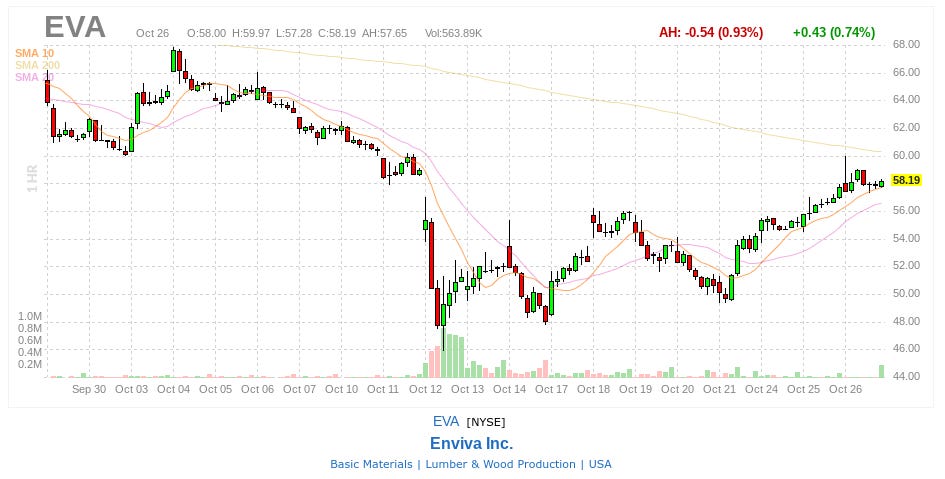
Blue Orca makes two broad points. First, Enviva is “greenwashing”. It claims to turn largely scrap wood from timber harvesting into wood pellets that are then shipped overseas (largely to Europe) to replace coal in energy generation. But the short seller argues that Enviva in fact is privy to clear-cutting practices and driving the decisions to clear tracts around its mills.
Second, Enviva’s dividend — currently yielding 6.2% — is being funded by debt and at risk of being cut in the near term.
On the first point, there appears to be quite a bit of debate. Analysts from Citigroup and Raymond James both have said Blue Orca misunderstood the business model. For its part, Blue Orca cites criticisms of the wood pellet business from climate activists — but those criticisms are far from definitive.
From an investment standpoint, however, the debate is not really all that material. The question is whether Blue Orca is going to convince anyone, and on that front there is plenty of cause for skepticism. ESG investing, to this point, is not often about deep dives into carbon dioxide measurements.
More importantly, it seems exceptionally unlikely that Europe, in the midst of market volatility driven by the Russian invasion of Ukraine, is going to question any source of energy any time soon. There are echoes here of the failed Herbalife case made by Bill Ackman: the question that matters is not whether policymakers should change course, but whether they will.
The financial argument is a bit more intriguing. Enviva’s results have been impacted by the company’s conversion to a corporation from a master limited partnership late last year. But Blue Orca’s core points hold. The dividend has been funded by debt. The company’s own metric suggests limited coverage. There’s not a lot of room for error here, and a reasonably high multiple (19x the midpoint of 2022 Adjusted EBITDA guidance).
To our eye, the case isn’t quite intriguing enough, and Blue Orca’s claims about the company overstating its results don’t pass the smell test. (There’s a decent rebuttal at Seeking Alpha4). More broadly, allegations that near the fraud line need to be much better substantiated. But it’s possible, particularly with the immediate losses recaptured, that EVA is a short anyway.
3. Short AST SpaceMobile
We took a long look at shorting ASTS earlier this year. The case is relatively simple. The company aims to provide mobile broadband service via satellite in a manner that can be accessed by standard smartphones. And that’s a model that many bigger, better companies have failed at.
Project Loon from Alphabet was eventually shut down. Facebook gave up on its plan for high-altitude Internet drones. AeroVironment and Softbank have their own similar effort, but it’s not going well.
Meanwhile, ASTS went public via the SPAC (special purpose acquisition company) route. So-called de-SPACs have a strong pattern of overpromising and underdelivering. There was even some sign that the optimism surrounding speculative stocks, so faded elsewhere, was lingering here: ASTS jumped 45% in March after announcing a multi-launch agreement with SpaceX. That was a bizarre rally. ASTS is a potential customer of SpaceX, rather than the other way around.
But, to be honest, that case felt a bit thin, both for this platform and for personal accounts. ASTS had held up well, at least by de-SPAC standards. Perhaps there was something there.
Last month, however, Kerrisdale Capital, an experienced activist short, absolutely eviscerated the stock. The report added specific criticisms to our broad sense that the market was ignoring history, both with the business model and with de-SPACs more broadly. ASTS dropped 11% and has kept falling. It’s lost 40% of its value since publication.
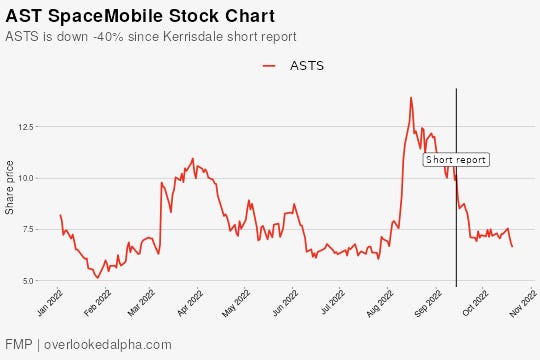
Shorts haven’t gone anywhere, however, and with good potential reason. ASTS still has a market capitalization of $1.2 billion. It still trades about where it did in July. Kerrisdale is making a “short to zero” case, and zero remains a long way away.
It’s been nerve-wracking in recent years to bet against these kinds of stocks (28% of the float is sold short). Cost of borrow is about 18% at the moment, and the options market unsurprisingly is skewed toward the put side.
But there are some potential opportunities in call spreads, and this is a stock that can give way in a hurry. This was a great short idea from Kerrisdale at $10, and it still looks like a good idea above $6.
4. Lending Club
Lending Club is a lending platform operating at a time of increasing macroeconomic risk and rising interest rates. LC stock is down more than 90% from its all-time high (adjusted for a 2019 reverse stock split). There seems no way that LC is anything better than a value trap at the moment.
Yet over at Value Investors Club, grizzlybear in August made a rather strong case5 for LC stock — even accounting for the headline risks.
A key part of the thesis is the change brought about by LC’s February 2021 acquisition of Radius Bank. The acquisition both allows LC to fund loans via deposits and to keep loans on its balance sheet.
To be sure, that acquisition might be exactly why investors are selling LC at the moment. The deal originally was well-received: Lending Club stock went from $12 to nearly $47 last year. Of course, that was a very different market, and at Wednesday’s close LC had essentially round-tripped. With an 8.6% after-hours decline following Q3 earnings, the stock is now down since then.
But with that decline — which narrowed during the after-hours session — there is an intriguing contrarian case. LC is trading at about 4x this year’s guidance for GAAP net income. Price to tangible book value is about 1.1x. Higher interest rates are a threat to originations — apparently the cause of the after-hours sell-off — but suggest a tailwind to net interest margin, which already has expanded in recent quarters.
Meanwhile, both LC’s balance sheet and portfolio look to be in healthy shape. The average credit score of borrowers is 730, as Lending Club has pulled back from a move into subprime lending a year ago.
The case here has to be based not on valuation — history shows how dangerous owning ‘cheap’ financials into a recession can be — but on the underappreciated strength of the business post-acquisition. That case remains intact, and the post-earnings move to pre-Radius levels strengthens it. Investors willing to make a macro bet should be taking a long look at LC.
As of this writing, Vince Martin has no positions in any securities mentioned.
Stocks mentioned: ASTS 0.00%↑, EVA 0.00%↑, FIZZ 0.00%↑, HLF 0.00%↑, LC 0.00%↑, LYFT 0.00%↑, UBER 0.00%↑
Disclaimer: The information in this newsletter is not and should not be construed as investment advice. Overlooked Alpha is for information, entertainment purposes only. Contributors are not registered financial advisors and do not purport to tell or recommend which securities customers should buy or sell for themselves. We strive to provide accurate analysis but mistakes and errors do occur. No warranty is made to the accuracy, completeness or correctness of the information provided. The information in the publication may become outdated and there is no obligation to update any such information. Past performance is not a guide to future performance, future returns are not guaranteed, and a loss of original capital may occur. Contributors may hold or acquire securities covered in this publication, and may purchase or sell such securities at any time, including security positions that are inconsistent or contrary to positions mentioned in this publication, all without prior notice to any of the subscribers to this publication. Investors should make their own decisions regarding the prospects of any company discussed herein based on such investors’ own review of publicly available information and should not rely on the information contained herein.
Per the 10-K, there are no financial covenants attached to the converts.
By my numbers, Black-Scholes calculations suggest a much lower value. For a number of reasons, I’d put more faith in market makers.
True story: I sold FIZZ because I had an interaction with CEO Nick Caporella and he was such a d—- that I decided I didn’t want to own shares of a company he ran. It’s an unusual example of the danger in letting emotions get in the way of investing.
The rebuttal has a couple of misses, admittedly. The funniest is when the author points to post-report insider buying from board member Jeffrey Ubben as a point against Blue Orca. We’re old enough to remember Ubben passionately defending another renewable energy play last year: Nikola.
VIC articles are paywalled, but articles over 60 days old can be accessed via a free account.