
Highlights:
French fry business Lamb Weston plunged 19% on Thursday, its largest-ever single-day decline.
The catalyst was a disappointing earnings report, caused by a poorly-executed ERP implementation.
The bigger issue appears to be structural: industry capacity is on the way, which may exacerbate already slowing demand.
History says LW is a buy with EV/EBITDA under 10. But investors have to trust their judgment of what this business actually is.
Lamb Weston seems to be an awfully good business. 13% of fiscal 2023 revenue came from McDonald’s, among the most defensive and most successful businesses in the world. On the supply side, the potato processing industry in the U.S. is essentially an oligopoly, though there’s more competition overseas (about 35% of Lamb Weston’s revenue).
In the market of the last few years, a good business is usually a good stock. In the case of LW, however, it depends on when an investor bought it:
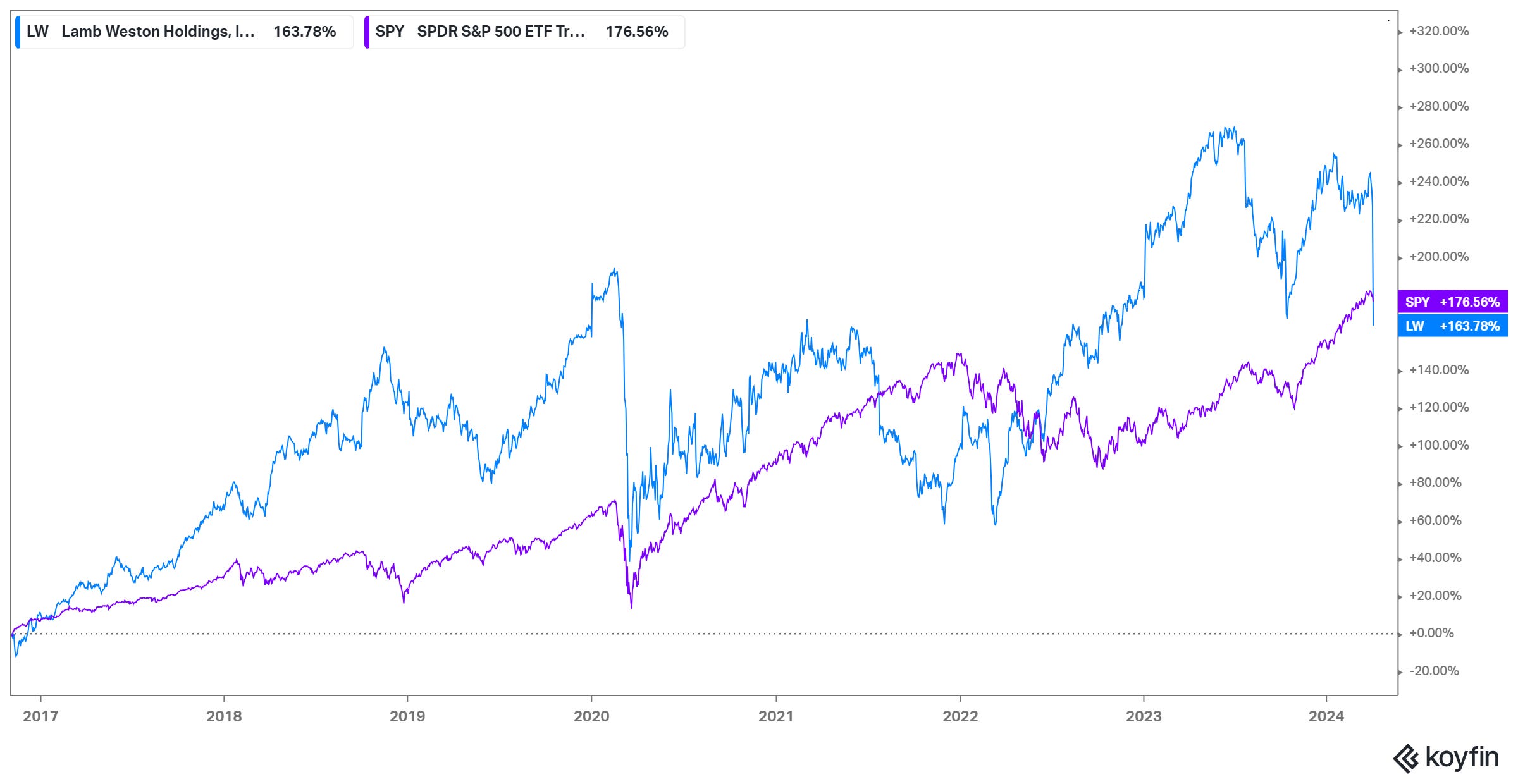
source: Koyfin; total return chart
Following a 19% decline on Thursday — LW’s biggest single-day drop in its seven-plus years on the public market — the stock is modestly below late 2018 highs. But those who bought dips in either late 2021 or early 2022 still have generated alpha despite Thursday’s plunge.
On its face, this week’s decline presents yet another opportunity. But there’s an argument that this time is different.
source: LW investor presentation
Introducing Lamb Weston
Lamb Weston was founded in Weston, Oregon in 1950 by F. Gilbert Lamb (hence the ‘Lamb Weston’ name) and originally focused on pea processing. But Lamb Weston quickly become one of the leading potato processors in the world; the company even invented the “water gun knife” (which cuts French fries by using high-pressure water to push a peeled potato through a slicer).
In 1971, the company landed what remains its biggest customer: McDonald’s. The fast-food industry remains hugely important: in fiscal 2023 the company’s “Global” segment, which includes the top 100 quick-service chains in North America, drove over half of revenue. The Global segment also includes international sales to distributors and retailers (and in FY24 LW transitioned to reporting only North America and International segments), so QSR exposure is less than 50%, but it’s still the key industry for the business. LW also has several retail brands, including Grown in Idaho and Alexia, serves the foodservice industry in the U.S. and Canada, and has small businesses around vegetables and dairy.
In 1988, Lamb Weston was acquired by Conagra Brands (then ConAgra Foods). It’s telling that Conagra kept the business for 28 years, an eternity amid the endless conglomerate-building and -destroying activities across the food industry over the next three decades. But in late 2016, Conagra spun off Lamb Weston, and the transaction has been a success. LW was spun at $34; the stock has gained 151% since, plus dividends. Until Wednesday, Lamb Weston had a higher market capitalization than its former parent.
What Happened On Thursday
On its face, the fact that LW saw its biggest decline ever on Thursday makes some sense. At least relative to Street expectations, Q3 FY24 was far and away the company’s worst report ever:

source: Seeking Alpha
There is an explanation for the miss — somewhat. Management said an ERP (enterprise resource planning) software implementation went poorly, leading to a lack of visibility surrounding inventory at distribution centers. This in turn led to delayed and canceled orders.
The catch is that even by management’s own estimates, the ERP issues don’t account for the entire shortfall. LW said the revenue hit was $135 million, meaning on a ‘normalized’ basis revenue still would have missed consensus by $55 million, or more than three percentage points. That’s a huge miss, given the kind of analyst coverage LW’s biggest customers get.
Similar math looks a little better on the bottom line. LW said Adjusted EBITDA took a $95 million hit in the quarter, with “over half” from the order issues. At $50 million, the after-tax effect would be about 26 cents per share, the entirety of the miss relative to the Street.
Still, even management admitted that part of the issue here is softening demand. And that sense is clearly evident in both Q3 results and Q4 guidance. In Q3, even excluding the exit of contracts and the ERP problems, volumes still fell in the range of 4.5% year-over-year. Q4 guidance contemplates similar performance.
LW Is Starting To Look Cheap
As we wrote up front, LW has been a good investment if you get it at the right price. That right price existed after the late 2016 spin-off, and has returned a few times since. Right now, it seems from a high-level perspective like it might be back again:
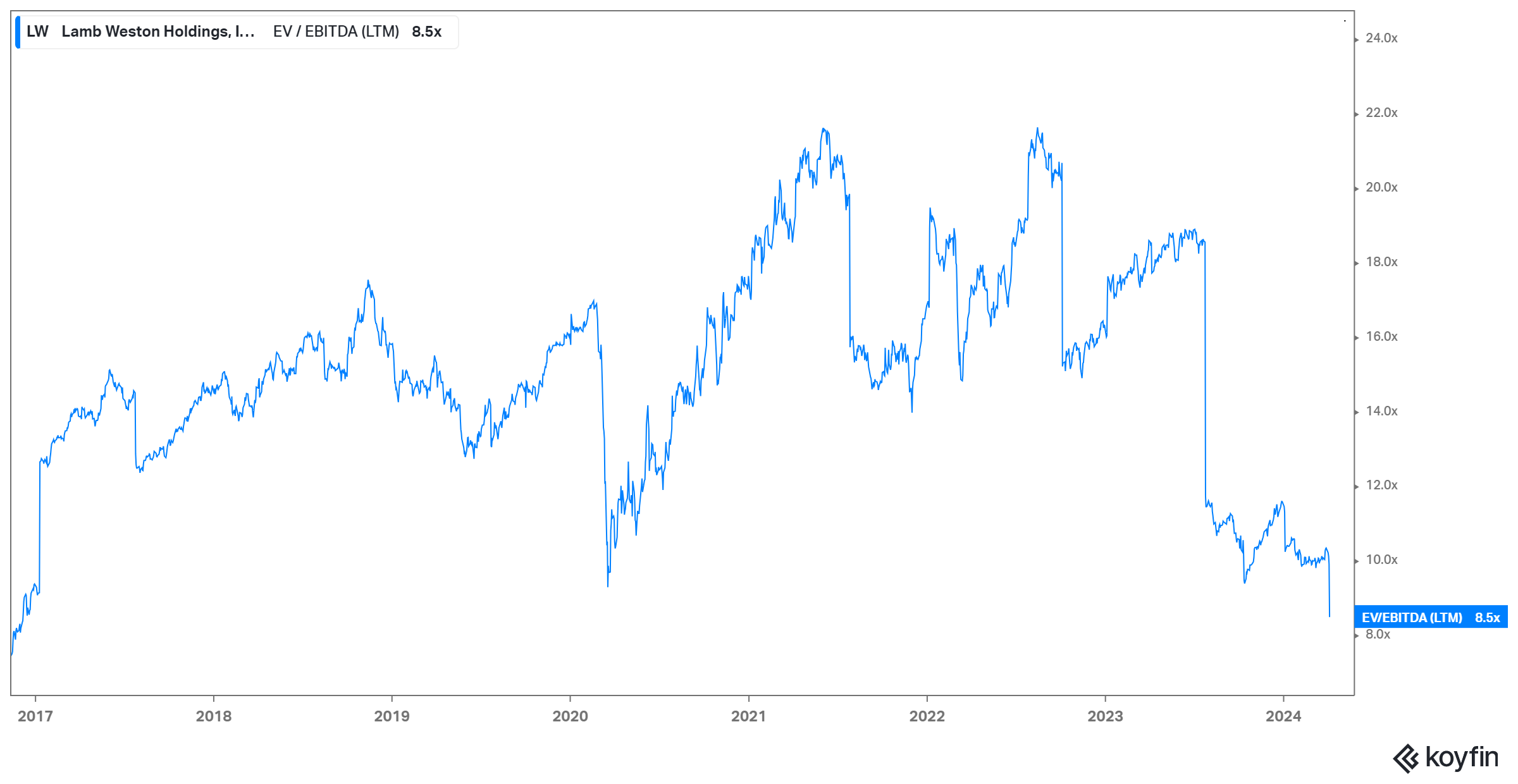
source: Koyfin
Valuation isn’t quite as attractive as the chart suggests: EV/EBITDA at the midpoint of updated FY24 guidance is 10.5x1. Still, that multiple is at the bottom of the multi-year range, and P/E multiples tell a similar story.
And where the fundamental case starts to get really attractive is in terms of what Lamb Weston means by “adjusted”. The $95 million in ERP costs (driven both by the implementation and its effects) is included in the Adjusted EBITDA results for the quarter and in guidance for the full year. So is a $25 million non-cash charge to write off excess raw potatoes.
Indeed, the second question on the Q3 earnings call covered precisely this fact, with analyst Andrew Lazar of Barclays positing that one-time costs were lowering FY24 Adjusted EBITDA to ~$1.5 billion from something closer to $1.7 billion. He asked if the latter, higher figure represented a base for growth looking to FY25. Chief financial officer Bernadette Madarieta responded, “You’re absolutely thinking about it correctly.”
So if Adjusted EBITDA in FY24, backing out one-time costs, is ~$1.65 billion, LW is actually trading at ~9.5x EBITDA — essentially its lowest multiple ever. In that model, underlying adjusted EPS is about 80 cents higher2, or about $6.38, and LW is trading at less than 13x this year’s earnings.
That multiple, too, would be essentially the lowest ever — but even the historical comparison misses a key point. Those underlying earnings are coming in a year where the second half seems clearly to be affected by cyclical pressures.
To be fair, investors aren’t necessarily paying 13x trough earnings, but it appears quite obvious they’re not paying 13x peak, either.
Capacity On The Way
To this point, the sell-off seems like an overreaction. Both the ERP implementation and the decline in restaurant traffic are temporary factors. There’s no sign in the quarter of a secular headwind in terms of potato demand. Management argued that the “fry attachment rate”, a nebulously-defined term that describes how often the side is ordered, remained stable in Q3. And the reason Lamb Weston wanted to consolidate overseas subsidiaries is because the French fry continues to make inroads outside the U.S.
But there is one potential source of downside we haven’t covered yet. It, too, was highlighted by a question from Barclays’s Lazar on the Q3 call:
One of the questions I'm getting probably most this morning — frankly, separate from all things sort of ERP related — really has to do much more with your comments around slowing restaurant traffic, at a time when industry capacity is set to start building once again, and what that could portend for pricing going forward…
Lamb Weston’s time as a public company has been in an almost uniformly constructive environment. Capacity across the industry has been tight: at last year’s Investor Day, Lamb Weston said capacity utilization was 100% in 2017 and 97% in 2022. That’s allowed, quite obviously, for pricing strength in a U.S. market with only four real players3.
The bear case for LW has been that the tight capacity has meant the company is overearning. And in 2019, more than a few traders put money behind that bear case. Short interest in LW spiked as high as 7% of shares outstanding, and the winning short idea at the Sohn Conference in May saw capacity increases driving downside:
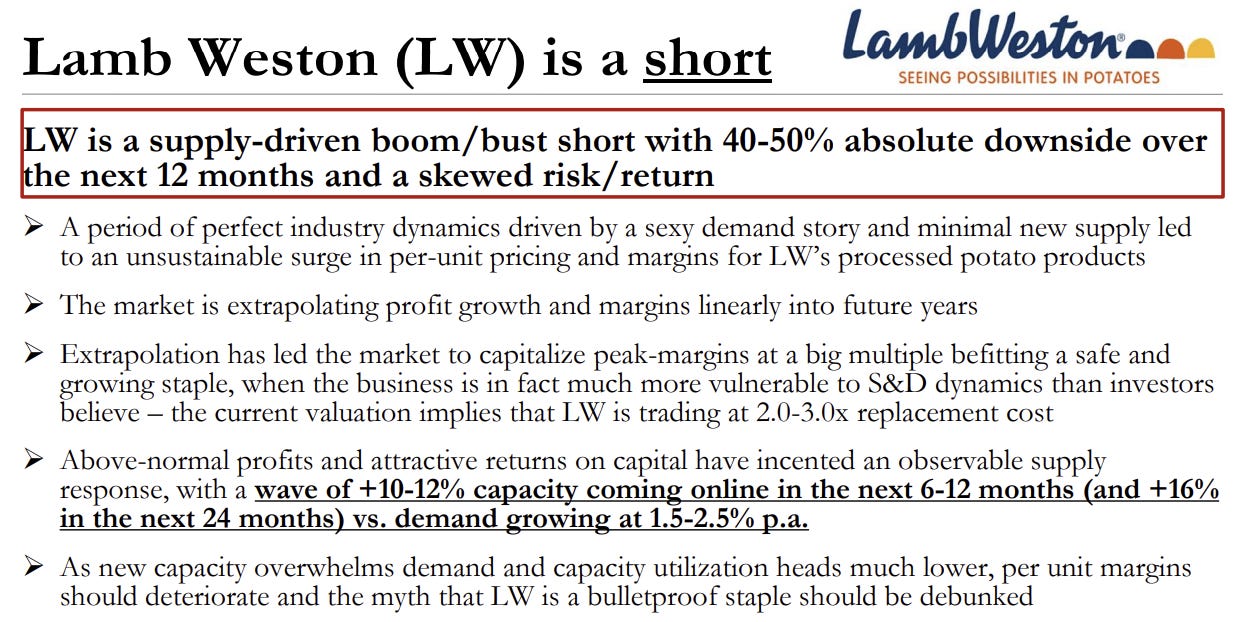
source: Tariq Barma, Sohn Conference presentation
The short case didn’t work out — but, of course, the novel coronavirus pandemic changed the industry’s trajectory. Capacity expansions were called off, and particularly in 2021 pricing grew even stronger. But now, with normalcy returning, capacity is increasing, and those increases may be coming right into a cyclical downturn in terms of demand.
How Good A Business Is This?
The issue here is not necessarily that LW’s FY25 results are going to take a hit (though that, of course, is a potential near-term risk). Rather, it’s that the long-awaited arrival of some kind of pressure on the industry is going to show that the bear case had some truth all along. Lamb Weston’s spin-off simply happened to coincide4 with an exceptionally benign operating environment. But ‘true’ mid-cycle performance is much weaker.
In essence, the debate after Q3 earnings comes down to the interpretation of this chart:
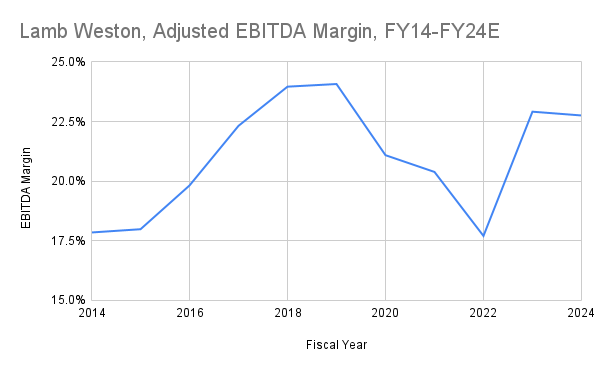
source: author from Lamb Weston filings. FY24 figures at midpoint of reported guidance ranges
Is this a business that has earned its margin improvement over the past decade thanks to scale, growth in its retail products, and international expansion, with only the post-pandemic environment creating an interruption? Or is it due to what Tariq Barma, the presenter of the LW short pitch at Sohn, called the “myth that LW is a bulletproof staple”?
More simply: is LW even a staple? Or is this actually a commodity business that has only looks like a staple due to favorable competitive and macroeconomic environments?
That’s the debate that has been underneath LW since its spin from Conagra. And, as the earlier chart of EBITDA multiples shows, for the most part the market has given the company the benefit of the doubt. Lamb Weston has been valued by the market mostly as a staple, not a cyclically-exposed commodity business.
The reaction to Q3, however, shows the fear that has been lurking all along. It’s a fear that has popped up on more than one occasion during LW’s time on the public markets. What the past tell us is to buy when the market thinks this is a commodity business, and sell when it think it is a staple. The problem, however, is that given industry and macro dynamics, the past and the future may look very different.
As of this writing, Vince Martin has no positions in any securities mentioned.
Disclaimer: The information in this newsletter is not and should not be construed as investment advice. Overlooked Alpha is for information, entertainment purposes only. Contributors are not registered financial advisors and do not purport to tell or recommend which securities customers should buy or sell for themselves. We strive to provide accurate analysis but mistakes and errors do occur. No warranty is made to the accuracy, completeness or correctness of the information provided. The information in the publication may become outdated and there is no obligation to update any such information. Past performance is not a guide to future performance, future returns are not guaranteed, and a loss of original capital may occur. Contributors may hold or acquire securities covered in this publication, and may purchase or sell such securities at any time, including security positions that are inconsistent or contrary to positions mentioned in this publication, all without prior notice to any of the subscribers to this publication. Investors should make their own decisions regarding the prospects of any company discussed herein based on such investors’ own review of publicly available information and should not rely on the information contained herein.
Market cap is $11.85 billion, and net debt $3.79 billion. The midpoint of guidance ($1.48-$1.51 billion) is for $1.495 billion in Adjusted EBITDA.
23% effective tax rate this year means an after-tax effect of $115.5 million, across143.5 million shares outstanding.
The other three are private: McCain, Simplot (which now manufactures for Kraft Heinz $KHC brand Ore-Ida), and Cavendish Farms.
Given that Conagra chose the timing of the spin-off, of course the timing of the multi-year period of prosperity may not be a coincidence.