
Highlights:
Overstock soared after the company acquired assets from Bed Bath & Beyond — then tanked after an early performance update.
The deal seems like a smart move, but one where patience might be required. The stock does look tempting after the recent plunge.
But the company’s long and volatile history make it difficult to trust Overstock.
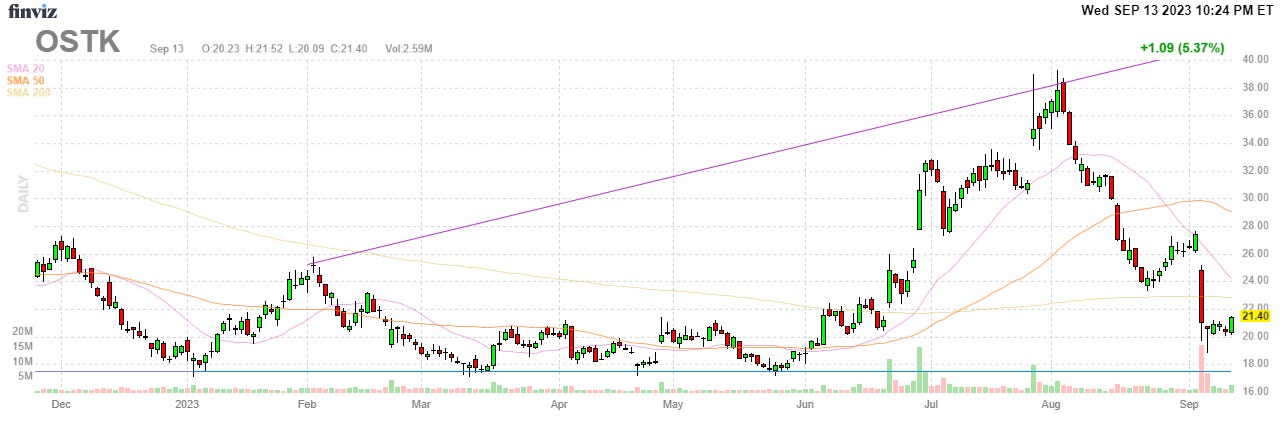
In late June, Overstock OSTK 0.00%↑ announced it was buying assets from bankrupt Bed Bath & Beyond. The market loved the deal; OSTK rose 20%, and kept climbing.
A strong Q2 report added to the optimism. By early August, Overstock shares had rallied 115% in ten weeks:
source: finviz.com
But the optimism reversed amid broader weakness across Internet retail. A performance update last week sent OSTK down 24% in a single session. Back near the lows, the stock does look intriguing, but Overstock’s history creates a major stumbling block to the bull case.
Overstock Goes Crypto
Few stocks in the market have seen as many dizzying changes as Overstock.
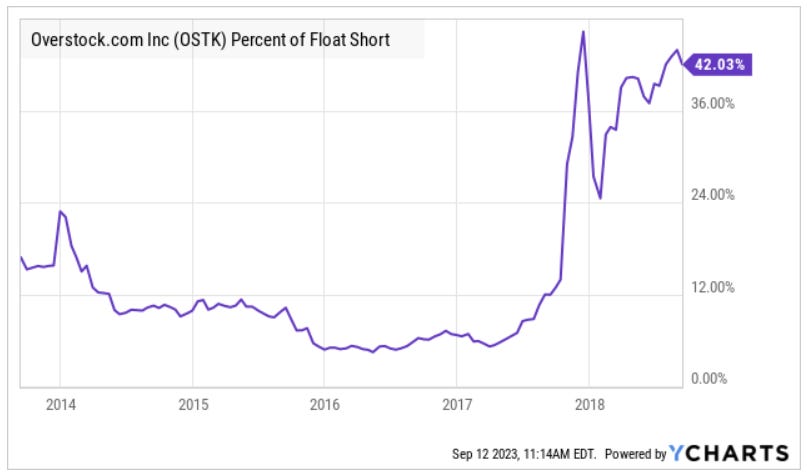
A decade ago, OSTK was a sleepy, if volatile, e-commerce play, and a classic “value play or value trap?” argument. Valuation was reasonable — ten years ago, shares traded for a little over 20x trailing twelve-month free cash flow — but competitive threats loomed. Amazon.com AMZN 0.00%↑ remained the 800-pound gorilla in the industry, while Wayfair W 0.00%↑ was growing sales at a ~50% annualized rate ahead of its October 2014 initial public offering. Owing to those threats — and with some help from the reputation of chief executive officer Patrick Byrne, who was waging a multi-year legal war alleging “market-rigging” by major investment banks — OSTK was a popular short target at the time:
source: YCharts; chart runs September 2013 to September 2018
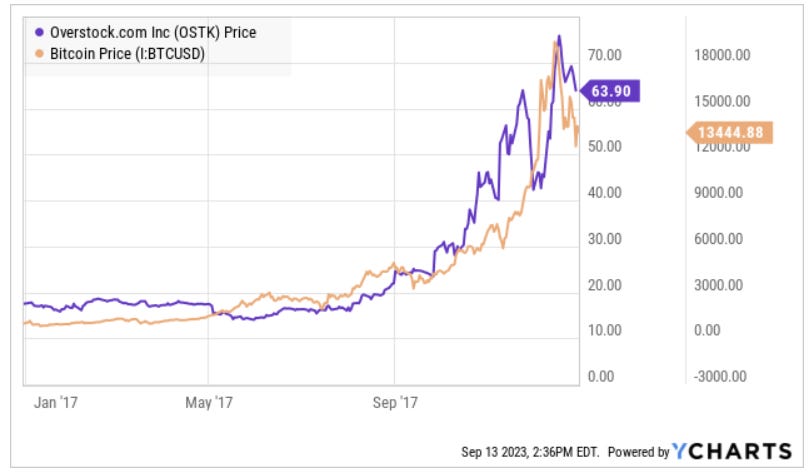
The following year, OSTK became perhaps the first crypto stock. In April, the company filed a shelf registration for digital securities. In December 2016, the company issued the first-ever digital security registered with the SEC, Series A Preferred Stock that traded under ticker OSTKP1. Subsidiary Medici Ventures began investing in cryptocurrency and blockchain companies.
One of those companies became tZERO, which commenced an initial coin offering in late 2017, backing a blockchain-enabled exchange for trading of digital assets. The tZERO name was itself a nod to Byrne’s belief in the conspiratorial nature of Wall Street, where the CEO believed naked short selling was abusing the three-day settlement period, referred to as T+3. Over time, Overstock expected that the platform would lead to tokenization of multiple securities, including equities, which would allow trades to settle instantaneously.
The timing of the shift to crypto proved fortuitous for OSTK stock:
source: YCharts; 2017 chart
And Overstock and Byrne believed the hype. On the Q3 conference call in November, the CEO pointed to a possible sale of the legacy e-commerce business and told listeners that “there is a non-negligible possibility that this is our last earnings call together.” Byrne had long pointed to Overstock’s capital disadvantage against well-funded peers, and lamented the fact that the public equity markets showed little interest in those companies actually turning a profit. It seemed at the time like Byrne preferred to run tZERO instead (and indeed he would later invest his own money into Medici businesses).
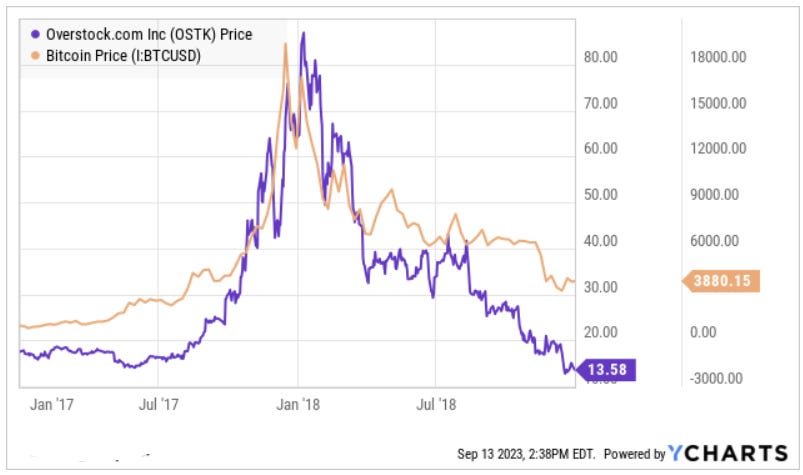
Unfortunately for the CEO and his shareholders, the blockchain hype didn’t last. Bitcoin crashed and tZERO struggled. Its ICO wound up falling well short of a $250 million target. A term sheet for $400 million in investments across OSTK stock, tZERO equity, and tZERO tokens was signed in August; it took 20 months for tZERO to finally garner just $5 million.
Meanwhile, Overstock’s retail business posted a dismal Q4 2017 performance, after which Byrne completely reversed course. Taking a “if you can’t beat ‘em, join ‘em” attitude, he said Overstock would mimic Amazon and Wayfair and implement a “high growth, negative GAAP net income” strategy. That effort didn’t work either, and with pressure on both sides of the business OSTK declined 79% in 2018, still its worst year ever:
source: YCharts; chart across 2017 and 2018
Another Rise And Fall
Byrne’s strategic change only had half of its intended effect. Losses indeed soared, even on a non-GAAP basis. Adjusted EBITDA in 2018 was a loss of $153 million against a loss of $12 million the year before. But Overstock hardly turned “high growth”: the Retail segment went from EBITDA of positive $11 million to negative $112 million — yet its revenue increased just 4.2%.
Declaring the performance “nauseating”, Byrne announced in the Q4 2018 release in March 2019 that the company would return to a focus on profitability. That strategy worked somewhat better: the retail business was near breakeven in 2019 (Adjusted EBITDA of negative $3.6 million). Improved bottom-line performance came at a huge top-line cost, however: revenue in the Retail segment plunged 20% year-over-year.
Byrne wasn’t around to see the year play out. In August, it was reported that he had a romantic relationship with convicted Russian spy Maria Butina. A week later, he resigned as CEO; the following month, he exited his stake entirely. By the end of the year, OSTK was trading at its lowest point in more than seven years. In March 2020, during the worst of the selling driven by the novel coronavirus pandemic, OSTK set an all-time low below $3.
But once again, the stock found a rally — this time, a huge rally. By August, the stock was above $120 — a nearly 50-fold increase in roughly five months. To some degree, the market was correct in pricing in a change in fortune. Pandemic-driven shutdowns led e-commerce demand to soar: Overstock’s revenue increased 75% year-over-year in 2020, and Adjusted EBITDA jumped to an $88 million profit from a $74 million loss. 2021 results, given the comparison, looked strong as well: revenue increased 11%, with Adjusted EBITDA climbing 61%.
That bottom-line growth wasn’t quite as strong as it appeared. In January 2021, Overstock agreed to convert Medici to a limited partnership led by Pelion Venture Partners. The nature of the agreement allowed Overstock to deconsolidate tZERO, which had posted an Adjusted EBITDA loss of $27 million the year before. Still, on a like-for-like basis, Adjusted EBITDA rose nearly 20%, and OSTK managed to close the year at $59, for a two-year rally of 737%.
Post-pandemic normalization, however, has not been kind to the retail business. Last year, revenue fell 30%, and Adjusted EBITDA was more than halved. First-half 2023 numbers have been just as bad: sales off 25%, EBITDA down 72%. OSTK again would plunge:
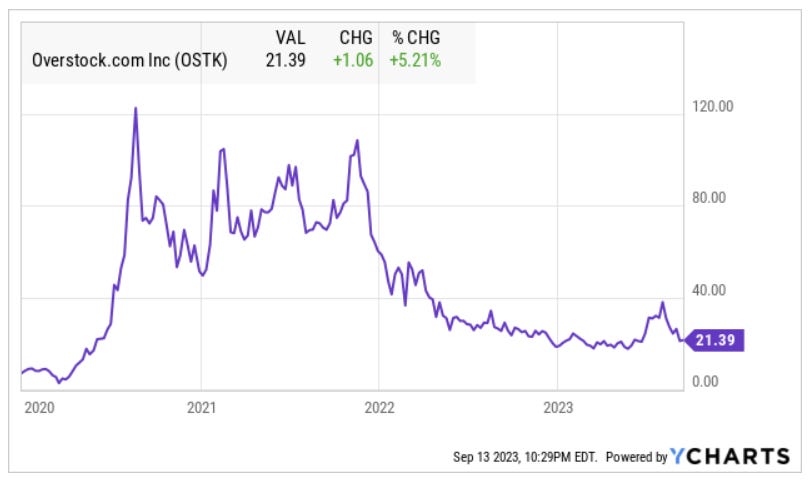
source: YCharts. chart from 1/1/20 to present
But Overstock had one more major change to make. In late June of this year, the company paid $25.6 million (including fees) for intellectual property assets from the bankrupt Bed Bath & Beyond.
The ‘New’ Bed Bath & Beyond
Overstock shares jumped 20% on the announcement of the acquisition. Given the ardent nature of Bed Bath and Beyond shareholders — what is now BBBYQ stock still has a market cap of $140 million — the sense might be that OSTK soared because of meme stock (or meme-adjacent) enthusiasm2.
But in fact this looks like quite a smart deal. The price paid is about 57 cents per share; this is hardly a “bet the company” type move. Overstock picked up customer lists — valuable given a decent amount of overlap between the two brands — and a brand that has some value. For its part, Overstock saw the transaction as one that strengthened the legacy business while also providing a new channel for sales growth:
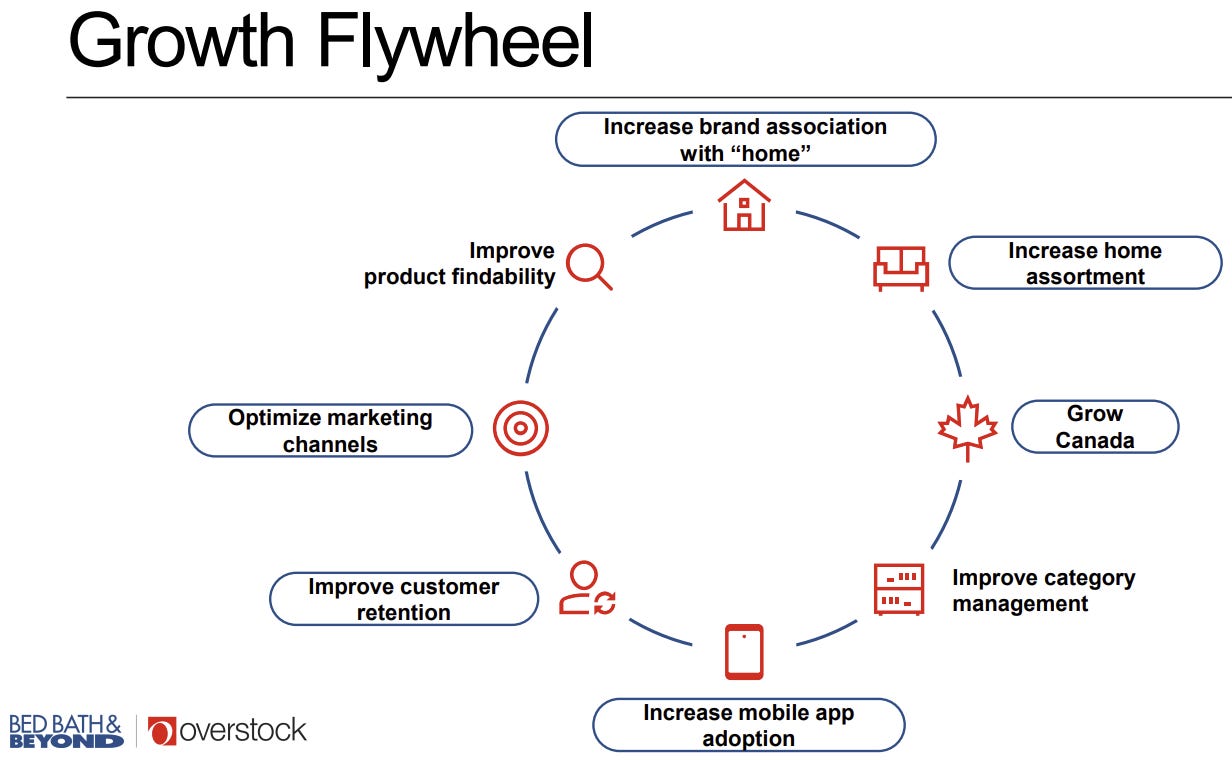
source: Overstock / Bed Bath & Beyond presentation, June 2023
And while the transaction was opportunistic, it didn’t come completely out of left field. Nearly four years earlier, in his 2019 resignation letter, Byrne disclosed that Overstock had already considered the idea of merging with a brick-and-mortar peer. He pointed to potential savings from Overstock gaining access to physical locations (which is not part of this deal), but also the benefit to legacy retailers of Overstock’s digital experience:
On the other hand, if joined to certain sites with high traffic but which have not cracked the monetization nut, models showed that, combined with us, there might be savings of ~$150-$200 million.
Bed Bath & Beyond posted an Adjusted EBITDA loss of $810 million in fiscal 2023 (ending February). Given that digital sales were running at ~40% of the company’s total, it’s safe to assume that, outside of the immediate post-pandemic period, that retailer had “not cracked the monetization nut”.
Even if Overstock’s 2019 models were off, there is a clear argument that Overstock can do more with the Bed Bath & Beyond digital offering than it could that brand’s prior owner. Given the low cost, it seems more than reasonable to try and find out.
Why The Sell-Off?
OSTK soared after the deal, and then kept gaining into a solid Q2 earnings report in late July. And yet, OSTK has round-tripped: shares in fact trade below where they did before the Bed Bath & Beyond deal was announced.
The core problem is that the Bed Bath & Beyond purchase isn’t working — at least not yet. Last week, Overstock provided a performance update for the “new” Bed Bath & Beyond, after it switched its websites in the U.S. and Canada over to the recently acquired brand. The company’s active customer count (anyone ordering within the last twelve months) grew roughly 5%, or by a little over 200,000. Orders have increased “high-teens” since the U.S. launch on Aug. 1, but those orders are more than 20% smaller. Overall orders quarter-to-date are up mid-single-digits, but revenue is down “mid-teens”.
It’s tempting, perhaps, to argue that it’s still early, but part of the optimism toward the acquisition was that Bed Bath & Beyond came with a large base of customers, at least some of whom remained reasonably committed to the brand. Yet those customers haven’t proven to be additive. QTD gross profit is 18%; it was 22% in Q2 and 23% in last year’s Q3. The gross profit pressure seems to come in part from promotions, but Overstock also ramped sales and marketing to 15% of revenue against 11.6% the year before. Revenue growth didn’t arrive, and profitability is worsening dramatically. Operating margins appear headed toward negative 10% for the quarter3 against positive 1.2% in the year-prior period and negative 1% in Q2.
OSTK fell 23.5% on the disclosure, and has recaptured only a small portion of the losses in the days since. The near-term chart seems to tell the story here: the optimism generated by the BBB acquisition has been all but wiped out by the early results from that acquisition.
An Utter Lack Of Consistency
But the longer-term chart sells a story too. Again, few stocks in the market have had a more eventful decade than has Overstock, which has cycled through business models, entered and semi-exited an industry that essentially didn’t exist in 2014, been involved in political intrigue, and provided a coda to one of the most widely-held meme stocks of recent years. As far as OSTK stock goes, however, it’s mostly been sound and fury signifying nothing:
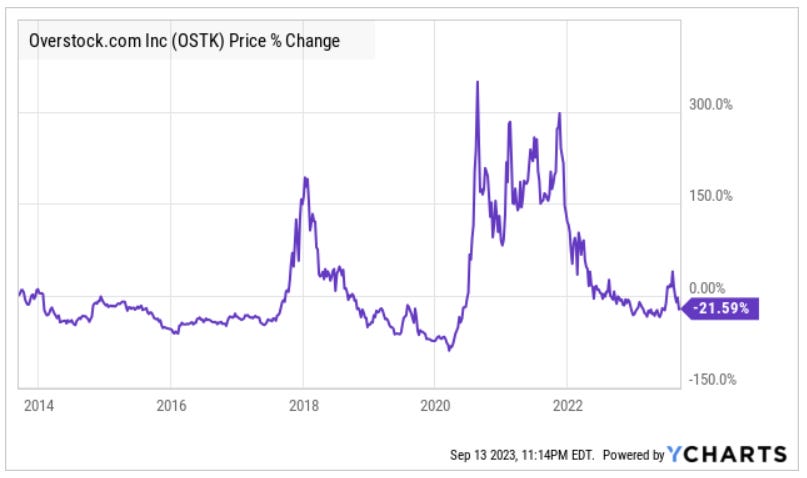
source: YCharts; 10-year chart
It’s not hard to be tempted by OSTK here; indeed, it’s why we did the work that underpins this article. The business has been around for more than two decades, and will generate well past $1 billion in sales this year. Despite the disappointing early performance from the Bed Bath & Beyond rebrand, the deal still makes some sense. There should be improvements going forward as online customers become more aware of the new offering and as Overstock better targets its legacy and newly acquired users.
Meanwhile, the stock is getting in the range of cheap. The Medici investments are carried at a bit over $200 million (the company’s estimate of fair value); that plus net cash of $309 million accounts for over half the current market capitalization of $967 million. On a trailing twelve-month basis, EV/EBITDA is under 14x (it’s exactly 20x assigning zero value to the joint venture asset). EV/revenue valuing Medici at carrying value is 0.3x, roughly half Wayfair’s multiple; it’s still under 0.5x assuming the blockchain businesses are worth nothing.
There’s a reason we went through the company’s history, however. Overstock has been public for more than two decades, yet still has an accumulated deficit over $250 million. The investment behind Medici seems roughly equivalent. In 20-plus years the retail business has created, roughly speaking, zero value.
Perhaps the longest peak of the business came from 2012 through 2016, when Overstock posted five consecutive years of GAAP net profit. Pre-tax income over that stretch was $87 million; the retail business promptly lost $25 million in 2017 and a staggering $159 million the following year. With post-pandemic tailwinds quickly fading, retail is likely headed for another operating loss this year.
To some extent, the erratic Byrne played a role. But the broader issue is that there’s simply so little room for error. Even in 2021, the company’s best year, and a year in which retailers of all kinds posted staggering margin improvements, Overstock’s Adjusted EBITDA was just 5.1% of revenue.
One aspect of the company’s history gets to the heart of that worry. Again, Byrne said in late 2017 that the company was for sale, and hinted that such a sale might happen quickly. (Overstock had hired Guggenheim Partners to lead the effort.) A year later, his story was pretty much the same. Byrne told the Wall Street Journal then that he expected a deal to be done by February 2019.
Obviously, no deal ever got done. The question is why. Byrne, at least, was a motivated seller — he told the Journal that “we think we’ve got cold fusion on the blockchain side” — and, including trusts related to his mother, controlled roughly 25% of the voting power. OSTK had soared precisely due to blockchain optimism, meaning it just needed to get a decent price, not a great one, to sell the retail business. Over nearly two years, a decent price apparently was never offered.
The history of the business before that point, and its performance since then, seem to show why. Overstock has simply never shown any consistency. Quite clearly, that hasn’t changed. Until it does, it’s hard to see OSTK as anything more than a trade at best.
As of this writing, Vince Martin has no positions in any securities mentioned.
Disclaimer: The information in this newsletter is not and should not be construed as investment advice. Overlooked Alpha is for information, entertainment purposes only. Contributors are not registered financial advisors and do not purport to tell or recommend which securities customers should buy or sell for themselves. We strive to provide accurate analysis but mistakes and errors do occur. No warranty is made to the accuracy, completeness or correctness of the information provided. The information in the publication may become outdated and there is no obligation to update any such information. Past performance is not a guide to future performance, future returns are not guaranteed, and a loss of original capital may occur. Contributors may hold or acquire securities covered in this publication, and may purchase or sell such securities at any time, including security positions that are inconsistent or contrary to positions mentioned in this publication, all without prior notice to any of the subscribers to this publication. Investors should make their own decisions regarding the prospects of any company discussed herein based on such investors’ own review of publicly available information and should not rely on the information contained herein.
A non-digital Series B preferred stock was issued at the same time; both classes were fully converted to common shares last year.
We gave our take on the BBBYQ saga back in early May.
Gross profit minus sales and marketing is 3% of revenue; a year ago, technology plus general and administrative expense accounted for 10%-plus of sales. Assuming some post-BBB inflation and a lower revenue base, -10% seems a reasonable estimate for operating margins.
So do we have a verdict on the current CEO/management. Do they get some credit for BBBY?
Great write-up on a complex situation. I don't think the upside for $OSTK is juicy. Wayfair trades at 0.9x EV/S. If we assume same multiple for $OSTK (no reason it should be valued higher, IMO, due to lack of consistency in execution), that's 900mn of TEV. Add 500mn of net cash gives you TEV of 1.4Bn v. 1Bn market cap today. I think valuing the blockchain biz at 200mn is ludicrous. Binance is about to implode and SFB is already in jail - the crypto sphere is melting and nobody trusts it. I would ascribe zero value to Medici/T-Zero and all that jazz - name me one tradable security on T-Zero - how many assets has it "tokenized"? Nothing. So if you exclude the blockchain valuation (assume 100% writedown), that's at most 40% upside from today's valuation going into a VERY uncertain 3Q23 where losses may accelerate (as you say, GM is heading down sequentially and SG&A is heading up). I would say overall OSTK looks like a dumpster fire and there's nothing to get excited about. Oh yeah, if US consumer heads into a recession, I don't see people rushing to buy expensive furniture.