
This week, we look at two very different stocks: a U.S. aerospace supplier and Asia-facing casino operators. But there’s a common thread between the two stories: a divergence between a hopeful narrative looking forward and years of disappointing performance in the rearview mirror.

The Easy Short In Spirit AeroSystems
Back in May, we made the short case for aerospace supplier Spirit AeroSystems SPR 0.00%↑. SPR stock had been hammered, but we saw more downside ahead.
Spirit was carved out of Boeing BA 0.00%↑ , which as one analyst has noted was an effort to make a profit center out of a cost center. Spirit manufactures fuselages and other aerostructures, meaning its revenue is directly tied to that of its major customer, but with far less ability to manage through the cycle or even predict through the cycle.
In practice, Spirit perhaps has been even worse. Multiple production issues during 2023 led to lower deliveries from Boeing itself. The balance sheet has been mismanaged to the point that Spirit needed to get a loan from Boeing to make it through last year. A leveraged business with a poor model and worse execution seems like a slam-dunk short — and, in many cases, a short to zero.
SPR Stock Sells Off (Kind Of)
In the context of that history, when it was reported over the weekend that a door ‘plug’ had blown out on a Boeing MAX 9, it was no surprise that Spirit was the manufacturer of the fuselage for that particular plane. It seems similarly unsurprising that SPR stock dropped 13% this week. Even after that decline, shares are about 12% above where we recommended a short in May. Weakness in the underlying business and the negative catalyst from last weekend’s incident would seem to only strengthen the bear case.
Yet we’re not making that bear case. In fact, I’ve watched SPR relatively closely this week to see if there’s a potential long opportunity here. In October, we recommended that investors cover the short after gains of about 14%, and in its own way this week’s trading actually supports the mid- to long-term bull case here.
In terms of the equity, a 13% decline is actually a sign of a market showing patience rather than panic. Again, Spirit is heavily leveraged: net debt (including forward loss provisions and advances from Boeing) is greater than the company’s market capitalization. And so a 13% drop in the share price represents less than a 6% reduction in Spirit’s enterprise value — hardly a reaction that suggests a material change in the company’s long-term outlook.
The same sense holds in the credit market:
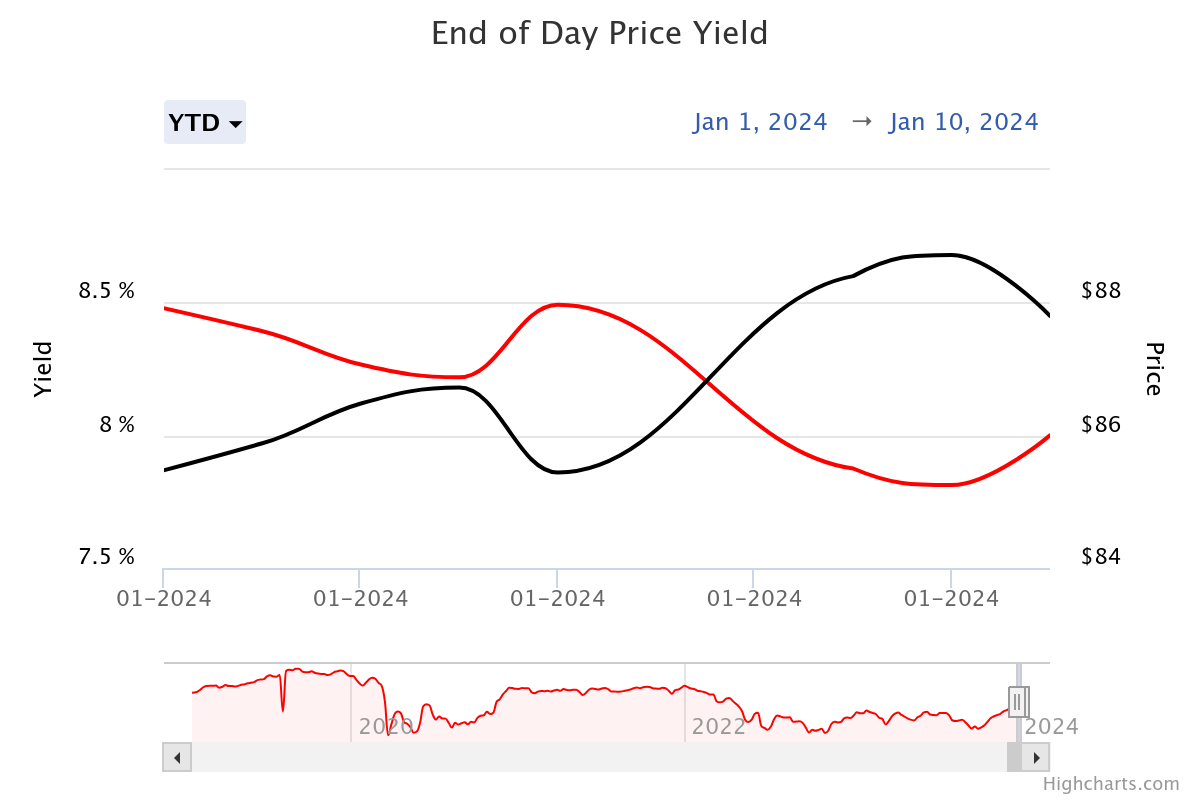
source: Finra; year-to-date chart. Price in red, yield in black
Yields in Spirit’s 4.600% Senior Notes due 2028 have risen 59 basis points this week. That’s more material than it might sound, but here, too, the market is not showing any belief that this weekend’s mishap is an existential threat to the company.
There are three broad reasons why investors are staying patient after bidding SPR up in the fourth quarter of 2023 (the stock nearly doubled in those three months).
The first is that Spirit unsurprisingly fired its chief executive officer in early October, replacing him with a former Boeing executive, Patrick Shanahan. Shanahan remains the interim CEO, but has been aggressive in both cleaning house (the company’s chief operating officer left in December) and bringing on former colleagues to improve operations.
The second is that Spirit has improved its balance sheet somewhat, issuing new debt and raising $200 million in an equity offering in November. But the most important is that Boeing itself gave the company a vote of confidence barely two weeks after Shanahan came on. The two companies executed a memorandum of understanding that cemented the idea that Boeing is simply not going to cut Spirit loose.
It was that agreement that sparked both our recommendation to cover and the rally in SPR stock. And it’s that agreement that seems to be keeping equity and debt investors relatively optimistic despite the negative news flow. Indeed, what’s more surprising than this week’s modest move in Spirit’s debt might be its current yield: the spread to the 5-year Treasury is still less than 500 basis points. The spread seems far too low, given the stretched balance sheet, still-negative free cash flow (Spirit has burned over $900 million over the past seven quarters), and potential effects of the door plug blowout.
Can You Really Buy SPR Here?
The market’s response this week suggests a simple belief: that both Boeing and Spirit are too big to fail. Boeing can’t (or won’t) end its relationship with Spirit and sign on with some other manufacturer of fuselages. Meanwhile, as Brooke Sutherland wisely noted at Bloomberg last month, airlines are trying to jam seemingly strange acquisitions past skeptical antitrust regulators in large part because they need to expand their fleets, and don’t really have another avenue to do so. Those airlines can’t (or at least for now, won’t) call up Airbus or China’s COMAC and buy a couple dozen new aircraft.
In other words, for the most part not much has changed1. And if that’s the case, then the turnaround hopes that drove SPR higher in Q4 and sent BA to a 37% rally in 2023 still exist. There’s still new management, still more support from Boeing for Spirit, and still a massive, multi-year backlog of planes that almost certainly will have to be fulfilled by Boeing and its suppliers.
The question that follows is whether an investor can think about owning SPR here. The fact that this business has been executing poorly is known, and (at least in theory) priced into the SPR stock price. It’s also possible that Spirit, despite its reputation, isn’t actually at fault. It’s Boeing that actually completes installation of the plug.
To our eye, this just isn’t a good enough business to own without a much more material sell-off (where the trade would be more of a play on a potential V-shaped bounce). And, in fact, we see another name in the sector as far more interesting, a name we’ll get to in the not-too-distant future.
A key part of the problem with taking any side with SPR right now is that it’s difficult to pound the table for any scenario. It might make sense for Boeing to simply bring Spirit back in house. A premium to Spirit’s equity holders would be almost meaningless for Boeing’s financials (SPR’s market cap is barely 2% that of Boeing) and would allow the manufacturer to retake control of a key part of its supply chain.
But such a deal is complicated by Spirit’s own efforts to diversify — which mean that Boeing’s major rival, Airbus, now drives 25%-plus of the company’s sales. Is that a complication Boeing management wants to deal with? Conversely, the continuing inability to execute and/or generate positive free cash flow would seem likely to push Spirit toward a restructuring at some point — but Boeing almost certainly can’t allow that to happen, given the potential disruption it would cause to its own operations. The middle path, of letting Spirit stumble along on its own, isn’t working either.
The least likely scenario, at least in the mid-term, is Spirit actually going under. Boeing’s commitment to its supplier suggests it simply won’t allow that to happen. And that’s the biggest reason why, even though both Spirit equity and debt look like ridiculously easy shorts here, the market continues to tell us otherwise.
Macau Gets Halved
In 2013, the Chinese enclave of Macau posted $45 billion in gaming revenue. Ten years later, the figure was nearly half as high.
Unsurprisingly, the six operators of casinos in the so-called Special Administrative Region have seen their share prices perform terribly over the past decade:
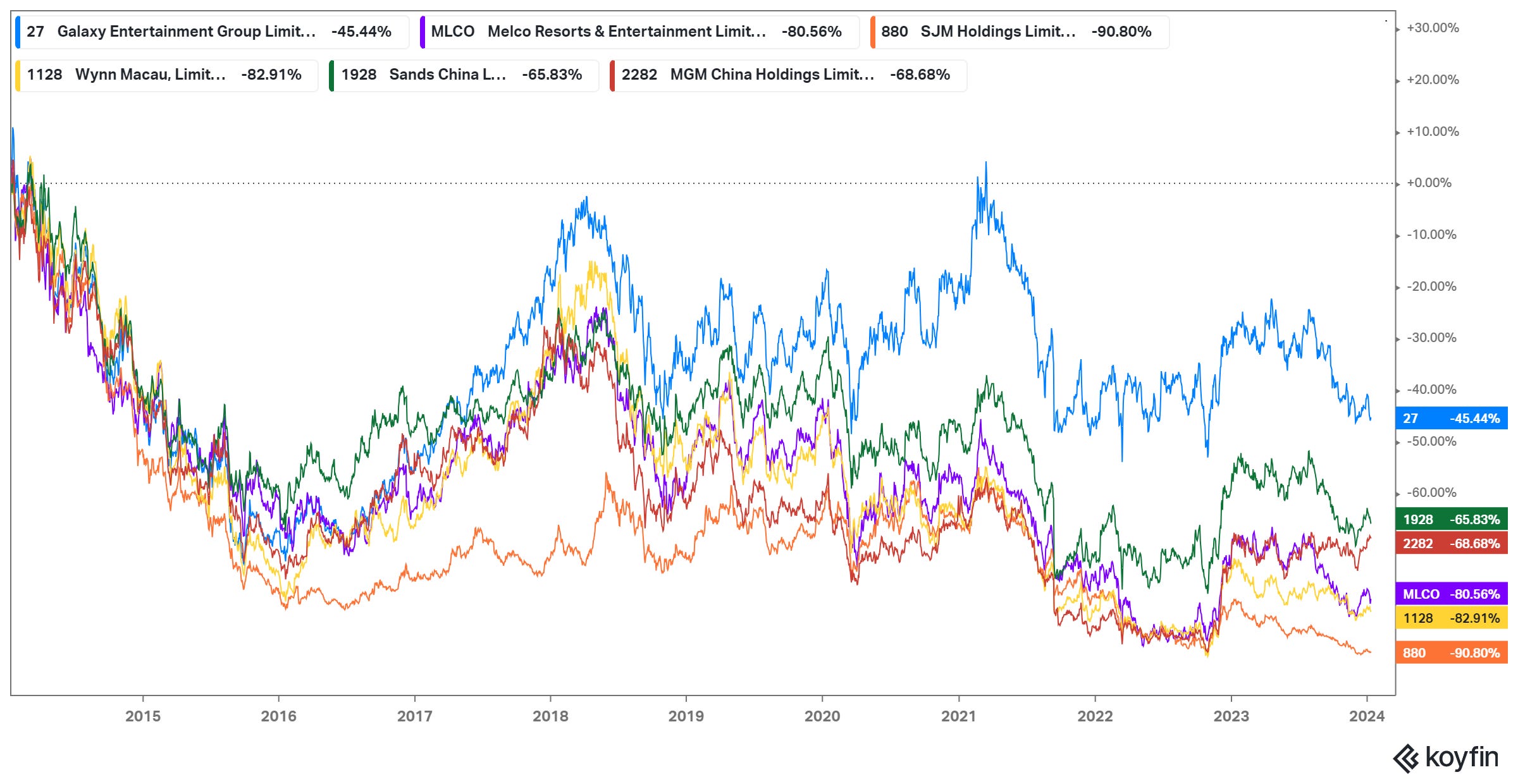
source: Koyfin; note use of Hong Kong-listed, Macau-facing subsidiaries of U.S.-based Las Vegas Sands LVS 0.00%↑, MGM Resorts International MGM 0.00%↑, and Wynn Resorts WYNN 0.00%↑
And yet, there is some good news. At the beginning of last year, each of the six operators received new 10-year licenses from the government to continue operating. The loss of a license would have been devastating, and the spectre of Genting, the massive Asian developer long interested in the market, meant that such a loss was at least a conceivable risk for one of the group.
The price for those licenses wasn’t cheap. China’s central government for years has pushed the developers to increase non-gaming revenue, and as part of the negotiations the operators will commit an estimated $14 billion in capital spending over the next decade. But the fact that no operator chose simply to walk away suggests that casino owners see promise of profit over the next ten years even with that spending. So does the fact that, in 2021, Las Vegas Sands chose to exit the U.S. business in a $6 billion deal and keep its Macanese (and Singaporean) operations on the books.
So there does seem to be some promise here. Indeed, sell-side analysts are not only bullish, but more bullish than they have historically been:
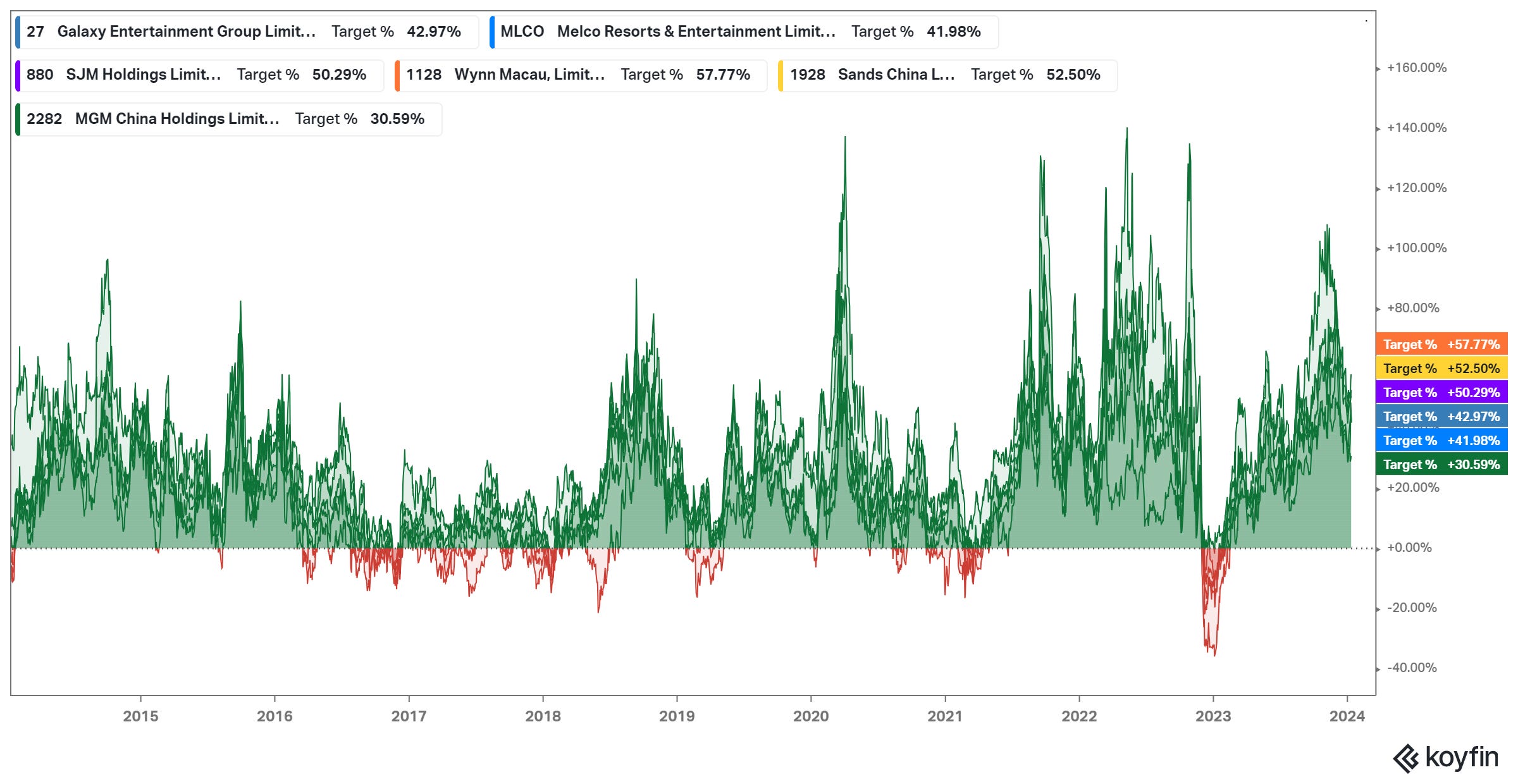
source: Koyfin; premium of average target price to share price
It’s worth remembering as well that the six direct Macau plays are not quite “Chinese stocks”. They are listed on the Hong Kong Stock Exchange (except for Melco Resorts MLCO 0.00%↑, which has a U.S. listing). The likes of MGM China and Sands China are headquartered in the Cayman Islands, a la Alibaba BABA 0.00%↑, but they don’t operate under the same variable interest entity scheme that means shareholders don’t actually own the business2. Three of the subsidiaries are majority-owned by the U.S. parents, adding another layer of protection for shareholders.
And so these are businesses that, for the most part, can be valued purely as businesses, in a way that’s not quite true for many companies that get most of their revenue from mainland China.
The Case For Macau Stocks
Meanwhile, the overall market is continuing to recover after the pandemic. 2023 revenue was equal to the three previous years combined. 2024 should be a strong year as a post-pandemic recovery continues. The Macau government itself has projected gaming revenue of nearly US$27 billion, up 20%-plus year-over-year, while most sell-side analysts see even stronger growth.
Meanwhile, the names in the space suddenly look attractive fundamentally. Sands, Galaxy, SJM, and MGM generally trade just below 10x 2019 Adjusted EBITDA, and just above 10x the 2024 estimate (as compiled by Koyfin). Melco and Wynn China get even lower multiples (both to 2019 and to 2024), but Melco has a notably weaker balance sheet and historically lower margins, while Wynn is now the laggard in market share.
SJM is revamping its properties and has posted the worst returns over the last 12 months, providing more room for a snapback rally if sentiment changes. MLCO and WYNN are both the highest-risk and highest-rewards plays given leveraged balance sheets and lower valuations (particularly looking to free cash flow, should it arrive faster and higher than expected).
Even the VanEck Gaming ETF BJK 0.00%↑ isn’t a terrible play. It has ~20% of its assets in the Macau plays3. Before the pandemic, that figure was much higher — a key reason why total returns in the fund have been almost exactly flat over the past decade, despite solid performances from most of its U.S.-based holdings.
Is 10x Cheap?
There is one potential sticking point: the idea that 10x EBITDA (or less) is necessarily cheap. It’s certainly cheap relative to where the names traded for most of the 2010s.
The longer-term argument is that these are simply lucrative concessions, and that Macau is a market with years of growth ahead of it. The enclave has long been compared to Las Vegas, its massive size relative to the largest U.S. gaming market:
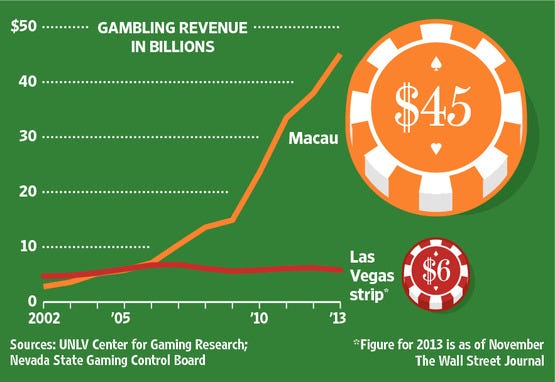
source: Wall Street Journal
Admittedly with government pressure, it’s to some degree aping the strategy of Vegas to diversify beyond gaming revenue. Balance sheets are less leveraged as well, though Macau’s tax regime is more aggressive.
The skeptical response, however, is that the government continues to pressure gaming revenue, which in turn means there’s likely an unofficial cap on profits even once normalcy fully returns. At the 2013 peak, about 70 percent of Macau gaming revenue came from VIP customers. Those customers were served by so-called ‘junket operators’, who helped high rollers get around restrictions on cash movements. Those, shall we say, borderline legal activities unsurprisingly led to allegations of money laundering and the involvement of organized crime.
On multiple occasions, most recently in 2021, the government has cracked down on junkets. A year ago, the former head of the biggest junket in Macau was sentenced to 18 years in prison. The result, unsurprisingly, has been a long-term chilling of the VIP market. The pandemic is far from the only reason why gaming revenue is at 50% of 2013 levels.
These efforts, along with the clear push to de-emphasize gaming revenue, provide the sense that Macau stocks share the same challenges as those of businesses operating on the mainland. LVS does have a U.S. listing and U.S. protections, but in 2019 that business generated nearly two-thirds of its profit in Asia from Macau. And in Macau, the same challenges of government intervention are going to persist.
Maybe that doesn’t quite make the group uninvestable in a way that the VIE structure might BABA for some investors. But some investors might reasonably argue that given roughly similar EBITDA multiples, they’d just as soon own Caesars Entertainment CZR 0.00%↑, which does business in a country where gaming regulation clearly leans much more in favor of the operator.
In other words, Macau isn’t a way to get emerging markets exposure without emerging markets risk. Investors once believed it was — and have spent the last decade being disabused of that belief.
As of this writing, Vince Martin has no positions in any securities mentioned.
Disclaimer: The information in this newsletter is not and should not be construed as investment advice. Overlooked Alpha is for information, entertainment purposes only. Contributors are not registered financial advisors and do not purport to tell or recommend which securities customers should buy or sell for themselves. We strive to provide accurate analysis but mistakes and errors do occur. No warranty is made to the accuracy, completeness or correctness of the information provided. The information in the publication may become outdated and there is no obligation to update any such information. Past performance is not a guide to future performance, future returns are not guaranteed, and a loss of original capital may occur. Contributors may hold or acquire securities covered in this publication, and may purchase or sell such securities at any time, including security positions that are inconsistent or contrary to positions mentioned in this publication, all without prior notice to any of the subscribers to this publication. Investors should make their own decisions regarding the prospects of any company discussed herein based on such investors’ own review of publicly available information and should not rely on the information contained herein.
Certainly, this discussion might be very different had the blowout occurred at higher altitude. That hypothetical event would likely have created “catastrophic” injuries.
Alibaba shareholders, for instance, own shares in a VIE that in turn has a contractual right to the cash flows of Alibaba’s operating business.
We’re rounding a bit there because most of that is in ownership of MGM, LVS, and WYNN.