
One strategy in a nervous market — and the NASDAQ Composite is down almost 5% Thursday as I write this — is to look at the biggest decliners, for stocks where market sentiment has either exaggerated longer-term risks or, in some cases, created them out of whole cloth.
This is not the only strategy, of course; focusing more intently on quality in a downturn is another way to go. But in a big-time downturn — 2009 being the best recent example, and Q4 2018 another — it’s the riskiest, most speculative and sometimes even kind-of-junky plays that provide the biggest returns when the market bounces back. (And let’s try and remember — it always bounces back, even if not all of the stocks in the market do the same.)
The problem with this strategy, even after a 3-5% sell-off in major indices today, is that most of the biggest decliners look like they should be the biggest decliners. We covered this in our best pick so far, a short of Carvana (CVNA). CVNA — down 78% from its highs when we published, and as of this writing another 40% since — has performed a near-perfect representation of the old saw about how a stock falls 90% (it drops 80% and then gets halved).
We’ve been cautious about this market literally from our first post. We still are. One reason to stay cautious now is precisely that so many of these decliners really don’t look that cheap. Some, in fact, still seem expensive.
Focusing on the most recent earnings reports, the same sense holds. There do seem to be some opportunities for long-term value, but the market’s reaction to these earnings reports — even when that reaction appears rather extreme in terms of share price moves — looks to be logical.
In even the best-case scenario, we’re probably heading into a “new normal” in terms of valuations for growth stocks in particular, and even the biggest growth stocks. As we wrote in our first post, we’ll stay invested, if cautiously so, and try and take the long view. But as this post, and most of our due diligence suggests, at the very least buying opportunities are not easy to find, and for those that exist, there’s no need to rush in.
A look at a few big declines, in no particular order:
Teladoc Health (TDOC)
Imagine being dead-on right about the novel coronavirus pandemic at the start of 2020, picking five of the stocks that proved to be the biggest winners — and being down on an equal-weight basket 28 months later:
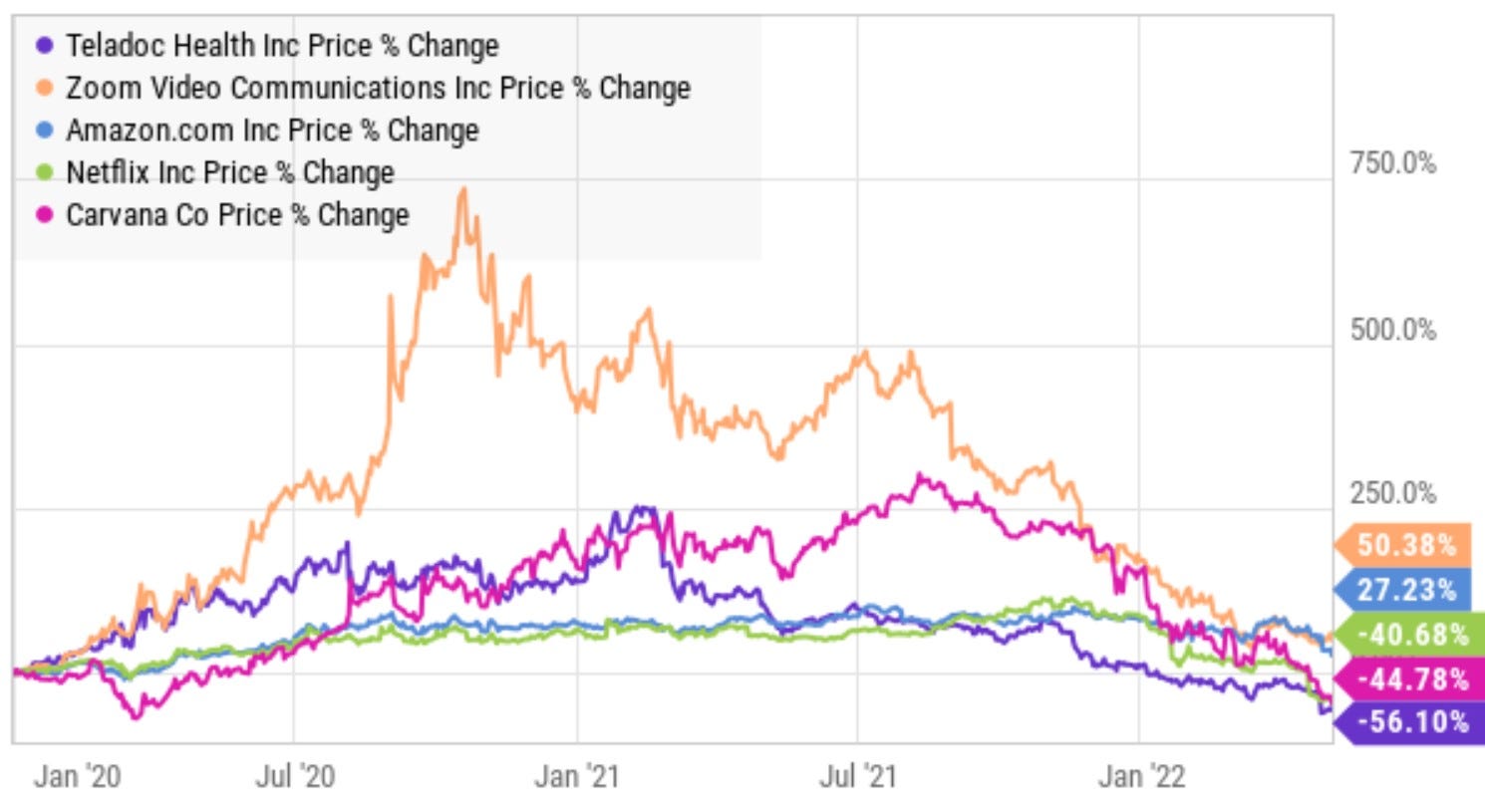
source: YCharts
And, man, at some point these have to bottom, right? Zoom Video Communications (ZM) looks a little bit tempting. I owned Amazon (AMZN) at a higher price in the past, and I’m intrigued at $2,500. (I don’t love the “hey, you’re getting the retail business for free!” argument; rather, I wonder just how much cost Amazon can pull out simply by focusing on profits, which it seems like the market is telling it to do.)
Even Teladoc, perhaps the biggest loser of the pandemic winners (TDOC stock now is down 87% from its February 2021 high) has a case. Indeed, the stock had gained 18% from its post-earnings close (admittedly following a 40% decline that day), before Thursday’s sell-off interrupted the rally. Perhaps more incredibly, TDOC is down more than half since Jan. 1, 2020 (though the dilution from the utter disaster that was the Livongo deal obviously is a key factor in that underperformance).
There’s certainly a way for bottom-timing to work here. Looking to 2022 guidance, TDOC now trades at less than 3x revenue, and ~28x Adjusted EBITDA. The issues cited by management at BetterHelp, the mental health business, seem legitimate, rather than excuses.
Teladoc cited lower yields in online marketing spend; struggling rival Talkspace (TALK) has done the same for several quarters, focusing specifically on elevated keyword costs for several quarters. Teladoc attributed the rise in costs this quarter to competition from startups, and that’s logical; those private companies (and there are several) in this funding environment are in desperate “grow or die” straits. Some of those startups, as management alluded to, really do look like online pill mills.
That said, TDOC isn’t an obvious, screaming buy here. Disrupting the US healthcare system in any way is a difficult endeavor; outside of BetterHelp, there’s a lot to prove. The fundamentals are fine, as far as it goes, but the Adjusted EBITDA figure is inflated by the exclusion of stock-based comp: the annual run-rate for that expense in Q1 is equal to the entirety of full-year Adjusted EBITDA guidance at the low end.
Exclude dilution and TDOC is unprofitable — and still valued at $7 billion. I can see why investors stepped into the decline, but I’m not willing to be one of those investors just yet.
Accolade (ACCD)
ACCD appears to be the biggest loser of earnings season so far: the stock was halved after its fiscal Q4 report last week. The “healthcare concierge” provides services for employees, provided by employers, to manage and understand benefits and the broader healthcare system. The company went public in 2020 at $22, closed its first day just shy of $30, touched $55 last June, and now is barely above $6.
The story with the Q4 report was hugely disappointing guidance: Accolade expects revenue growth of just 13% to 18% this year, below expectations. The company also is losing Comcast, which not only was its largest customer but its first customer.
But ACCD’s decline into earnings also highlights a huge error that the market made: using elevated price-to-sales multiples for companies without SaaS gross margins. Accolade’s adjusted gross margin in FY22 was just 46.5%, and a Wells Fargo analyst bearish on the stock before earnings projected the figure would top out in the mid-50s.
Yet, at the highs, ACCD was trading at a forward P/S multiple around 11x — the equivalent of an 80% GM SaaS business trading at nearly 20x. That kind of multiple, even in a bull market, should be reserved only for the highest-quality names.
The market made the same mistake with EV/revenue with names as disparate as Chewy (CHWY) and Twilio (TWLO), where EV/GP multiples got as high as 40x. Even now, ACCD trades at more than 2x FY23 revenue guidance, while the company still is guiding for -10% to -11% Adjusted EBITDA margins.
To be fair, it’s at least possible to see a bull case here. If ACCD was like TWLO at the highs, perhaps it can echo that stock at the lows: TWLO got dumped mercilessly back in 2017 when Uber (UBER) diversified its business, and that sell-off proved to be a huge buying opportunity. Accolade reduced its long-term growth target, but still aims ~20% annualized top-line growth after FY23; the current valuation is more palatable in that context.
Still the declines here, both after earnings and over the past 12 months, at the least seem merited. Again, we’re not seeing a screaming buy or a market overreaction here.
Netflix (NFLX)
I detailed my thoughts on the stock elsewhere, and the hinge here really comes down to content costs. Assume current cash spend = normalized content cost and the stock is not cheap. Use amortized content costs and it is.
As is usually the case (in life, not just in investing), the truth is probably somewhere in the middle — and, measuring content costs between cash cost and amortization expense, Netflix stock is fine, but not really compelling. (We’re getting repetitive here, yes.)
One interesting aspect here, however, is that it does seem Netflix is going to tighten its belt. That’s going to be true with content (the spending on stand-up comedy, in particular, was absolutely ridiculous) and, as The Information reported (paywalled article), it will be true in terms of employee salaries as well.
We don’t really know how much fat there is to cut in Big Tech. Anecdotally, it seems potentially significant. (The “why the @#$#$! does Twitter (TWTR) need 8,000 employees question that went around social media after the Musk buyout doesn’t seem to have a good answer.) As with Amazon, there is a scenario where margins materially improve simply because these tech companies have to start acting like grown-ups.
But at these valuations — Netflix still has an enterprise value near $100 billion — perhaps the best trade on that thesis is to find a way to short Bay Area/West Coast housing.
Chegg (CHGG)
CHGG seems like a classic, “yeah, this is probably too cheap long-term, but why I am buying now?” case. Here, too, the stock isn’t that cheap: reduced guidance post-Q1 suggests an EV/EBITDA multiple around 13x. And as with NFLX and TDOC, investors do have to wonder if the long-term case has been materially changed.
At the same time, even that reduced guidance is ~double FY19 results. Chegg has a dominant competitive position. College enrollments may see some pressure, but I’m skeptical the higher education model gets blown up any time soon. Yes, Chegg has literally become synonymous with cheating, but worrying about future generations is precisely how so many of us missed out on the multi-baggers in the oil and gas space1.
One thing to remember is that a business like Chegg is probably to some degree counter-cyclical. Amid the “jobless recovery”, for-profit education stocks were among the best investments in the entire market from 2010 to 2013 (or so, going off memory there) before the Obama Administration blew up their business model. Chegg CEO Dan Rosensweig said on the Q1 call that an estimated 1 million students have chosen to “forego or postpone higher education over the last two years.” A recessionary environment, and a decline in jobs, is good news for enrollment, and thus a potential tailwind for Chegg.
In a market that a) calms down a bit and b) comes around to accepting a recession as likely/inevitable CHGG probably at least finds a bottom. Are we at all intrigued by selling a January 10 put for a 7% return (~12% annualized)?
Shopify (SHOP)
SHOP is down 13% as of this writing, and the report highlights the key themes around this earnings season for tech.
On the bullish side, management teams need to adapt to the new environment. We saw this with Amazon, which overbuilt facilities. We see this with Shopify, whose Deliverr acquisition is raising the same fears. Lyft (LYFT) had an earnings call so bad (here’s a great thread on it) that it was ridiculed by analysts, FinTwit, and CNBC alike for the tone-deafness of increasing investments when the market is screaming for profitability. Etsy (ETSY) clearly took its sellers for granted, and now, with far less leverage, is going to have to make some adjustments.
Long-term, this isn’t a bad thing. I do think Amazon will figure it out. Netflix, probably. Shopify, maybe (we don’t really know what Tobias Lütke looks like as CEO in an environment where the wind isn’t blowing stiffly at his company’s back). Lyft, probably not.
But we circle back to where we started. It’s not as if the market is pricing in these lower normalized growth rates going forward. Shopify still has a market cap in the range of $55 billion. It trades at ~85x forward EPS estimates — and those estimates are coming down over the next few weeks.
An investor can reasonably believe that tech companies are going to react to the shellacking their stocks are taking, and understand that the days of focusing almost solely on revenue are over. (Anyone, whether on Twitter, Substack, Seeking Alpha, or in a sell-side report, using EV/revenue as a key metric right now will be mocked mercilessly. EV/revenue as a valuation method is done for years until we start this madness all over again.)
An investor can also believe that, particularly for these pandemic winners, the “slowing” year-over-year growth rates ignore the multi-year trend and the difficult comparisons. On both fronts, I’m one of those investors.
The problem remains, however, that such a thesis has to be paired with an argument that, fundamentally, the cost savings (whether in the P&L or the cash flow statement) and/or an eventually disproven apprehension about the “end of growth” will drive upside in the stock.
And that’s where we keep running into problems. An investor can look at the operating results and environment and believe “it’s not as bad as sentiment seems to suggest.” But these stocks, even the big decliners, aren’t yet priced to where that sentiment is — even after a pretty ugly session Thursday.
As we said up front, we started this project cautious. We remain so.
Disclosure: As of this writing, Vince Martin has no positions in any securities mentioned.
Disclaimer: The information in this newsletter is not and should not be construed as investment advice. Overlooked Alpha is for information, entertainment purposes only. Contributors are not registered financial advisors and do not purport to tell or recommend which securities customers should buy or sell for themselves. We strive to provide accurate analysis but mistakes and errors do occur. No warranty is made to the accuracy, completeness or correctness of the information provided. The information in the publication may become outdated and there is no obligation to update any such information. Past performance is not a guide to future performance, future returns are not guaranteed, and a loss of original capital may occur. Contributors may hold or acquire securities covered in this publication, and may purchase or sell such securities at any time, including security positions that are inconsistent or contrary to positions mentioned in this publication, all without prior notice to any of the subscribers to this publication. Investors should make their own decisions regarding the prospects of any company discussed herein based on such investors’ own review of publicly available information and should not rely on the information contained herein.
It’s a joke. Honestly.