
Highlights:
Manchester United stock (MANU) has been on a roller coaster ride due to takeover speculation, but the Glazer family's high asking price has left investors in limbo.
The club's on-field struggles since Sir Alex Ferguson's retirement have coincided with the rise of rival Manchester City, fueling fan discontent and financial underperformance.
A new minority investor, Sir Jim Ratcliffe, has taken control of football operations, offering hope for a turnaround.
We discuss the risks and rewards for an investment in MANU.
As a stock, Manchester United MANU 0.00%↑ has become an intriguing story. An above-market tender offer that completed in February sent traders scrambling to capture potential upside. Since the close of that offer, however, the stock has seen heavy selling pressure, and touched a 17-month low.
It’s hard not to wonder if trading dynamics, rather than underlying fundamentals, are at play. Those fundamentals are becoming attractive, even acknowledging the difficulty in valuing such a unique business (with no real peer on the public markets).
At the same time, there are long-term impediments to realizing that value. Among them is ownership and performance on the pitch. There is a case for owning Manchester United, but it’s one that requires both patience and some confidence in the team itself.

The Glazer Years
We’ll assume most readers are at least vaguely familiar with Manchester United. The club has been arguably the most successful1 in the history of English football2, with 20 top-flight league titles in its history and three Champions League titles. It’s one of the most popular teams in a global game, and a franchise that Forbes last year estimated was the second-most valuable in all of football, behind only Spain’s Real Madrid.
Yet, as many readers will know, United has struggled in recent years. Under legendary manager Sir Alex Ferguson, United won thirteen Premier League titles in 21 years. Since Ferguson’s retirement, United hasn’t won the league once:
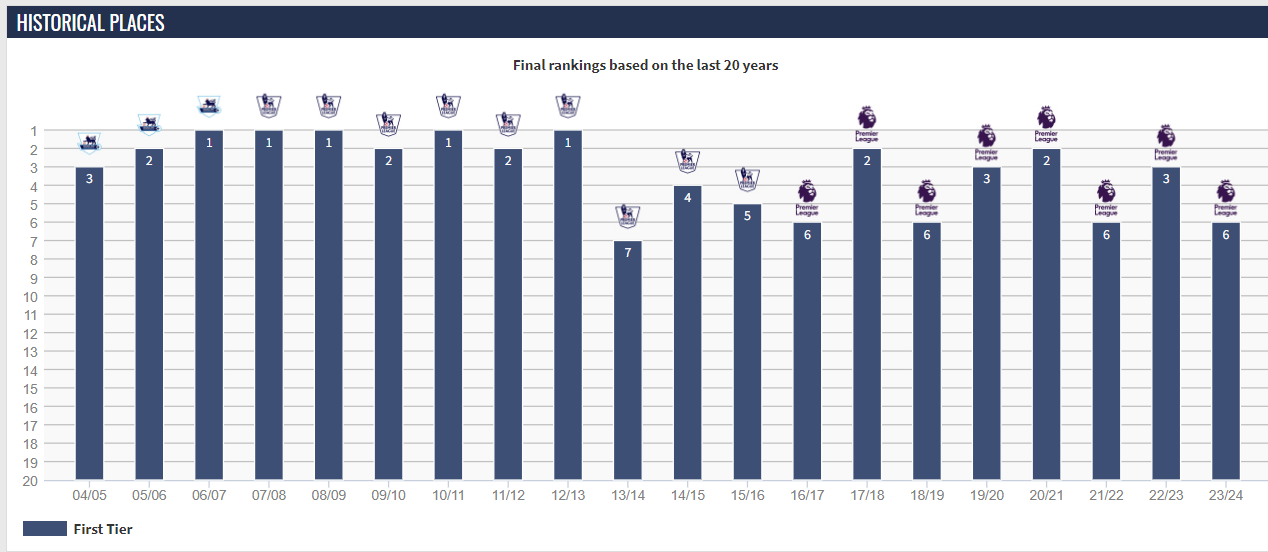
source: TransferMkt.US
The disappointing performance has come alongside a stunning rise by the company’s rival, Manchester City. In 2008, Abu Dhabi billionaire Sheikh Mansour ibn Zayed Al Nahyan bought a majority stake in Man City. Backed by his spending Man City has become the most successful team in England, and perhaps the world. Man City has won five of the last six Premier Leagues (a feat only previously accomplished by Man United itself), and is fighting for another win this year. (United is in a distant sixth place.)
To United fans, the disappointing performance stems from another factor: the club’s 2005 acquisition by American businessman Malcolm Glazer. The purchase was jeered from the start: Glazer was hung in effigy at Old Trafford amid chants of “he’s going to die”. Files from the U.S. Federal Bureau of Investigation, released years later, detailed a number of violent threats made against Glazer at the time.
Glazer passed away in May 2014, but his six children still share majority ownership of the club. United fans are still angry. Protests against the Glazer clan remain fairly common, including a sit-in in October.
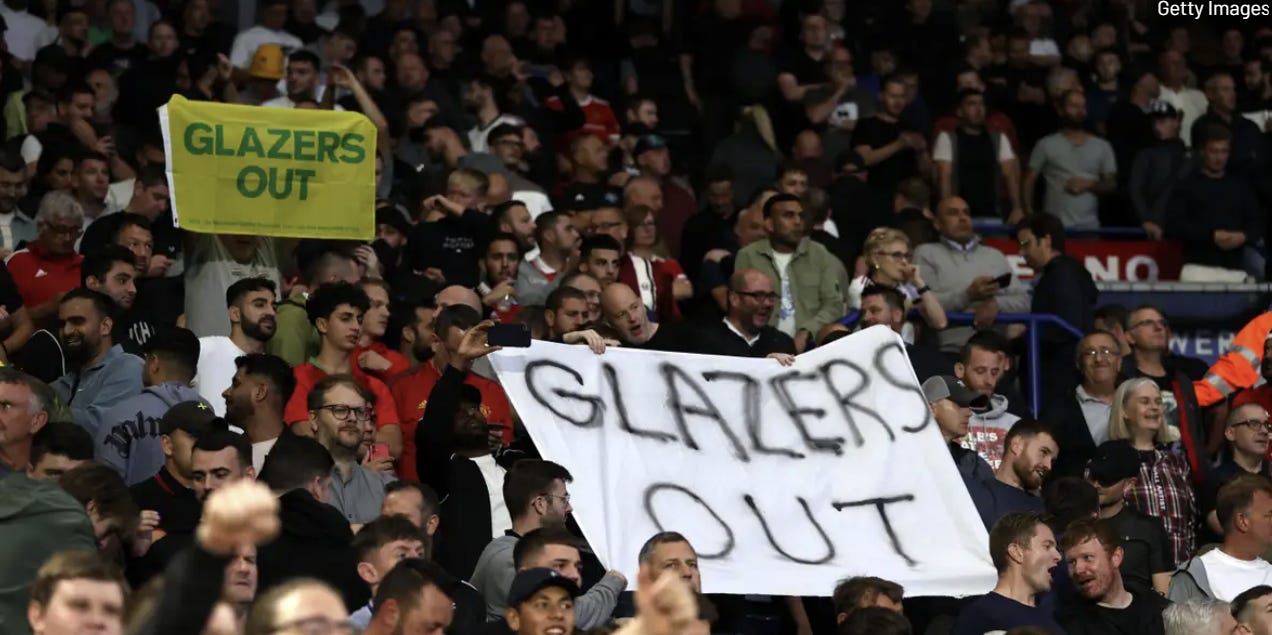
source: Getty Images via Goal.com
But for a while last year, it seemed like the Glazers were going to sell. Speculation around the event cheered not only fans of Manchester United, but investors in the stock.
ManU Goes Up For Sale
According to a filing with the SEC, in June of 2022 Manchester United representatives began meeting with American boutique bank The Raine Group about “potential strategic opportunities to enhance shareholder value”. In late November, United publicly announced a strategic alternatives process, with the press release tantalizingly disclosing a sale as a potential outcome.
By February, ten potential bidders had expressed an interest. Sir Jim Ratcliffe, the founder of chemical giant INEOS and reportedly the second-richest person in the United Kingdom, offered $22 to buy out the Class B shares owned by the Glazers. Those shares offer controlling voting power (ten votes per share) and at the time represented ~30% economic interest in the company. “Bidder A” — reported to be Qatari Sheikh Jassim, who publicly confirmed a bid at the time — offered $25 per share to buy out both classes. Seven other investors offered varying forms of minority investments3.
At this point, MANU stock soared. The strategic alternatives announcement sent MANU up more than 60% in a week, as investors clearly saw the potential for a full exit by the Glazers (helping minority shareholders in the process). Reporting around the bids stoked more optimism, with multi-billion pound price tags being thrown around:
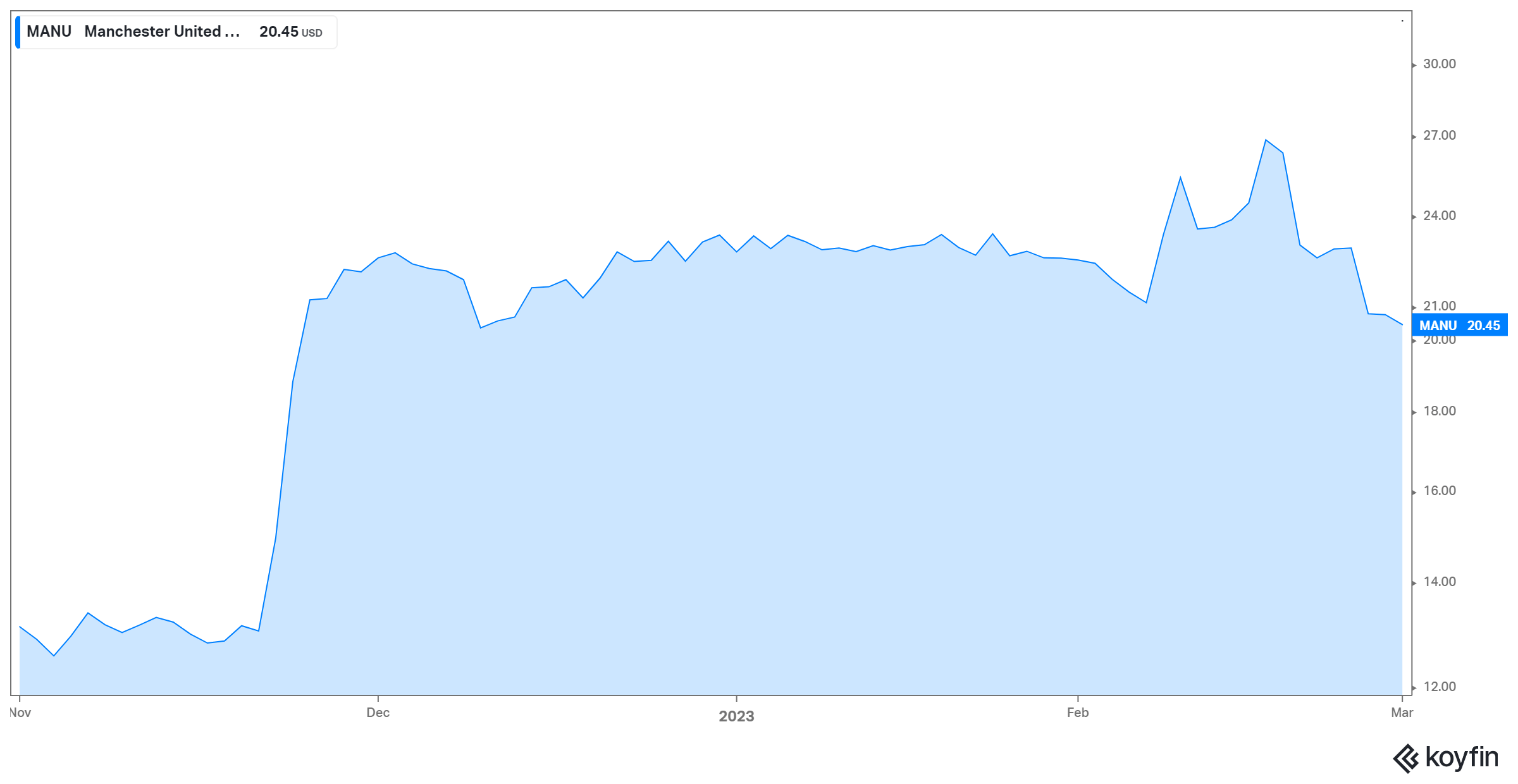
source: Koyfin; chart from 11/1/22 to 3/1/23
Raine, who had orchestrated the rushed sale of Chelsea F.C. for $3 billion earlier that year, spent months negotiating with both of the public bidders, along with others who had proposed minority investments. Per the filing, Bidder A eventually withdrew in October after the board requested both financing commitments and equal consideration for both Class A and Class B shares. (It’s not clear which request proved to be the breaking point.) Ratcliffe’s plan to simply buy out the Class B shareholders was rejected. The United board (ie, the Glazers) required either a full sale or a minority investment.
Eventually, Ratcliffe came around to the latter option. He agreed to buy 25% of both the Class A and Class B shares for $33 per share, along with an additional $300 million investment fund, for which he would be compensated in new Class A and B shares at the same $33 per share price.
Importantly for United fans, the agreement gave Ratcliffe control of the club’s operations. Unfortunately, for investors, it was not the full sale for which many had been hoping. MANU now has basically round-tripped:
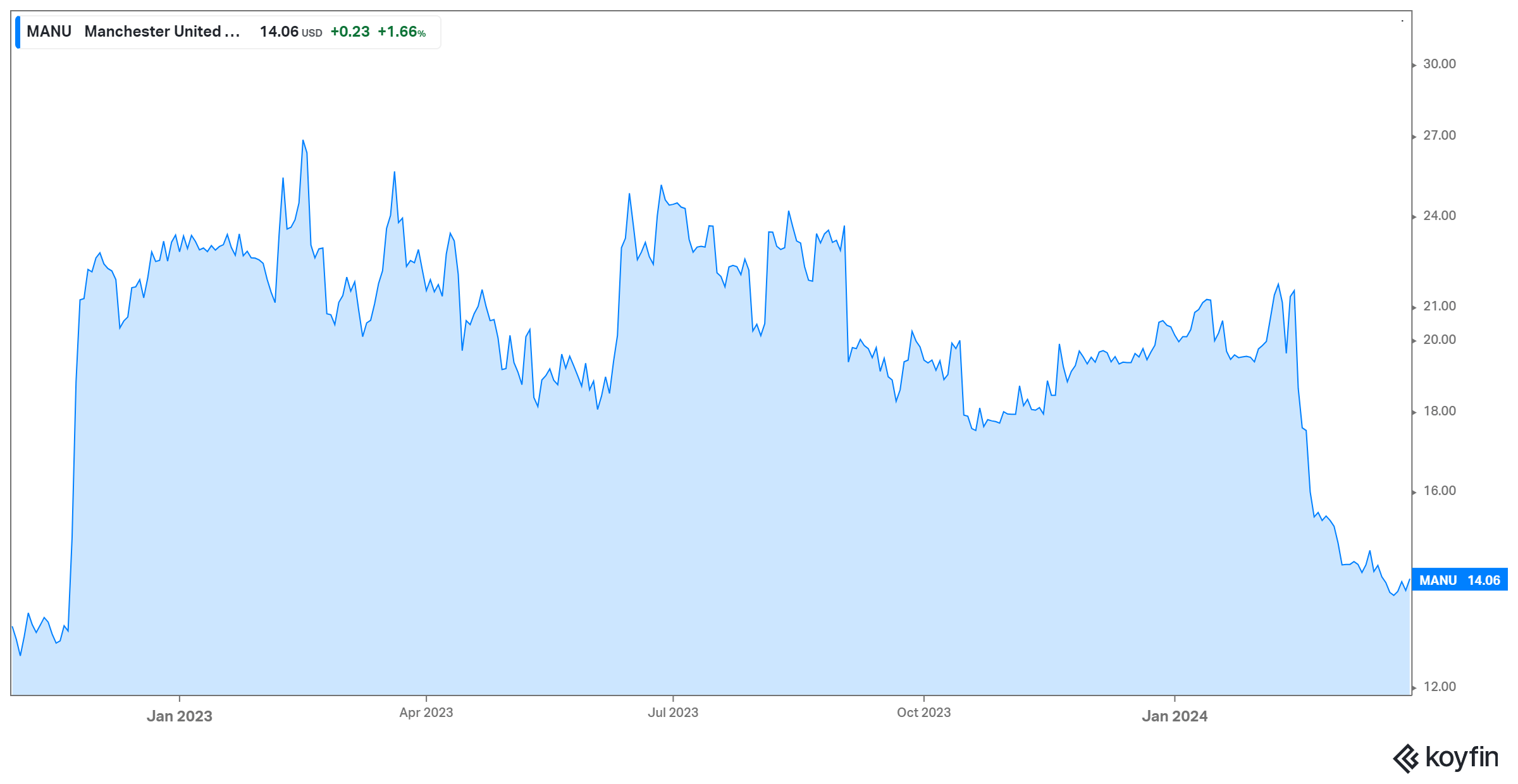
source: Koyfin; chart since 11/1/22
The most recent sell-off is likely caused at least in part by the tender offer itself. Because the offer wound up being at such a premium to the market, event-driven traders raced into the stock. Once the offer was completed on February 16th, many of those traders were induced to exit their positions as quickly as possible.
The Case Against MANU Stock On Its Own
That dislocation creates the possibility of a buying opportunity. Volume soared in mid-February, and the recent decline is no doubt driven in part by price-insensitive sellers.
But, it’s difficult to get too excited. Fully-diluted enterprise value is 2.43 billion GBP, pro forma for $100 million of Ratcliffe’s direct investment that will take place later this year4. Fiscal 2024 (ending June) EBITDA guidance is for 125 million to 150 million GBP; at the midpoint, that puts EV/EBITDA below 18x.
Whether Ratcliffe’s investment should be considered as a reduction to net debt perhaps is up for debate — the money needs to be earmarked for specific improvements, though those improvements of course can help financial performance — but even adding back that $300 million, EV/EBITDA is about 20x.
Free cash flow numbers look even better. Calculating free cash flow as cash flow from operating activities less capex, free cash flow has averaged over 90 million GBP the last three fiscal years.
But there’s a huge catch on both fronts: amortization. In the case of Manchester United, amortization is “primarily” of registrations: ie, signed contracts with players and managers. The figure is enormous: 173 million GBP in fiscal 2023, with actual payments for registrations totaling 156 million GBP.
Those are obviously very real expenses (it’s in fact somewhat disingenuous in that context for Manchester United to use EBITDA at all), and when accounting for those expenses, this simply is a business that is losing money on a consistent basis.
And in that context, the argument for a short after the Ratcliffe tender offer actually seems rather strong. (Indeed, 8.6% of the float, and 6%-plus of shares outstanding, are still sold short at the moment.) This is a business that, on its own, is losing money. It then initiated a process that might have resulted in a profitable sale of the club as a trophy asset — yet did little but get a minority investment, leaving those minority shareholders almost literally back where they started5.
Looked at solely as a business, MANU indeed looks like a short. The reputation of the Glazers not just with fans, but investors familiar with MANU is exceptionally poor at the moment. There’s more than a little speculation that the process, and the agreement with Ratcliffe, were not done for the benefit of minority shareholders. Rather, the point simply was to get a high ‘mark’ for the business (using the minority investment at $33 per share).
MANU then, has disincentivized financial management (the Glazers still control the business, even if Ratcliffe now controls football operations). So we have a cash-burning business that is underperforming according to its biggest supporters, a reasonable debt load, and a still-heavy valuation. Maybe in theory the business would be worth 4 billion GBP if it were sold — but if it’s never sold, that fact is of little concern to shorts and of little aid to shareholders.
Where Were The Buyers?
But there are two reasons for optimism. The first concerns the likelihood of a sale by the Glazers at some point.
Again, in November 2022 Manchester United stock rose more than 60% in a week simply because the board said there was a possibility of a sale. Quite clearly, the market believed that, before the announcement, there was significant value in the franchise that could be unlocked if and when the Glazers chose to monetize their own investment.
For most of 2023, United’s enterprise value bounced around the $4.5 billion / 3.5 billion GBP range. Experienced, professional investors were betting on Manchester United selling itself in the biggest deal in the history of sport. Not only were they wrong, but they were really wrong. At least per the proxy for the tender offer, Sheikh Jassim was the only person to propose a full takeout of the club — and, in the end, he never even offered satisfactory financial commitments.
This feels quite a bit like “the dog that doesn’t bark”, the classic example of a “negative fact” from a Sherlock Holmes piece6. In May of 2022, Chelsea is sold to a consortium. The final round of the bidding process included three groups, all with some connection to the U.S.. Less than a year later, Manchester United reaches out to multiple parties in a public process…and no one outside the Middle East makes a full offer? The same groups willing to pay $3 billion-plus for Chelsea — in a deal that also included nearly $2 billion in commitments going forward, and a ban on a sale for a decade — had no interest in a ~$5 billion deal for Manchester United (which would have required a ~$25 per share price, nearly double the November level)?
There’s been much reporting about what the Glazer siblings actually want. A Value Investors Club article from April7, recommending MANU on the takeout thesis, pointed to reporting that the six siblings are split over their desire to sell — but in agreement on a price at which they would.
And, again, it was the same firm — The Raine Group — that managed the sales process for Chelsea and the strategic alternatives review for Manchester United. It does seem exceptionally likely that Raine gave the Chelsea bidders information about what price the Glazers would take. It seems likely that information was known among the potential bidders of all stripes. In that context, it’s not a coincidence that the sole proposal for a full takeover came from the Middle East, and from a buyer (reportedly backed by the Qatari government) perhaps not privy to such information.
As a result, the fact that Manchester United didn’t sell in 2024 doesn’t necessarily mean it will never sell. It just, apparently, isn’t going to sell at $25 per share.
Can United Turn It Around?
Admittedly, with MANU at $14, that’s a problem. There seems to be a mismatch, even for a trophy asset, between what the Glazers will accept and what the highest bidder will pay.
Of course, there’s a way to fix that problem: start winning. Winning might fix the financial issues as well.
We can see a sign of this in results for the first half of fiscal 2024. Year-to-date, Adjusted EBITDA has increased 60%, or by about 43 million GBP. The key driver is a huge increase in broadcasting revenue (ie, rights fees paid to broadcast United matches), which has increased by 62 million GBP.
The key difference: this fiscal year, Manchester United played in the top-flight Champions League. The year before, it was in the Europa League.
Being a good club simply matters to the bottom line. Admittedly, as this year’s guidance shows, it doesn’t necessarily fix the bottom line, but it is a start. So is new management: this deep dive from U.S. outlet The Athletic, in December 2023, highlights significant dysfunction across United’s previous leadership.
Ratcliffe’s investment highlights another potential source of improved financials. His $300 million is part of a redevelopment scheme at Old Trafford that could cost as much as 2 billion GBP. United plans to seek government support for the project, and a true multi-use project (as seen at many new American facilities) could add diversified revenue streams for the club.
To be sure, this doesn’t necessarily mean that Manchester United is five years away from generating consistent free cash flow that can support upside in the share price. But that’s not really what is necessary.
What is necessary is a buyer who will finally meet the Glazers’ demands. Manchester United can’t make that buyer appear instantly, but the combination of an improved product on-field (and the subsequent brand enhancement) and a more stable financial picture (as The Athletic reported, United has backed off potential signings in part due to its finances) can make the club far more valuable.
There is absolutely a world in which Manchester United gets the 4 to 5 billion GBP offer investors believed was on the way last year. It’s not a world that exists in 2024 or 2025, but there is an intriguing turnaround play here under Ratcliffe (whose history with INEOS suggests he is a man worth taking seriously).
After so many traders bet on the sales process last year, MANU is now a different bet. It’s a bet on United’s return to glory. Few football fans (or investors) might want to take that bet right now, but Ratcliffe and his team have an opportunity to change that.
As of this writing, Vince Martin has no positions in any securities mentioned.
Disclaimer: The information in this newsletter is not and should not be construed as investment advice. Overlooked Alpha is for information, entertainment purposes only. Contributors are not registered financial advisors and do not purport to tell or recommend which securities customers should buy or sell for themselves. We strive to provide accurate analysis but mistakes and errors do occur. No warranty is made to the accuracy, completeness or correctness of the information provided. The information in the publication may become outdated and there is no obligation to update any such information. Past performance is not a guide to future performance, future returns are not guaranteed, and a loss of original capital may occur. Contributors may hold or acquire securities covered in this publication, and may purchase or sell such securities at any time, including security positions that are inconsistent or contrary to positions mentioned in this publication, all without prior notice to any of the subscribers to this publication. Investors should make their own decisions regarding the prospects of any company discussed herein based on such investors’ own review of publicly available information and should not rely on the information contained herein.
Supporters of Liverpool F.C. may dispute this point.
In this piece, we’ll use the global name of “football” rather than the American term of “soccer”.
Hilariously, an unnamed person reached out to offer to take Manchester United public via a SPAC (special purpose acquisition company). Per the filing, after submitting the proposal, “such counterparty failed to further engage with the process”.
Per the interim report, after the tender there were 56.601 million Class A shares and 114.30132 million Class B shares outstanding. MANU closed Thursday at $14.12, or 11.18 GBP, putting the market cap at 1.95 billion GBP.
Ratcliffe’s future $100 million (that investment is measured in dollars) plus the $200M received in February totals 237.5 million GBP at current exchange rates. That reduces net debt from 710.5M GBP at December 31 to a pro forma 473 million GBP.
This is true in another way: Manchester United went public in 2012, at a price of $14. Thursday’s close was $14.12.
Holmes solves the case of a stolen horse by noting that the dog didn’t bark, which proves the thief must have been someone the dog knew.
VIC articles more than 60 days old can be read with a free account.