
Highlights:
With Apple accounting for more than 80% of sales (and headlines suggesting weak iPhone demand) the bear case for this small cap is obvious.
But the Apple relationship is solid, and the idea that the iPhone has reached “the beginning of the end” seems overwrought.
Meanwhile, a strategy of diversification beyond Apple is now bearing fruit, and has a clear path toward further success.
At barely 12x earnings, the combination of bottom-line growth and a higher valuation could lead to triple-digit upside over a multi-year period.
In April of last year, shares of Cirrus Logic CRUS 0.00%↑ were rolling. CRUS had held up reasonably well in 2022, with a 19% decline against -35% total returns for the iShares Semiconductor ETF SOXX 0.00%↑. In 2023, SOXX roared back, and CRUS joined in, reaching a new all-time high of $110 in late March.
But on April 12, an analyst at Hong Kong-based TF International Securities reported that Apple AAPL 0.00%↑ was changing the design of certain high-end versions of the iPhone 15. Plans to replace the volume and mute buttons on the side of the phone with a solid-state design had been scrapped, the firm said. As the supplier of the controller chip for the new design, Cirrus Logic was a clear loser. CRUS stock dropped 12% on the report (which proved to be accurate).
Ten months later, even with chip stocks soaring, Cirrus Logic hasn’t regained the momentum it had a year ago. Shares in fact are down 3% since the end of 2019. But worries about the iPhone 15, and Apple more broadly, distract from a business that actually seems to be executing well. More importantly, those worries miss a wealth of opportunities that Cirrus Logic has to diversify away from its reliance on Apple — and to re-ignite long-term growth.

Introducing Cirrus Logic
Cirrus Logic is a fabless semiconductor manufacturer focused on two core product categories: audio and high-performance mixed-signal, or HPMS. In audio, the company develops boosted amplifiers, ADCs and DACs (analog-to-digital converters and digital-to-analog converters), signal processors, and codecs used to compress and decompress audio data. HPMS products include camera controllers, power integrated circuits, and haptics solutions (used to give the illusion of tactile response on a smartphone).
The company was founded in the early 1980s and went public in 1989. The company saw initial success, but business crashed in the 2000s. By the end of 2009, shares had gained 10% total since the initial public offering. But a couple years earlier, Cirrus had finally made its way into an Apple product, providing the codec for the iPod. As the iPhone took off, so did Cirrus Logic’s business: revenue rose from $175 million in fiscal 2009 (ending March) to $810 million four years later.
Today, Cirrus Logic remains heavily dependent on Apple, which accounts for about 85% of trailing twelve-month revenue. But it has diversified the products with which it supplies its most important customer, notably through the addition of the HPMS line. And the company’s strategy is to diversify further, both in terms of what it ships to Apple’s contract manufacturers and in terms of its business beyond that giant. Cirrus Logic does have placement in Android devices, and is making a concerted effort to move into laptops and, eventually, end markets like industrial and automotive.
At the moment, investors aren’t giving Cirrus Logic any credit for the potential of that strategy. Instead, they’re focused on the risks.
The Reliance On Apple
It’s not clear whether Apple’s return to physical volume buttons in the iPhone 15 was driven by failures by Cirrus Logic, issues elsewhere in the supply chain, or other considerations1. But the reversal (after multiple reports that the switch to haptics was being made) reignited the core concern about Cirrus Logic: that it is simply so dependent on Apple.
The only close comparison is Skyworks Solutions SWKS 0.00%↑, which generated 66% of fiscal 2023 (ending September) revenue from the Cupertino giant. All the way back in 2017, the Financial Times noted that Cirrus Logic’s then-chief executive officer refused to utter his biggest customer’s name in public, and used the same careful phrase on every one of his company’s quarterly earnings calls2. This was, the FT noted, the price of doing business with such a large, secretive manufacturer.
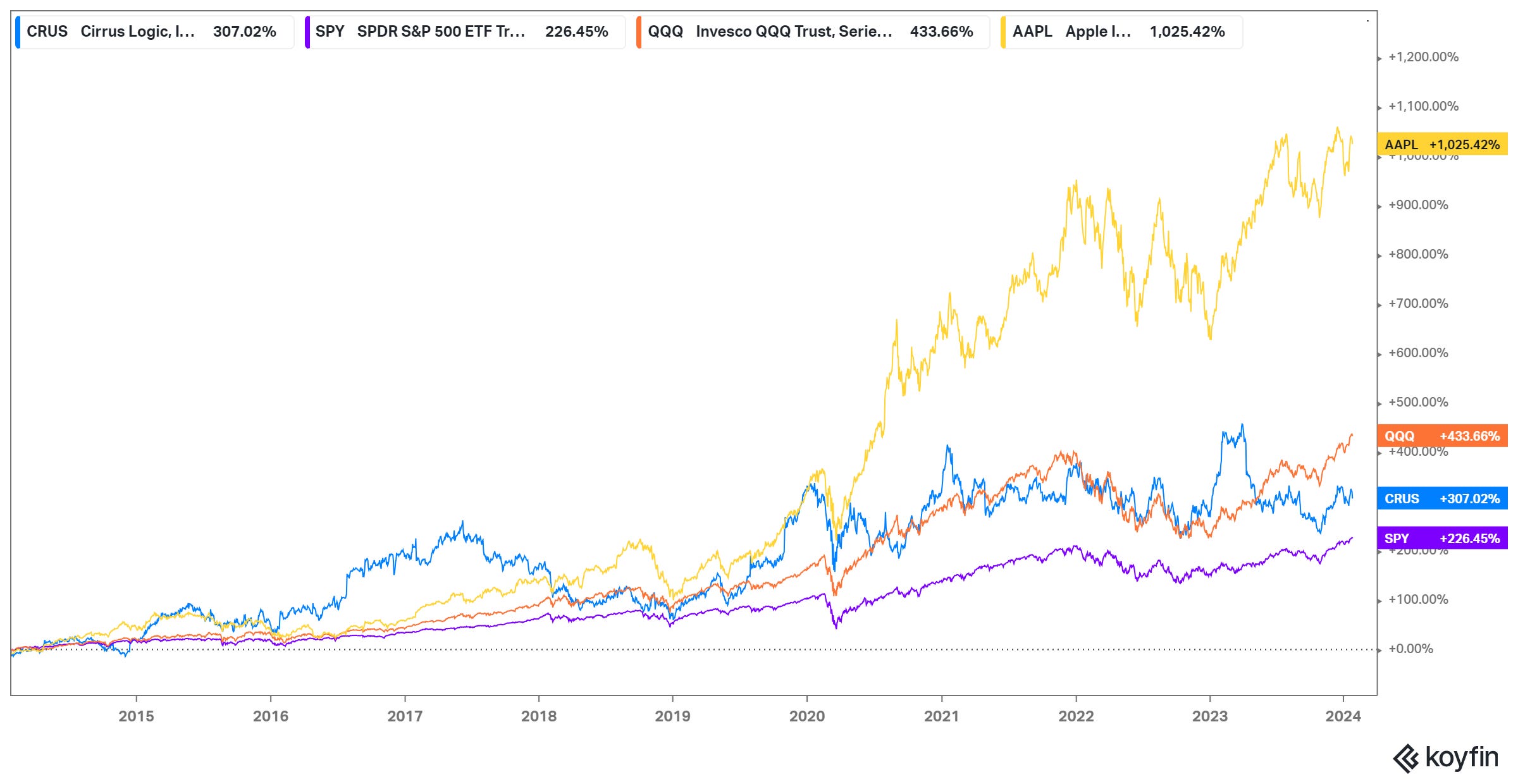
That said, being reliant on Apple hasn’t been that bad for Cirrus Logic. Going back to the beginning of 2010, when Apple revenue first began to ramp (growing more than eightfold between FY10 and FY13), CRUS has outperformed the NASDAQ 100 and more than doubled the S&P 500 with returns over 1,000%. The ten-year chart is more muted, and investors obviously would have been better off simply buying Apple, but that’s true for 99% of stocks3 out there:
source: Koyfin
The clear risk beyond conference call decorum would seem to be around pricing, with Apple able to use its leverage to bully Cirrus Logic around. Back in 2017, the U.K.’s Imagination Technologies was told that Apple would replace its graphics chips with those developed in-house. Imagination at that point got about half of its sales from Apple. The stock plunged 70% in a single session, and Imagination was eventually sold to a private equity firm controlled by the Chinese government. It would seem likely that Apple could make a similar threat.
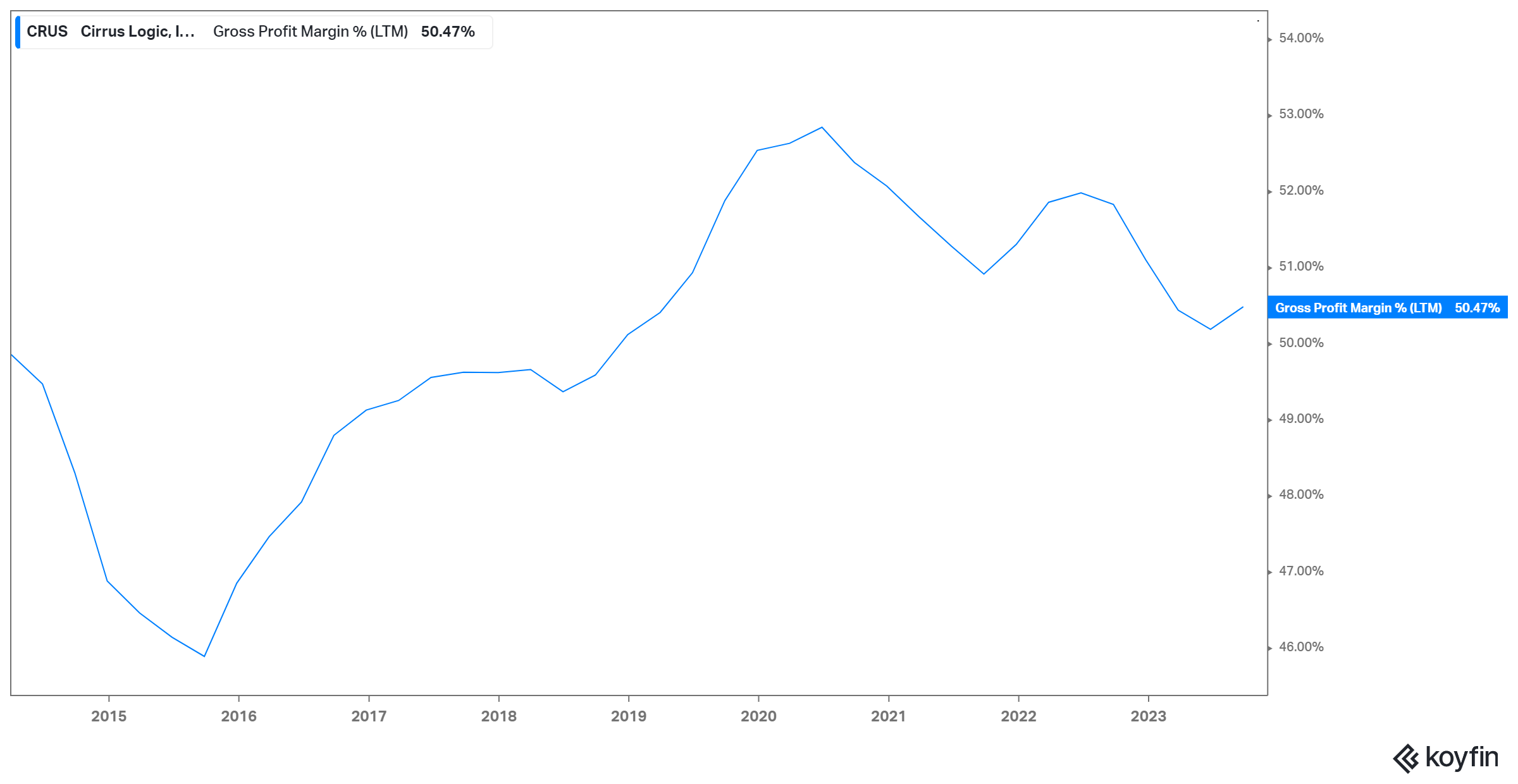
But, as far as the public financials show, Cirrus has been able to hold its own. Gross margins have actually expanded in recent years:
source: Koyfin
There is still the possibility that CRUS shareholders one day wake up to an Imagination-style wipeout. But the longer that doesn’t happen, the less likely that risk becomes. In fact, there has been on and off speculation that Apple might eventually just buy Cirrus Logic, speculation that goes back to the earliest days of the relationship.
Are Fiscal Q3 Earnings A Trap?
The reliance on Apple has been a long-term concern, but it also seems to create a short-term risk. Cirrus Logic earnings are due next week (Tuesday, February 6 after the market close). Meanwhile, the narrative around Apple has been that iPhone 15 sales are disappointing. Early this month, London’s Daily Mail asked if it was “the beginning of the end for the iPhone”.
Admittedly, the Mail is not the pre-eminent source for global business reporting, nor is it an outlet prone to restraint in its headlines. But Bloomberg this month pointed toward unusual discounts for the iPhone 15 in China; after Apple’s fiscal Q4 release in November, the Wall Street Journal too sounded the alarm.
In that context, Cirrus would seem to be at significant risk of an earnings miss this quarter, and/or an outlook that leads the stock down further. But if you go beyond the headlines, there’s little evidence the market is expecting a soft quarter.
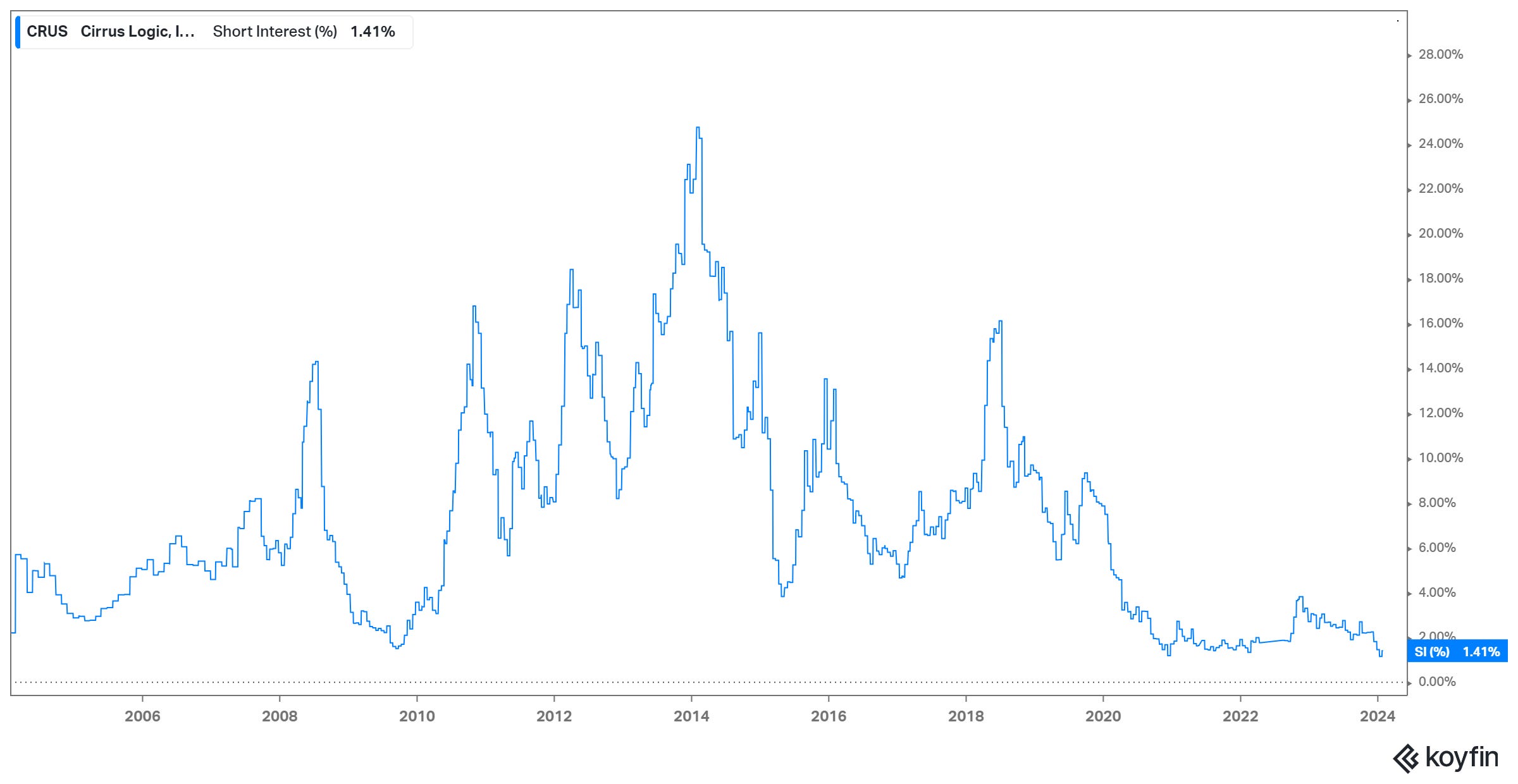
Notably, CRUS has been a popular short, going back to last decade when concerns about ‘commoditization’ swirled around the iPhone. Yet heading into the fiscal Q3 release, at a time when hedge funds have no shortage of alternative data, bearish bets against CRUS in fact are at an all-time low:
source: Koyfin
It’s possible there’s been a tick up in short sales in recent sessions: CRUS did sell off Thursday and Friday, and NASDAQ does not appear to have yet released short interest data for the two-week period ending Friday. Still, short CRUS is probably the simplest bet that can be made against the iPhone. That’s probably more true now that it was ten years ago, given the growing importance of services to Apple. Yet even assuming an increase in recent sessions, very few traders are making that bet. (Bear in mind that dollar exposure at January 12 is only about $63 million.)
There’s also the fact that AAPL itself has rallied of late, after an early-year sell-off apparently driven by fears around iPhone 15 uptake and longer-term trends. Bank of America Merrill Lynch analysts upgraded the stock on January 18, citing potential tailwinds from new hardware required to support generative AI features; the firm added AAPL to the BAML US 1 list four days later. The idea that the end of the iPhone is nigh drove headlines, but so far in 2024 hasn’t driven much movement in the market: AAPL is now flat year-to-date.
To be sure, this doesn’t mean CRUS is set for a blowout quarter next week. The timing of shipments to Apple and sales of the iPhones being supplied don’t match up so a soft quarter for Apple doesn’t mean the same for Cirrus. Inventory stocking and de-stocking has further broken the correlation since the pandemic. It’s absolutely possible that Cirrus Logic delivers a weak Q3 and/or outlook for Q4, or that investors react poorly to the quarter. Indeed, cyclical pressure has led to seemingly weak first-half performance, with revenue down 15% year-over-year. Consensus estimates imply an 8.6% decline in Q3 and a -11.6% print in fiscal Q4.
But in terms of Apple news or positioning of traders, there doesn’t appear to be data suggesting that a significantly weak report is likely on the way. And it’s worth noting, this quarter trading will be a bit different: Cirrus Logic usually reports the same day as Apple, but next week will be reporting five days after its biggest customer does. No doubt the Apple release will move CRUS before its own report does.
HPMS Growth
Obviously, Cirrus Logic management knows that such a significant concentration with Apple is not necessarily a good thing. And so the company has made an effort to diversify its business, with results that to this point are somewhat mixed.
The good news is on the HPMS front. HPMS sales don’t necessarily represent diversification away from Apple, since only a fraction of those sales are coming from other customers. But the growth in the category has been enormously impressive. HPMS revenue was first broken out in the FY21 10-K, which disclosed FY19 revenue of $145 million. The figure over the last twelve months is $703 million, nearly 5x growth in 4.5 years.
Notably, nearly all of that growth has come from technology developed in-house. Cirrus Logic did acquire Lion Semiconductor for $335 million in 2021, but that deal actually has disappointed in terms of revenue, per management commentary. Even the guided annual run-rate at the time (in the range of $100 million) would account for less than 20% of the increase in segment revenue from FY19 to date.
That performance alone supports the idea that Cirrus Logic can further branch out from audio going further, because it’s done so already. Importantly, it’s also made the company much more critical for Apple. Cirrus Logic CEO John Forsyth noted at a conference last month that his company originally only shipped one chip to Apple; for high-end iPhones, Cirrus Logic now ships nine.
It’s one thing for Apple to replace a single-product supplier with in-house technology; it’s much more difficult (and perhaps impossible) for a business with multiple sockets across multiple products. And, of course, the steady increase in content in Apple devices also serves to offset concerns about unit sales of the iPhones; if Cirrus Logic can get more sockets on fewer units, that can keep revenue stable, allowing non-Apple revenue to drive growth going forward.
Indeed, it’s an interesting thought exercise as to what a HPMS-only Cirrus Logic might be valued at, even given Apple concentration. With an enterprise value of $4.15 billion4, CRUS trades at less than 6x trailing twelve-month HPMS revenue — but that revenue will likely exit FY24 at a five-year annualized growth rate of ~35%.
Given ~50% gross margins, it’s probably too aggressive to argue that the audio business is available “for free”, but there is a case that the market isn’t appropriately valuing the impressive performance in HPMS. Indeed, as the company’s audio business ramped in the beginning of the 2010s, CRUS itself often traded above 3x revenue in a market with much lower valuations. Applying a similar multiple to HPMS significantly de-risks the story here.
Getting Away From Apple
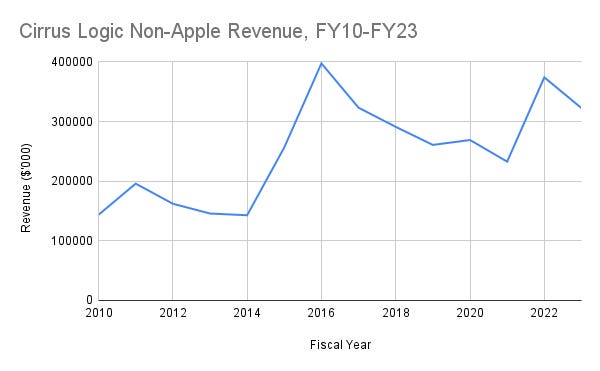
The less-good news, perhaps, is that overall Cirrus Logic hasn’t driven enough growth in its non-Apple business:
source: author from CRUS 10-K filings
There have been disappointments. For instance, Cirrus Logic lost a socket in the Samsung Galaxy to Qualcomm QCOM 0.00%↑. But the company also targeted a smart home market that doesn’t appear to have met expectations. And in smartphones, a big part of the issue is that the company has not wanted to chase low-margin, largely commoditized business, and globally that kind of business characterizes most of the Android ecosystem.
That said, there are reasons for optimism that future efforts to expand beyond Apple will be more successful. A push into laptops makes sense, given an increasing emphasis among audio among major manufacturers. Cirrus Logic has said it already has wins with each of the five biggest PC makers, and particularly in a world with more remote work, the focus on audio by those makers is likely to increase.
More broadly, those companies (particularly Dell DELL 0.00%↑ and HP HPQ 0.00%↑) have been dealing with the effects of a largely commoditized business, and better audio is one way to stand out. Another is by getting thinner and lighter, which in turn suggests the eventual development of haptics in that industry to save space within the notebook. Given its Apple experience, Cirrus Logic obviously is an expert in creating architectures that maximize performance within tiny spaces5.
A shift to a 22-nanometer node further adds to Cirrus Logic’s competitive positioning in higher-end laptops (and, of course, higher-end smartphones as well, be they iPhones or otherwise). The opportunity in power is still a few years out, but management believes that digital power chips can displace current analog offerings — and may have to do so in multiple devices given the demands required by AI applications.
Underpinning these opportunities is the fact that HMPS has ramped so impressively in recent years. Cirrus Logic developed mixed-signal products for decades; they simply weren’t material to the business. The fact that the HMPS business has been built up to grow revenue more than 300% suggests, importantly, that there is a good business here beyond the legacy leadership in portable audio. That point seems like it has been lost amid the consistent focus on iPhone teardowns and unit sales.
CRUS Is Cheap Enough
By the standards of the space, CRUS isn’t valued like a very good business at all. On a trailing twelve-month basis, shares trade at less than 14x adjusted earnings per share. Backing out net cash (and the related interest expense), the multiple drops to 13x. Even adding back stock-based comp, the ex-cash multiple is about 18x.
Essentially, CRUS is being valued much like SWKS, which trades at 12.3x FY23 (ending September) non-GAAP EPS, with pretty similar multiples on an enterprise basis. Looking backwards, that seems to make some sense. The two companies share more than just heavy reliance on Apple. Compared to fiscal 2018 results, annualized EPS growth rates are quite similar, in the mid-3% range. Revenue growth rates are nearly identical over the past decade.
But looking forward, the two businesses can post significantly divergent performance. Skyworks’s focus on networking chips creates a largely commoditized business with weaker gross margins (~45% vs ~50% for CRUS). Skyworks doesn’t have a secondary revenue stream that has generated impressive growth like HPMS has for Cirrus Logic. SWKS has been dead money for years; the stock now trades right at its 2015 peak, while CRUS has more than doubled over the same timeframe.
The comparison of CRUS to SWKS doesn’t tell the entire story, but it does get to the idea that investors right now are treating the two Apple suppliers as roughly the same. That in turn gets to the core of the bull case: the market is focused on the reliance on Apple, and missing the Cirrus Logic’s ability to develop new products or apply existing products to new markets.
If Cirrus cannot diversify its reliance on Apple, there’s enough cash flow to keep the stock reasonably stable. But if and when it does, there’s room for the combination of both earnings growth and earnings multiple expansion as the perception of Cirrus Logic changes. That combination can lead to explosive upside.
As of this writing, Vince Martin has no positions in any securities mentioned.
Disclaimer: The information in this newsletter is not and should not be construed as investment advice. Overlooked Alpha is for information, entertainment purposes only. Contributors are not registered financial advisors and do not purport to tell or recommend which securities customers should buy or sell for themselves. We strive to provide accurate analysis but mistakes and errors do occur. No warranty is made to the accuracy, completeness or correctness of the information provided. The information in the publication may become outdated and there is no obligation to update any such information. Past performance is not a guide to future performance, future returns are not guaranteed, and a loss of original capital may occur. Contributors may hold or acquire securities covered in this publication, and may purchase or sell such securities at any time, including security positions that are inconsistent or contrary to positions mentioned in this publication, all without prior notice to any of the subscribers to this publication. Investors should make their own decisions regarding the prospects of any company discussed herein based on such investors’ own review of publicly available information and should not rely on the information contained herein.
It appears from both management and analyst commentary that the issue was not that Cirrus Logic’s product simply failed to perform, but as far as we can tell that hasn’t been publicly confirmed.
Cirrus Logic executives continue to make an obvious effort to say the name “Apple”, usually referring to “our top customer” or sometimes just “our customer”. Every now and then, however, “Apple” does slip out.
Literally: per a Koyfin screen, of 4,185 stocks currently listed on U.S. exchanges with a market cap above $50 million, 58, or 1.39%, have outperformed Apple over the last decade.
Market cap of $4.51 billion, cash and investments of $353 million, no debt.
As Forsyth put it at last month’s conference, the space in a smartphone camera module “is effectively nothing. It rounds to zero.”