
Highlights:
An 18-month takeover process ended in the most stunning way possible.
With the deal finally in the rearview mirror, investor attention is turning back to the standalone business — which looks headed for a cyclical swing higher.
Optionality from arbitration adds more potential upside, as does the reinstatement of the dividend and a potential share buyback.
The stock can move higher on its own, with legal wins adding to potential returns.
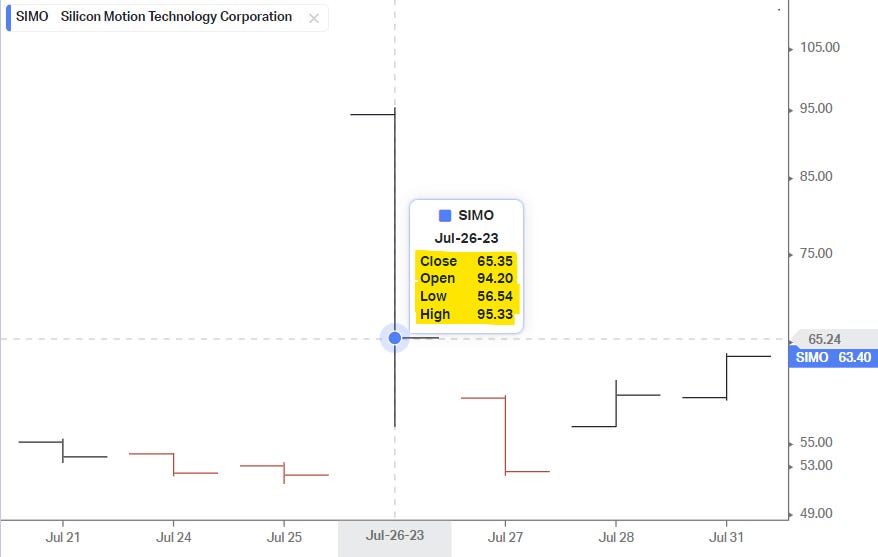
On July 26 of this year, Silicon Motion SIMO 0.00%↑ saw insane trading. SIMO stock had closed the session before at $52.20; it opened up 80% at $94.20, bottomed with just an 8% rally, before finishing +25%. It then gave back nearly all of those gains the following day, before climbing again.
source: Koyfin (with author highlighting)
It wasn’t an unhinged market that drove the seemingly unhinged trading. In fact, the market’s reaction made some sense: investors were reacting to a series of surprises.
In May 2022, fellow chipmaker MaxLinear MXL 0.00%↑ had agreed to acquire Silicon Motion in a cash-and-stock deal worth, at the time of the announcement, ~$114 per SIMO American Depositary Share. But the market quickly came to the conclusion that the deal was unlikely to get approval in China. By October, SIMO traded at a greater than 50% discount to the implied consideration, and the discount would stay sizeable from that point forward.
But overnight on July 25, Chinese antitrust regulators followed other agencies and gave the tie-up conditional approval. It was that approval that drove the 80% early-session gain in SIMO, a move that priced in sharply higher odds of the deal getting done. Another surprise followed, however: on the afternoon of the 26th, MaxLinear stunned the market by terminating the acquisition itself.
Though Silicon Motion protested vehemently — and is availing itself of legal recourse — the deal at this point is essentially over. But it’s that fact, and not anything wrong with the underlying business, that seems to have kept SIMO back down at recent lows.
source: Simms
Introducing Silicon Motion
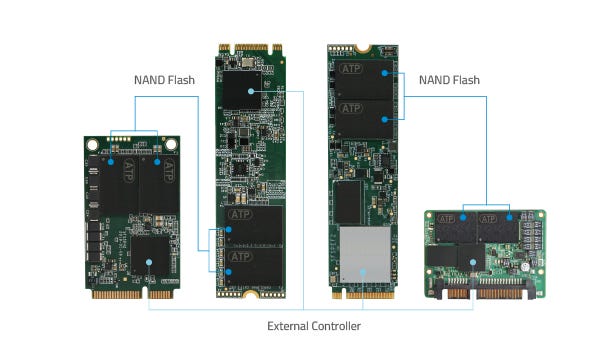
Silicon Motion is a ‘fabless’ chipmaker whose business centers on NAND controllers. Controllers communicate between flash memory and the device: in Silicon Motion’s case, those devices include everything from low end IoT (Internet of Things) products like smart thermostats to laptops and smartphones to solid-state drives (SSDs) used in customer products and industrial data centers. In 2022, controllers accounted for over 90% of revenue, with SSDs just under half (down a bit from past levels), and controllers using the eMMC protocol driving 35% to 40% of revenue.
The remainder of the business comes from Silicon Motion’s own SSD solutions. The Ferri line targets client devices such as laptops or smartphones, while the Shannon line is used in data centers. This effort, to this point, hasn’t been a huge success. Silicon Motion itself notes in filings that the acquisitions of Shannon Systems, designer of the data center SSDs, in 2015 and software developer Bigtera two years later “have not met financial expectations to date”.
And so the controller business remains the core driver here. The market is reasonably competitive: Silicon Motion goes up against fellow Taiwanese concern Phison Electronics (8299.TWO) as well as Marvell Technology MRVL 0.00%↑, and a few smaller players. Importantly, however, competition also comes from within key customers: Micron MU 0.00%↑ and SK Hynix (660.KS) accounted for 45% of revenue last year, and both have developed internal controllers from various products.
Still, over time the controller business has been a good one for Silicon Motion. The company was founded in 1995 by Wallace Kou, who remains the company’s chief executive officer, and went public a decade later. Total returns since the initial public offering are 620%, better than 11% annualized.
MaxLinear’s Stunning Exit
Indeed, 18 months ago, MaxLinear management thought this was an excellent business. On the conference call following the announcement, MaxLinear CEO Kishore Seendripu cited a “passionate culture of engineering excellence” at Silicon Motion, and “world-class core technologies that have powered the rapid growth of and the transition to solid-state storage devices.” Seendripu of course put his money (or, at least, his shareholders’ money) where his mouth was: the deal valued Silicon Motion at $3.8 billion, with over 80% of the consideration paid in cash.
In fact, what is so strange about MaxLinear’s exit in July is that up until the final few hours — almost literally — the company seemed intent on pushing the acquisition through. On the first quarter conference in late April, chief financial officer Steven Litchfield said “[we] remain confident of a mid-2023 close”. At the end of May, MaxLinear reportedly was making progress in negotiations with SAMR, the Chinese antitrust regulator; the same report claimed that Seendripu himself had traveled to Beijing earlier that month1.
A week before MaxLinear walked away, another source claimed that MaxLinear and Silicon Motion were contemplating a joint venture structure to get around potential export bans to the Chinese mainland2. That report is buttressed by a later press release from Silicon Motion which disclosed that on the very same day, MaxLinear’s counsel was telling SAMR that approval was urgent, given an August 7 deadline for the close of the acquisition.
In that press release, Silicon Motion claimed its management team was as stunned by MaxLinear’s reversal as everyone else:
Upon receiving SAMR approval, Silicon Motion executives sent congratulatory messages to MaxLinear’s CFO and CEO in anticipation of officially closing the transaction following receipt of this regulatory approval. Approximately 10 hours after SAMR announced its approval of the merger, Silicon Motion received the termination letter from MaxLinear. The termination letter came as a complete shock to the Company and its directors, officers, and employees…
For its part, when announcing the termination, MaxLinear gave four reasons for its ability to walk away. Notably, the company said Silicon Motion had suffered a “Material Adverse Effect that is continuing” — a claim which Silicon Motion has repeatedly denied. On the Q2 call the same day, MaxLinear CFO Litchfield said his company would not be paying a breakup fee, since it was within its rights to terminate.
Since then, MaxLinear has had little to say: responses to subsequent press releases from Silicon Motion were met with a boilerplate summary of its termination notice. On August 16, Silicon Motion said it was terminating the acquisition (admittedly with some “I can’t believe you broke up with me, I’m dumping you” kind of vibes). Last month, Silicon Motion filed a notice of arbitration against MaxLinear; a decision is not likely to come for at least a year.
Silicon Motion Goes It Alone
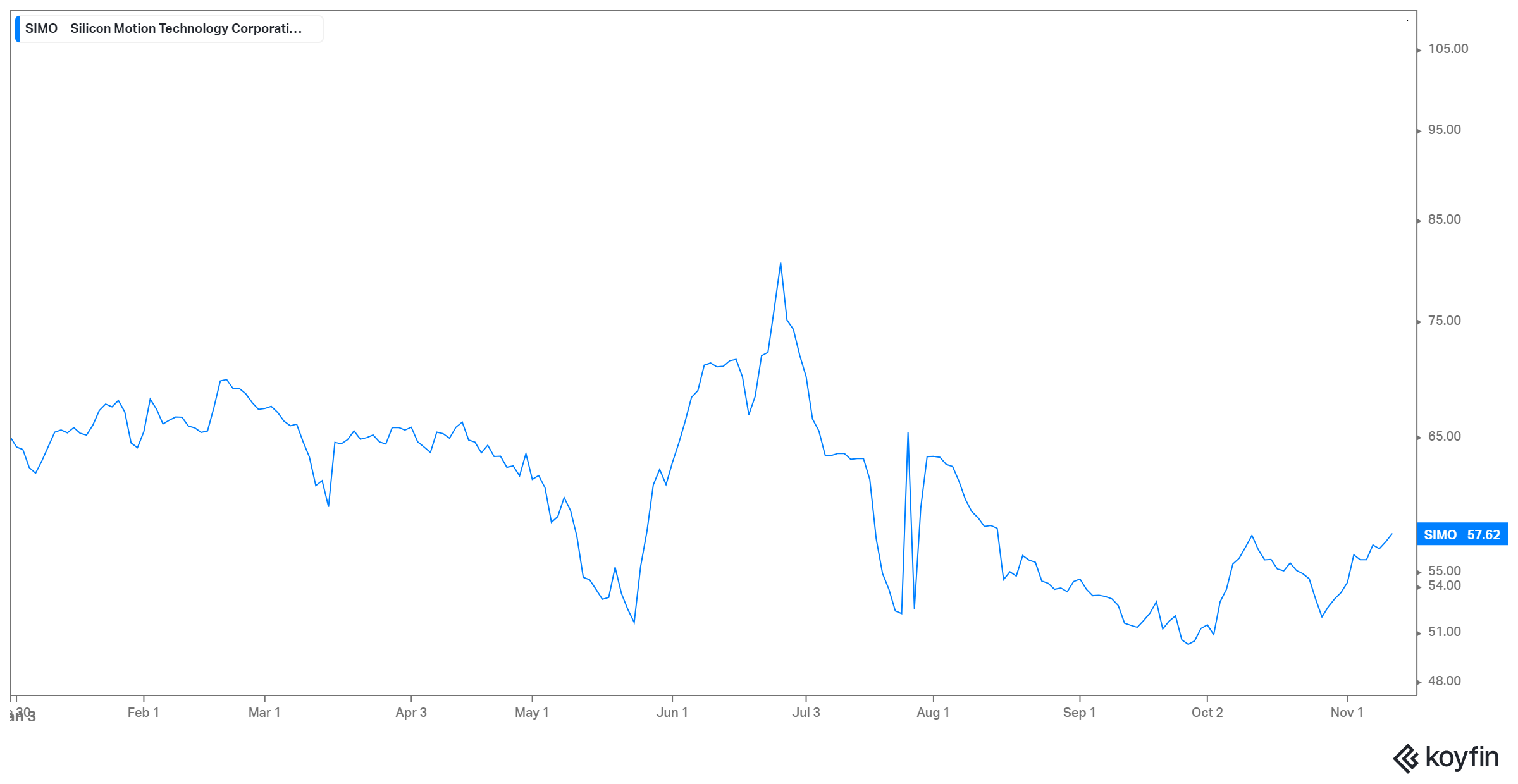
After initial volatility following the deal break, it certainly seems like the market has moved on:
source: Koyfin
On its face, that seems like a huge problem for SIMO. Results so far this year have been ugly: revenue is down 41%, with gross profit dollars off by more than half. As a result, operating profit has been crushed, with margins plunging to barely 5% from 25%-plus in the year-prior period.
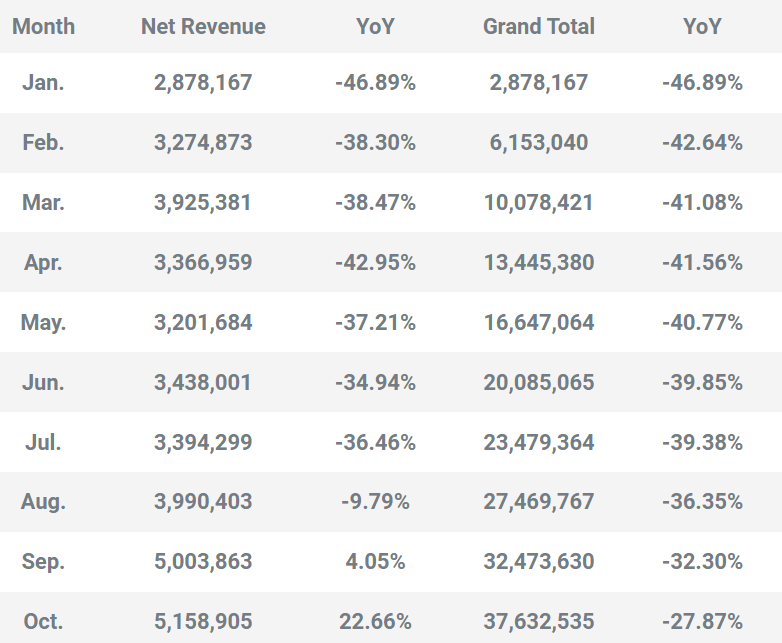
But anyone familiar with NAND knows how cyclical this industry is. Micron is one of the most cyclical businesses in the market, and its revenue in fiscal 2023 (ending August) was just shy of halved against FY22. There’s certainly no sign that Silicon Motion is losing share. Marvell has talked up big declines in its enterprise SSD controller sales, and results from Phison (which reports monthly) show similar pressure:
source: Phison Electronics investor relations
What has happened is that the reversal of supply chain headwinds, combined with aggressive consumer buying from 2020 through 2022, has created a one-two punch. Inventory levels wound up being elevated at the same time as demand cratered.
Commentary from Silicon Motion management after Q3 suggests that a bottom might be in. Revenue in eMMC and UFS more than doubled sequentially, with smartphone demand returning to normal. Inventories across the board look healthy.
Interestingly, even Silicon Motion admitted — if not directly — that the MaxLinear offer had hurt its business. (Phison CEO Pua Khein-seng predicted exactly that outcome when the deal was announced.) Kou said on the Q3 call that “especially after July 26 [the day MaxLinear walked away], we do see the momentum [behind the business] become stronger.” It’s not a surprise, then, that SIMO gained after the release and has posted a modest rally since.
What Happened While SIMO Was Quiet
There’s a broader aspect to the Q3 call as well. It’s the first time the Silicon Motion management team had spoken publicly about its business in eighteen months. Because of the MaxLinear merger, the company wasn’t holding earnings calls or making conference appearances.
Yet, of course, it’s not as if the business was standing still. One potentially big launch was tipped in August, when Silicon Motion showed its Gen 5 SSD controller, a product which one site noted seems superior to that of Phison and which importantly offers power consumption equivalent to Gen 4 controllers. That can ameliorate the heat issues created by faster NAND. The company is moving into the Gen5 enterprise SSD market as well.
The other notable positive from the Q3 call is that Silicon Motion is managing in-house competition as well. As noted, SK Hynix was a key customer in 2022, and management (without naming names) talked up potential business there in 2024 and beyond. That’s a big deal because Hynix went with an internal solution when flash transitioned from eMMC to UFS last decade; the return to a key role with that developer should calm worries about the mid-term outlook, and further supports the idea that year-to-date weakness is cyclical rather than structural.
On the whole, this simply isn’t a management team that has been able to make its case for a year and a half. And given that the news around the stock has been dominated by a terminated merger — and a merger terminated in perhaps the most stunning way possible — it hardly seems likely that the market as a whole is fully clued into the story here. Meanwhile, Silicon Motion has reinstated its dividend, which will yield more than 3%, and a share buyback seems likely, particularly if the stock stays down here.
Admittedly, this is probably a 2H 2024 story in terms of a significant inflection point for the business. But the good news is that such an inflection point doesn’t look priced in.
SIMO Still Looks Cheap On Its Own
SIMO is up about 6% since the Q3 report, which topped consensus estimates and included guidance for double-digit sequential revenue growth. But that modest rally still leaves the stock quite reasonably valued.
Based on guidance, SIMO trades at about 29x this year’s EPS. But it bears repeating: this year’s performance is clearly a trough, rather than anything close to a peak. Even that excludes about $9 per share in cash on the balance sheet (a chunk of which built up while Silicon Motion was waiting for approval). Adjusted for that cash, P/E drops toward 25x.
There is room for profits to inflect higher in a hurry. 2024 adjusted operating margins should be ~7.5% or so. After Q3, management targeted a return to past gross margins, which at ~50% are about 800 basis points higher than the year-to-date print — enough to double operating margins. Add a cyclical revenue recovery to doubled operating margins, and EPS should increase more than 100%.
Importantly, that doesn’t mean EPS is going to double on the way to a peak; it should double simply as the industry normalizes, a process which is already underway. Indeed, the Street sees that kind of growth coming in 2024, with consensus EPS at $3.71 against a sub-$2 print for this year.
For these kinds of cyclical names, pegging valuation perfectly is exceptionally difficult (as anyone who has tried to analyze MU knows quite well). But, roughly speaking, mid-cycle earnings per share here are probably over $4. Silicon Motion did nearly $3 in 2019 (based on the current share count), $6-plus in each of the last two years, and ~$2 this year. If that model is roughly correct, SIMO is trading at 12x-15x mid-cycle EPS, backing out net cash3. That’s easily an attractive multiple for a business that has grown steadily for years, even if SIMO historically has traded at a discount to MRVL. (Another small point in favor of valuation: Phison stock is modestly more expensive than SIMO at the moment as well.)
Owning a cyclical like this, with the potential for snapback growth (again, consensus is for EPS to increase ~90% year-over-year in 2024), and with evidence that a bottom is in, usually is at worst a good trade. That sense seems augmented here given how little information there’s been in the public sphere about Silicon Motion since May 2022. There is the potential for the cycle to reverse, or for a major customer to bring controllers in-house. But as it stands, SIMO at $57 looks like a solid investment.
What Can Silicon Motion Get Out Of MaxLinear?
But what makes SIMO particularly intriguing here is that there’s a normal case for a cyclical upswing combined with an absolutely abnormal potential for recovery from MaxLinear.
What that recovery might look like isn’t clear. The arbitration hearing will be held in Singapore, but according to one source will be based on Delaware law. After Elon Musk’s acquisition of Twitter last year, we are all unofficial experts in material adverse events; MaxLinear’s argument on that point seems particularly weak (this is not legal advice). As Silicon Motion has pointed out, MaxLinear’s efforts to get the deal closed continued until mere days before the termination was filed significantly undercut the claim of a material adverse effect (MAE). Even if the cyclical downturn rose to that standard, MaxLinear by its own admission was still working to get the deal closed while that downturn was in process.
Silicon Motion has said it wants a termination fee of $160 million (~8% of its current market capitalization) plus interest plus “further substantial damages”. Getting the full ~$3 billion implied simply by the cash portion of the 2022 offer probably is a no go, in part because MaxLinear’s business has collapsed: Q3 revenue was down 53% year-over-year, and the company has a market cap of just $1.4 billion (~$500 million less than Silicon Motion does at the moment).
Still, there seems to be a material possibility of an award here. (Again, that is our layman’s reading, not legal advice.) The optionality isn’t quite high enough to make SIMO attractive on its own, but that’s why the Q3 report is so helpful to the bull case. There’s a strong case to be long SIMO; the potential for an award from MaxLinear only makes it stronger.
As of this writing, Vince Martin has no positions in any securities mentioned.
Disclaimer: The information in this newsletter is not and should not be construed as investment advice. Overlooked Alpha is for information, entertainment purposes only. Contributors are not registered financial advisors and do not purport to tell or recommend which securities customers should buy or sell for themselves. We strive to provide accurate analysis but mistakes and errors do occur. No warranty is made to the accuracy, completeness or correctness of the information provided. The information in the publication may become outdated and there is no obligation to update any such information. Past performance is not a guide to future performance, future returns are not guaranteed, and a loss of original capital may occur. Contributors may hold or acquire securities covered in this publication, and may purchase or sell such securities at any time, including security positions that are inconsistent or contrary to positions mentioned in this publication, all without prior notice to any of the subscribers to this publication. Investors should make their own decisions regarding the prospects of any company discussed herein based on such investors’ own review of publicly available information and should not rely on the information contained herein.
It would seem likely that the reporting came from sources within MaxLinear and/or Silicon Motion, rather than Chinese officials. Notably, the article cites on MaxLinear who refused to confirm the CEO’s trip — but quite obviously did not take the opportunity to deny the discussion of progress toward merger approval.
MaxLinear’s U.S. headquarters meant that, under its ownership, Silicon Motion would be subject to Biden Administration export controls.
To be fair, there is an argument that cash shouldn’t be valued at 100%, since Silicon Motion historically runs a very conservative balance sheet. But some of that cash is excess since the dividend was paused for 18 months, and likely will be returned to shareholders in the medium term.
Thanks for the article; why do you think MXL walked?