
This publicly-traded resort developer, is trading at historically low multiples despite strong growth and partnerships with major hotel chains.
While concerns about competition, cyclicality, and management have weighed on the stock, assets and cash flow suggest significant upside
With an attractive valuation, resilient business model, and potential to benefit from a growing all-inclusive trend, a breakout could be on the cards.
During a Memorial Day Weekend in which the U.S. Transportation Security Administration (TSA) set a new record for flyers screened in a single day, it seems fitting to highlight an idea focused on the resilience of the American traveler.
Playa Hotels & Resorts N.V. PLYA 0.00%↑ is a developer, owner, and manager of all-inclusive resorts in Mexico and the Caribbean. The company is in fact the only publicly-traded player in the space — and it sees that fact as an opportunity.
The broad strategy is to use agreements with major hotel chains known to U.S. travelers, and re-brand largely family-owned, legacy beachfront resorts. That in turn should drive higher direct booking and group sales, which improves ADR (average daily revenue) and resort-level EBITDA.
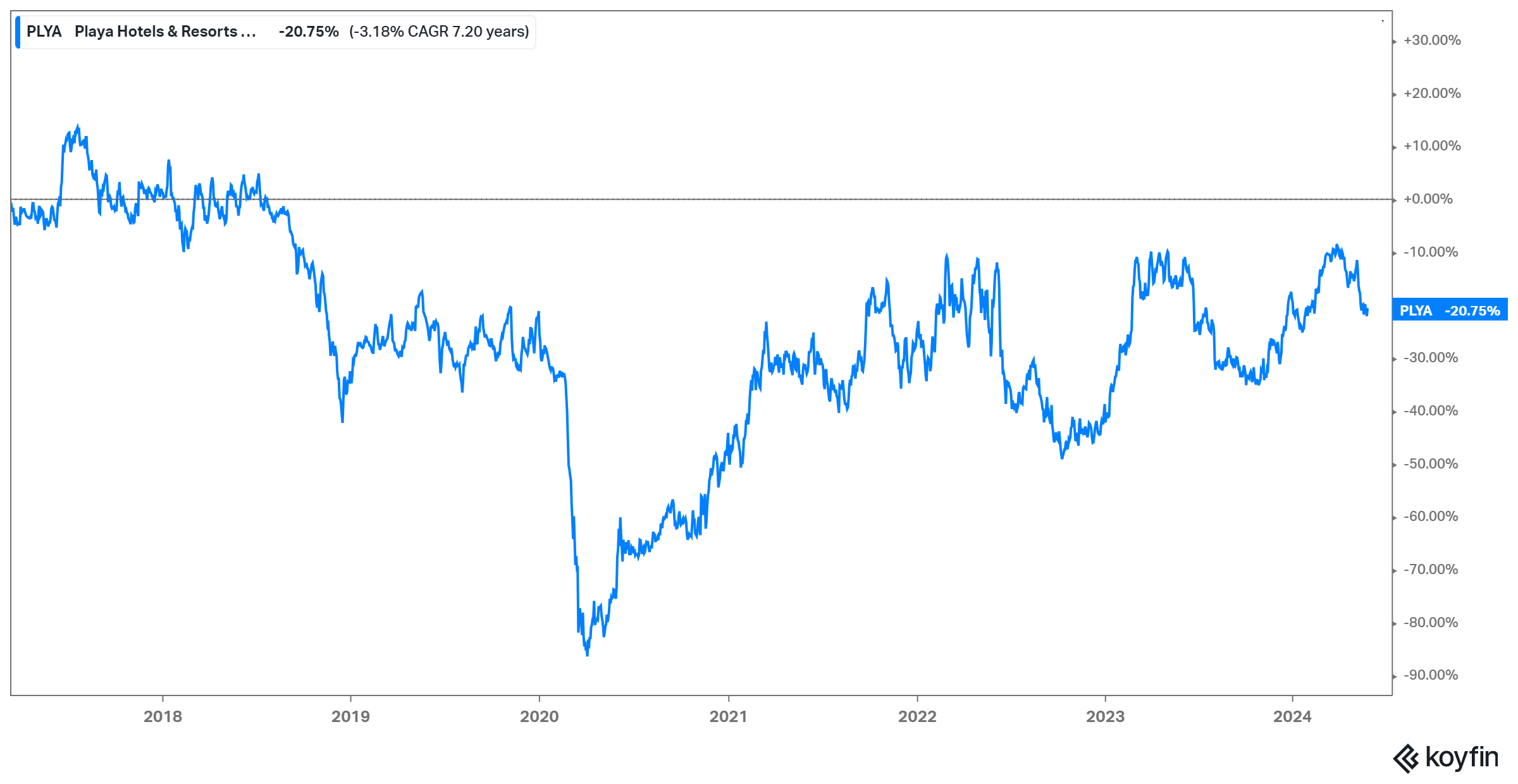
What’s interesting about PLYA at the moment is that there’s likely some debate as to whether that strategy has worked. Certainly, the stock price would suggest otherwise:
source: Koyfin
But for the most part, Playa has done what it set out to do. Profitability has improved nicely, and the company has roughly doubled its resort count since it went public in March 2017. Right now, the stock is getting little credit for that performance and there’s an argument that the market is missing the broader, attractive, story here.
source: Playa Resorts
Introducing Playa Resorts
Playa was founded by hotel industry veterans in 2006 thanks to a roughly half-billion dollar private equity raise. In 2013, the company recapitalized itself through a transformative agreement with Hyatt Hotels H 0.00%↑. Hyatt invested $325 million in Playa, taking a 20% stake in common equity and preferred shares as well.
This was a legitimately important deal: Hyatt itself trumpeted the agreement as its entry into the all-inclusive space. Playa at the time operated 13 resorts, and five were re-branded to Hyatt over the next couple of years. In September 2016, Playa filed for an initial public offering, but it instead executed a SPAC (special purpose acquisition company) merger with Pace Holdings, backed by private equity giant TPG TPG 0.00%↑.
Since the IPO, Playa has expanded. A major acquisition in 2018 brought on five resorts in Jamaica, and the company has built out a small but growing third-party management business as well. Now, Playa operates 24 all-inclusive resorts in Mexico, the Dominican Republic, and Jamaica. One-third of its rooms are in the Cancún market; 13% on Mexico’s Pacific Coast; 37% in the Dominican Republic; and 17% in Jamaica.
Hyatt remains the key brand, with just shy of one-third of rooms, but Playa has expanded its reach via strategic alliances with both Hilton Hotels HLT 0.00%↑ (20% of rooms) and Wyndham Hotels & Resorts WH 0.00%↑ (16%). The agreement with Wyndham moved the company into the mid-range market, while the Hyatt brands play at the top of the market. Overall average daily rate in 2023 was $430, with occupancy at 72%, though both figures will improve this year. Last year’s performance was pressured by results at a pair of properties in the Dominican Republic; one of those properties has been sold, and the other is on the market.
Unsurprisingly, the American traveler is key. Playa said when it went public that a little over half of guests were from the U.S. The company does not appear to have updated that figure, but commentary since suggests the proportion has increased. Of late, the company has seen pressured visitation from markets like Asia and Canada.
PLYA Gets Historically Cheap
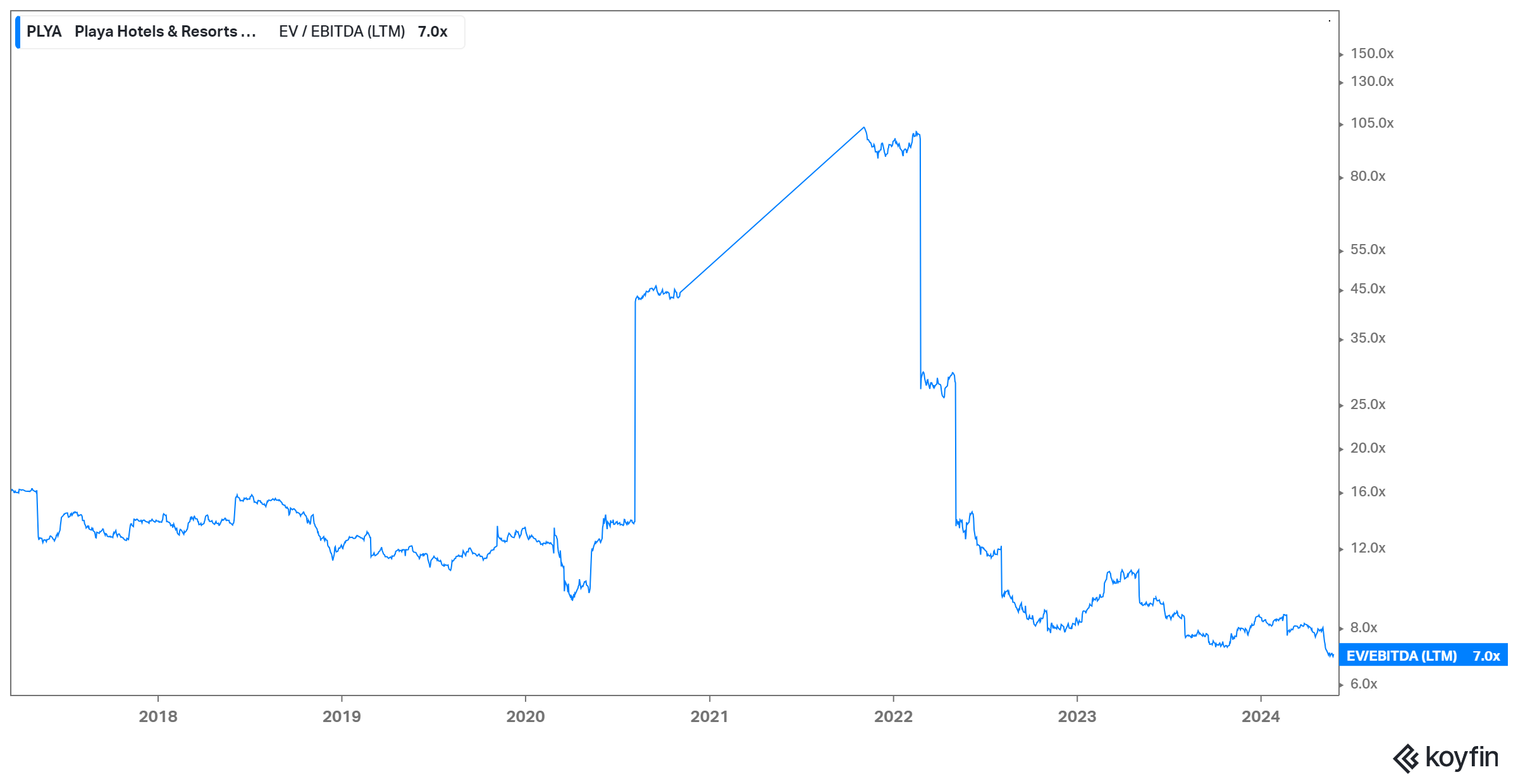
On an EV/EBITDA basis, PLYA is as cheap as it’s ever been:
source: Koyfin
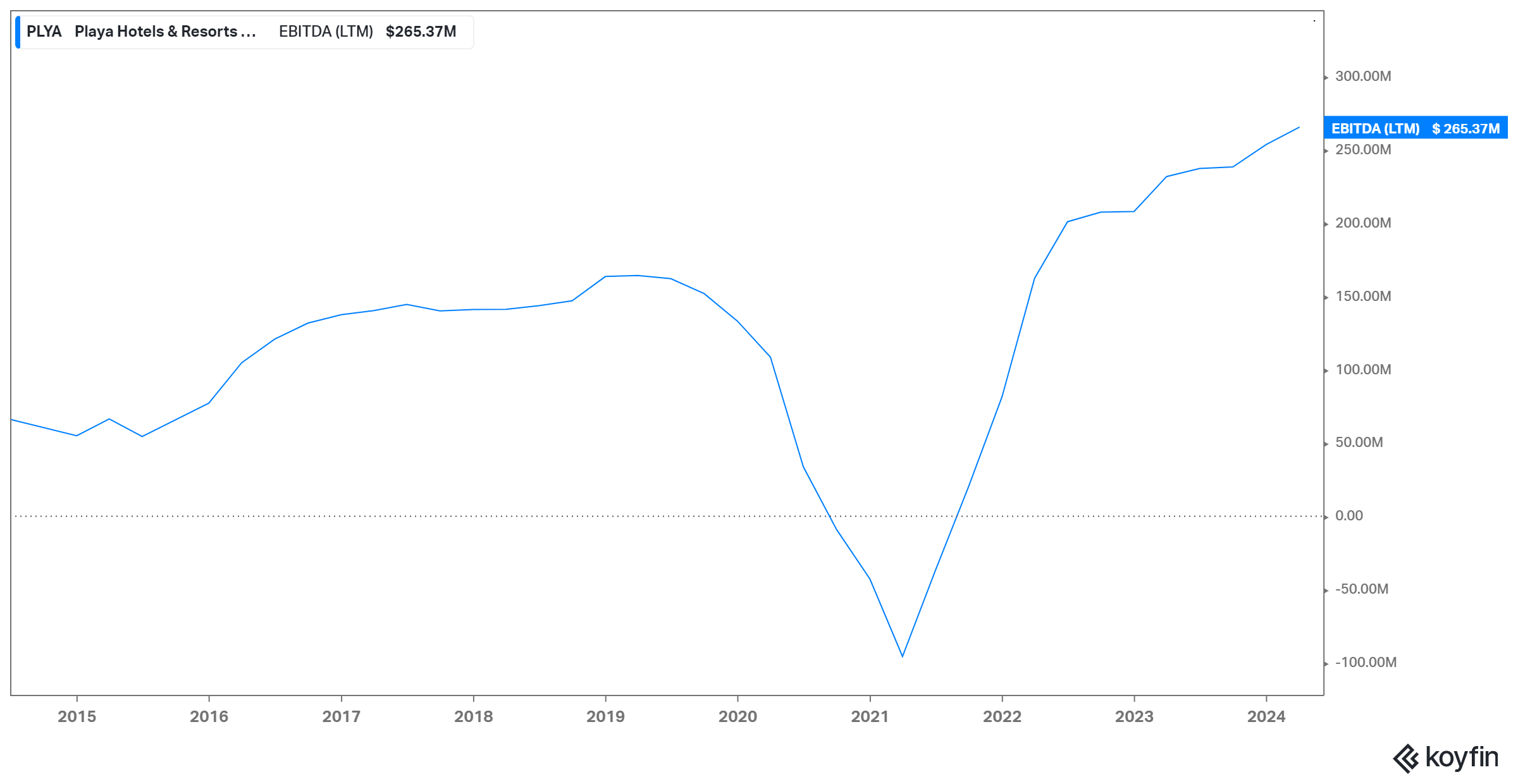
And at this point, fundamentally there are a lot of ways to see real upside here. On a relative valuation basis, PLYA is pretty much the cheapest stock in the space, at 7.2x EV/EBITDA. That’s a modest discount to Global Business Travel Group GBTG 0.00%↑ (the former travel business of American Express AXP 0.00%↑) , which is still navigating a shaky recovery in business travel: its guidance for 2024 Adjusted EBITDA is still below the 2019 print. Meanwhile, Playa has grown its profits nicely over the same timeframe:
source: Koyfin
Of course, rising profit in a business with a clear mid-term tailwind — pent-up travel demand following the novel coronavirus pandemic — isn’t necessarily a surprise. And skeptics would argue that means PLYA’s multiple should be the lowest it’s ever been. Given external conditions, the company is likely at peak earnings. Indeed, 2024 guidance (reiterated after Q1) projects Adjusted EBITDA of $250-$275 million against $272 million in 2023.
But the same analysis should hold for the rest of the space. Yet, against those names, PLYA is receiving a discount. Timeshare operators are in the high 8x to low 10x range; cruise lines at 9x-10x; and even mid-sized U.S. hotel operators like Wyndham and Choice Hotels CHH 0.00%↑ are at 11x-plus and 12x-plus, respectively. Hyatt paid $2.7 billion for Apple Leisure in 2021; the segment generated $199 million in EBITDA in 2023, a decline from $231 million the year before. Even the 2022 multiple comes in at 11.7x — and Hyatt executives have absolutely crowed about the success of that deal. Notably, Apple’s segment EBITDA margins in 2023 were 13%, less than half those of Playa.
Playa’s discount doesn’t necessarily seem merited, and there’s clear room for that valuation gap to close. Each turn in EV/EBITDA multiple expansion is worth nearly 20% upside to the stock — and on paper, there’s an argument that the multiple should be over 10x instead of barely 7x.
Simply on an absolute basis, the stock looks attractive as well. The midpoint of EBITDA guidance is $262.5 million. Cash interest at current rates is $90 million1. Cash taxes are exceptionally low (less than $8 million total over the past three years), and maintenance capex is $40-$50 million this year. That leaves free cash flow of about $120 million, putting the P/FCF multiple in the 9x range.
Asset-based valuation seems to work as well. Playa is now valued at just under $300,000 per key (ie, per room), and closer to $290K/key when capitalizing the high-margin $8-9 million annual management fee stream2. But before the pandemic, the the company spent more than $300K per room in building its Cap Cana in the Dominican Republic — a market with a lower ADR than other geographies. Apple Leisure in 2019 built a new all-inclusive property in Cancun for almost $400K/key; the company was acquired by Hyatt two years later. Luxury hotels in the U.S. are going for over $800K per key.
Fundamentally, an investor can credibly argue that the stock is worth closer to $14 against Friday’s close of $8.44. That’s a valuation of about $400K/key, which given post-pandemic inflation is likely reasonably close to replacement cost for the assets. $14 would also value the business just shy of 10x EBITDA, which given the multiple for Apple and similar travel stocks, doesn’t seem unreasonable.
A Questionable-Looking Business
But there are reasons to suggest that PLYA isn’t necessarily likely to trade at that on-paper valuation. This is a de-SPAC (admittedly of 2016 vintage, when the trend wasn’t nearly as crowded as in 2020-2021) that still trades below $10 more than seven years after it went public. There does seem to more interest of late in buying ‘busted de-SPACs’, to coin a term, but the multi-year chart alone suggests PLYA is the kind of name that will look cheap and most likely stay that way.
Looking backward, there are some management concerns as well. Before the pandemic, Playa targeted $300 million in EBITDA by 2021. Obviously, the pandemic caused a great deal of disruption, but the company still hasn’t hit that bogey. (The sell-side doesn’t expect it to until 2027 at the earliest.)
On the Q1 conference call back in 2018, chief executive officer (and founder) Bruce Wardinski talked up in detail about the creation of a vacation club that would sell memberships (ranging between five and 40 years in length) in return for discounted pricing. Wardinski targeted selling the memberships to 10%-20% of customers. The idea was barely mentioned again until an analyst asked more than four years later, on the Q4 2022 call; the CEO said it contributed less than $2 million in revenue, and the concept does not appear to have grown since.
Direct selling (through the Playa and partner websites, among other channels) has been a key part of corporate strategy and the investment thesis. Dodging tour wholesalers — whose commissions can be ~30% of the price — would drive significantly higher rates on a net basis. Playa showed early strength there, particularly with help from Hyatt, but the improvements have stalled out in recent years. Not coincidentally, a target of 35% Adjusted EBITDA margins has been missed, with the 2023 figure coming in at 29% (though the stronger Mexican peso, which works against Playa, has been a factor of late, hitting 2023 margins by 260 basis points).
And as a result, EBITDA growth has actually been quite disappointing. At a 2018 conference, chief financial officer Ryan Hymel talked up run-rate EBITDA at the time of about $230 million. The existing portfolio was doing $170 million; Cap Cana would add (“conservatively”, per Hymel) $30 million, and Sagicor another $26 to $30 million. Six years later, the property is on track to drive EBITDA that, at the midpoint of guidance, is 14% higher, an annualized rate of about 2%.
Management might point to higher costs from the pandemic and disruption from travel warnings from the U.S. State Department (targeting Mexico before the pandemic, and Jamaica more recently). But the sell-off since Q1 2024 earnings seems driven by investor response to those constant explanations. Playa is one of those businesses that, at least per management, is perfectly on track except for supposedly one-time issues that keep recurring. This quarter, it was a bookings hit from traveler concerns about Jamaica and an accelerated pace of renovation in Los Cabos, on Mexico’s Pacific Coast, which is likely to hit this year’s profit.
Management does have a tendency to frame renovations as unusual events, when in fact they seem to be (quite literally) the cost of doing business in highly competitive markets. Similarly, Wardinski has criticized the State Department, noting (somewhat correctly) that an April travel advisory for Jamaica was not based on new information and received relatively overblown media coverage. (The fact that State specifically noted that “sexual assaults occur frequently, including at all-inclusive resorts” surely didn’t help Playa’s bookings.)
But the nature of operating in unstable environments is such that news cycles matter to consumer demand. All-inclusive resorts in the Caribbean are going to see occasional bouts of negative press, and likely to need renovations on a relatively consistent cycle. That’s simply part of the business model.
As a result, there’s a ‘feel’ with PLYA that the stock is cheap for legitimate reasons, even if those reasons aren’t blatantly obvious. Indeed, I’ve personally looked at the stock on several occasions going back to before the pandemic, and generally come away intrigued but not compelled.
Barring the huge bounce off pandemic lows (something not unique to PLYA among travel names), that sense has been mostly correct. 1H 2020 aside, this is a stock that simply hasn’t been able to break out. One obvious risk here is that trend will continue.
Is Playa A Good Business?
The interesting questions are whether the sense of Playa being a weaker operator justifies its valuation — and whether that sense is correct at all.
There are some concerns but at the same time there is a lot to like about Playa. Certainly, management seems to think so: the company has poured cash into share repurchases of late. In 2022, Playa bought back $44.6 million in shares. Last year, the figure was $186.9 million. Q1 2024 diluted share count was down a whopping 13% year-over-year.
The pace of repurchases will slow given higher capex this year, but management clearly believes the stock is undervalued and, in recent quarters, has seen its own shares as the investment with the highest possible returns. The buyback also mitigates the fears of capital-destroying “empire-building” that can come in this industry; managers can be incentivized to grow the business, whether that growth is profitable or not.
So there is some focus on shareholder returns, in part because management has a decent amount of skin in the game3. There’s also the fact that, cycle or not, post-pandemic tailwind or not, Playa’s profits have grown, if not quite at the rate investors would hope. And the valuation is such that any further growth going forward, particularly combined with share buybacks, is likely to lead to double-digit annualized returns in the stock.
In other words, this isn’t quite the travel industry sh—co some investors might assume it is (and there were no shortage of those4). Indeed, the very fact that Playa was able to partner with Hilton and Wyndham suggests some real importance within the industry: the company had to renegotiate its agreement with Hyatt to do so, meaning that hotel chain needed Playa as much as Playa needed it.
Meanwhile, Playa was clearly right in seeing the all-inclusive space as an opportunity. All-inclusive has become one of the hottest trends in travel. The extent to which Playa can capitalize on that trend likely will determine where the stock goes from here.
All-Inclusive Gets Hot
On Playa’s very first earnings call, in March 2017, Wardinski estimated that only 2%-3% of Americans had taken an all-inclusive vacation. “If we can get that number up to 4% to 6%,” he said, “it will be an absolute grand slam for Playa and for the all-inclusive business in Mexico and the Caribbean”.
Playa hasn’t updated that estimate, but it seems likely that Wardinski’s target has been hit. All-inclusive has become a huge priority for the major chains. Hyatt’s purchase of Apple Leisure underscored a strategy that now encompasses ten brands. That chain has worked, as has Playa, to transform the image of all-inclusive and take it further upscale. Marriott MAR 0.00%↑ moved into all-inclusive in 2019, and has clearly made the category a priority. Hilton, with Playa and without, too has grown its all-inclusive portfolio.
These moves seem like potential negatives for Playa, as competition in the all-inclusive space clearly is heating up. But it’s also worth noting that the aggressive efforts of the majors to expand all-inclusive is clearly good for the space as a whole — a space which, again, has been largely niche and somewhat poorly regarded. When Playa went public, its competitors were all smaller private companies (think Sandals and Club Med) that almost solely marketed their resorts based on price and value. Hyatt and Hilton, in particular, are changing the reputation of the space to simply being a better overall experience, and indeed often a luxury experience.
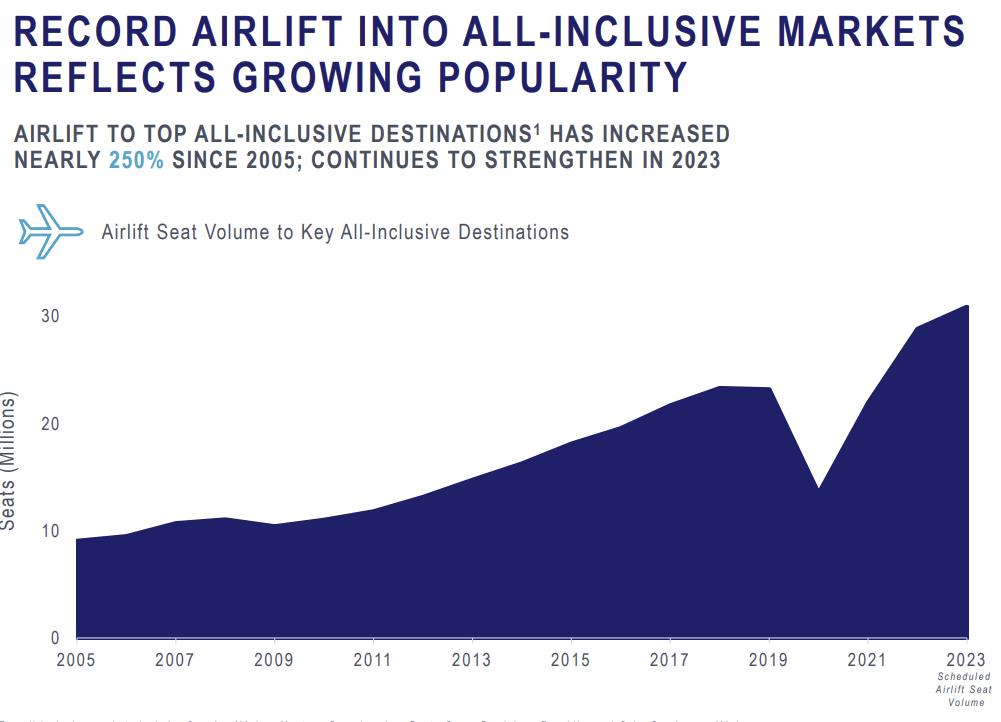
And as a partner to those chains, Playa has a clear opportunity to benefit from that shift in perception. That alone has the potential to offset cyclical pressure when it eventually arrives. It’s also worth noting that the space actually made it through the financial crisis relatively unscathed. Playa’s SPAC presentation noted outperformance in 2009 (Property Adjusted EBITDA fell just 10%), and Hyatt pointed out last year that air traffic into all-inclusive markets held up as well:
source: Hyatt Investor Day presentation
It’s here where the opportunity in PLYA gets interesting. The stock is trading at its lowest multiple ever because investors are concerned about what’s coming. They see an end to the post-pandemic boom in travel, and (at some point) pressure on the consumer from a downward macroeconomic turn.
But there’s quite another way to view PLYA: as a potential winner of a secular trend toward all-inclusive. That trend promises better-than-expected results going forward and resilience against the cycle (augmented by the fact that the U.S. consumer, in particular, is showing no signs of slowing travel spend).
It might also make Playa a logical acquisition target at some point, particularly given the per-key valuation assigned the assets. The agreement with Hyatt does appear to restrict Hilton and Wyndham from buying the company5, but given cash flow private equity could make some sense, as could a strategic that wants to follow Hyatt into the space. There are options if Playa wants to try and catalyze the value of its assets and cash flow, and it’s worth noting that Wardinski is now 64 years old.
Whatever the scenario that plays out, Playa needs to execute. But, again, this is a better business than investors might perceive, and there is clearly a big opportunity for Playa to capitalize on a trend that promises a massive tailwind. This does seem like a case where investors are simply too pessimistic, and it doesn’t take that much of a sentiment change for PLYA to finally have its long-awaited breakout.
As of this writing, Vince Martin has no positions in any securities mentioned.
Disclaimer: The information in this newsletter is not and should not be construed as investment advice. Overlooked Alpha is for information, entertainment purposes only. Contributors are not registered financial advisors and do not purport to tell or recommend which securities customers should buy or sell for themselves. We strive to provide accurate analysis but mistakes and errors do occur. No warranty is made to the accuracy, completeness or correctness of the information provided. The information in the publication may become outdated and there is no obligation to update any such information. Past performance is not a guide to future performance, future returns are not guaranteed, and a loss of original capital may occur. Contributors may hold or acquire securities covered in this publication, and may purchase or sell such securities at any time, including security positions that are inconsistent or contrary to positions mentioned in this publication, all without prior notice to any of the subscribers to this publication. Investors should make their own decisions regarding the prospects of any company discussed herein based on such investors’ own review of publicly available information and should not rely on the information contained herein.
Playa has a term loan balance of just over $1 billion, with interest at SOFR plus 3.25%.
Market cap at Friday’s close of $8.44 is $1.165 billion; net debt is $775 million for an enterprise value of $1.94 billion. The company owns 6,504 rooms, putting EV/key at $298,000; call the management fee stream $80 million (10x revenue and probably mid-teen EBITDA) and EV/key is $286K.
Wardinski owns 3.7% of the company, a stake valued at about $44 million. Karl Peterson, who led the Pace Holdings SPAC, still owns 1.8% of shares, worth $22 million. Sagicor and HG Vora lead a group of active institutional investors as well.
Vacasa VCSA 0.00%↑, Sonder SOND 0.00%↑, Selina Hospitality SLNA 0.00%↑ and Inspirato ISPO 0.00%↑ are all down at least 97% from their $10 merger price. Online travel agency Mondee Holdings MOND 0.00%↑ is only off 77%.
Per the 10-K, a chain of more than 12 all-inclusive resorts cannot own more than 15% of the company. A “Restricted Brand Company”, whose definition is not specified, cannot own more than 5%.