
Highlights:
This brand has undergone multiple ownership changes over the years — in an attempt to find growth.
Shares have dropped 21% over the past five years. Competitive challenges and a leveraged balance sheet suggest the decline should accelerate.
The history of the consumer space is clear: brands like these don’t have the power they use to.
This isn’t the sexiest short in the market, but there are catalysts for big returns.
The bull/bear debate over Energizer Holdings ENR 0.00%↑ is pretty common in the consumer sector. Bears point to low growth, a leveraged balance sheet, and a dated brand. Bulls highlight a conservative valuation, an attractive dividend, and the potential for operational improvements that can jumpstart growth.
In most of these debates, the bears have won. Packaged food is the most obvious category, where the likes of Campbell Soup CPB 0.00%↑ and Kraft Heinz KHC 0.00%↑have tried pretty much everything to avoid decline. Energizer’s former parent, Edgewell Personal Care EPC 0.00%↑, is down big. Newell Brands NWL 0.00%↑, the market of Rubbermaid, has seen its stock collapse; Tupperware TUP 0.00%↑ continues to skirt bankruptcy.
Shorting these names hasn’t necessarily been sexy, but it’s usually been a good funding short and occasionally a way to make huge returns.
source: Energizer
How Energizer Got Here
In 1898, Conrad Hubert invented the handheld flashlight (though he called it the “Electric Hand Torch”). Seven years later, Hubert incorporated the American Ever Ready Company. When the business was acquired in 1914, the product name was shortened to Eveready. From 1917, Everready was part of chemical giant Union Carbide (now part of Dow DOW 0.00%↑).
In 1955, the company introduced batteries for hearing aids. The first 9-volt battery followed the next year, and in 1959 Everready revolutionized the world, with the launch of the first cylindrical alkaline battery.
In 1986, in a classic bit of M&A, it was sold to conglomerate Ralston Purina (now part of Nestle). By that point, the Everready brand remained, but a new brand launched in 1980: Energizer. Nine years later, an ad campaign featuring a battery-powered bunny made the brand a household name in the U.S. By the mid-1990s, Energizer and rival Duracell dominated the market, with 36% and 48% share, respectively.
In 2000, Ralston Purina spun off Energizer into a separate company, Energizer Holdings. Holdings made a few acquisitions during the 2000s to diversify, most notably acquiring the maker of Schick razors in 2003, and Playtex Products four years later. In 2015, Energizer Holdings decided to split; the battery business again was spun, while keeping the name. The legacy business was renamed Edgewell Personal Care EPC 0.00%↑.
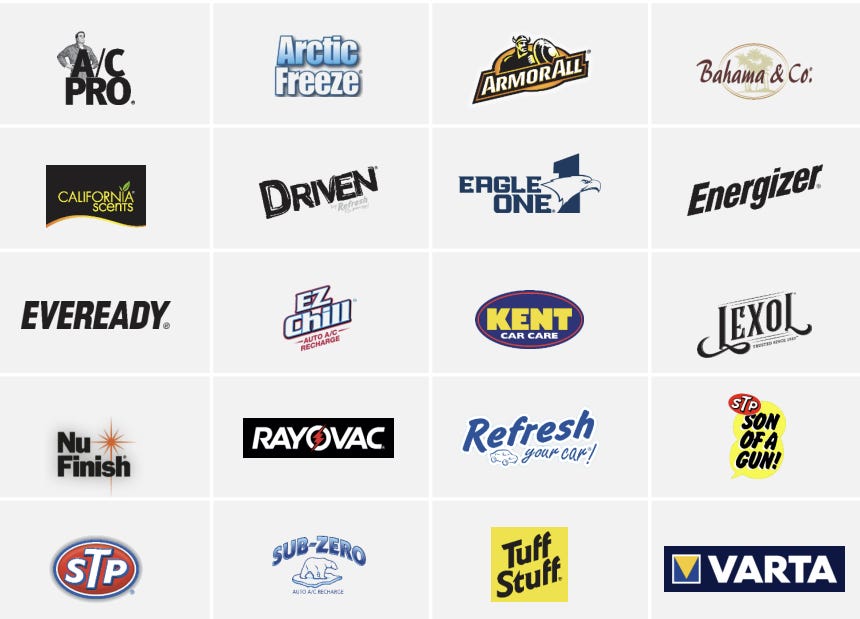
The ‘new’ Energizer looked to diversify. In 2016, the company bought automotive fragrance manufacturer HandStands for $340 million1. In 2019, Energizer made a pair of deals with Spectrum Brands SPB 0.00%↑, first buying its battery business (including Rayovac, the #3 player in the market) and then Spectrum’s Global Auto Care brand for a combined price north of $3 billion.
The result of those acquisitions was a consumer products company with an expanded brand portfolio:
source: Energizer Holdings Investor Day presentation, November 2019
But it’s still a company heavily reliant on the battery business. In fiscal 2023 (ending September), the Batteries & Lights segment accounted for 79% of total revenue and 88% of segment profit.
The Battery Business Isn’t Great
That fact is a problem in the context of Energizer’s history. Because it highlights a key part of the short thesis: for about 25 years now, no one has really wanted this business. Ralston spun Energizer because the battery business already was struggling, and management wanted to focus on Ralston’s more attractive pet food business. As soon as the first Energizer Holdings was up on its feet, it looked to diversify through a pair of pretty significant deals. (Schick cost $930 million and Playtex, including debt, $1.9 billion. Energizer’s market cap at the end of FY03, six months after the Schick deal closed, was $3 billion.)
That business decided to split, with ‘old’ Energizer management saying that Edgewell would provide investors with growth, while the battery business would create cash flow.2 And that business, too, spent billions to diversify away from the battery business. A big chunk of those billions went to Spectrum, which too was trying to get out of the battery business.
An optimist might argue that scale is a good thing, and that combining Energizer and Rayovac made sense. A cynic might add that the post-Ralston issue is not necessarily a desire by executives to get out of the battery business, but a desire by executives to get into the empire-building business.
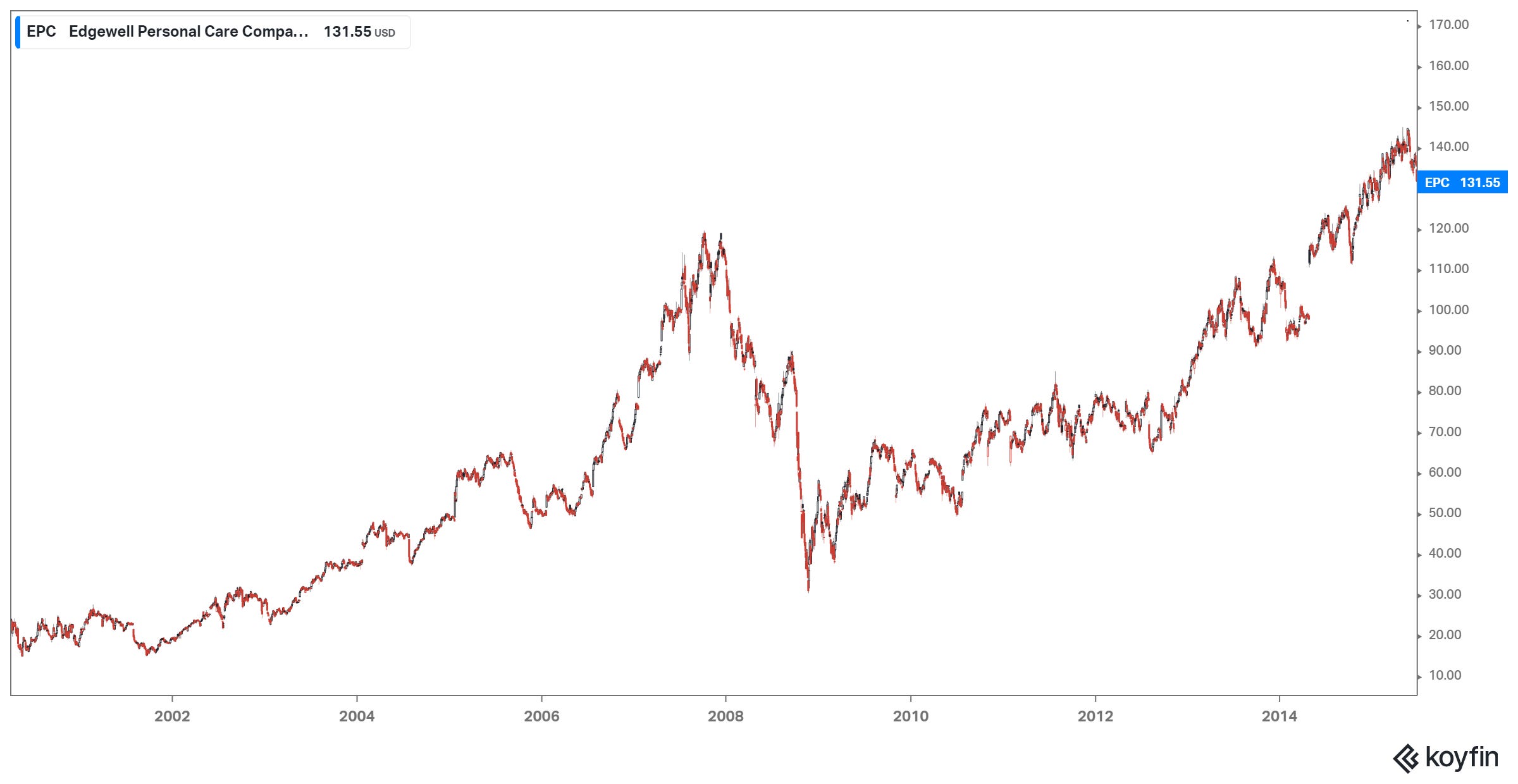
But the fact is that the battery business simply isn’t all that attractive. It sounds decent enough: the product is absolutely essential for many expensive products to work, and for Energizer competition is limited to basically one major rival. And it’s worth noting that, between the Ralston spin and the Edgewell spin, this actually was quite a good business:
source: Koyfin
A lot of the value creation here seems to have come from personal care. While ENR rose more than 500%, the battery business saw operating profit only double between 2000 and 20143 (only a ~5% annualized growth rate). Still, Energizer was a valuable brand during that period, and quite obviously the ‘old’ ENR crushed the market.
Other than that, the modern battery business hasn’t been one worth owning. Gillette paid $7 billion for Duracell in 1996. In 2014, P&G (which had acquired Gillette) sold the brand to Berkshire Hathaway for less than $3 billion net. Under Berkshire’s ownership, Duracell has struggled: per 10-K filings, its market share has dropped to 29% from 36%, and revenue has grown at a low-single-digit annualized rate. Duracell’s earnings plunged 31% in 20224.
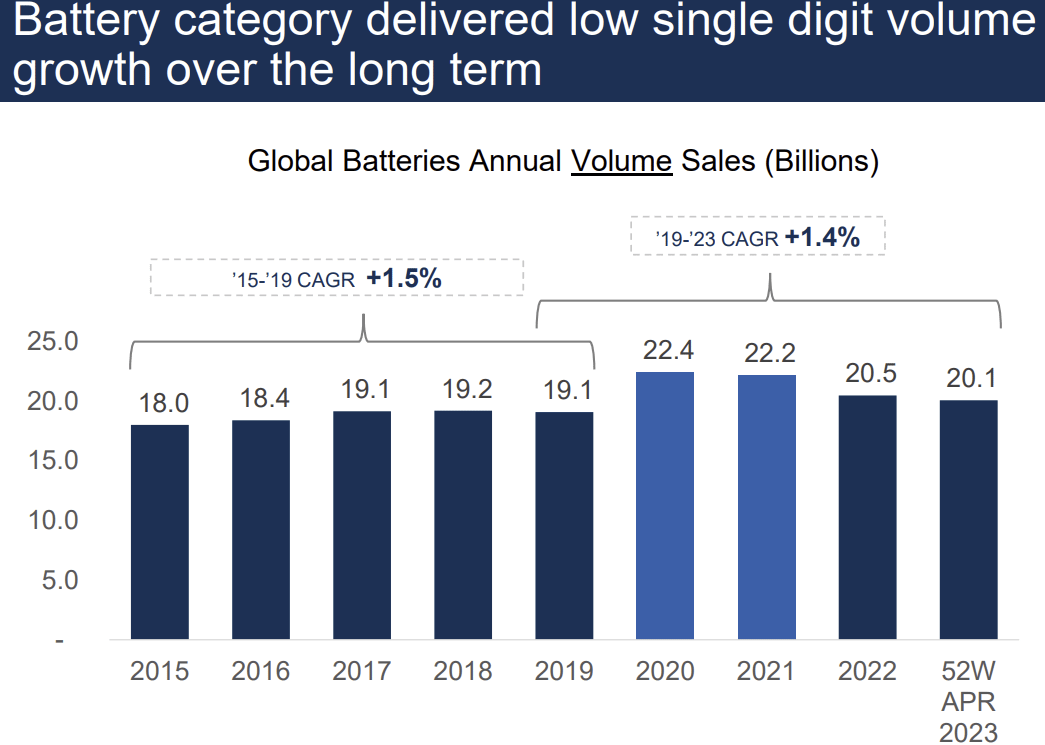
The core issue is that battery demand is quite stagnant, as even Energizer itself admits:
source: Energizer Holdings Q4 FY23 presentation
The weakness isn’t a surprise. The rise of smartphones has made obsolete some of the products once powered by batteries. Going back to the 2000’s, for instance, industry executives were talking up digital cameras as a source of long-term volume growth.
Energizer Struggles, And Responds
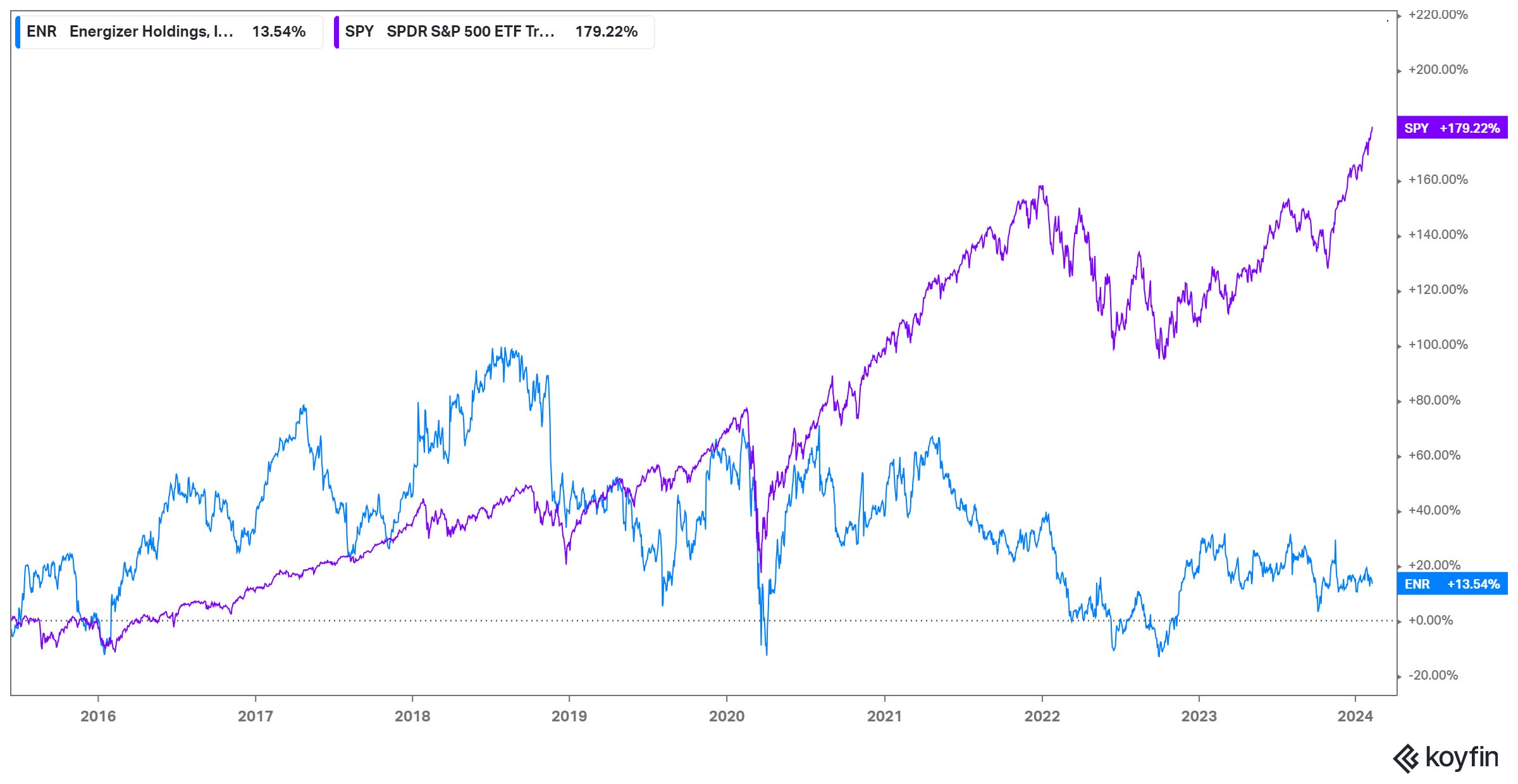
Meanwhile, the new Energizer Holdings has been a disappointment:
source: Koyfin
When Energizer announced the second deal with Spectrum Brands in November 2018, the company said pro forma adjusted EBITDA was $670 million. Current guidance for FY24 is $600 to $620 million. At the company’s Investor Day the following year, Energizer targeted over $700 million in Adjusted EBITDA by fiscal 2022, with net leverage down to 3.3x-3.5x at year-end. That ratio still is past 5x at the moment.
In response, Energizer in late 2022 announced Project Momentum, an aggressive restructuring effort. The company claimed savings of $55 million last year, is guiding for $55-$65M this year, and now sees an incremental $50-$60M in FY25. Those efforts have boosted margins, and on the Q1 call this week Energizer guided for a top-line improvement in the back half of the year. Like so many consumer companies, Energizer took pricing increases multiple times during 2021 and 2022, and management believes the ‘new normal’ will allow volumes to return after they fell 7%-plus in FY23.
Valuation remains quite conservative, with ENR (based on guidance) trading at less than 10x adjusted earnings per share and under 9x on an EV/EBITDA basis. Project Momentum savings add another 8-10% of EBITDA in fiscal 2025, and almost 20% in adjusted EPS. Management plans to rebuild profitability in auto care as well, where inflation has led margins to drop from 15% in FY21 to just 12% in FY23. That business isn’t large enough to drive growth on its own, but further margin recapture can augment the gains from cost-cutting.
What Happens When This Gets Worse?
But there’s a reason why we opened with a discussion about broader trends in the consumer space. All of the companies that have struggled (and a few that don’t even exist anymore) argued that they would find a way around low industry growth and leverage, quite often with cost-cutting5. It doesn’t usually work. And in the case of Energizer, Project Momentum only highlights how weak underlying bottom-line growth has been: FY24 results will include $100 million-plus in savings, and yet EBITDA will still be $50 million-plus lower than the pro forma figure from five years earlier.
There is an important distinction between Energizer and those other stories, however. For Energizer, the real pressures on the business haven’t really begun yet. For old-line food brands, categories like cereal, canned soup, and yogurt went into decline at the same time younger, smaller competitors popped up.
In batteries, however, the market hasn’t been that brutal. In fact, overall, it’s been reasonably good. Duracell has donated share, much of which Energizer has taken. The pandemic provided a solid boost to demand (both companies showed much-improved revenue growth). And commentary across the space is that competition remains relatively muted.
At a conference in early 2021, Truist analyst Bill Chappell opened a question at an early 2021 conference by noting that private label market share hadn’t moved for a decade, despite the rise of Amazon AMZN 0.00%↑ and other retailers.
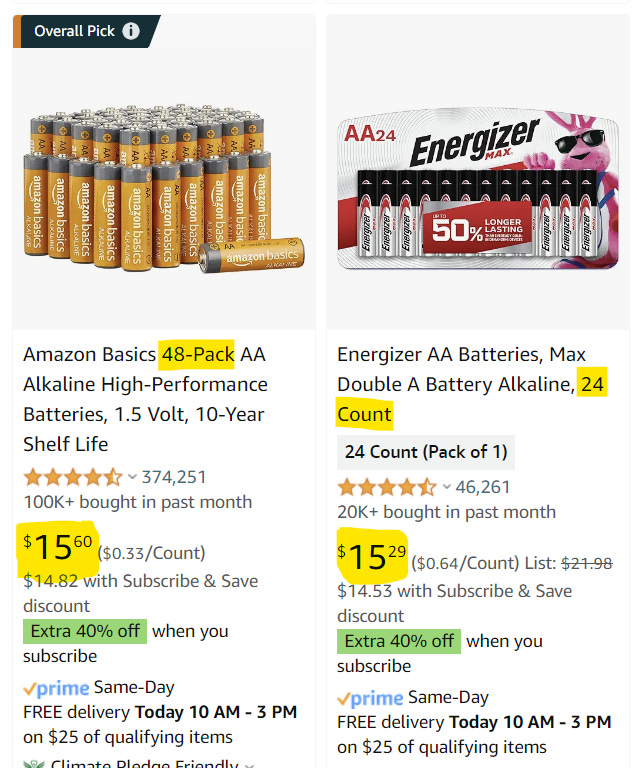
In essence, Duracell and Energizer have been able to advertise often enough and effectively enough to convince consumers that battery brands are not interchangeable. And yet Energizer hasn’t been able to drive any profit growth even in a relative positive environment.
At a certain point, that will change: consumers will come to believe that the brands are interchangeable, or at least that the premium paid for Energizer products simply is too high. In an environment of suddenly normalized inflation, it’s hard not to wonder whether that point is arriving:
source: Amazon (with author highlighting)
Given that the market is growing 1% a year, even minimal share loss can tip a branded player with ~30% share into top-line declines.
The headline numbers from Energizer provide some evidence that the premium side of the market is finally starting to crack. In FY23, volumes declined 7.5%. Admittedly, there’s probably some noise in that figure (and perhaps some post-pandemic normalization), and Energizer blamed a similarly weak Q1 (volume -7%) on the timing of orders around the Christmas holidays. So it’s not guaranteed that volumes have peaked for Energizer.
But it’s certainly possible that management is misreading the situation, and a ‘new normal’ of pricing means that peak volume has arrived, or will arrive soon.
And when a 5x leveraged business sees its volumes start to decline, the stock is done. Energizer won’t have enough pricing power to maintain revenue growth and margins, which means the EBITDA multiple compresses, which means, thanks to leverage, that the stock falls, and in the most bearish scenario absolutely collapses.
The Refinancing Headwind
To be sure, that outcome isn’t guaranteed. Duracell and Energizer historically have kept share, and Energizer has used Rayovac to ward off purely price-based competition from private label rivals.
But even without negative volumes, and even acknowledging Project Momentum, there are clear headwinds here. One comes from the balance sheet:

source: ENR 10-Q, Q1 FY24
Energizer has about $3 billion worth of debt with below-market interest. Its existing dollar bonds are yielding about 6.5%, and even the term loan is covered (mostly) by a $700 million interest rate swap which starts stepping down at the end of this year and terminates in 2027. The impact of refinancing that debt is probably an incremental $50 million in annual interest (the weighted rate on that debt is ~4.5%) even assuming continued paydown over the next couple of years.
In other words, any further cost-cutting benefits are getting negated once the debt gets refinanced. And so Energizer is going to have to grow profits on its own. For years now, it hasn’t been able to do that.
A Funding Short (And Maybe More)
Given secular pressure on battery ownership, the likelihood of incremental share gains for private label and lower-cost rivals, and even the fact that batteries last longer (per Energizer’s own advertising!), there’s not much reason to expect the next five years will be all that different than the last five.
An inability to grow in FY25, in particular suggests more compression as the consensus view moves toward “this is a leveraged business in real trouble”. All else equal, just one turn of EBITDA multiple compression drops the stock about 27%; even giving credit for debt reduction, that’s still 15-20% downside from Friday’s close.
But there are also potential catalysts that can drive the stock down big (bear in mind that equity value is barely 40% of enterprise value at this point). If volume and revenues fail to recover in the second half of FY24, the multiple compresses and guidance gets missed, that’s a 30%-plus decline. There’s the possibility that Duracell, whose market share per Berkshire filings has gone from 36% to 29% in six years, decides to get aggressive with price and/or promotions, leaving Energizer no choice but to answer at the cost to its own margins.
All of this more broadly ties back to our opening point: for a business in Energizer’s current position, it’s usually too hard to do anything but survive. Without volume growth, there’s really no operating leverage. Costs have to be cut to fix the balance sheet, but it’s quite easy for those cuts to go too far.
These businesses usually have the brand power to hang in for a while. But whether or not Energizer’s volume has peaked, it’s almost certain that Energizer’s business has peaked. Add in 5x leverage and the history of consumer brands and there should be more downside ahead.
As of this writing, Vince Martin has no positions in any securities mentioned.
Disclaimer: The information in this newsletter is not and should not be construed as investment advice. Overlooked Alpha is for information, entertainment purposes only. Contributors are not registered financial advisors and do not purport to tell or recommend which securities customers should buy or sell for themselves. We strive to provide accurate analysis but mistakes and errors do occur. No warranty is made to the accuracy, completeness or correctness of the information provided. The information in the publication may become outdated and there is no obligation to update any such information. Past performance is not a guide to future performance, future returns are not guaranteed, and a loss of original capital may occur. Contributors may hold or acquire securities covered in this publication, and may purchase or sell such securities at any time, including security positions that are inconsistent or contrary to positions mentioned in this publication, all without prior notice to any of the subscribers to this publication. Investors should make their own decisions regarding the prospects of any company discussed herein based on such investors’ own review of publicly available information and should not rely on the information contained herein.
No, that is not a typo: $340 million.
This is a pretty common corporate-speak way of saying “we’re splitting up because investors like the faster-growing business more”. The recent Kellogg split, which sent the cereals business away as WK Kellogg KLG 0.00%↑, is a good example.
Assigning corporate expense in FY2014 to each segment based on their respective profits.
Berkshire has not yet released its 10-K for 2023.
Acquisitions of course are another common strategy, but Energizer a) already has tried that and b) doesn’t have the balance sheet to make a transformative deal any time soon.