
⚡ Highlights
Allbirds stock has been a disaster since its 2021 initial public offering.
An aggressive expansion plan simply hasn’t worked — and leaves the company’s back against the proverbial wall.
But if Allbirds reverses course, there’s the possibility of salvaging value here.
Meanwhile, an analogous situation from the past suggests an unlikely but extraordinarily profitable outcome.
Two weeks ago in this space we wrote a piece titled (not entirely accurately) “Too-Big Tech”. At the time, we promised a follow-up article looking at stocks that could succeed not just from pulling back on growth plans, but actually shrinking. Then SVB happened and we took a long look at regional banking software play Q2 Holdings.
We planned to return to our previous theme then came across footwear maker Allbirds BIRD 0.00%↑ and found a story interesting enough for its own post.
How Allbirds Got To $1
For Allbirds, there is a real business of some kind. Founded in 2015, Allbirds were “Silicon Valley’s favorite sneaker,” as the Wall Street Journal termed it by November 2020. The company has expanded into some 30 countries and generated just shy of $300 million in sales in 2022.
The sneakers are well-made and well-reviewed:
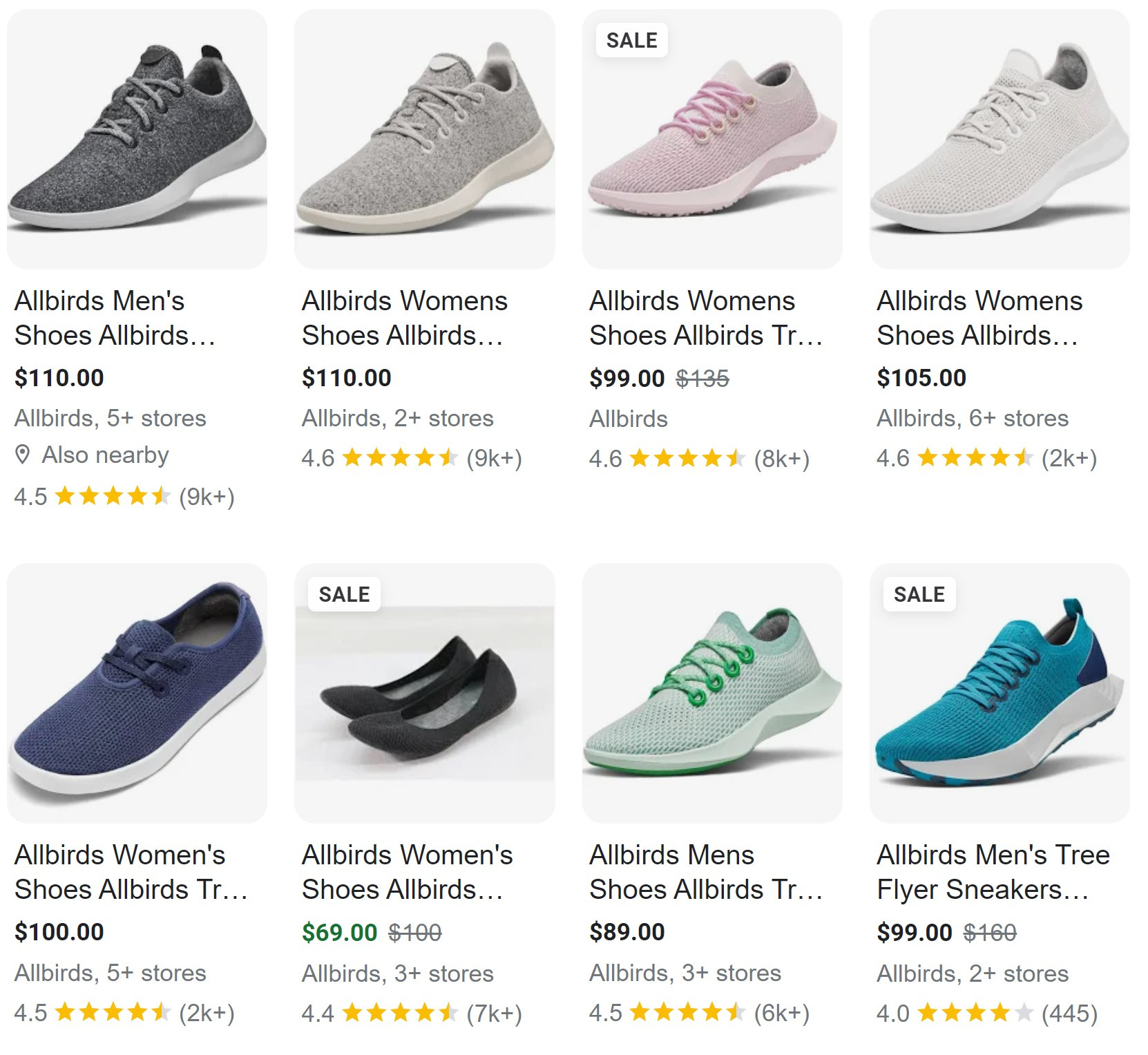
source: Google
Yet even by the standards of an overpriced batch of 2021 initial public offerings, BIRD has been a dud:
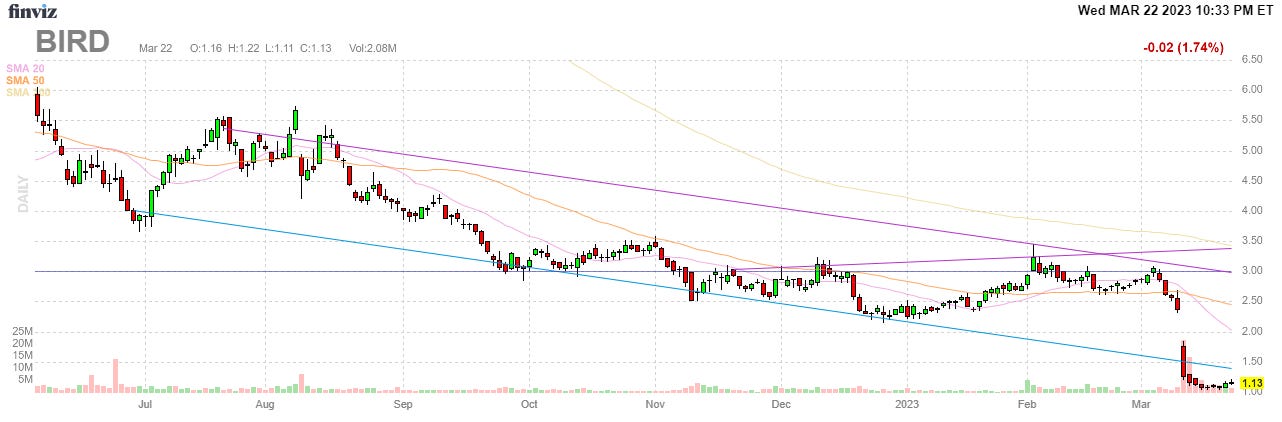
source: finviz.com
To be sure, changing trends have played a role. Barely two years after naming Allbirds the choice of tech bros in the Valley, another article in the WSJ reported that "the tech bros moved on”.
But trends change in fashion, and successful companies in the space adapt to those changes. Allbirds to some degree itself has done the same: in the 2022 WSJ piece, Allbirds noted that its two biggest markets now are London and New York. And through the first nine months of 2022, revenue still increased 18.5% year-over-year.
The bigger problem is that Allbirds flew too fast (sorry) trying to be as big as possible.
Allbirds Grows Too Fast
In 2019, Allbirds revenue was $126 million, with 90% of the total generated through the online direct-to-consumer business. That year, Adjusted EBITDA was a loss of just $1.3 million, a figure which excluded $4.3M in stock-based comp.
By 2022, sales had more than doubled, to just shy of $300 million. But Allbirds paid up big-time for the growth: Adjusted EBITDA in 2022 was a loss of $60.4 million. The building out of a retail footprint (Allbirds had three locations at the end of 2018, and 58 four years later) is the clear issue here. SG&A was 32.8% of revenue in 2019 — and 56.0% in 2022.
There are other factors at play, certainly. Gross margin plunged in 2022 to 43.5%; the figure had been in the low 50s from 2018 to 2021. The compression is all the more disappointing given that the higher proportion of in-store sales should boost the figure. Overall, in three years, Allbirds’ sales increased $172 million, and its Adjusted EBITDA loss increased $59 million (plus another ~$16 million in incremental stock-based comp). The company’s strategy has clearly played a major role in that widening loss, and yet it’s impossible to argue the company is in a better position than it was three years ago.
Again, trends have changed, and 2022 was a difficult year for pretty much every apparel/footwear company after consumers stocked up during 2020 and 2021. But the problem here is not just the results (including a disastrous Q4 in which sales declined 13%), but the fact that Allbirds may well have backed itself into a corner.
At the end of 2022, Allbirds had cash on the balance sheet of $167 million. (Bear in mind that the company’s market cap at Wednesday’s close was $166 million. Net current assets are $163 million; BIRD actually is this close to being a net/net.) But last year the company burned $122 million. Even with planned cost savings going forward, Allbirds probably has maybe two years’ of cash left on its current path. It may be worse than that: Q1 guidance suggests Adjusted EBITDA loss will more than double from the $12.2 million print in Q1 2022.

Will Allbirds Find The Right Answer?
The answer would seem to be: get back to the 2018/2019 model. The incremental sales from brick-and-mortar expansion, in particular, are not worth generating. A smaller footprint means sharply lower losses, which in turn means the company is not going bankrupt. From that point, options open up.
The most obvious option is to simply call up Deckers Outdoor DECK 0.00%↑. Even assuming a disastrous 2023, Allbirds can probably still generate gross profit in the range of $100 million1. DECK trades at ~5.5x trailing twelve-month gross profit.
A 3x to 4x multiple for BIRD almost certainly is accretive for Deckers. It's worth noting as well that Deckers' chief executive officer actually joined the company as the head of DTC in August 2012; by October, Deckers stock had plunged ~75% in twelve months in part due to a widespread belief that Ugg was simply a fad. DECK is up more than 1,500% from those lows.
Deckers could run a similar playbook on Allbirds, which would also benefit from existing distribution, scale, etc. A $300 million equity valuation looks like a good deal for Deckers, and assuming cash burn to that point (call it $100M in remaining cash) probably suggests BIRD could easily sell itself for something close to $400 million, or $2.50/share (fully diluted), well more than double the current price. A decent negotiation might be able to move that figure higher (6x what might be trough gross profit could still be a fruitful deal for Deckers, and now Allbirds is looking at $5/share).
There are a couple of problems here, however. The first is management’s willingness both to shrink aggressively and to consider a sale. It’s indeed solely up to management: co-founders and co-CEOs2 Joseph Zwillinger and Timothy Brown combined control ~42% of the voting power, with Series A investor Maveron holding another 26%.
Management strategy is always an issue in catalyzing value, of course. We discussed this at length in our piece on sum of the parts cases two months ago. One piece of good news for BIRD is that management at least is aware there is a significant problem. After Q2, the company announced a series of “simplification initiatives”, which from a financial perspective mostly involve cost savings at the corporate level. Following Q4, “simplification” became the more aggressive “strategic transformation”.
But as with Stitch Fix (which we covered two weeks ago and also posted a disastrous calendar Q4), the response still seems insufficient. One of the pillars is to [emphasis ours] “optimize U.S. stores and slow pace of openings.” There’s still a belief (as with Stitch Fix and so many other companies in similar positions) that “profitable growth” is achievable, despite so much evidence to the contrary to this point3. Allbirds still needs to grow — but maybe not quite as fast, or with such reckless disregard for profits as was accepted before investors regained their sanity the Federal Reserve hiked interest rates.
Here’s how Zwillinger framed the company’s core problem in the prepared remarks of the Q4 call:
we overemphasized products that extended beyond our core DNA…Because we were spending significant time and resources on these new products that did not resonate well, we underinvested in our core consumers' favorite products. Finally, we did not increase our brand awareness to the level that we anticipated.
That may all be true. But it would seem there’s a way to serve the core customer that doesn’t require 58 store locations, and SG&A that’s well past half of sales.
Running Out Of Time
The problem is that it’s not that easy to simply reverse the expansion. Again, management needs to see that as the proper decision, and by then the company’s financial situation may be beyond salvaging. The other issue is that Allbirds has entered into leases for its retail locations, which total $111 million after 2023, including more than $60 million in minimum lease payments beyond 2026.
As the old saying goes, for Allbirds it’s getting late early. Capex is expected to decline in 2023, to $10-$15 million from $31 million in 2022. But right now, weaker EBITDA might well eat up that entire benefit: the better end of Q1 2023 guidance still suggests ~$14 million in incremental losses year-over-year. Inventory should help some, with a build of ~$24 million last year turning into a reduction in 2023 per the Q4 conference call. But that reduction is coming in part from aggressive clearance which will pressure gross margin.
Allbirds said on that call that it expected to be Adjusted EBITDA-positive by 2025. It’s trying to upsize its revolver to $100 million, which would add further liquidity. The company seems intent on transitioning its international business (23% of 2022 sales) to a third-party distributor model. That transition will probably be cash flow neutral, as inventory benefits and lease transfers offset one-time costs, but might help results in 2024 as well as potentially reducing those lease commitments going forward.
Still, it bears repeating: Allbirds burned $122 million in 2022, and has $167 million left (and perhaps in the range of $135 million at the end of Q1). It’s still guiding, if unofficially, for burn in 2024 as well (and maybe 2025, depending on what EBITDA-positive actually means). There’s really no room for error with $90 million-plus in post-2024 operating leases on the books.
If Allbirds is going to do something, it needs to do it fast. Waiting to see how 2023 plays out simply doesn’t work. And it’s worth noting that, at least on the Q4 call, management didn’t have quite that level of urgency. The company is making changes, such as cutting costs, focusing assortments, and changing its go-to-market model overseas.
But more is needed. Zwillinger said in the Q&A that “it continues to be our belief and the Board's belief that the best opportunity is as a public company that's seeking an independent future and that's in the best interest of shareholders.” That might be correct, but decisions in the past threaten the company’s ability to be an independent company in the future.
Can Allbirds Be The New Crocs?
On the other hand…


It's interesting to note that Crocs CROX 0.00%↑ was in pretty much the same exact spot in 2009. From a 2007 high just shy of $75, CROX plunged to below $1 in 2008 and a low of $1.11 in 2009. Since that latter point, the stock has been a 100-bagger.
To be sure, there are a lot of huge winners from March 2009 lows, and the fact that one was in footwear does not mean that BIRD is a buy. But there are some interesting parallels.
From 2007 to 2009, Crocs revenue declined 24%. Like Allbirds, the decline came despite a rapid expansion in store count (from 25 to 182). Like Allbirds, Crocs expanded dramatically beyond its core product: the number of models went from 25 in 2006 to over 230 (!) three years later. In 2006, Crocs even bought a company that manufactured sporting equipment with the same Croslite material used to build classic Crocs (the business was liquidated two years later).
The stories admittedly are not analogous. Even in 2009, Crocs had positive EBITDA, and free cash flow of $41 million.4 CROX was a "busted growth" story, certainly, but even with $170 million in lease commitments at the end of 2009, its financial viability was not in question to anywhere near the same extent. And, to be sure, in terms of the macroeconomic environment, 2022 and 2023 are not 2009.
But considering the impact of pulled-forward demand in 2021, and the shift in consumer demand from products to experiences, there’s some sort of cyclical pressure occurring at the moment. There are clearly improvements to be made to the assortment, and some ability to refine the go-to-market strategy. It’s important to remember that this business is only seven years old. Crocs was seven years old in 2009. That company made its own improvements, growth returned, and Crocs now has an enterprise value above $9 billion.
BIRD Looks Intriguing…But Not Yet
To be clear, we’re not arguing that Allbirds has a path to 10,000% upside. We’re not even arguing that BIRD is a buy right now.
But there is a potentially interesting story here. It’s possible that Allbirds simply is a $25 million business inflated by venture capital money and a “go big ethos”, and that something close to the best-case scenario is the business winding up at that point. Even assuming management figures that out in time, given cash burn, BIRD winds up selling itself for probably less than half the current price.
At the same time, two-thirds of the company is owned by three major shareholders (including the two co-founders and VC firm Maveron). There’s an obvious potential acquirer, and probably a few that aren’t quite so obvious. And there’s a business here that should generate $250 million-plus in sales this year, eight years after its founding.
All told, it’s a story that has some attractive pieces. It’s up to management to put those pieces together.
As of this writing, Vince Martin has no positions in any securities mentioned.
If you enjoyed this post you can help us by clicking the heart ❤️
Disclaimer: The information in this newsletter is not and should not be construed as investment advice. Overlooked Alpha is for information, entertainment purposes only. Contributors are not registered financial advisors and do not purport to tell or recommend which securities customers should buy or sell for themselves. We strive to provide accurate analysis but mistakes and errors do occur. No warranty is made to the accuracy, completeness or correctness of the information provided. The information in the publication may become outdated and there is no obligation to update any such information. Past performance is not a guide to future performance, future returns are not guaranteed, and a loss of original capital may occur. Contributors may hold or acquire securities covered in this publication, and may purchase or sell such securities at any time, including security positions that are inconsistent or contrary to positions mentioned in this publication, all without prior notice to any of the subscribers to this publication. Investors should make their own decisions regarding the prospects of any company discussed herein based on such investors’ own review of publicly available information and should not rely on the information contained herein.
That’s a ballpark figure, assuming a 20%-plus decline in revenue this year (Allbirds is guiding for -20% to -28% in Q1) and gross margins in the low 40s, in line with the 2022 print.
Look, it doesn't take a genius to know that any organization thrives when it has two leaders.
Go ahead, name a country that doesn't have two presidents. A boat that sets sail without two captains. Where would Catholicism be without the popes?
(Oscar Martinez, The Office)
It’s not like 2021 results were that impressive, either. For the year, gross profit dollars increased $34 million. SG&A increased $35.5 million. Given broader tailwinds, that performance seems abysmal.
At the 2009 low, Crocs had an enterprise value of roughly $30 million. It is absolutely insane what valuations looked like early that year. Insane.
Crocs is different though - they optimized to survive but then started killing it when they started doing partnerships and collaboration. They took a first initial fad of a shoe because of how dumb it was and made looking "unorthodox" cool and then made it more cool by the various collaborations it launched.
On the other hand, I like how you're looking at BIRD as a special situation. I could see there being a takeout but I think heavy hitting investors to twist their arm. I think eventually they'll get hit again with broader downturn, do a very dilutive equity raise to keep the strategy going under the guise of a turnaround. Fail. And then be bought out.
The boxes is what screwed them, among other things you mentioned. Should have just gone wholesale.
The Allbirds net zero shoe is here https://www.voguebusiness.com/sustainability/allbirds-says-its-net-zero-carbon-shoe-is-here