
💡 Highlights:
OGE, the parent of Oklahoma Gas & Energy, looks like the strongest play in the utility space.
Tailwinds for the industry should benefit OG&E, while population growth in the key market of Oklahoma City suggests an additional boost to demand.
There are bigger swings to take in AI but high-single-digit earnings per share growth and an increasing dividend suggest a path toward consistent annual returns of 10%-15%.
We talked this week about the case for utilities, focusing on a widely-forecast increase in power demand. Generative artificial intelligence is one obvious driver. So is the “reshoring” of manufacturing and the rise of electric vehicles.
OGE Energy $OGE , the $7.4B holding company for Oklahoma Gas & Electric, should be a beneficiary of those trends. Given a constructive valuation and an attractive market, we’d argue OGE should trade at a premium to most peers in the space. The fact that it doesn’t suggests an opportunity for consistent, double-digit, annual returns as load growth accelerates.

The Economic And Political Landscape
OG&E has just shy of 900,000 customers, predominantly in Oklahoma, which accounts for 92% of revenue. The remainder comes from operations in and around Fort Smith in western Arkansas:
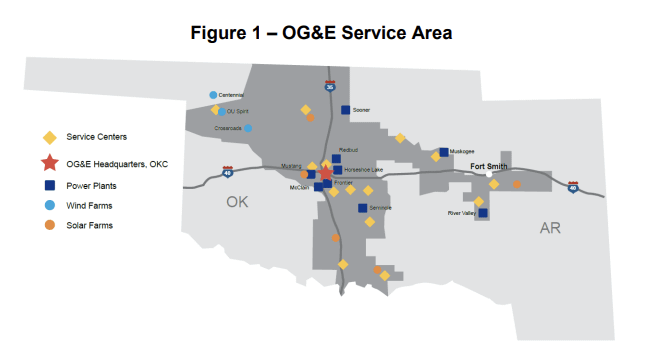
source: OG&E Integrated Resource Plan, 2024
Oklahoma City is a good place to own an electric utility. The area is much larger than some readers might realize: its metropolitan area is the 42nd-largest in the U.S., with nearly 1.5 million residents. The metro has been growing quickly, with population increasing at twice the national average during the 2010s. The city itself (just under half the population of the metro) was one of fourteen to add more than 100,000 residents during that decade, alongside better-known ‘hot’ markets like Dallas-Fort Worth, Denver, and Charlotte, North Carolina.
Since the pandemic, population growth has accelerated. Notably, more people are relocating to Oklahoma from California than making the opposite move. That’s no doubt a point of civic pride for an area where the “Okies” of the 1930s, memorialized in The Grapes of The Wrath, still has some purchase.
For current and new residents, the city has undergone a transformation over the past twenty years. I lived in Oklahoma City between 2008 and 2013 and saw a chunk of that transformation, including the arrival of the National Basketball Association’s Oklahoma City Thunder. Low cost of living helps attract new residents as well: the median home price in the city was $270,000 in May of this year, about one-third below the national average.
The job picture is another draw. For years, the unemployment rate has remained well below that of the country as a whole. Despite a seemingly tight market, the city is still bringing new businesses in, partly due to location and costs, and partly due to a stable, fairly rational center-right government. OKC has had two mayors in the last two decades. The current leader, David Holt, was re-elected with 60% of the vote in 2022.
That’s more impressive than it sounds: Holt took that share in a four-candidate race without really campaigning. OKC is business-friendly, but has also had a wildly successful program, referred to as MAPS, that uses short-term sales taxes to fund major projects ranging from improvements to the Thunder’s arena to parks, schools, senior centers, and mental health programs.
The efforts of the city government to improve quality of life and attract new business has helped diversify the city’s economy. OKC was once heavily reliant on oil and gas, and suffered through the industry’s booms and busts. Falling oil prices led to the well-known 1982 collapse of Penn Square Bank, which lent generously (and not particularly wisely) to the industry. Penn Square’s failure catalyzed a massive city- and state-wide downturn. Citizens fled, and seven of Oklahoma City’s ten largest banks eventually were wiped out.
This century, however, industries like aerospace and distribution have become major contributors to the economy, and though the skyline is still dominated by the headquarters of Devon Energy $DVN , the boom-and-bust cycle has been sharply mitigated.
At the state level, politics move further right, but OG&E and American Electric Power $AEP subsidiary Public Service of Oklahoma, which serves the Tulsa metro, seem treated reasonably well — to a point. OG&E managed to get through a 6.6% rate increase in an uncontested settlement last month. But the utility originally asked for double that, driven by an increase in the cap on return on equity to 10.5% from the current 9.5%.
That said, 9.5% is still about in line with the national average, and it’s likely OG&E plans to try again to raise the cap in the future. (An environment in which inflation continues to be a major topic of discussion is probably not the best environment in which to make that play.) Meanwhile, a bill passed in February through the Oklahoma House would allow utilities to own transmission lines; this ostensibly was done to ensure local control, but also comes after intense lobbying by both OG&E and PSO. Regulated utilities in the state clearly don’t have a rubber stamp, but they do have some power, no pun intended.
A Solid Outlook
Relative to other utilities, OG&E seems to be in a favorable position. Population growth appears likely to exceed the national average (even the rural parts of the service area have seen net growth since the pandemic began). Commercial demand should also continue to increase at a rate above most states. Regulators seem not to be an impediment toward further rate increases, particularly with new assets coming online after recently elevated capital expenditures1.
Indeed, the forecast from OG&E itself looks rather strong. The utility expects five-year annualized earnings per share growth of about 5% to 7%, better than many of its peers. That includes the impact of higher interest rates, and increased depreciation of recently built assets.
But even that forecast looks too low. OG&E’s load forecast is particularly impressive in the context of U.S. demand. As we noted on Thursday, multiple industry participants see load growth jumping higher over the next few years. Goldman Sachs is looking for 2.4% annualized increases through 2030. Florida Power & Light owner NextEra Energy $NEE about 1.6% over the next decade. Consultant GridStrategies ~1% growth for five years, with bias to the upside.
OG&E’s offers an even more optimistic plan: 3.2% annualized growth through 2034 even net of efforts to incentivize power reduction. And that outlook looks potentially conservative. A huge driver is commercial demand, which the utility impressively thinks will double over the ten-year period:

source: OG&E IRP, 2024; ‘DSM’ refers to utility-driven incentives to reduce demand, such as load management, smart meters, etc.
Commercial aside, OG&E’s projections don’t look particularly aggressive. Given population trends, residential growth of ~1.4% annualized seems likely to suggest minimal increased usage on a per-household basis. With the low-hanging fruit related to efficiency— smart meters, energy-efficient light bulbs and appliances — largely harvested for those customers, there’s clear upside to those projections. Similarly, industrial demand is modeled to actually decline. Given Oklahoma City’s commercial growth, that outlook too seems like it could be understated.
Even the ~7% annualized growth in commercial load has room to the upside. The figure has grown sharply in recent years — 11% in 2023, 12.2% the year before — in part because of Bitcoin mining. Oklahoma has benefited from cheap land, plenty of room for noisy centers, and, not coincidentally, low electricity rates: commercial electricity rates in the state are 40% below the national average, per data from the U.S. Energy Information Administration.
Of course, as OG&E management has noted, those factors all bode well for the state’s ability to attract data centers amid the rise of generative artificial intelligence. We discussed the potential impact of that trend earlier this week; at least one forecast suggests data centers will go from using 2.5% of U.S. electricity to as much as 7.5% by the end of the decade.
OG&E management has already pointed out that some of the Bitcoin miners are repositioning to more typical data center activities. Meanwhile, chief executive officer Sean Trauschke said on the Q1 call that his company was in talks with a “half dozen or so [data center] projects in various stages of development”. The quarter before, chief financial officer Bryan Buckler noted new projects were skewing more toward traditional and genAI-driven data centers, away from the legacy reliance on Bitcoin mining (though that latter activity still appears to account for roughly twice as much load as do data centers, at least for now). And, as we noted on Thursday, latency simply isn’t a big issue for AI data centers. It’s cheap land and cheap power that matter. Oklahoma, and OG&E, have plenty of both.
Indeed, on the Q1 call Buckler noted that he thought there was “upside” to the company’s outlook for load growth in both 2025 and beyond. He’s made similar comments in recent years, and largely been proven correct, as load sharply outpaced the company’s five-year plan then in force.
The impact of past load growth has been blunted by the spike in interest rates and higher depreciation. Looking forward, however, both headwinds should moderate. In that environment, it’s unlikely that OG&E is going to grow demand 3%-plus and see earnings per share rise only 6%. The simple fact of a leveraged balance sheet and the ability to likely take further rate increases following 2024 and 2025 capital expenditures mean that, even with higher depreciation, EPS growth in that scenario is almost certainly stronger.
OGE Stock Is Cheap Enough
Again, OG&E seems like a utility in excellent position — yet it isn’t quite treated as such. Valuation is pretty much in the middle of the pack in the sector, with forward P/E multiples basically identical to those of fellow single-state operators Pinnacle West $PNW (Arizona) and Idacorp $IDA (Idaho). Yet OG&E is projecting stronger load growth than both of those rivals.
Meanwhile, if the utility simply hits its five-year plans, returns look pretty solid. The 5-7% growth is planned off 2024 guidance of $2.12, suggesting 2029 EPS (at the 6% rate) of $2.84. The dividend should grow at a slower rate, given a current payout ratio of 79% and a target of 65-70%. ~$0.05 annual increases suggest cumulative payments just over $9 over the next five years, with the yield on current cost moving above 5%.
Assuming out-year multiples hold, annual returns here exceed 10%, with each turn in 2029 multiple compression dropping that figure by about 1.5 percentage points. But, again, we see a very real path toward upside to the 5%-7% forecast — each point in load growth, per management, adds about 3 cents in EPS — and thus a path toward returns into the 12% or even 15% range. This isn’t a story that ends in 2029, either, given the potential for further data center growth and, presumably, a still-stable and attractive market for new residents in Oklahoma City. All told, we do like the sector, but we like OGE a little better.
What Can, And Has, Gone Wrong
To be sure, this isn’t a table-pounding bull case, or a big swing2. But in a market with some concern around valuations, a reasonable path toward ~12% annualized returns, with some downside protection, looks attractive.
One obvious retort to the bull case is: if the Oklahoma City market has been so attractive, why has OGE been such a dog? Certainly, returns looking backward have disappointed:
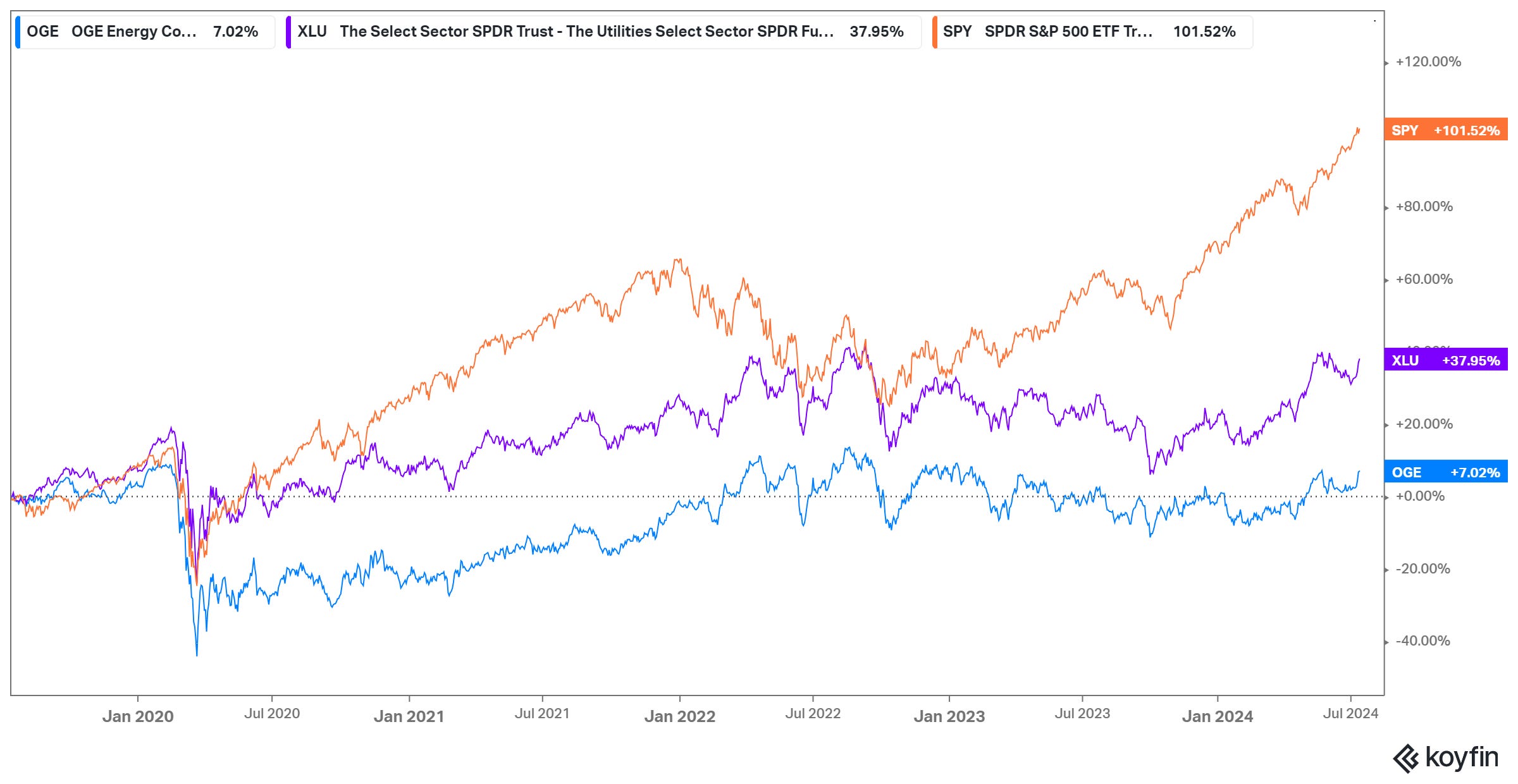
source: Koyfin
But part of the issue has been that the OG&E story, so to speak, hasn’t really shown through. Obviously, the pandemic wreaked havoc in 2020. In 2021, the company divested its midstream natural gas operations, which had weighed on the stock, via a merger with Energy Transfer $ET , which affected comparability with 2022 results. That year saw exceptionally favorable weather plus a gain on the divestiture, which meant 2023 results looked soft. (GAAP EPS was $2.07 versus $3.32 the year before; the utility saw EPS decline a little over 3%.) It’s only now, as a pure-play regulated utility in a (hopefully) normalized environment, that the underlying story can start to show through.
That aside, the obvious risks remain. Federal policy has been both a positive (OG&E has received grants as part of Biden Administration initiatives) and a negative (the utility is party to a lawsuit over a rejection by the Environmental Protection Agency of Oklahoma’s State Implementation Plan to manage emissions). Given that lawsuit, and the potential political impact of the unnerving events of this weekend, there’s obviously a substantial amount of uncertainty as to what federal policy looks like going forward.
A recession would hit both the business and the stock. Utilities aren’t quite as defensive as their reputation might suggest; the sector plunged both in 2008-09 and in early 2020. We do believe OKC has a bright future, but I admit to a bias toward my hometown and it’s possible business and population growth both disappoint.
Interest rate expectations are important too: the sector has recently seen huge moves (by its standards) during the current focus on Federal Reserve rate cuts. To some extent, that’s driven by the fact that utilities are probably going to have relatively high capital needs ahead of AI growth to rebuild the grid and add generation capacity; even in OG&E’s case that will require debt issuances, for which price matters. But the balance sheet here is in good shape, and management has said that the current five-year plan does not require the issuance of equity for funding.
Overall, the risks seem manageable — and, of course, shared by nearly every other play in the space. For the sector as a whole, we think those risks are worth taking. Given OG&E's clear path to outperformance in terms of load growth and EPS gains, the stock has a path for strong annual returns.
Disclosure: As of this writing, Vince Martin is long OGE.
Believe it or not, but that “♡ Like” button is a big deal. It signals to new readers that this content is worth reading and it helps us to grow. So if you found value in this post, please give it a quick click!
Disclaimer: The information in this newsletter is not and should not be construed as investment advice. Overlooked Alpha is for information, entertainment purposes only. Contributors are not registered financial advisors and do not purport to tell or recommend which securities customers should buy or sell for themselves. We strive to provide accurate analysis but mistakes and errors do occur. No warranty is made to the accuracy, completeness or correctness of the information provided. The information in the publication may become outdated and there is no obligation to update any such information. Past performance is not a guide to future performance, future returns are not guaranteed, and a loss of original capital may occur. Contributors may hold or acquire securities covered in this publication, and may purchase or sell such securities at any time, including security positions that are inconsistent or contrary to positions mentioned in this publication, all without prior notice to any of the subscribers to this publication. Investors should make their own decisions regarding the prospects of any company discussed herein based on such investors’ own review of publicly available information and should not rely on the information contained herein.
As we noted on Thursday, a larger asset base generally allows for a higher rate base, since regulators should allow the utility to recapture the spending on that asset.
Our “big swing” in AI-driven energy demand was the recommendation of offshore wind developer Ørsted A/S in May, a case we still like two-plus months later.