
💡 Highlights
3D printing leader Materialise (MTLS) trades at ~7x EBITDA despite solid growth in its medical segment.
Semiconductor firm Silicon Motion (SIMO) offers value as memory chip sentiment swings wildly.
Cabinet maker MasterBrand (MBC) faces headwinds from industry pressures: Why we maintain a bearish outlook.
Aerospace supplier Astronics (ATRO) presents an opportunity for triple digit upside.
Materialise Falls Again
Our bull call last year for additive manufacturing play Materialise MTLS 0.00%↑ has not played out at all. MTLS is down a disappointing 39% and the stock touched an all-time low in late June.
But to be honest, it’s not clear why. Results remain reasonably solid. Second half 2023 results were a touch light and 2024 outlook was a bit soft, but Materialise is still looking for ~6% revenue growth and, at the midpoint, a healthy 27% jump in adjusted operating profit.
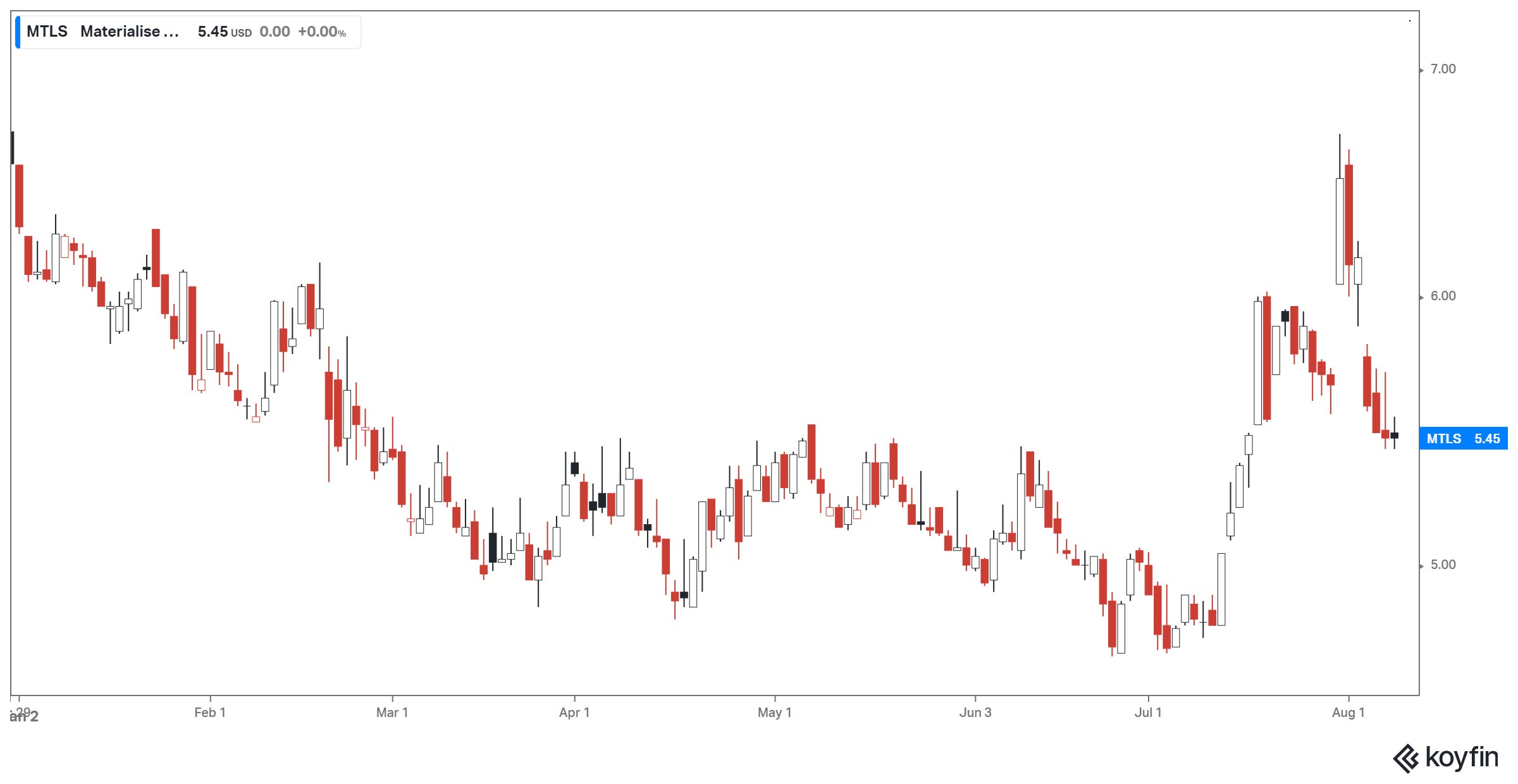
The business results and stock chart simply don’t seem to match, a sense that grew after Q2 earnings last week. A solid quarter and reiterated guidance drove some confidence, with MTLS jumping 15% after the report. Then the small-cap sell-off arrived, and MTLS is now back below where it traded before the release:
source: Koyfin
MTLS Gets Cheap
We thought last year MTLS looked cheap enough given its prospects. Now, the stock just looks cheap. Current market cap is $322 million; net cash is $74 million, for an enterprise value of $248 million. Guidance this year is for Adjusted EBIT of 11 to 14 million EUR (roughly US$12-15 million), which suggests a high teens EV/EBIT multiple. But that misses a key point. Materialise’s definition of Adjusted EBIT does not exclude amortization of intangible assets, nearly all of which have been acquired1.
That figure is running at about $7 million, moving ‘true’ adjusted EBIT, for lack of a better term, to about $20 million. EV/EBIT is thus 12x, EV/EBITDA (given ~$16 million in depreciation) ~7x, and P/E in the mid-teens (though benefiting from interest income). Free cash flow this year should be pressured thanks to capital expenditures for a new manufacturing plant, but on a normalized basis, Materialise is pricing in very little growth.
To be sure, the company hasn’t been a torrid grower: revenue from 2019 to 2024 should grow at a 6%-plus annualized clip, with margins relatively flat. But if you go back to 2019, over two-thirds of revenue came from the manufacturing and software segments — which have been the laggards. The software business, which aims to serve 3-D printing users, almost certainly will see revenue decline; manufacturing is likely to grow at an annualized rate of only about 3%.
Materialise Medical, however, looks like a hugely attractive business. It’s carried all the weight this year, with first-half revenue up 10% while the other two segments are negative. It’s tracking toward $110 million in sales this year, which would represent 12% to 13% annual growth over a five-year period in which some of its end markets (notably orthopedics) faced significant pressures from the novel coronavirus pandemic. Elective procedures are only now starting to recover.
Segment-level EBITDA margins, meanwhile, are over 30% on a trailing twelve-month basis. Even assigning all of Materialise’s unallocated costs to the business, margins are above 20%. MTLS now trades at almost exactly 10x Medical EBITDA less corporate costs, which seems an absurdly low multiple for a double-digit grower with some obvious secular tailwinds and 20%-plus margins. Partnerships with basically every major medical device manufacturer suggest Materialise’s medical products have real value, and demand for orthopedic surgeries like knee replacements should continue to rise. A July acquisition is a first step into the cardiovascular market, part of a broader strategy to expand indications beyond orthopedics and CMF (cranio-maxillofacial).
Is The Market Paying Attention?
It’s not hard to imagine a standalone Materialise Medical business being worth twice as much as Materialise as a whole is right now; 20x EBITDA for this growth and these margins in that industry seems completely reasonable. Yet, the market is not assigning those multiples.
The question is why. One possibility is that investors fear the importance of 3-D printed surgical guides to the business. Those guides could be disintermediated by the rise in robotic-assisted surgeries (the robots don’t need guides). More broadly, the vast number of partnerships itself could be seen as a negative, with the likes of Johnson & Johnson unit DePuy Synthes eventually moving to their own 3-D printed options and leaving Materialise out in the cold.
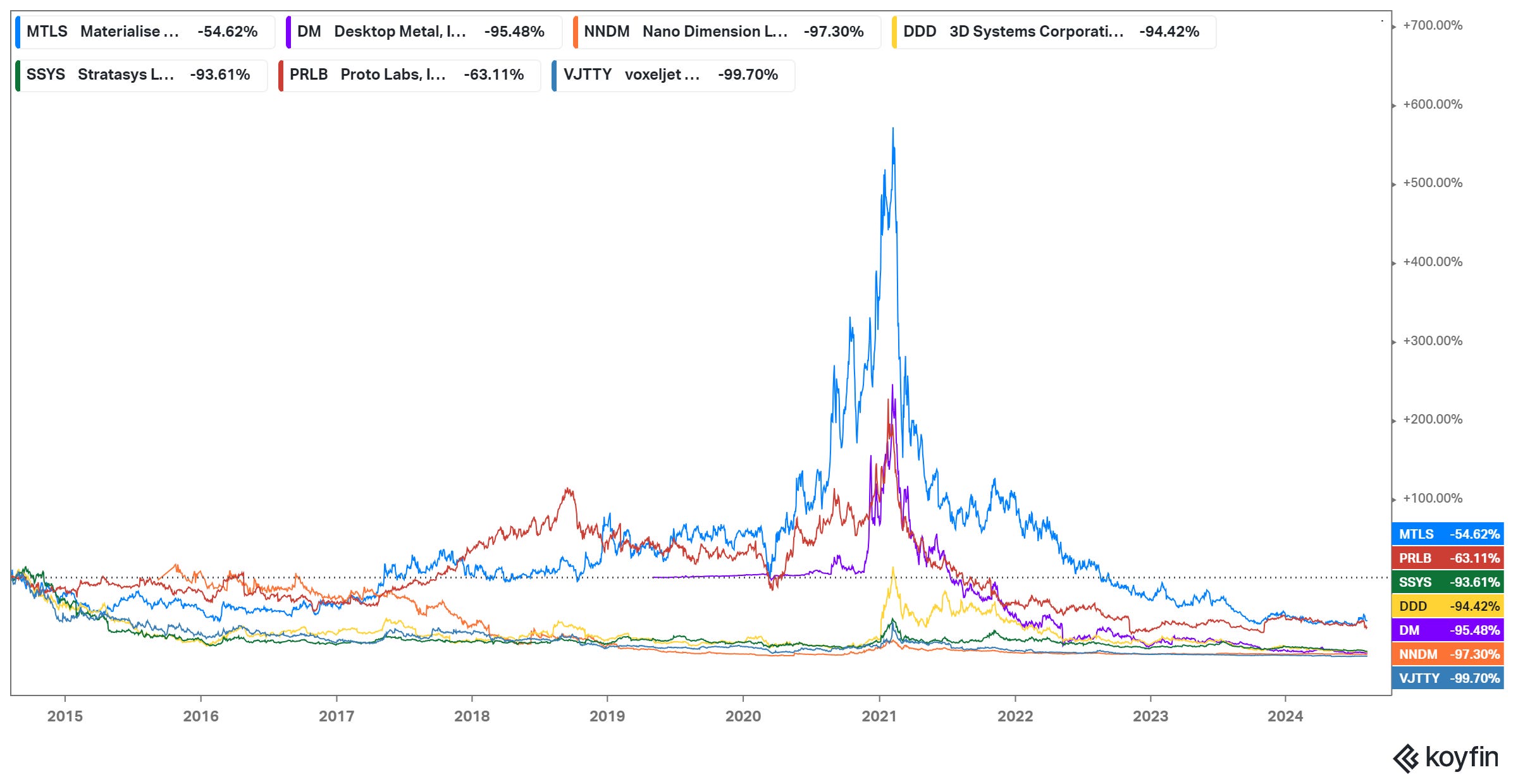
The other possibility is that investors simply aren’t paying that much attention. They view Materialise as another member of the stunningly disappointing 3-D printing sector:
source: Koyfin; 10-year chart
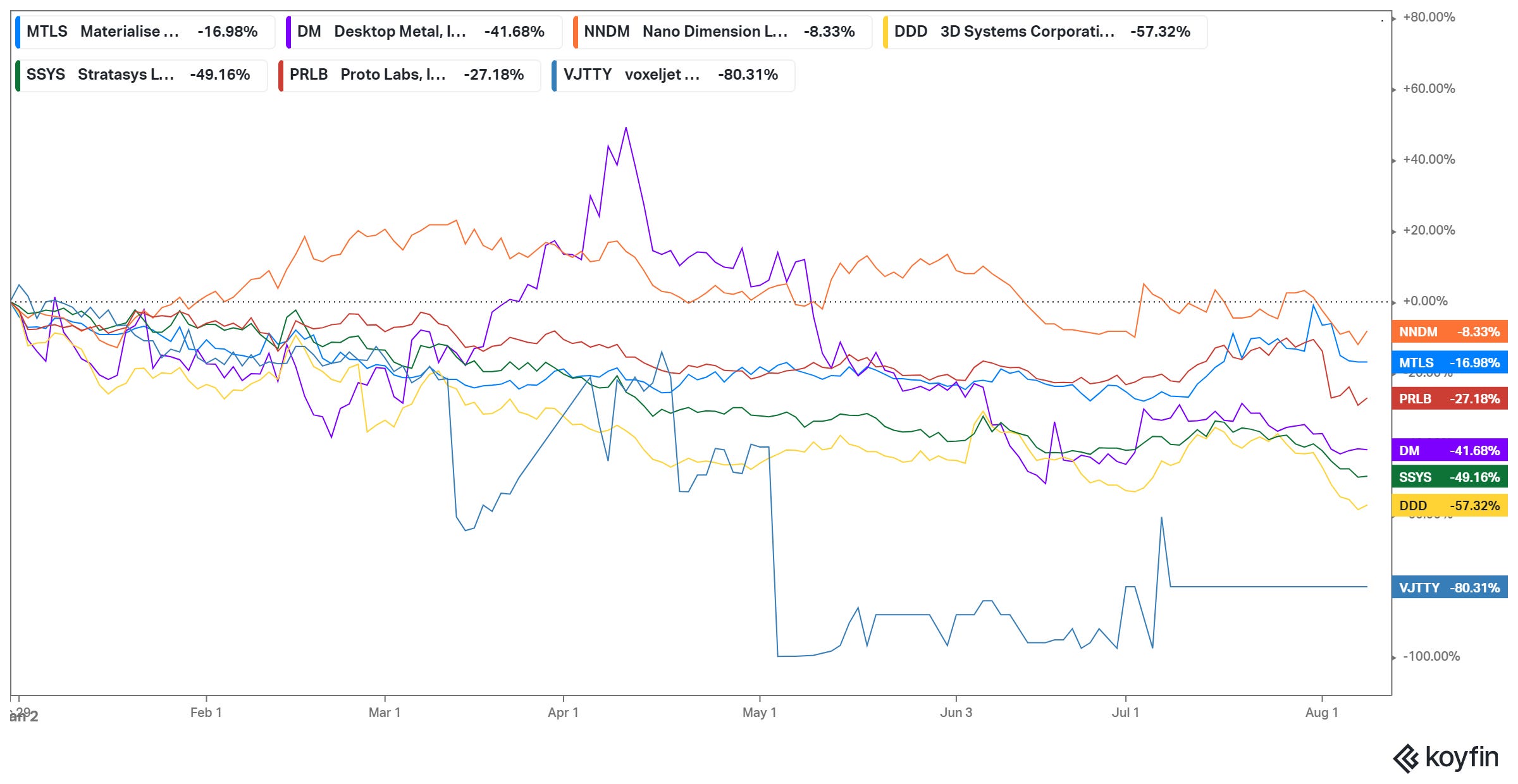
That chart is skewed somewhat by its starting point, during a 2014 in which optimism toward 3-D printing was a poor man’s version of the hype surrounding generative artificial intelligence over the past twelve months. That said — perhaps because AI itself is seen as a negative for the industry — 2024 has been exceptionally poor for the sector.
The best performer, Nano Dimension NNDM 0.00%↑ has a negative enterprise value. Nano agreed to acquire Desktop Metal DM 0.00%↑ last month, and DM is still down 40% year-to-date:
source: Koyfin
Materialise itself doesn’t seem to get much notice. Average daily volume is pretty thin (90-day average around $400,000 a day), sell-side coverage is limited (three analysts whose targets range from $9.51 to $12.01), and media/social media coverage is minimal. The ‘$MTLS’ cash tag hasn’t received a single Tweet this year with more than three likes.
Given the somewhat unusual non-GAAP reporting (without stock-based compensation or excluded amortization to juice the numbers), and the sector performance, it does seem like there might be an opportunity here. We thought last year this was a business not given proper credit by the market.15 months later, that still seems to be the case.
Silicon Motion: A Fear-Driven Sell-Off
In November, we made the case for chipmaker Silicon Motion SIMO 0.00%↑. In 2022, the company had agreed to an acquisition by MaxLinear for about $114 per SIMO share. Investors didn’t think Chinese antitrust regulators would allow the deal, so the spread ballooned. Those regulators did in fact approve the deal, so SIMO soared; and then MaxLinear just walked away, claiming a “material adverse event” (and, later, fraudulent projections from Silicon Motion ahead of the acquisition).2
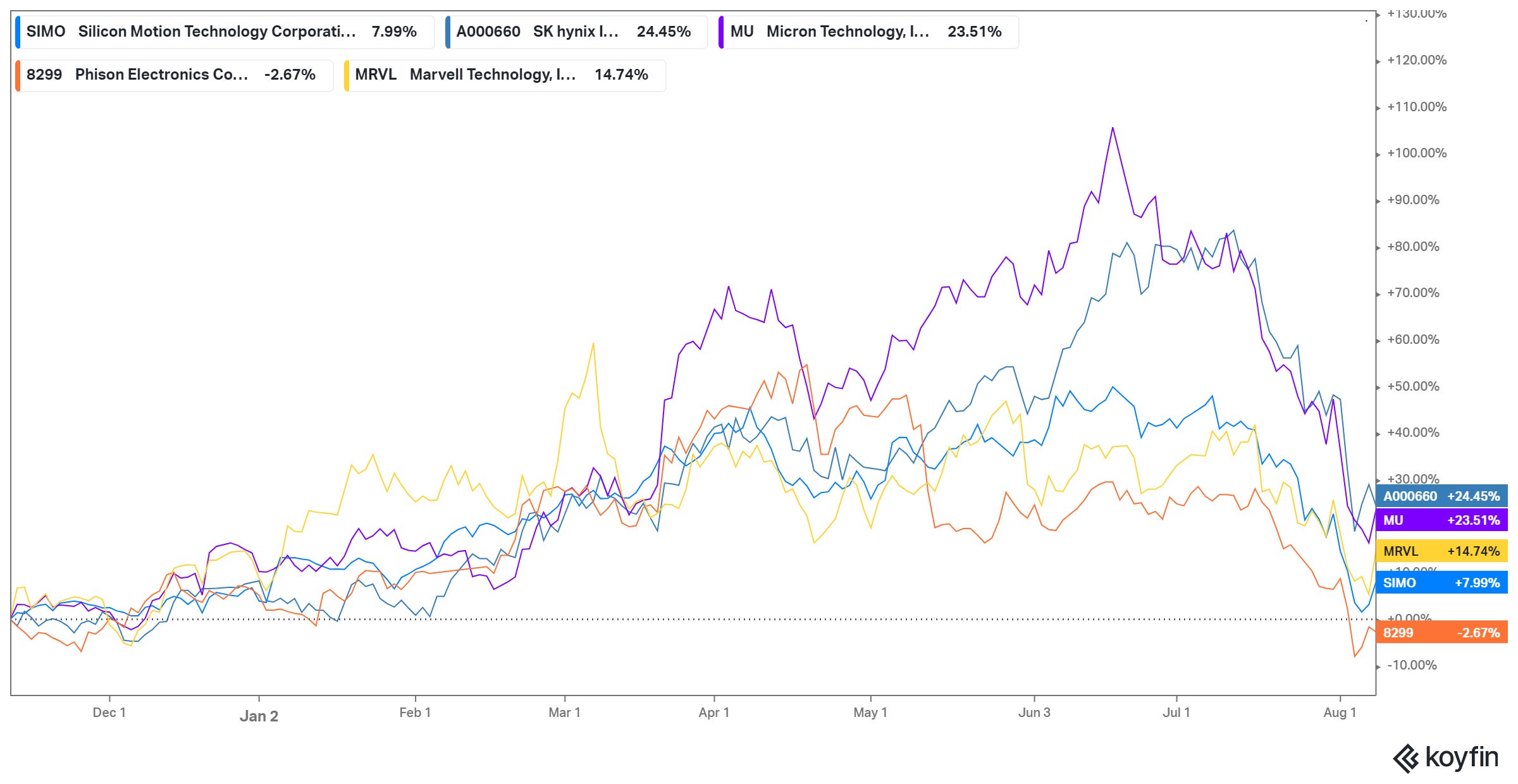
Our case at the time, three-plus months after the deal blew up, was that investors would eventually turn their focus from the failed merger to the remaining SIMO business, and would start to price in a cyclical recovery in a historically solid business. That case played out well pretty much from the jump, with the stock also benefiting from AI-driven optimism. By April, the stock was up almost 50%. After the last few weeks, however, it’s gained just 9%:
source: Koyfin
As the chart shows, the decline has been driven by a rapid reversal in sentiment toward the memory space in particular. That began in late June, when Micron MU 0.00%↑ saw its stock fall sharply despite a seemingly excellent quarter. The gains in the first half of the year came in part because the market saw memory as part of the broader AI play. The sharp declines of late — SIMO has dropped 25% in a month — have come as that sentiment has cooled.
But the core story we laid out last year remains firmly intact. Silicon Motion posted a solid Q2, with full-year guidance reiterated after a hike following Q1. Notably, management continues to cite improved wins from companies with so-called captive (in-house) operations. Overall, Silicon Motion has projected about five full points of market share gains this year, and post-Q2 commentary essentially reaffirmed that target. The automotive and smartphone markets — the latter of which has driven huge gains in another of our chip calls, Cirrus Logic CRUS 0.00%↑ — provide strong multi-year opportunities as well.
This kind of volatility is not unusual in memory, as even a cursory look at the MU chart will show. But in this case, it presents another crack at SIMO at an exceptionally attractive valuation. Based on guidance, shares are trading around 17-18x this year’s earnings, which appear closer to the trough of the cycle than the peak.
The broader narrative that drove the sector higher — genAI, data center growth, “edge AI” — likely returns at some point. And a historically good business (annualized returns since the 2005 initial public offering are 11%) is performing well. There’s some optionality from an arbitration case against MaxLinear as well; Silicon Motion is asking for $160 million (~8% of the current market cap) plus interest and damages.
To what extent SIMO is the best play on the almost-guaranteed reversal in sentiment toward memory is up for debate. But it’s certainly a good play. The story we laid out nine months ago has only strengthened, yet the stock is marginally more expensive (and now relatively cheaper against the SOX or MU). This decline gives investors another opportunity to buy this story at an attractive price.
Another Look At A MasterBrand Short
Our overall performance has been reasonably solid, depending on what metric you use. Our long positions have returned double-digits, and on an annualized basis we’ve beaten both the Russell and the S&P from the long side.
Our short positions have been a huge drag, however. This is in part because of the (still-running) bull market, and in part because we’ve chosen some difficult targets (Coinbase being the most obvious).
We’ve largely stayed away from the short side this year, but it’s not hard to wonder if some of those past calls were not wrong, but early. Cybersecurity play Tenable TENB 0.00%↑ is one such idea — we still are not convinced it’s a viable business long-term — but complicated by reports that the company is looking to sell itself.
For cabinet manufacturer MasterBrand MBC 0.00%↑, however, the short case looks more attractive with the stock moving higher. Sales are heading in the wrong direction;. MasterBrand attributed its recent growth to improved execution, but as we argued at the time the company was simply growing with the category. A recent acquisition re-levers the balance sheet at a time when demand looks rather shaky — paying nearly 9x EBITDA for a business likely near cyclical peak profits looks like it could be an error.
The broader case we made just over a year ago was that the cabinet industry is brutal. Foreign competition has been intense for a couple of decades now, but took a hit among tariffs and soaring container costs for ocean shipping. With that latter factor certainly ameliorating, and some possibility of tariff reduction next year, the industry’s old competitive dynamics are likely to return. Over a decade, peer American Woodmark AMWD 0.00%↑ quite often has been a good short (and itself looks like a potential target at the moment); we’re not convinced MBC should be any different.
Valuation admittedly isn’t that high. Pro forma for the acquisition, MBC is at ~10x EPS and a mid-7x EV/EBITDA multiple. But AMWD is actually slightly cheaper, and the case here remains more qualitative than quantitative. As we noted, there were reasons why Fortune Brands FBHS 0.00%↑ shareholders wanted to spin MasterBrand off. It’s a difficult business, and one facing a potential cyclical decline. Adding leverage and acquisition risk to the mix suggests a recent pullback could, and probably should, continue.
Staying The Course With Astronics
Aerospace supplier Astronics ATRO 0.00%↑ has faced a number of short-term challenges. The pandemic obviously crushed demand for new planes which would be fitted with Astronics’ power solutions. Inflation pressured margins as Astronics delivered those products under multi-year contracts. The case we made in January was to take the long view on the huge demand for aircraft going forward, and to ignore the constant noise around the problems at Boeing BA 0.00%↑ and their short-to mid-term impacts3.
As with SIMO, that case played out well until recently. ATRO dropped 12% in two days into and out of Q2 earnings — a decline that, as with SIMO, seems driven solely by sentiment. The quarter was fine, Astronics raised guidance, and a new win with the U.S. Army in the test business should add mid-single-digit revenue growth over the next few years alone.
Revenue this year is at $800 million. There’s a clear path toward $1 billion-plus. Management believes EBITDA margins should be in the high teens (against just over 10% in the first half of 2024), which suggests EBITDA can pretty easily get to $150 million over time, with a print over $200 million hardly unreasonable.
Right now, Astronics has an enterprise value of about $850 million (market cap $675M, net debt $175M). Put a high-single-digit multiple on the $150 million figure and the stock roughly doubles. Get to $200M-plus and 200% returns come in focus. We still really like this name, and think a short-term pullback to $19 leaves plenty of room for market-beating returns. This is a company with 95% share in its core power business, and its major customers are booked fully for years. It’s hard to see how Astronics doesn’t grow, and as long as it grows, the stock is going to do well.
As of this writing, Vince Martin is long ATRO, MTLS and SIMO.
Believe it or not, but that “♡ Like” button is a big deal. It signals to new readers that this content is worth reading and it helps us to grow. So if you found value in this post, please give it a quick click!
Disclaimer: The information in this newsletter is not and should not be construed as investment advice. Overlooked Alpha is for information, entertainment purposes only. Contributors are not registered financial advisors and do not purport to tell or recommend which securities customers should buy or sell for themselves. We strive to provide accurate analysis but mistakes and errors do occur. No warranty is made to the accuracy, completeness or correctness of the information provided. The information in the publication may become outdated and there is no obligation to update any such information. Past performance is not a guide to future performance, future returns are not guaranteed, and a loss of original capital may occur. Contributors may hold or acquire securities covered in this publication, and may purchase or sell such securities at any time, including security positions that are inconsistent or contrary to positions mentioned in this publication, all without prior notice to any of the subscribers to this publication. Investors should make their own decisions regarding the prospects of any company discussed herein based on such investors’ own review of publicly available information and should not rely on the information contained herein.
Materialise doesn’t really exclude anything at all, just stock-based compensation which in the first half was just 142,000 EUR.
To be clear, we don’t believe those allegations; MaxLinear’s behavior appears fairly obviously driven by buyer’s remorse and, more recently, a plunging stock price. Andrew Walker put it well, half-jokingly writing that “MXL is breaking [the deal] because of a MAE; it's just they're the ones who suffered the MAE.”
In that piece, we highlighted a long quote from Astronics chief executive officer Pete Gundermann. The money quote remains: “We ought to grow with the market, and the market growth is pretty substantial.”