
Highlights:
We take a look at three of the market’s best stocks; Nvidia, Eaton and Eli Lilly.
The rally in NVDA continues to be incredible — but the performance of the business is unprecedented.
ETN was one of the first AI plays to take off, and now looks like it might be one of the first to flatten.
Eli Lilly shares a concerning parallel with another one-time pharma darling. But there’s an NVDA-like path for the rally to keep going.
In the second half of the 2010s, the debate over Salesforce.com CRM 0.00%↑ stock essentially boiled down to valuation. Salesforce was the first major cloud play, a consistent 20%-plus grower, and the epitome of the argument that SaaS (software-as-a-service) revenue was “better than first-lien debt”1. Investors could disagree over the precise trend of revenue growth going forward or the ability of competitors to take share, but there was no legitimate argument over the quality of Salesforce.com as a business.
In terms of the stock price, however, there was a legitimate argument. Following the first quarter fiscal 2020 earnings release, CRM traded at 55x the high end of full-year adjusted earnings per share guidance. That multiple even understated the case: the exclusion of stock-based compensation accounted for nearly two-thirds of that adjusted EPS.
Adjusting for the impact of dilution, CRM traded at about 150x earnings. Even forecasting consistent bottom-line growth going forward, there was a valid fundamental case that Salesforce.com was an excellent business, but an unattractive stock.
To what extent that bearish argument has been vindicated in the nearly five years since depends on an investor’s perspective:
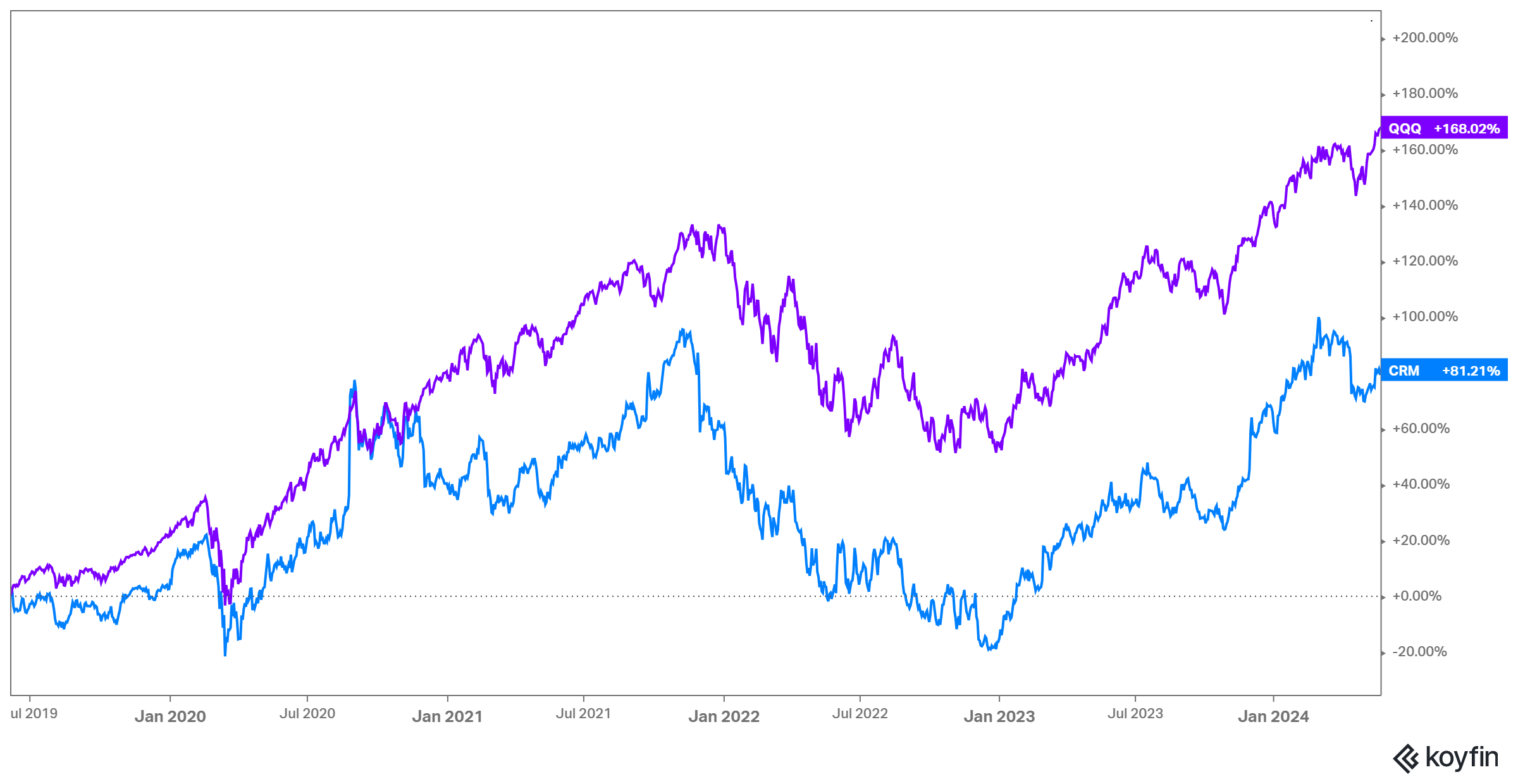
source: Koyfin; chart since 6/5/2019
CRM has been a good stock, returning over 12% on an annualized basis, but investors would have done better elsewhere in large-cap tech.
In other words, even for excellent businesses, valuation does still matter. And so at a time when a number of excellent businesses have seen soaring price tags, it’s worth checking in on their valuations.

Nvidia
We should have been more confident. Just under a year ago, we thought Nvidia NVDA 0.00%↑ shares looked attractive. Since then, shares have gained about 150%, adding ~$1.4 trillion or so in market capitalization.
What’s interesting twelve months later is that our analysis isn’t all that different. Then, as now, it’s easy to dismiss the rally as “having gone too far” or driven by an overhyped attitude toward generative AI. But then, as now, NVDA’s valuation doesn’t look all that ridiculous when investors look forward.
Coming into the Q1 release, the Street saw FY25 adjusted EPS at $25.40. That figure likely comes up a couple of percentage points: the Q1 revenue beat (and strong Q2 guidance) seems to suggest a top-line hike is needed, while other aspects of guidance around gross margin and operating expenses appear basically in line.
So NVDA is basically trading at a bit under 40x this year’s earnings. That’s roughly where the stock was a year ago after annualizing the outlook for fiscal Q2. That’s a big multiple, but not huge in the context of what the company is accomplishing:
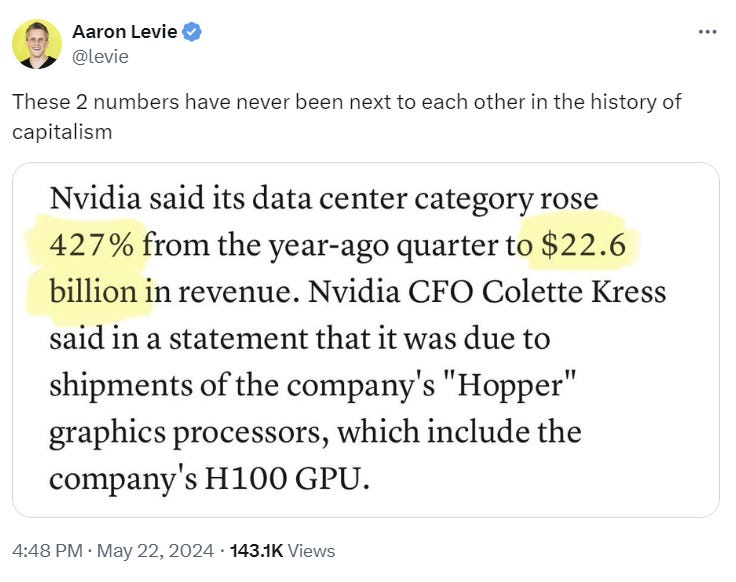
source: X (f/k/a Twitter)
The risk remains the same: not necessarily that the equity market has overhyped AI, but that its customers have done so. Two weeks after last year’s Q1, we noted the eerie similarity between NVDA and Cisco CSCO 0.00%↑ at its March 2000 top. Cisco stock plunged from that top because demand dried up; Nvidia stock has kept gaining because its demand seems to be accelerating.
At some point, that is going to change. The question becomes how big, and how valuable, Nvidia is once that point arrives. Certainly, the same multiples now look much less attractive than they did twelve months ago. But — in a theme that will repeat among these names — this is not a case where the fundamentals are disconnected from reality (as was the case for so many stocks in 2021, for instance). The valuation does make some sense. But after this rally, an investor has to believe that Nvidia can become the world’s most valuable company and stay there. Given what has happened over the past year, that’s hardly a far-fetched scenario.
Eaton
Power equipment manufacturer Eaton plc ETN 0.00%↑ has been a very good stock for a very long time. During the 2000s, ETN posted total returns right at 10% annualized, while the S&P 500 Total Return Index was negative 9%2. The stock outperformed the index again over the following decade.
So far in the 2020s, ETN has been a great stock again:
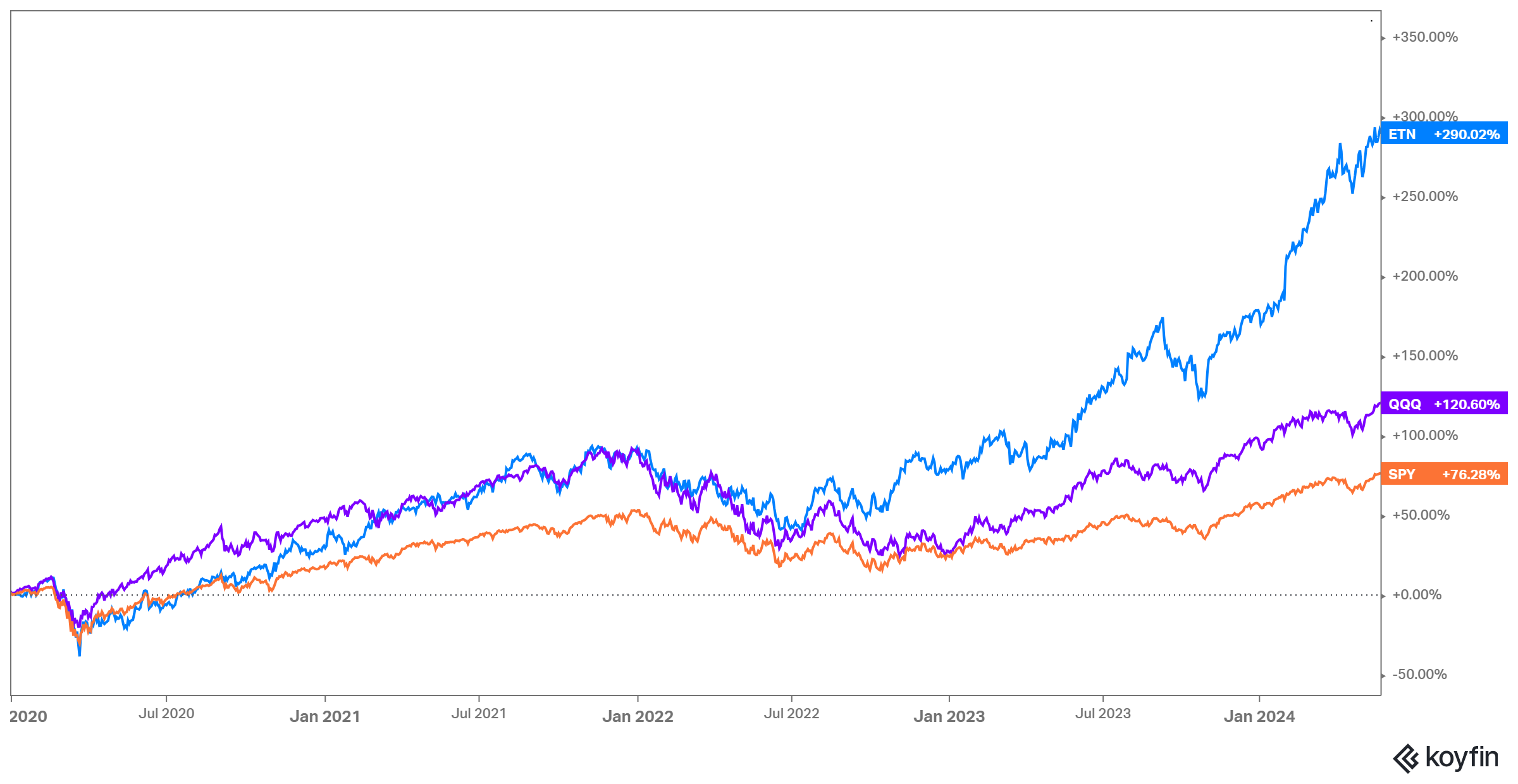
source: Koyfin
ETN was probably the first beneficiary of the “generative artificial intelligence is going to need a lot of data centers, and data centers are going to need a lot of power” trade. That trade has since expanded much further, and even into utilities3.
But Eaton has been probably the biggest winner. As Brooke Sutherland of Bloomberg noted earlier this month, Eaton has added $100 billion in market capitalization since the end of 2019. The company is now worth more than Boeing BA 0.00%↑:
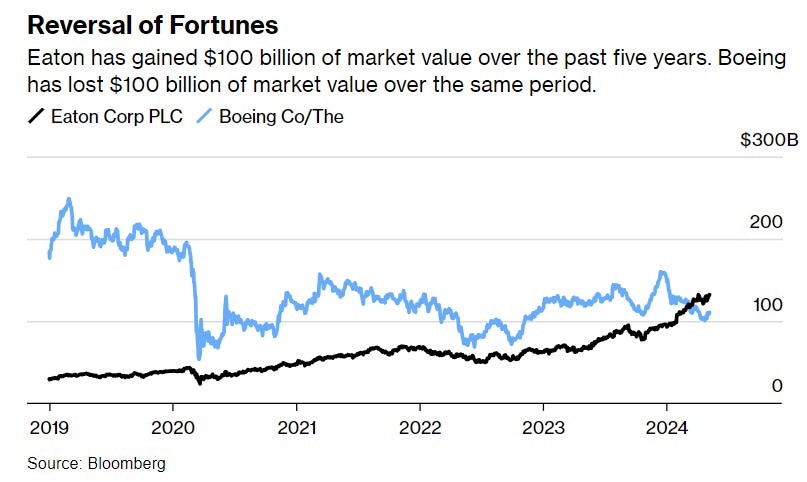
On its face, the rally looks a bit too much. Eaton did raise full-year guidance after its first quarter earnings release, but the outlook doesn’t seem that impressive. Eaton sees organic revenue growth of 7% to 9%, and adjusted earnings per share of $10.20-$10.60. The high end of the latter range suggests a 16% increase year-over-year.
Yet shares now trade at about 31x that $10.60 figure, 25x analyst estimates for Adjusted EBITDA, and almost 40x free cash flow. Those are enormous multiples for an industrial — even Eaton.
Three Concerns For ETN
One obvious problem for ETN — and perhaps a surprise given the stock is up 70% just since September — is that it’s not actually a huge AI play. Per management, about 14% of 2023 revenue came from what it calls the “data center/AI channel”. Eaton now expects that channel to grow ~25% annually in 2024 and 2025, with growth continuing beyond that point, but we’re still talking about maybe a ~400 basis point growth to top-line rates going forward. That’s material in the context of Eaton’s history but it doesn’t make the stock the most obvious or natural AI play out there.
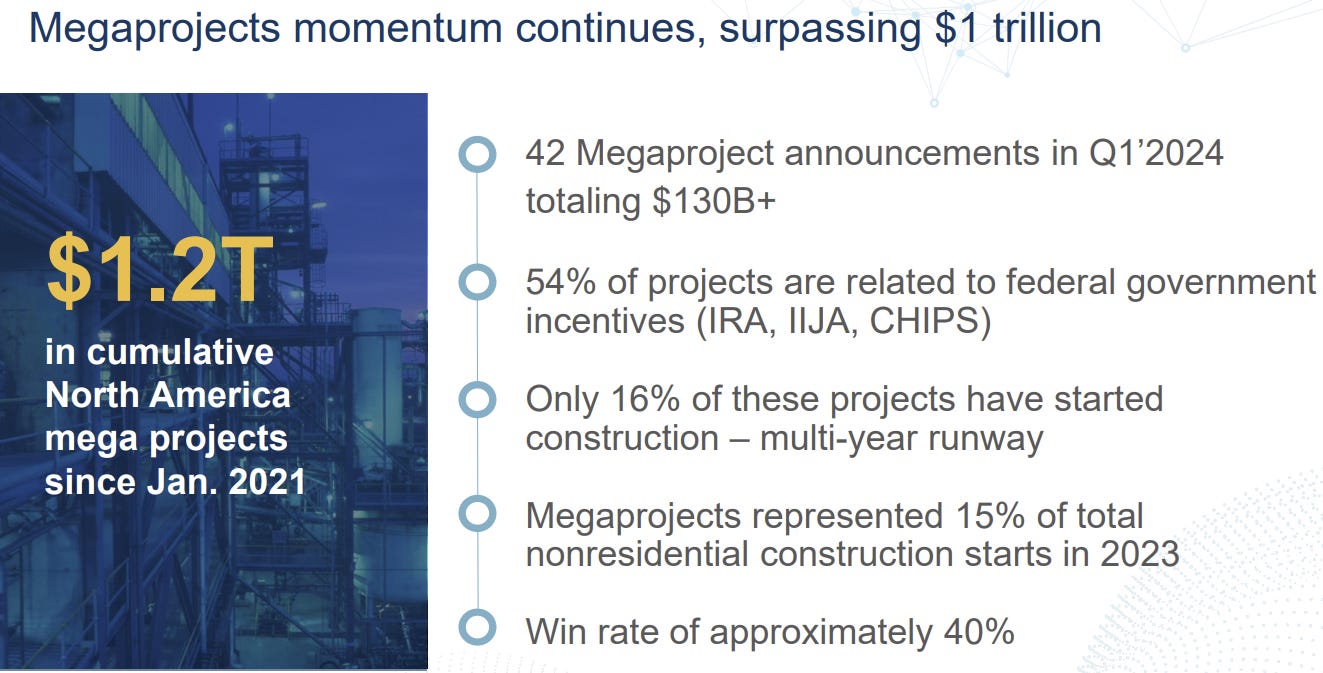
To be sure, investor (and management) optimism isn’t just centered on generative AI:
source: Eaton Q1 earnings presentation
AI is being layered on top of a generational boom in domestic construction, thanks to government stimulus and ‘reshoring’, among other trends boosting the ~70% of revenue that comes from electrical products and services.
But these trends, of course, are cyclical. It might be both a long and huge cycle, but current tailwinds don’t necessarily represent a step-change in the company’s uber-long-term prospects (in the way that AI potentially could be). And in theory a cyclical stock should see its multiple compress as we head toward the peak.
If that peak isn’t until 2030, perhaps the stock is fine. If the peak arrives much sooner because genAI is overhyped and government priorities change, ETN likely isn’t fine. The remaining portion of the business — aerospace, legacy automotive, and eMobility (electric vehicles and charging) — isn’t large enough to move the overall needle.
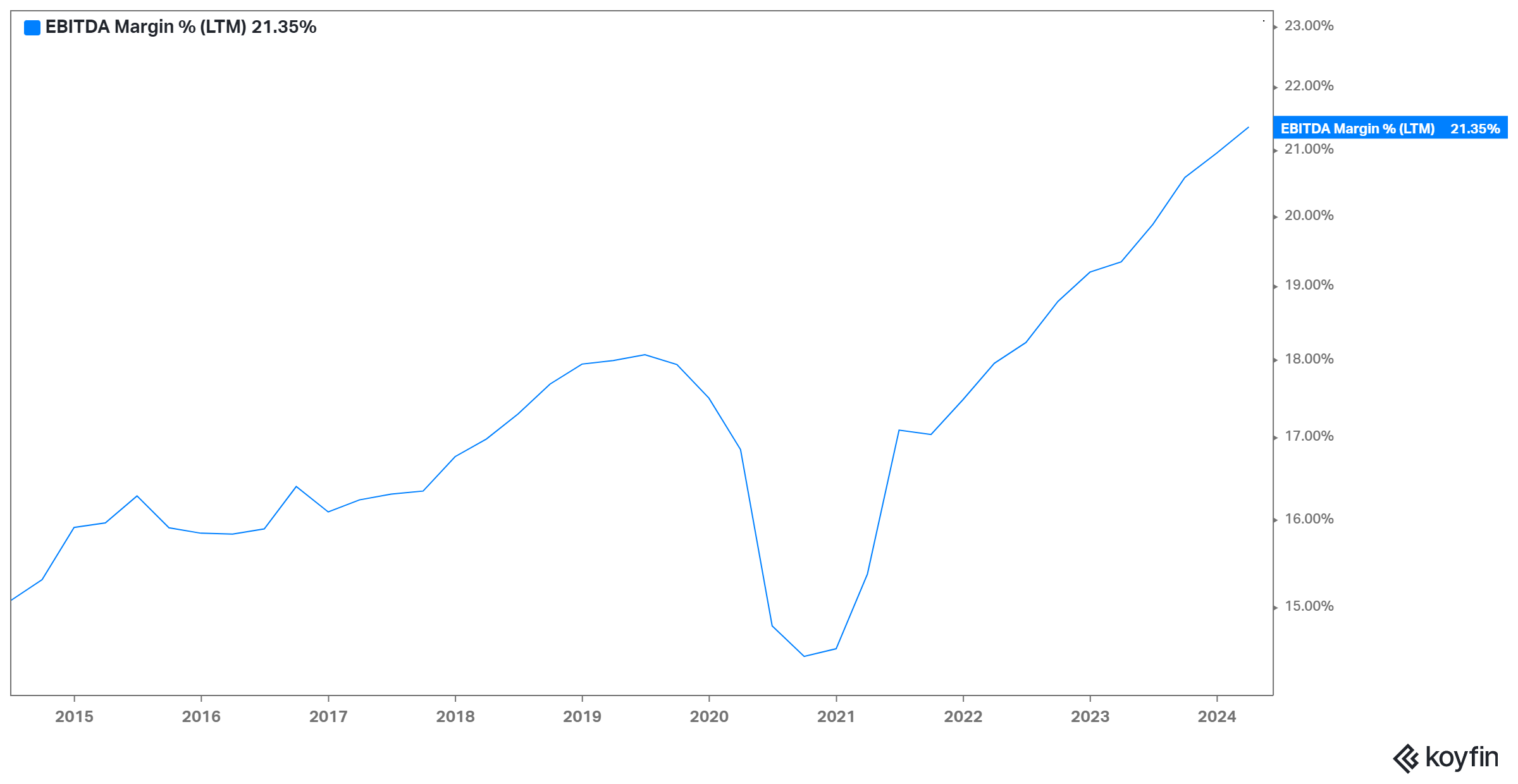
Finally, there’s the margin question. Eaton’s margins have improved nicely from pre-pandemic levels:
source: Koyfin
But that pace almost certainly slows. Gross margins, though expanding, are still only about 37%. Barring a huge increase in pricing power or a shift to higher-margin products, margin expansion is going to be more difficult as time goes on.
And in that context, the fundamental math starts to weaken. ~12% bottom-line growth over a decade would get EPS to ~$33 or so; put on a low-20s multiple and ETN stock doubles. But even with a (presumably) increasing dividend, that’s annualized returns still shy of 10% in a scenario that looks solid from here (and, notably, a scenario where there’s likely minimal interruption to any of the drivers of the current optimism toward the stock).
The sell-side seems to agree: depending on the source, the average analyst price target is now modestly above or modestly below ETN’s Wednesday close of $336. The rally here isn’t illogical, but it does seem like there are more intriguing ways to play the megatrends that have driven Eaton stock so strongly over the past couple of years.
Eli Lilly: Does History Repeat?
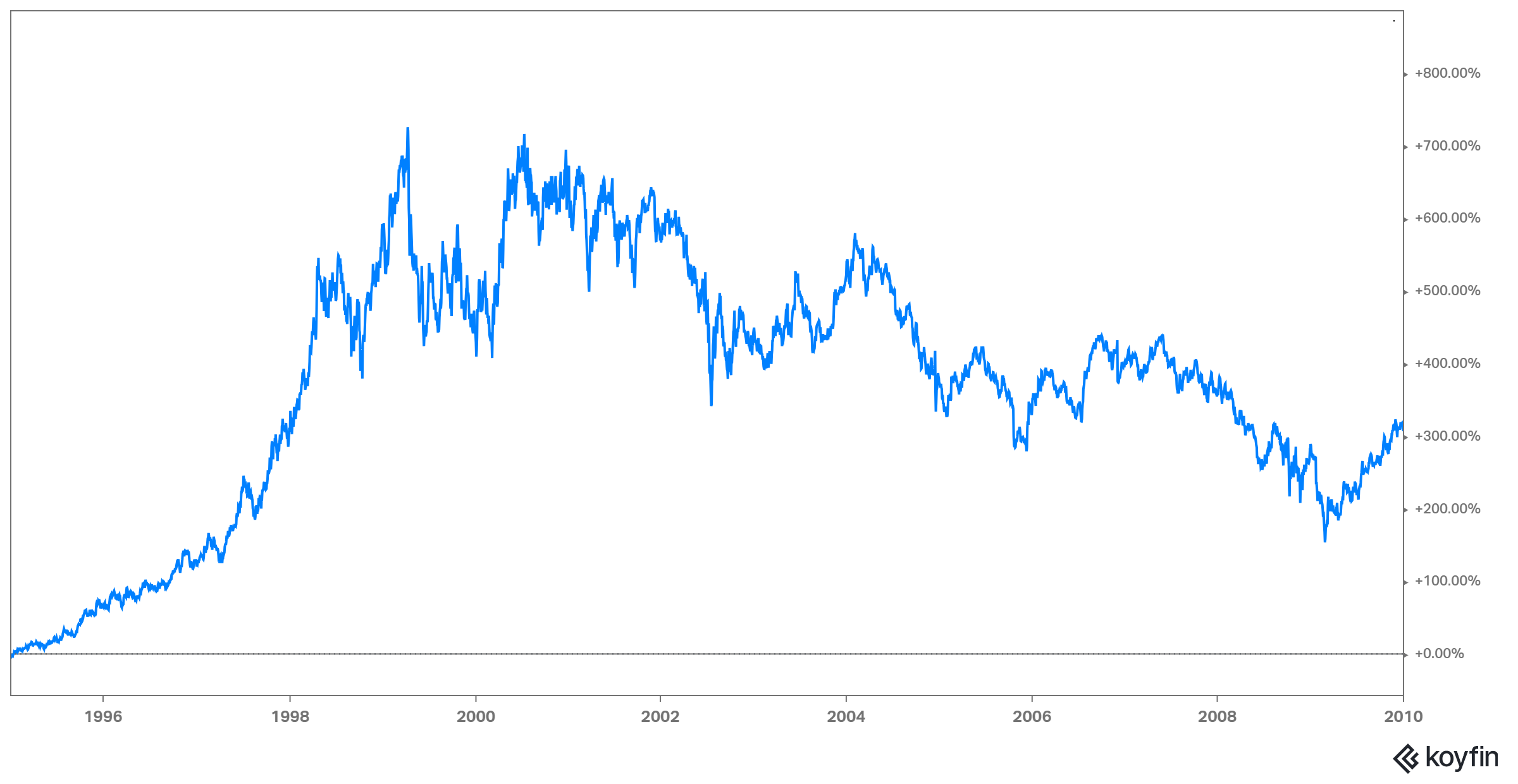
This chart seems to have come from one of the winners of the dot-com bubble:
source: Koyfin; chart from 1/1/1995 to 12/31/2009
But in fact, it’s not a tech stock: it’s Pfizer PFE 0.00%↑. PFE traded like a tech stock in the second half of the 1990s, thanks to the 1998 launch of Viagra and its co-promotion of Lipitor — still the highest-selling prescription drug of all-time.4
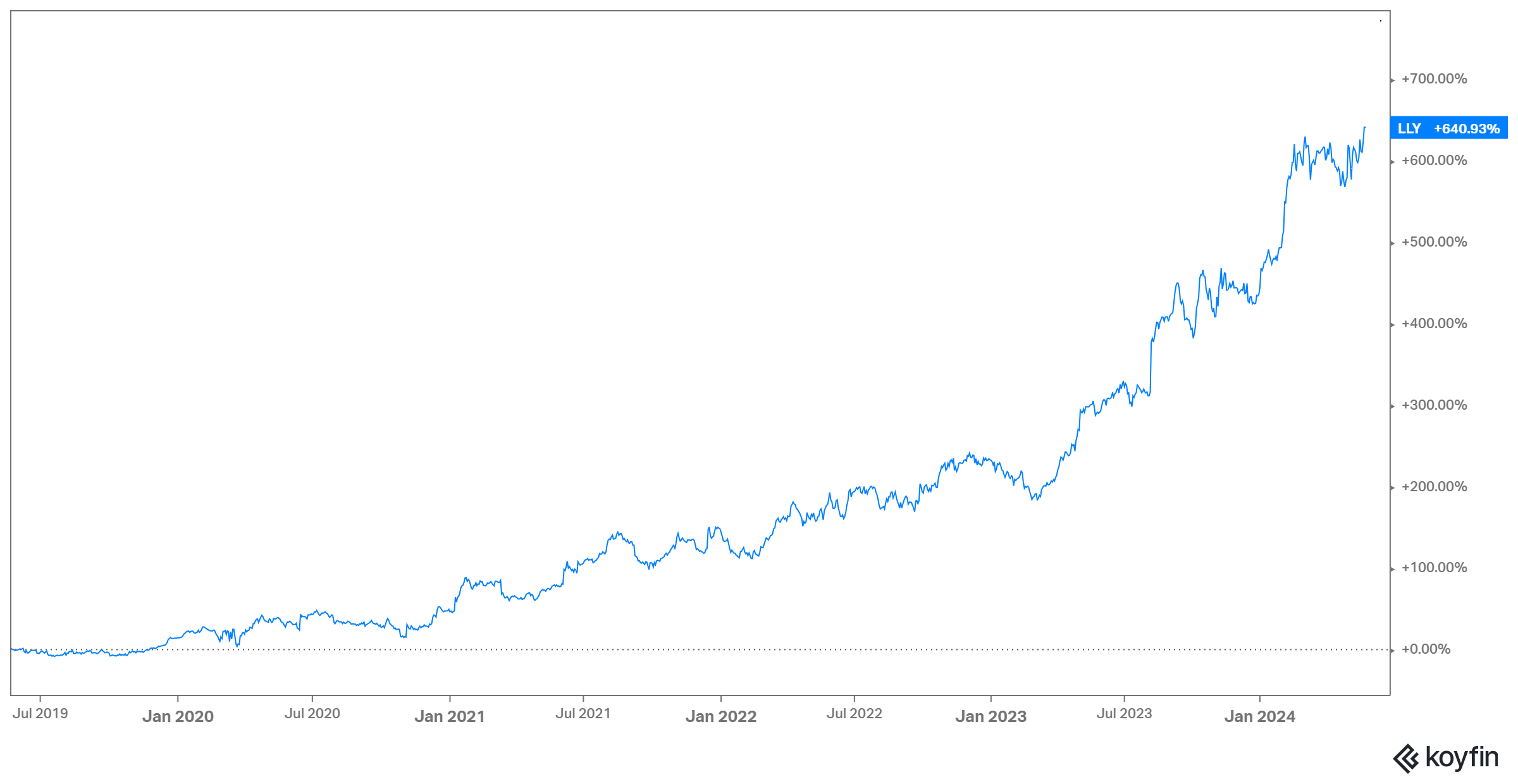
This chart does look at least a little similar to the beginning of the previous chart, doesn’t it?
source: Koyfin
The parallels are intriguing: both Pfizer and Eli Lilly LLY 0.00%↑ benefited from the launch of drugs that were not only blockbusters but reached into the broader culture. Both stocks rallied at a time when the market as a whole was soaring, raising questions of whether the underlying fundamentals warranted such a move, or if generalist investors were simply piling into a ‘hot’ stock.
One notable distinction has been in just how much value has been created. In the second half of the 1990s, Pfizer’s market cap rose a little over $100 billion. Over the past five years, Eli Lilly’s equity valuation has increased by more than $600 billion.
Most of that increase seems to have come from the company’s GLP-1 agonists, Mounjaro (indicated for diabetes) and recently launched Zepbound. That’s obviously not the whole portfolio, but there are some “patent cliff” concerns among the best sellers. Trulicity, Lilly’s biggest drug in 2023 ($7.1 billion, or more than 20% of the total) comes off patent in 2027, while Jardiance ($2.74 billion, ~8% of revenue) follows the next year.
At the least, Mounjaro and Zepbound, along with any successors in the group, need to generate something like $1 trillion in revenue to justify owning Eli Lilly here. That’s perhaps not quite as crazy as it sounds. The two drugs did $2.3 billion in Q1 even with intense supply shortages. Analyst estimates for peak revenue generally seem to clear $50 billion. Given a patient population that likely stands in the hundreds of millions globally, even with competition from Novo Nordisk NVO 0.00%↑ and other major pharmas that are playing catch-up, that number (at least from an order of magnitude perspective) is probably not that far off.
What’s interesting about LLY here — and perhaps a reason for caution — is that the stock gives generalists a chance to play. It’s incredibly difficult for someone without a pharma background to find an edge in diversified large-cap names. The amount of research required on not only approved drugs, but the pipeline (along with competitors on both fronts) is daunting, and the average generalist probably should have little confidence in that analysis anyhow5.
But in the case of Lilly and Novo, the GLP-1s are simply so critical to the bull case. And the rate of adoption by consumers and, critically, the length of adoption by consumers is probably going to come down to factors that aren’t really captured by FDA trials. How severe are the side effects? How important is the lost weight from a physical standpoint? A lifestyle standpoint?
We pretty much know the drugs will work, and we can assume with some certainty that future versions will work better (and potentially with less side effects). It’s everything after that — what reimbursement looks like, how willing consumers are to try and stay on the drugs, how politicians react — that is up for debate. And that’s a debate that takes place on the turf of thematic specialists rather than pharmaceutical ones.
From here, the rally looks like too much: forced to choose, I’d rather be long NVDA and short LLY than the other way around6. Novo and Lilly combined have added more than $1 trillion in market cap in five years mostly from a single class of drugs. Even if those drugs are huge, culture-changing, and wind up crushing Lipitor’s ~$150 billion in cumulative sales so much success is already priced in.
Between politicians, regulators and competitors, it’s difficult to see that much value eventually making its way to shareholders. And for LLY and NVO to outperform, GLP-1 profits need to be stronger than the market currently predicts.
After all, that is what happened for Pfizer. Lipitor indeed became the best-selling drug ever, and Viagra changed the culture. And across the 2010s, PFE stock including dividends returned negative 24%. It wouldn’t be stunning to see the same thing happen to LLY and NVO.
As of this writing, Vince Martin has no positions in any securities mentioned.
Disclaimer: The information in this newsletter is not and should not be construed as investment advice. Overlooked Alpha is for information, entertainment purposes only. Contributors are not registered financial advisors and do not purport to tell or recommend which securities customers should buy or sell for themselves. We strive to provide accurate analysis but mistakes and errors do occur. No warranty is made to the accuracy, completeness or correctness of the information provided. The information in the publication may become outdated and there is no obligation to update any such information. Past performance is not a guide to future performance, future returns are not guaranteed, and a loss of original capital may occur. Contributors may hold or acquire securities covered in this publication, and may purchase or sell such securities at any time, including security positions that are inconsistent or contrary to positions mentioned in this publication, all without prior notice to any of the subscribers to this publication. Investors should make their own decisions regarding the prospects of any company discussed herein based on such investors’ own review of publicly available information and should not rely on the information contained herein.
We’ve discussed that quote from Robert Smith, founder of Vista Equity Partners, before. In the case of Salesforce.com, it’s difficult to imagine what expense would be paid before the CRM bill. The loss of access to the platform would essentially be the end of the business.
For younger readers, that’s not a typo: investors in the S&P 500 lost money over ten years.
We pitched our version of this trade earlier this month, in European wind energy developer Ørsted A/S (ORSTED.DK).
In February 2000, Pfizer would acquire Lipitor’s developer, Warner-Lambert, in a $92 billion all-stock deal.
That’s been my personal take, anyhow: the last pharmaceutical stock I owned was Forest Labs, which was acquired by Actavis in 2014.
To be clear: if forced to choose. Shorting any of these names, with or without a hedge, seems like an absolute fool’s errand.