
Highlights:
Legacy media companies have proven attractive shorts so far. Secular pressures suggest that trend will continue.
At ~6x EBITDA, valuation seems reasonable, but operating deleverage can inflate that multiple in a hurry.
From a risk/reward perspective, this looks like the best short trade in the sector.
One of the easiest ways to lose money from the long side is to believe that a challenged business is “cheap enough”. Almost always, it isn’t. Secular forces inevitably win out. The same is likely true for Fox Corporation FOX 0.00%↑ FOXA 0.00%↑.
Fox looks cheap fundamentally and to this point, the business hasn’t yet turned south. In fiscal 2023 (ending June), Fox set a record for both revenue and Adjusted EBITDA. Both shareholders and executives believe that the company’s core focus on news and sports will drive growth going forward, even amid a rapidly changing environment.
But that view seems too optimistic. Subscriber declines are pressuring affiliate fees. Distribution partners are starting to push back elsewhere, and will likely start to do so here. Stations that are part of the Fox network are at a breaking point.
Fox News is facing turbulence, owing to a massive legal settlement and changes in its lineup. At some point soon — and it might have started in the most recent quarter — Fox is going to be squeezed from all directions.

Fox Corporation Now
Fox was spun from Twentieth-First Century Fox in March 2019. At the same time, the remainder of the company, including the eponymous movie studio, cable channels, and a stake in Hulu was acquired by Disney DIS 0.00%↑.
What remains of Fox after the Disney transaction is largely two businesses. There’s the cable networks, including Fox News, Fox Business, Fox Sports 1, and Fox Sports 2, which comprise the Cable Network Programming segment. There’s also the Television segment. That includes the Fox broadcast network, along with 29 broadcast stations in 18 markets (18 are Fox-branded; another 10 are MyNetworkTV, which runs syndicated shows). Fox also owns AVOD (advertising-based video on demand) platform Tubi, and programming production companies; it acquired TMZ last year. The Corporate segment includes a studio lot in Los Angeles and two-thirds ownership in Credible, a U.S. consumer finance marketplace; Fox paid $265 million for the stake in 2019.
It is the cable networks that remain the major profit centers. In fiscal 2023 (ending June), the Cable Network Programming segment generated $2.47 billion in EBITDA; the Television segment just $1 billion. (The Other, Corporate, and Eliminations segment recorded a loss of $290 million.) Fox News almost certainly is the most profitable business in that segment. It gets the highest affiliate fees (payments from cable and satellite operators for the right to carry the channel):
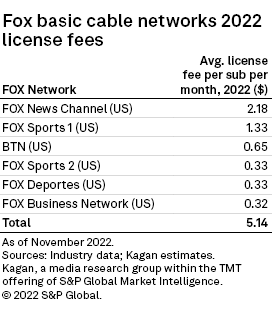
source: S&P Global; BTN is Big Ten Network
And it likely has lower costs. Fox management has been somewhat tight-lipped about expenses, but at an Investor Day in 2019 the company disclosed that nearly half of its entire operating expenses came just from sports programming:
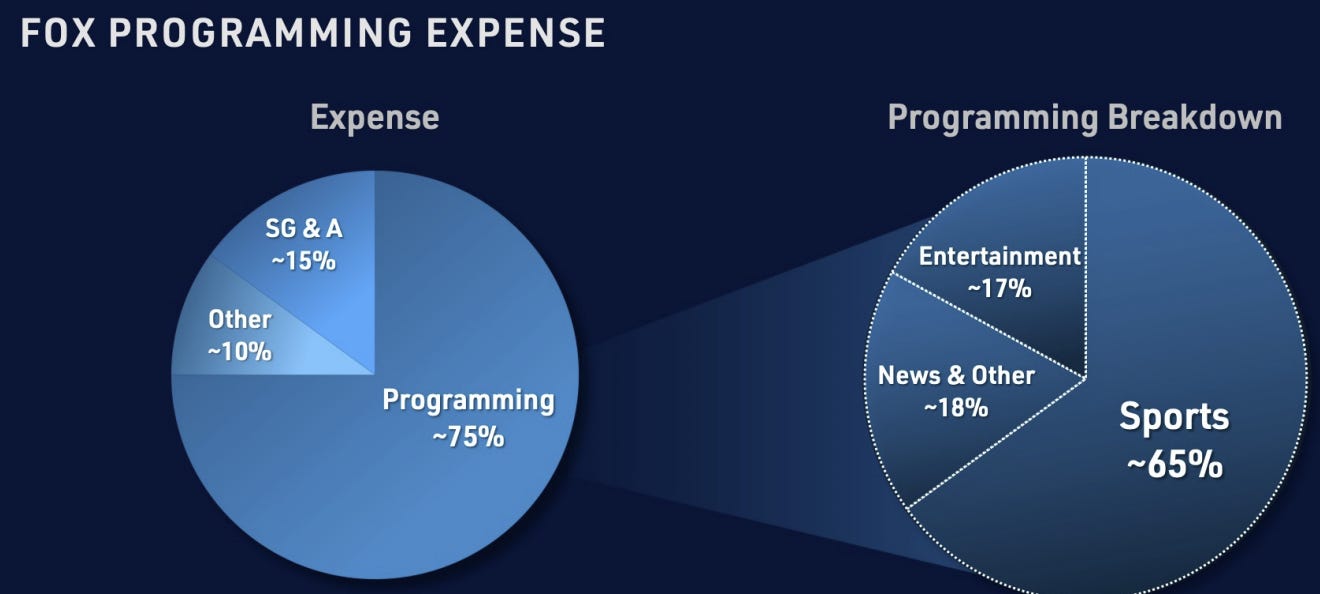
source: Fox Investor Day presentation, May 2019
Much of that expense is in the Television segment — operating expenses in that segment are more than double those in the cable business — but even so, FS1 and FS2 do have media rights agreements that cover college sports.
Overall, affiliate fees drive 47% of revenue; advertising 44%, and other revenue the remaining 9%. The impact of affiliate fees is more pronounced in the cable business, where they accounted for 69% of revenue in FY23, with advertising 23%. In Television, where affiliate fees are paid to owned and operated stations (“retransmission fees”) as well as from non-owned networks in the Fox network (“reverse retransmission fees”), advertising is more important. Advertising accounted for 60% of Television segment revenue in FY23, up from 58% the year before, in large part due to Fox’s broadcasts of both the Super Bowl and the World Cup.
The Flutter Asset
Fox does have significant investment in one other business. Back in 2019, Fox launched Fox Bet in partnership with Canada’s The Stars Group. Stars was then acquired by London-based Flutter Entertainment (OTC ticker PDYPY), the owner of U.S. sports betting leader FanDuel. Fox invested in a Flutter secondary offering the following year; it now owns 4.3 million shares of the company, currently valued at about $680 million.
As part of the Stars-Flutter deal, Fox also received an equity option to buy 18.6% of FanDuel. But Fox and Flutter wound up disagreeing on what exactly the exercise price of that option should be. The matter wound up in arbitration, and last year the arbitrator ruled in Flutter’s favor. Fox’s option has an exercise price right now of about $4.1 billion; that exercise price goes up 5% every year until its expiration in 2030. The option currently values FanDuel at about $22 billion; rival DraftKings DKNG 0.00%↑ currently has a market cap just shy of $18 billion, so that option presumably is at-the-money, roughly speaking.
A basic Black-Scholes valuation values the option at about $1.9 billion1. But that model does not account for the escalator, which should significantly dampen valuation. One point in Fox’s favor here, however, is that Fox’s consent is required for any initial public offering of FanDuel, something Flutter shareholders have asked for and a possibility Flutter management has publicly floated. It’s possible that, at some point, Flutter simply pays Fox to go away, and pays a bit over market to do so.
In that context, then, the combined value of the Flutter/FanDuel assets matters, though we’d argue it’s likely still under $2 billion even with Fox’s negotiating power. That’s material against a current market cap of $15 billion and an enterprise value of $18.4 billion (excluding those assets), but not quite enough to fundamentally change the investment case — in either direction. And, as we’ll discuss, there is another potential one-time event whose fundamental impact might well run the other way.
The High-Level Case For A Short
There are two broad reasons why a short of FOXA2 is attractive. The first is that, with the lone exception of station owner Nexstar Media Group NXST 0.00%↑, shorting legacy video companies has worked basically everywhere else:
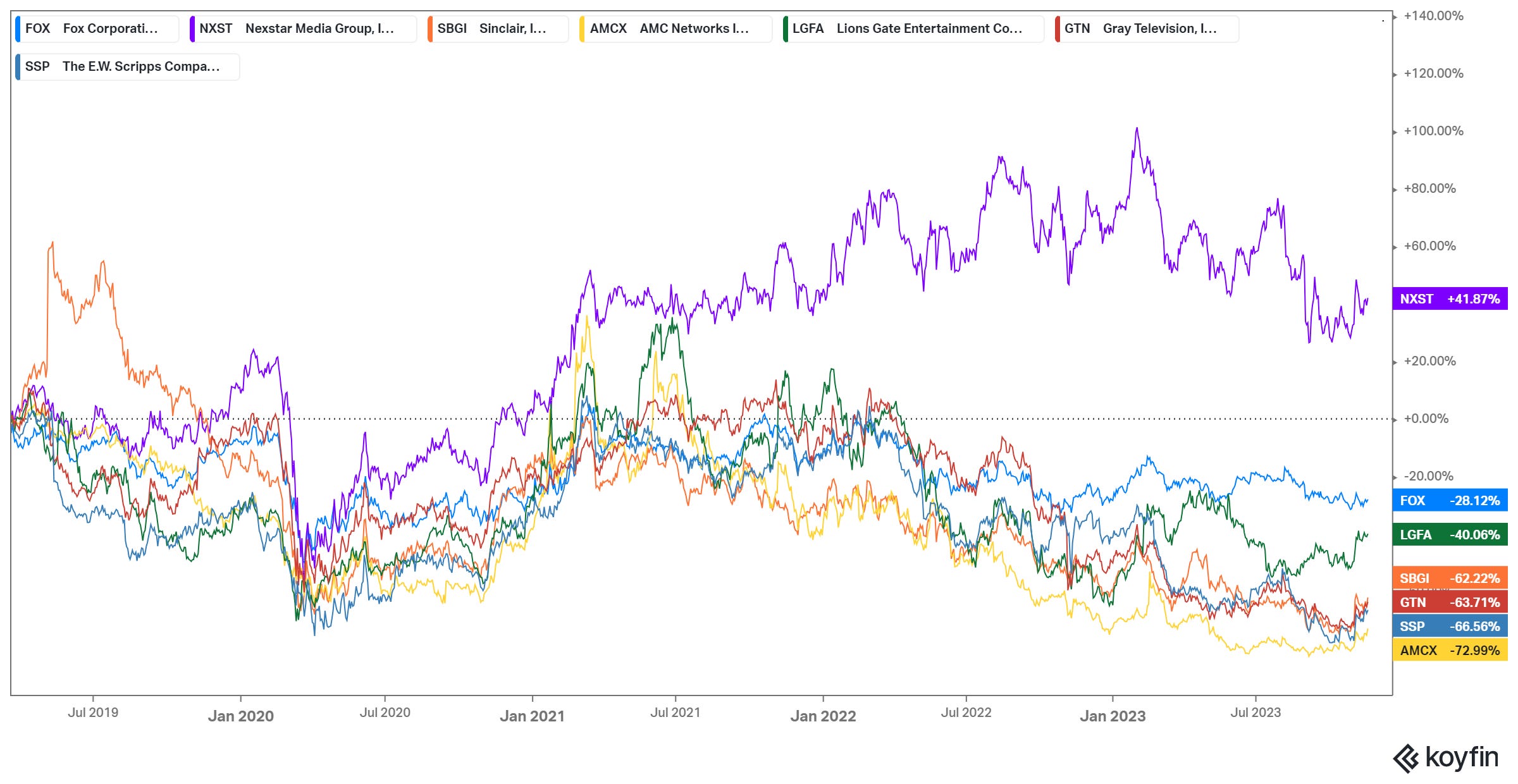
source: Koyfin; chart since March 2019
Whether it’s station owners like Gray Television GTN 0.00%↑ or E.W. Scripps SSP 0.00%↑, or cable operators AMC Networks AMCX 0.00%↑ or Lions Gate Entertainment (which owns Starz), the transition to the streaming world has been painful. Meanwhile, the giants trying to make that transition have been weighed down by their own legacy businesses, whether it’s ESPN and ABC for Disney DIS 0.00%↑ or CBS for Paramount PARA 0.00%↑.
As we’ll discuss, FOXA is cheap — but many of these names have also looked cheap on their face. AMCX, for instance, has traded as low as 3x EBITDA. Again, when a business — and more importantly, when an industry — is in decline, valuation is not going to save shareholders. As such, it shouldn’t be an impediment to a short trade.
The second point is that, for Fox in particular, there are clear, secular, pressures across the entire business. This is a model set up for the old way of doing business, as even chief executive officer Lachlan Murdoch admitted on the first quarter conference call this month:
Frankly, from a Fox perspective, the cable bundle…remains our largest and really the most important revenue stream. And we believe that it will remain our largest for years to come.
The problem is that relying on the cable bundle is precisely what has gotten so many other companies in the media space into trouble. The core argument for FOXA is that it will prove to be the exception to that rule.
The Bull Case For FOXA
The argument for FOXA, whether from bulls in the stock or the executives of the company, is that Fox can sidestep some of the biggest challenges facing the industry because of its focus on news and sports. Both categories remain relatively popular; both are, at least for now, mostly impenetrable to streaming. Even a ‘cord-cutter’ who wants to watch Fox News or FS1 still has to get a subscription to a vMVPD (virtual multichannel video programming distributor) like YouTube TV or Fubo FUBO 0.00%↑. Those vMVPDs pay affiliate fees to Fox Corporation.
And so even in a cord-cutting world, Fox should be able to keep its profits and revenue at worst intact, and potentially still growing. Indeed, to this point that’s exactly what has happened. Here are the company’s growth rates between FY18 and FY23:
Overall revenue: 47% (8% annualized);
Cable revenue: 20% (3.7% annualized);
Television revenue: 71% (11.3% annualized);
Adjusted EBITDA: 28% (5% annualized);
Cable EBITDA: 7% (1.4% annualized);
Television EBITDA: 166% (21.6% annualized).
There are going to be changes in how content is distributed in the U.S., certainly. The agreement between Disney and Charter Communications CHTR 0.00%↑ suggests as much. That agreement followed a dispute over affiliate fees, during which Charter pulled Disney channels off the air. The deal will give Charter’s subscribers access to the Disney+ streaming service, a notable move toward the end of the firm dividing line between linear and digital distribution.
For his part, Murdoch said after Q3 that the agreement seemed like “a net positive” for his company, arguing that what was good for cable companies in fact was good for Fox. FOXA bulls can also point to commentary from Christopher Ripley, the CEO of Sinclair SBGI 0.00%↑, which operates 55 Fox stations. Ripley said one lesson of the Charter/ESPN battle was that “premium content got paid and non-premium content…did not get paid.” The former descriptor applied to ESPN; the latter to the multiple Disney-owned channels (including Freeform, FXX, and Disney Junior) that are being dropped by Charter.
Whether it’s Fox News, or American football (pro or college), the case for Fox is that it carries the premium content. And that in turn means that the company will still be paid, no matter what the distribution landscape in the U.S. looks like.
Cable Affiliate Fees Start To Turn
What makes a short of FOXA intriguing, however, is that the bear case can still hold even if there’s some underlying truth to those bullish arguments. The issue here is not so much if Fox will get paid, but how much and by whom.
One of the obvious issues centers on affiliate fees in the cable business. This is a huge revenue stream for Fox, driving nearly 30% of consolidated revenue in fiscal 2023. And it’s likely peaked. The metric declined (if by less than 1%) in FY23, and then fell 2.7% year-over-year in Q1 2024. That weakness follows a period of deceleration, with the growth rate dropping from 7% in FY19 to 2%, 3%, 5%, and negative.
The issue is the subscriber base. Fox News had 87 million subscribers at June 30, 2018; the figure was 72 million five years later. Like other network operators, Fox for a few years was able to offset declines by hiking per-subscriber rates. But that is precisely why the Comcast-Disney dispute was discussed on seemingly every conference call in the sector this earnings season: at a certain point, MVPDs were going to push back. The fact that Charter flexed its muscle against ESPN — far and away the most powerful cable network for years and, as we’ve written previously, the poster child for making billions of dollars annually off customers who don’t even watch the network — shows how serious distributors are about reining in affiliate fees. Those distributors are barely making money off video at this point anyway; in that context, the threat of losing subscribers unhappy at the loss of a favorite channel (or channels) is barely a threat at all.
Fox is going through a particularly heavy cycle of negotiations at the moment (about one-third of its base in 2023, 2024, 2025), and management has tried to talk up a good game. But chief financial officer Steven Tomsic probably gave a bit away on the Q4 call. He said renewals had helped drive 3% affiliate fee growth in FY23 for the entire company, before admitting that “the impact from these initial renewals primarily benefited our Television segment”. Indeed, subscriber data suggests per-subscriber affiliate fees only rose about 3% year-over-year in FY23, a rate below that seen in the past. Given that the slowing increase likely is driven by renewals, that suggests that even per-subscriber figures are getting to a ceiling.
And Murdoch’s optimism about the Charter-Disney deal seems to ignore the fact that, for his business, losing non-premium channels would be a material issue. Based on the per-subscriber estimates from Kagan cited earlier and subscriber disclosures in the 10-K, FS2 probably accounts for 5-6% of cable affiliate fees, and the Big Ten Network another 10%. The Charter-Disney precedent would suggest those might be at risk, or at least concessions that distributors will be looking for heading in 2024. On the whole, then, nearly 30% of revenue almost certainly has peaked. That alone is a good start for any bear case.
Where Does Cable Advertising Go?
In March 2021, voting machine manufacturer Dominion Voting Systems sued Fox News for defamation after the network allegedly broadcast false statements about rigged voting machines during the 2020 election. In April of this year, the companies settled: Fox paid Dominion $787 million.
There was, and perhaps still is, a sense that the settlement might significantly damage the reputation of Fox News. Whatever the merits of the case — and Murdoch continues to argue that his company was treated unfairly — the settlement was the largest ever, among those publicly known. The discovery phase of the suit included seemingly embarrassing text messages among Fox personalities, with opinion leaders repeatedly criticizing accurate reporting from the news division, and often delivering sentiments at odds with their public personas3. And, though the exact reasons for the move aren’t entirely clear, just days after the settlement announcement Fox let go Tucker Carlson, at the time its top-rated host.
There’s not a ton of evidence to suggest that case holds water, however. Ratings did fall precipitously after Carlson’s departure, and were down year-over-year in Q1, but they appear to have stabilized. Murdoch said at a conference in May that it was the brand, not the individual, that drove viewership, pointing to past “superstars” like Bill O’Reilly, Glenn Beck, and Megyn Kelly, all of whom have struggled to gain an audience after leaving Fox.
But Fox has seen some pressure on advertising revenue in the cable business: the metric declined 8% year-over-year in the first quarter after a 4% fall in FY23. There are some puts and takes here: management has said supply increases from rivals in the spot market has lowered pricing, and last year saw political midterms with historically high spending. Even so, there’s a sense that here, too, the business might be at or near a peak. And that’s a time when the economy is by most standards pretty solid (even if the advertising market, in TV and beyond, is relatively choppy).
On the whole, it simply looks Fox News is not going to be the growth juggernaut it was for the first 25-plus years after its 1996 founding. The platform’s reach is narrowing. Its reputation has taken a hit, if not necessarily with viewers then with advertisers. At the very least, the one-quarter of revenue coming from advertising is not growing, or going to grow, fast enough, to offset weakness in affiliate fees. It seems highly likely that Fox News is a declining business. Given performance at ESPN, it seems almost certain that its weaker rival, Fox Sports, is the same.
Can Television Pick Up The Slack?
And if cable is in decline, then the short thesis here becomes enticing. Again, that business is 70% of EBITDA. Even modest erosion in profits put pressure on Television simply to keep overall earnings stable.
To this point, the segment has been up to the task. But here, too, there are pressures on the horizon. 2023 affiliate fee growth likely benefited from payments from station operators known as “reverse retransmission” fees, ahead of the new television deal with the NFL. Those hikes had been expected for some time. Those hikes have also been huge: Television segment affiliate fees rose 8% in FY23 and in Q1 FY24, and 10% in fiscal 2022, with a chunk of that coming from reverse retrans.
But those operators simply can’t afford to go much higher. Sinclair has a market cap under $1 billion and debt of over $4 billion; Gray’s enterprise value of $6.9 billion includes an equity slice of less than $800 million. And reverse retrans keeps growing: retransmission fees were originally targeted to help local stations, but for Gray (as just one example), 64% of those fees now are getting kicked back to the networks.
The 10-year term of Fox’s NFL deal admittedly provides some certainty. The network is doing well with college football and the popularity of both versions of the sport should keep Fox’s negotiating power reasonably intact.
Yet, here, too subscriber declines are a factor — and even the use of digital antennas (which mean no retransmission fees) is a possible risk. Scripps said after Q4 that industry data suggested about one-third of homes now have antennas, and that’s a way to watch Fox stations without cable — and without a pretty lucrative revenue stream for the network operator.
One possible upside catalyst in the segment is Tubi. Management continues to talk up the business, citing a 30%-plus revenue growth rate in FY23 with similar performance in Q1. Notably, viewer time spent on the service is growing faster. Tomsic has said new management will aim to get monetization growing at the same rate as viewership.
Whether Tubi is material, or close, is tough to decipher. The business remains unprofitable, based on disclosures about Fox’s decisions to “invest” behind the platform. Revenue growth is impressive, but to the best of our knowledge the actual figure hasn’t been disclosed. It’s hard at this point to see Tubi changing the outlook if the rest of the business tumbles — nor does the content seem all that impressive — but one piece of good news is that Tubi, unlike other streaming platforms, doesn’t ‘cannibalize’ Fox’s existing profits, because only a small portion of those profits comes from outside news and sports.
What’s Fox Worth?
On the whole, this simply looks like a business that is going to decline going forward — even granting some validity to management’s claim about the power of live sports and news. There is value to that content, but between pressured MVPDs and pressured station owners, the indirect path of that value to Fox is simply much tighter than it has been in the past.
Admittedly, to some extent FOXA is pricing that in. Shares only trade at about 5.7x trailing twelve-month Adjusted EBITDA (valuing the FanDuel/Flutter assets at $1.4 billion). Political advertising should help calendar 2024 results, and Fox does have a deferred tax asset which should shield ~$1.5 billion in net profit from taxes each year, a ~$360 million annual benefit that management expects to last a couple more years.
But we’d make a couple points here. First, ownership in declining businesses very rarely provides upside. It’s simply too difficult for margins to hold up and for management to hold its fire. Fox hasn’t been that shy about making acquisitions, either — it’s spent about $1.4 billion, even net of assets it’s disposed of — and after taking over from his father Rupert, Lachlan Murdoch is not going to let this company just gently wither away.
Second, there is substantial operating deleverage in the model. Fox’s costs aren’t really going anywhere. Given the company’s aggressive posture with media rights, the cost of those rights may well be over half of total operating expenses at this point — and they will grow every year. Meanwhile, every lost dollar of revenue comes off the EBITDA line at pretty close to 100 cents, since variable costs are minimal. Trailing twelve-month EBITDA margins are 20%. Take 5% off revenue, and those margins probably drop toward 16%, meaning EBITDA falls 20%-plus. Put a mid-5x multiple on $2.2 billion in EBITDA (down 25% from the current level) and even with a $1 billion-plus valuation on the FanDuel asset, FOXA drops by about 30%.
That’s probably a two-year process if it happens, but double-digit annualized gains is not bad work if you can get it, particularly because a big spike higher requires a number of things to go right.
Third, there is an idiosyncratic risk here. Dominion sued Fox for $1.6 billion and got nearly half as much. Smartmatic, another voting machine manufacturer, is asking for $2.7 billion. Fox lawyers don’t appear ready to settle that case yet, but there’s a risk of a material reward there that would offset much of the ‘hidden’ benefit of the FanDuel stake.
And, finally, there’s the pesky nature of what the political universe looks like. It’s not clear whether a Democratic or Republican win would be beneficial for Fox News ratings. Those ratings did go up during the Obama presidency, but rose further during at least the beginning of the Trump Administration. This is a very different environment in multiple ways; historical lessons are unlikely to apply neatly, if at all.
That said, it does seem likely that the nature of the environment has been favorable, most notably because of the presence of Donald Trump. Trump himself has noted on many occasions that he’s made the media a lot of money, and Fox News is probably number one on that list. Reports of a split between Trump and Fox, however, persist, with Trump on occasion flirting with other networks and post-Dominion Fox clearly taking a harder line with the former president’s claims of election fraud. And, at the very least, a replay of the Trump-Biden battle in 2024 seems unlikely to draw the same ratings as the past two contests, if only because so few Americans want to see that show again.
Things simply used to be better, and easier, for Fox News. And at its core, that’s the short thesis for FOXA: that pretty much everything gets tougher from here.
As of this writing, Vince Martin has no positions in any securities mentioned.
Disclaimer: The information in this newsletter is not and should not be construed as investment advice. Overlooked Alpha is for information, entertainment purposes only. Contributors are not registered financial advisors and do not purport to tell or recommend which securities customers should buy or sell for themselves. We strive to provide accurate analysis but mistakes and errors do occur. No warranty is made to the accuracy, completeness or correctness of the information provided. The information in the publication may become outdated and there is no obligation to update any such information. Past performance is not a guide to future performance, future returns are not guaranteed, and a loss of original capital may occur. Contributors may hold or acquire securities covered in this publication, and may purchase or sell such securities at any time, including security positions that are inconsistent or contrary to positions mentioned in this publication, all without prior notice to any of the subscribers to this publication. Investors should make their own decisions regarding the prospects of any company discussed herein based on such investors’ own review of publicly available information and should not rely on the information contained herein.
A Black-Scholes model for an at-the-money option expiring in 7.1 years, with risk-free rate at 5%, and volatility of 31.72% is worth 45% of the exercise price.
Somewhat oddly, FOXA is more expensive than FOX, despite the fact that the FOX ticker is assigned to Class B shares, which have voting power. Class A shares only have voting rights in very limited circumstances. The most likely explanation is that liquidity begets liquidity: three-month daily average volume in FOXA is more than three times that of FOX, and so investors will pay a premium to trade that issue.
NSFW link.