
Highlights:
The bull case for PACK took some time to play out, but the Q4 report suggests a return to growth.
JMIA looks awful fundamentally. But new management has opened a path to upside.
WOOF might be a zero — and that might be good news for a key competitor.
After an ugly quarter from VFC, a key question hovers over the case for a turnaround.
With earnings season just about over, we’ll take a look at four big movers.
Ranpak Holdings Gets A Bid
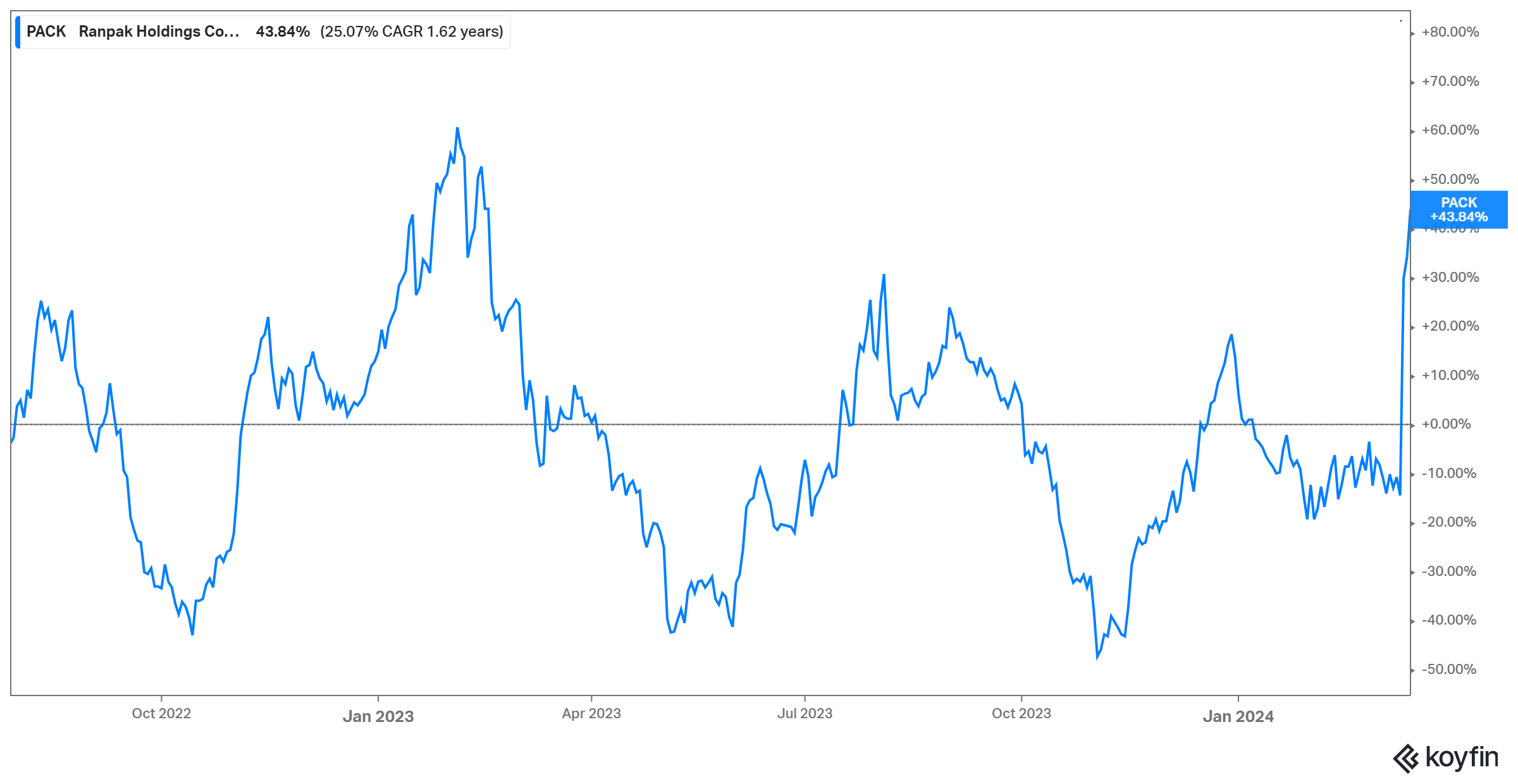
It took almost 20 months, but our bull case for Ranpak Holdings PACK 0.00%↑ seems to have played out:
source: Koyfin; chart since 7/30/22
PACK jumped 52% on Tuesday, and tacked on another 3.7% on Wednesday and then 7% more on Thursday. What’s interesting about the rally is that neither earnings nor the stock look that impressive. The outlook for 2024 seems to be in line with consensus before the release: Ranpak sees revenue growth of 6%-12% (the Street was at 9.3%), with constant-currency Adjusted EBITDA up 10.4% at the midpoint (which is actually ~$0.5 million below consensus, albeit from just three analysts).
Per detail given on the Q4 call, the EBITDA outlook implies free cash flow for the year of about $15 million. That’s a high 30s price/FCF multiple for a business still net leveraged 4.6x based on 2023 results, and ~4x based on the 2024 guide. EV/EBITDA is over 11x for low double-digit growth.
But in the context of the last couple of years, the rally makes sense. Thanks to heavy exposure to e-commerce demand, Ranpak was a ‘pandemic winner’ turned pandemic loser. Pulled-forward demand in 2020 and 2021 pressured results in 2022 and into 2023. Now, management is saying that, finally, normalcy is returning.
That in turns opens a path toward steady, double-digit annualized returns, even after this week’s huge rally. Valuation isn’t necessarily cheap, but between reduced capex and lower interest expense thanks to deleveraging, free cash flow should improve in 2025 and beyond.
source: One Madison/Ranpak merger presentation, December 2018
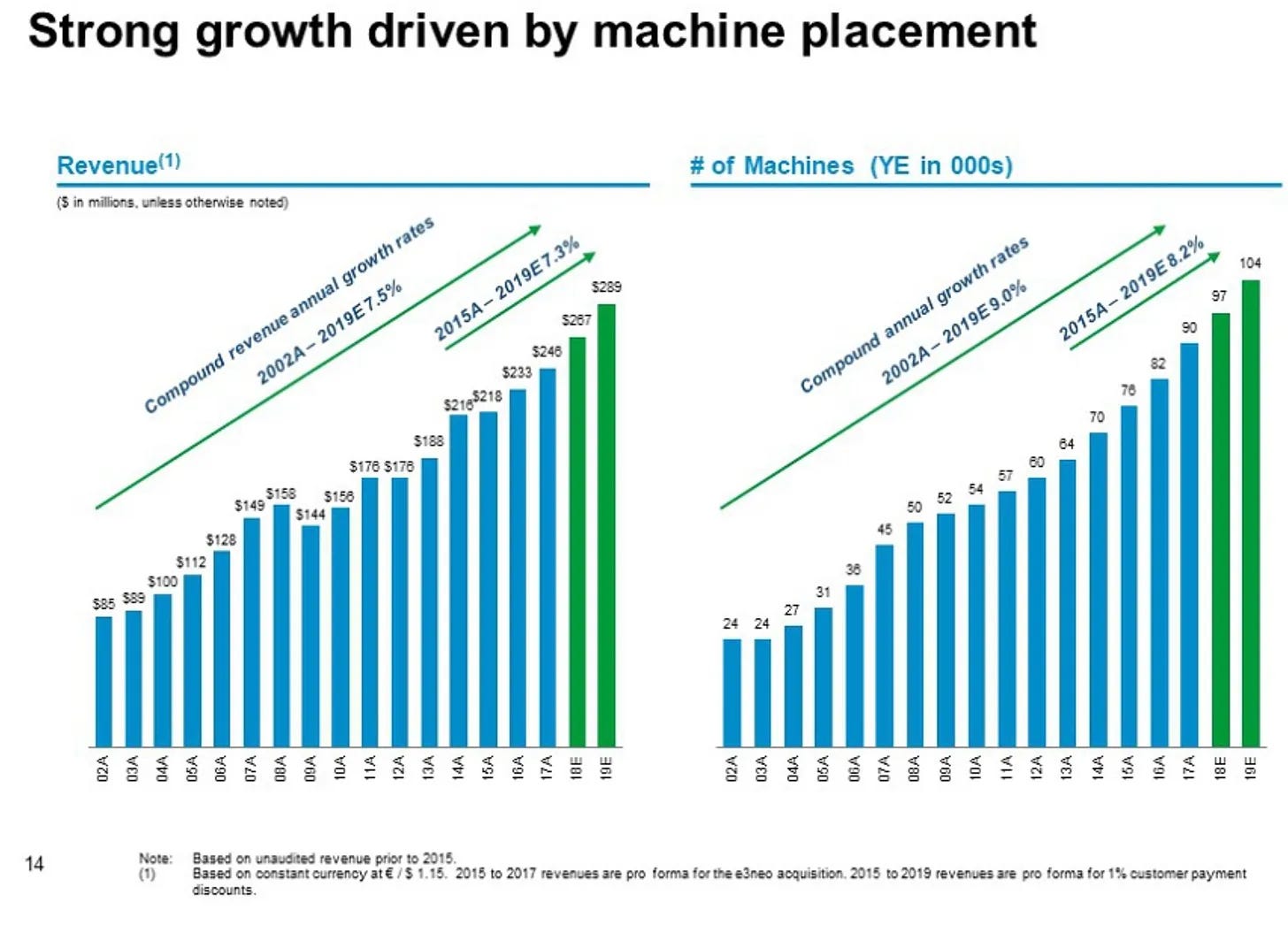
As management noted after Q4, so-called “extended producer responsibility” laws are coming to the U.S. This is a clear tailwind for Ranpak’s more environmentally-conscious offering, and the benefits of a razor/blade model (Ranpak installs systems and then sells the materials used to create packaging) should drive margin expansion along with that revenue growth.
All told, an attractive long-term story is finally starting to show. That was our argument nearly two years ago, when we thought PACK had a strong chance to double from a price of $5. $10 still seems like a reasonable two- to three-year target if Ranpak can keep the momentum going in 2024, which means there’s room for double-digit annualized returns even from here.
The ‘Amazon of Africa’ Is Up 99% Year-To-Date
I’ve always had an odd soft spot for Jumia Technologies JMIA 0.00%↑. The company, often referred to by bulls as the ‘Amazon AMZN 0.00%↑ of Africa’, seems to have at least an opportunity to develop a sustainable, profitable business as an e-commerce leader on the continent. And, from a high level, that does open the path to potentially enormous returns — at the right valuation.
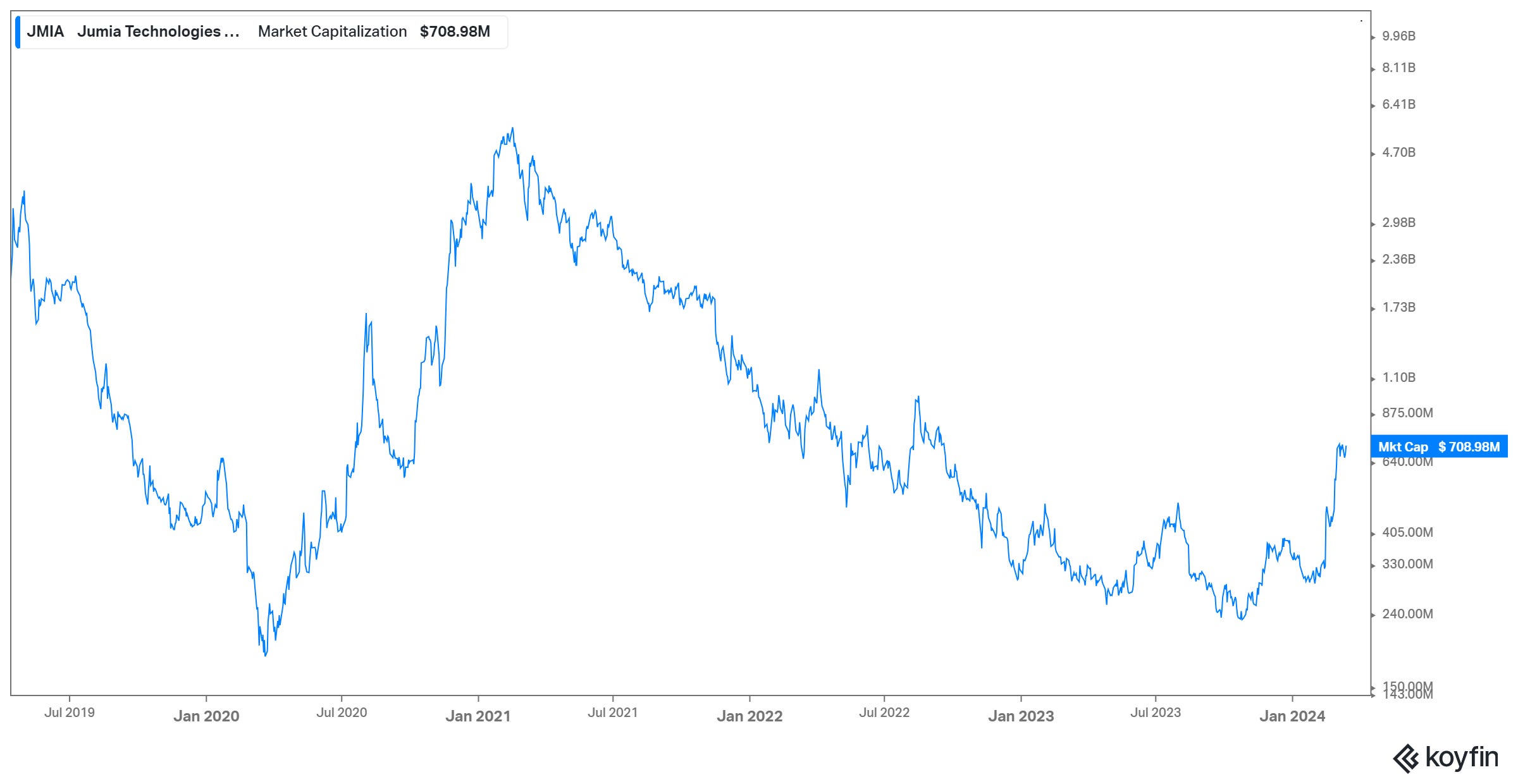
The problem is that the valuation has never been close to right:
source: Koyfin
At the February 2021 peak, JMIA traded at more than 30x revenue — an incredible multiple for a low-margin e-commerce operator. By “low-margin”, we mean gross margins at maturity: the company’s operating margins even during the pandemic were abysmal. Across 2020 and 2021 combined, Adjusted EBITDA loss was 98.7% of revenue.
Jumia remains unprofitable, but it is making progress: Adjusted EBITDA loss in 2023 shrunk by 68%, though margins are still pretty rough (negative 31%). That, combined with some optimism from management toward 2024, has been enough for JMIA to roar off the lows and nearly double year-to-date.
The bear case here is that Jumia is a business that is simply going to take decades to get anywhere. The issue in Africa is not necessarily Internet access, but infrastructure. In 2022, cancellations, failed deliveries and returns accounted for a stunning 20% of GMV (gross merchandise value)1.
Because of safety issues in some neighborhoods and an underbanked population, Jumia has to offer the option to pay cash on delivery, but in many cases customers simply aren’t home, which means deliveries eventually just get canceled. Over time, that figure will improve, while a young population and decent economic growth in key markets like Egypt and Nigeria should allow Jumia to get to profitability — eventually.
One question has been whether Jumia would be able to fund itself to that point. The company has hemorrhaged cash amid an aggressive marketing strategy, but managed to grow GMV in constant currency in 2024 despite a sharp pullback in spending. The company will need to raise capital — year-end liquidity of $120.6 million would last about six quarters at the 2023 burn rate — but lower losses mean lighter dilution. In that context, the year-to-date rally has some basis, perhaps in a way that the 2020-2021 did not.
Can Jumia Get There?
JMIA is not a stock that can be valued with a discounted cash flow model. There are simply too many moving parts. The political situation on the continent remains rather fraught. Inflation has spiked this year: incredibly, reported fourth quarter revenue was down 2%, but up 28% in constant currency. Competition is an issue: Jumia long has battled rival Konga in Nigeria, and Amazon looms.
The American giant is entering the South African market this year, which is not a huge problem for Jumia, which generates just 3% of GMV in the country. The bigger threat is in Nigeria (one-third of GMV). In 2022, Amazon announced plans to launch in that country; those plans have apparently been delayed, but there’s no indication they have been canceled.
And one big problem for the Jumia bull case is that it’s difficult to have confidence that the company can necessarily compete at the highest level. The company has changed its product focus multiple times before finally settling on a core group of categories: phones, electronics, home & living, fashion and beauty. It launched a food business, then shuttered it. It prioritized groceries, then exited that business as well.
The ability to grow constant-currency GMV with sharply lower marketing spend is good news in terms of the outlook going forward. But that ability also raises real questions as to why Jumia needed to accumulate losses of nearly $2 billion driven by much more aggressive spending, and on what basis management was projecting return on that spending.
But a new chief executive officer, promoted from within, has clearly focused much more closely on the bottom line and instituted a number of other changes as well, including forcing executives to work in Africa instead of a satellite office in the Middle East. The Q4 report in particular highlights some green shoots in the turnaround. Again, the rally here makes some sense.
As to valuation, it’s likely in the eye of the beholder. But with a market capitalization of just $700 million, there clearly is a path for JMIA to be a huge winner. A market cap of $10 billion a decade from now, to use round numbers, wouldn’t be shocking. Economic growth, improved infrastructure, and better execution can lead to the long-awaited sustainable top-line growth, eventual profitability, and a glowing multi-year (if not multi-decade) outlook. Even assuming dilution along the way, JMIA is probably a ten-bagger in ten years in the bluest-sky scenario.
Obviously, there’s a lot that can go wrong for Jumia as well. It’s just as true that it wouldn’t be shocking if Jumia didn’t exist a decade from now. But if the company can stay on the current path, that outcome probably doesn’t play out — and shareholders probably do quite well from here.
The Petco Story Sounds Familiar
In late 2022, we briefly touched on the second quarter conference call from Petco Health + Wellness WOOF 0.00%↑. To our ears, the call sounded an awful lot like so many in the apparel retail space in the second half of the 2010s: management blaming disappointing performance (Petco cut its guidance in that release) on external factors (in this case, ‘transitory’ inflation; in 2010s retail, ‘macro weakness’, the weather, and a variety of other causes).
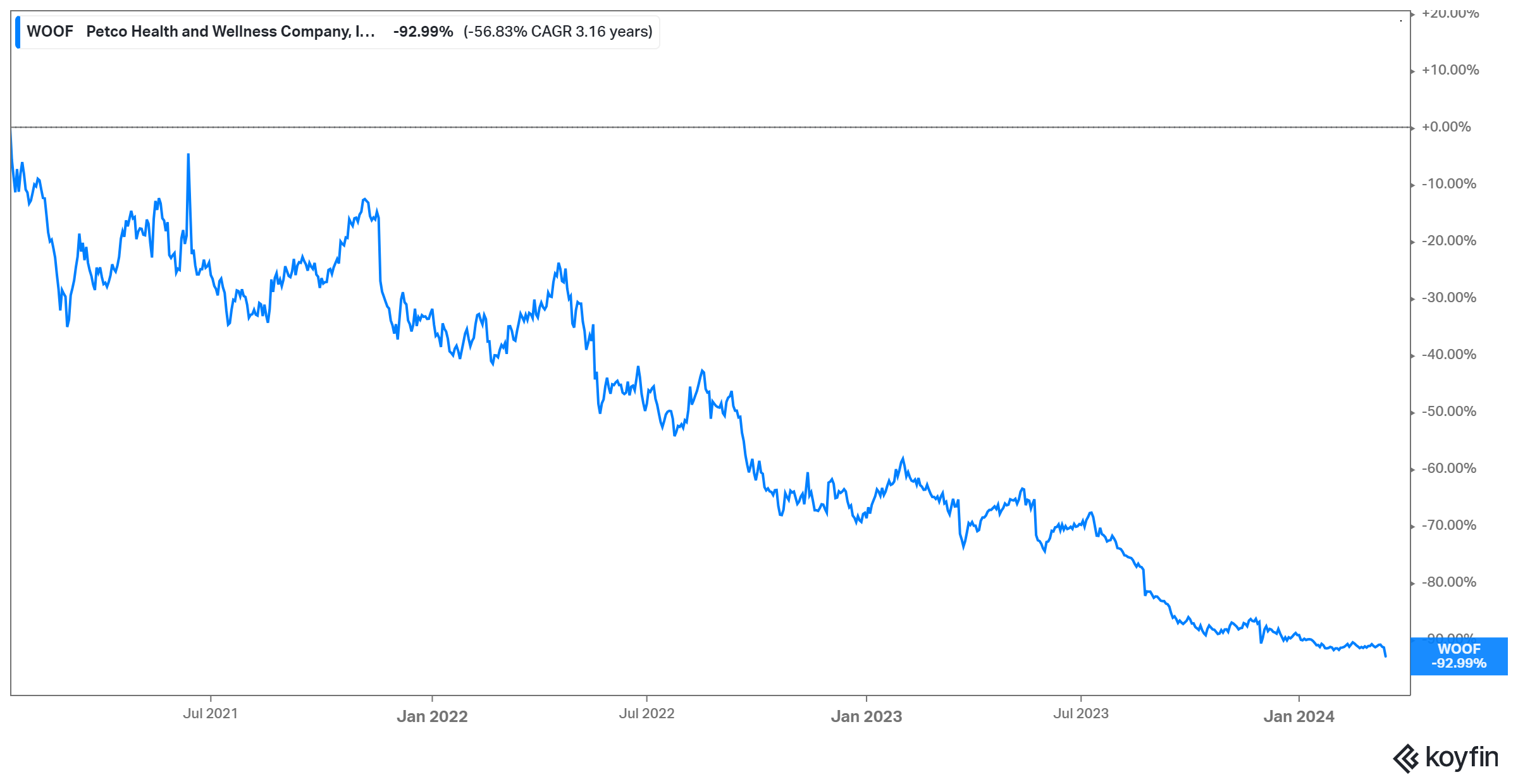
Nearly 18 months later, WOOF now looks like a retail stock circa 2018:
source: Koyfin
The business has the same sense. The top line doesn’t look that bad: same-store sales increased 1.8% in fiscal 2023 (ending February 3, 2024), and the two-year stack is +6.3%. But gross profit is heading in the wrong direction (-3% year-over-year, even with a 53rd week) and that in turn is driving operating deleverage. Adjusted EBITDA fell 24% in FY23, and by one-third in the fourth quarter (which had an extra week).
The reaction sounds the same as well. Chief executive officer Ron Coughlin stepped down on the same day as the Q4 release (he also relinquished his chairman title and board seat), but it’s not really clear what new management can or even is supposed to do. Under Coughlin, Petco expanded its reach beyond brick-and-mortar retail into not only e-commerce, but services such as training, grooming, and veterinary care as well. The strategy made some sense; it just hasn’t worked.
WOOF Might Be A Zero
Unfortunately for Petco, the company has a still-heavy debt load, a vestige of its days under private equity ownership. (The company’s 2021 initial public offering was actually its third IPO.) Net debt at the end of FY23 was $1.48 billion, and there’s another $1.12 billion in operating leases. FY23 Adjusted EBITDA was just over $400 million, but Q1 guidance2 is for just $70 million, a year-over-year decline of 37%.
Per Koyfin, analyst consensus for FY24 Adjusted EBITDA is $343 million, but that figure has to come down, and maybe sharply. A similar decline for the full year would put EBITDA at ~$250 million, even ignoring the loss of the extra week3.
The problem with that figure is that it suggests net debt right at 6x EBITDA — and that’s simply not tenable for this kind of business in a normalized interest rate environment. Petco did give a full-year outlook for interest and capital expenditures: they total $285 million, which strongly suggests another year of negative free cash flow (the figure in FY23 was -$10 million).
With meme stocks seemingly done4, the ability to “short to zero” is back on the table (and cost of borrow is minimal). That trade already is somewhat popular: short interest is 17% of the float. It’s not a perfect trade: the interim CEO is a Best Buy BBY 0.00%↑ veteran, and it doesn’t take that much for turnaround hopes to spark a big rally. But it is at least intriguing (though the term loan here doesn’t mature until March 2028).
The more interesting question is if Petco’s $6 billion-plus in revenue might be up for grabs. Chewy CHWY 0.00%↑ stock declined 4.4% on Thursday, apparently in sympathy with WOOF — but it’s fair to wonder if the market is taking the wrong message here. Chewy’s $11 billion in revenue, and aggressive efforts in building out its own services platform, both stand to benefit if Petco tries to shrink its way to solvency.
As we wrote back in September, CHWY looks intriguing at the lows, despite a few risks. Perhaps one way to hedge those risks is with a short position in the company’s struggling brick-and-mortar rival.
An Ugly Q3 For VF Corporation
Since Bracken Darrell took over as CEO of VF Corporation VFC 0.00%↑ in July, he has consistently cautioned that the turnaround of the struggling company is going to take time. Relative to Vans, the weakest-performing major brand in the portfolio, he flatly said in October that “we will not see a turnaround this [fiscal] year”.
Darrell was telling the truth. Fiscal third quarter results from VF last month look dreadful. Revenue declined 16% year-over-year, and adjusted operating margins plunged 560 basis points to 9.3%. Adjusted EPS was nearly halved.
Investors unsurprisingly responded by sending VFC down 10% after the release. Shares bounced the following week after Darrell bought nearly $1 million worth of stock in the open market and amid optimism that activist Engaged Capital would get a pair of board seats (that optimism was confirmed two days later). But VFC has again weakened, and is on a path to re-test the 12-year low it reached in early November.
To be sure, the report itself doesn’t really break the turnaround case we discussed last year. Timing of wholesale orders was a negative in Q3 after being a positive the quarter before. Again, Darrell has been crystal clear that improvements in execution, marketing, and efficiency are going to take time. Between Vans, The North Face, Timberland and Dickies, VF still has valuable brands. It simply needs to maximize the value from those brands — and with Q3, Darrell announced a portfolio review as part of that process.
That said, the report hardly helps the case, either. Valuation is only attractive if the turnaround indeed works: VFC is trading at around 10x FY24 (ending March) EBITDA, based on current consensus. Net debt is about 4.6x EBITDA, and by the end of Q4 that ratio will rise toward 5x: full-year guidance for free cash flow implies burn of over $300 million this quarter. At some point, VF needs to give investors a reason to buy, and Q3 didn’t do so.
Turnaround Hopes Dim
In fact, coming out of the quarter, we’re probably less optimistic toward VFC than we were at the time. We’re not alone, as shorts continue to press their bets on the stock:
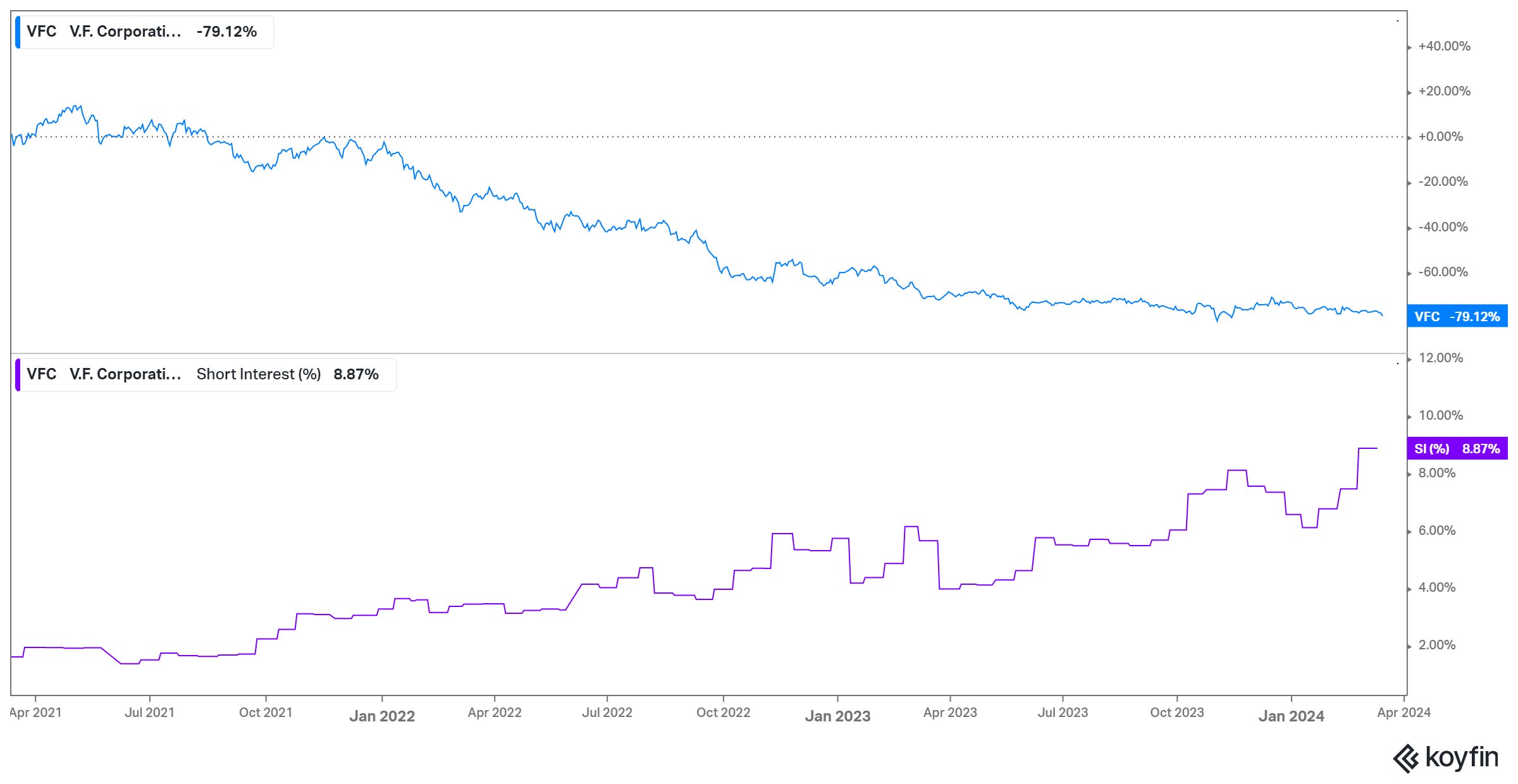
source: Koyfin (top chart is total return)
Two important points from the quarter stand out, one in a short-term sense and the other from a multi-year perspective.
The short-term concern is that, on the Q3 call, Darrell still didn’t have much in the way of concrete evidence for improvements in the business. There were a lot of assertions, certainly, that Vans will bounce back; that the North Face is in excellent shape despite an ugly quarter5; that the backpack business finally will be sold after at least 16 months of deliberation; and that the direct-to-consumer business will keep growing.
But given that Darrell had been in his role for six months at the time of the call, the CEO had little to say in terms of concrete examples of why respective brands have faltered and clear strategies for driving a rebound. (Darrell seems to think that management is one issue: the housecleaning in the top ranks continued, with the chief financial officer retiring and the chief product officer for Vans leaving along with other “high-level” colleagues.)
The longer-term concern, which we may have underplayed in our initial coverage of the stock, is sparked by a comment from the outgoing CFO on the Q3 call. In the Q&A, Matt Puckett noted that gross margin was “a couple hundred basis points, maybe even a little bit more, below where we were just a couple of years ago, all attributable to promotional activity and higher inventories and inventory reserves, et cetera.”
Here’s the thing: almost every company in the industry has gross margins below where they were a couple of years ago, precisely because promotional activity has normalized. In fact, VF’s gross margins through the first nine months of FY24 are only 130 basis points below where they were four years earlier (ie, before the pandemic). Given normalized inflation, that doesn’t suggest a massive opportunity for improvement (though Puckett argued otherwise).
The issue is that operating expenses have deleveraged dramatically (by 580 bps). And so, excluding impairment charges, operating margins have been basically halved to 7.2% from 14.3% in the first three quarters of fiscal 2020. That deleverage isn’t being driven by wild spending (SG&A has increased barely 2% total over the four years), but by disappointing revenue performance (-11% over the same period).
In our November piece, we noted that VF’s performance during the pandemic was actually quite pedestrian. Full-year revenue between FY20 and FY23 rose just 11%, and adjusted operating income fell 16%. Performance in both metrics is quite soft in the context of soaring sales and massive margin expansion for apparel plays during that period.
But we didn’t jump to the potentially bearish conclusion from that performance: it may well be that the pandemic obscured the brand problems in Vans, Timberland, and Dickies. That in turn means that there is not just a year or two of rot to fix, but potentially four years. That is an eternity in the modern consumer space.
And VFC really is about whether Darrell can fix these brands. It’s that simple. The portfolio review sounds good on its surface, but there’s almost certainly nothing materially important that can come out of it. VF can sell a brand at trough performance to deleverage, or it can keep the brand in-house and have to fix it itself. Neither path changes the story enough; single-digit consolidated operating margins mean there’s no viable way to break up the company, by spinning North Face for instance6.
As we wrote last year, Darrell is a well-respected executive for good reason. He fixed Old Spice for Procter & Gamble PG 0.00%↑, and had an impressive tenure at Logitech LOGI 0.00%↑ after that. But he absolutely has his hands full. The old saw is that turning around a business like VF is like turning around a battleship. But, to stretch the metaphor to its breaking point, it doesn’t matter how good the captain is if the ship isn’t seaworthy. Right now, VF has a lot of holes.
As of this writing, Vince Martin has no positions in any securities mentioned.
Disclaimer: The information in this newsletter is not and should not be construed as investment advice. Overlooked Alpha is for information, entertainment purposes only. Contributors are not registered financial advisors and do not purport to tell or recommend which securities customers should buy or sell for themselves. We strive to provide accurate analysis but mistakes and errors do occur. No warranty is made to the accuracy, completeness or correctness of the information provided. The information in the publication may become outdated and there is no obligation to update any such information. Past performance is not a guide to future performance, future returns are not guaranteed, and a loss of original capital may occur. Contributors may hold or acquire securities covered in this publication, and may purchase or sell such securities at any time, including security positions that are inconsistent or contrary to positions mentioned in this publication, all without prior notice to any of the subscribers to this publication. Investors should make their own decisions regarding the prospects of any company discussed herein based on such investors’ own review of publicly available information and should not rely on the information contained herein.
Jumia hasn’t released its 20-F for 2023, and management hasn’t discussed the metric on earnings calls so far this year. That suggests the figure likely hasn’t improved, though Jumia has been hit-and-miss in highlighting the metric in the past.
The company isn’t giving full-year guidance, which it attributed to the change in management.
Put another way, the only way Petco is hitting consensus expectations if the business stabilizes in Q2-Q4, and there’s little evidence that is going to happen.
WOOF itself had a day in the meme stock sun back in June 2021.
Management blamed the weather for a 10% decline in sales, which almost always is a red flag for a consumer business. In the case of North Face, however, the winter really has been warm, and it’s likely more of a reason and less of an excuse.
There are shades there of the Gap Inc. GPS 0.00%↑ plan to spin off Old Navy, which was canceled because the increased operating costs of two businesses negated any potential value creation.