
Last week, we looked at the most impressive stocks of the year. This week, we’re reviewing the weakest performers.
To reiterate, these lists are not just compilations of stocks that performed the worst (though, obviously, stock price is a key factor). Instead, these are companies where strategic errors or execution failures (rather than external factors) have led to significant destruction of equity value.
A Quick Look At The 2022 List
Our list of last year’s least impressive stocks would have made an incredible short portfolio here in 2023:
Cano Health seems headed for bankruptcy. The stock is down 95%, and Cano recently executed a 1-for-100 reverse split.
Big Lots has shown a bit of life lately, gaining 122% off November lows. But there may be a short squeeze at play. The discount retailer continues to show little reason for existing, let alone competing. BIG is down 48% YTD, even with the rally.
FTC Solar couldn’t show positive returns in a strong 2022 for solar stocks; shares declined 65%. This year performance has been even worse: FTCI is -73%.
Verizon has clawed back to positive total returns in 2023, and has outperformed AT&T by about five percentage points on that basis. But that’s hardly impressive performance: AT&T doesn’t exactly create a high bar to clear, and T-Mobile is +11% YTD. A 7% dividend still draws in income investors, but VZ still seems to be a yield trap.
This year’s list may well show poor performance in 2024 as well — in large part because at least one, and maybe more, of these companies won’t be able to salvage any value for shareholders at all.
Enviva Sends Itself Hurtling Toward Bankruptcy
Enviva stock is down 98% so far in 2023. At the start of the year, the company’s market cap was $3.5 billion. It’s now $74 million.
Those two facts alone could merit the manufacturer of wood pellets a spot on this list. But it’s how the EVA stock price collapsed that shoots it up the rankings. As we detailed back in late June, Enviva held an Investor Day in early April. At the time, the company expressed confidence toward 2023 and beyond. The company forecast that Adjusted EBITDA would double by 2026, and that its dividend would remain “stable” (the company in fact used the term “stable dividend” four different times in the accompanying PowerPoint presentation). The company noted that funding needs were coming down sharply, with capital expenditures for new plants coming from a partnership with the state of Mississippi.
At the Investor Day, co-founder and then-chief executive officer Thomas Meth said in his initial remarks:
I have great conviction around this. Nothing that we've experienced would lead to any questions on my mind that we can achieve what we've set out to accomplish…
I hope that after you leave today, you will have the same confidence that I have, that we are on an incredible path, [and] that we are making the right decisions to fulfill the promise [of our company] by building incremental capacity. As you know, we have a pretty substantial backlog, and we're sold out for many years.
The company’s other co-founder, John Keppler, at the time was Enviva’s executive chairman (after returning from a leave of absence to manage a heart condition). He too tipped a hugely optimistic presentation [emphasis ours]:
What you're going to see [today] is that we have plenty of liquidity, complemented by growing long-term cash flows that protect our stable dividend, and enable us to invest in projects with strong returns.
One month later, Enviva reported results for the first quarter — a quarter that ended three days before that Analyst Day took place. It was a disaster: cost-saving efforts disappointed, leading to a huge whiff on bottom-line guidance. It was unclear why or how management didn’t know the quarter was so poor before the Analyst Day (which, again, was held in Q2, not in Q1). But clearly, at some point between the Investor Day and the Q1 release, Enviva executives did a 180: after talking up the payout repeatedly in early April, in early May the company eliminated its dividend.
Thanks to both fundamental disappointment and managerial malpractice, EVA plunged 67% the next day. Shares kept falling, and Enviva itself kept adding to the pressure.
In Q3, the company disclosed a bad trade on wood pellets that had already cost it $140 million, and at current prices would cost it $140 million more. Those losses might well be enough to tip Enviva into bankruptcy. The company’s 2026 unsecured notes now yield 47.7%:
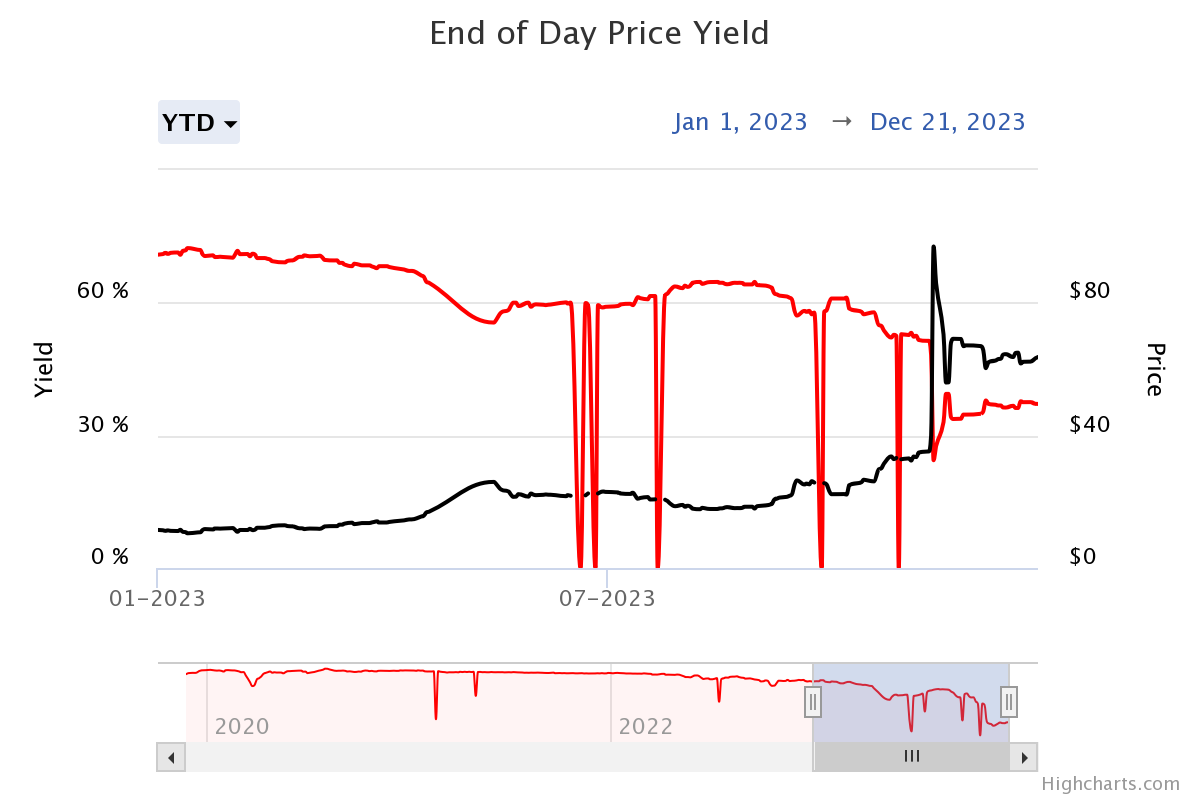
source: Finra (price in red, yield in black)
Even in the bull market of 2023, there are stocks down big. But nearly the entirety of Enviva’s wounds are self-inflicted. Wood pellets are sold to Europe as an environmentally-friendly substitute1 for coal; with the war in Ukraine still raging, demand remains intact. It’s terrible execution and an awful trade that have driven most of the year’s 98% decline.
More broadly, it’s difficult to remember this kind of implosion from this kind of company. Stocks that drop 98% in a year are usually questionable companies to begin with, biotechs that whiff on development, or small-cap growth names that see financing dry up. None of those characteristics really apply to Enviva. There were some risks around the business — activist short Blue Orca took aim at Enviva last October — but nothing that could create such spectacular value destruction in such a short amount of time. Enviva’s performance in 2023 almost certainly qualifies as the worst in the entire market — and one of the worst in recent memory.
Farfetch: Management Or The Model?
The narrative around Farfetch is going to be that the problem was simple: the business model didn’t work. And so it was inevitable that the story would end badly for shareholders, as it did last week. Farfetch is selling itself to a consortium led by Coupang in a deal that will wipe out its shareholders; Farfetch stock was delisted as a result.
There is some truth to that narrative. In May 2022, we made a not-quite-wholehearted recommendation of Farfetch stock, but also highlighted precisely the risk that seems to have played out:
The long-running worry here has been that multi-brand retailers will get shoved out by so-called monobrand offerings [single-brand websites operated by the brand owner]…Luxury retailers, in particular, simply have to control supply and distribution because brand perception is so key. Those retailers are not trying to sell everything they can; in many cases, they’re not necessarily even trying to sell more.
That said, the problem here wasn’t necessarily that Farfetch couldn’t take market share. Gross Merchandise Value was modestly positive year-over-year in the first half of 2023 (Farfetch never did deliver Q3 results after postponing the release last month), and plus 2% in constant currency for full-year 2022. That’s hardly impressive growth, but GMV had grown at a 50% annualized clip between 2015 and 2021. Farfetch expected the figure to exceed $4 billion this year so there seemed some kind of role for the company in the luxury ecosystem. As recently as May, the stock had shown some life, gaining 41% in four sessions into and out of a Q1 earnings release that handily topped analyst expectations and seemed decent on an absolute basis as well.
The issue is that Farfetch couldn’t do almost anything else right. Full-year guidance was cut sharply in both 2022 and 2023. Profitability was nonexistent: Adjusted EBITDA margins were negative 7% in the first half of 2023, even excluding heavy share-based compensation. But despite that, there was enough here for Farfetch, in May, to still have a market capitalization well past $2 billion.
That in turn was enough for the company to avoid imploding just seven months later. An equity offering would have been painful, but the company ended Q2 with net debt of $463 million. Even a 15% slug would have raised $300 million, covering first-half cash burn (some of which was caused by inventory build which would reverse during the holidays) and likely putting lenders at ease. Similarly, Farfetch could have looked to have moved some of its acquired businesses, such as UK retailer Browns or “brand platform” New Guards, the latter of which seemed to have performed reasonably well after it was purchased in 2019 until hitting an air pocket this year. There’s even a stake in retailer Neiman Marcus which appears to still be on the books. Farfetch did cut costs this year, but obviously that was too little, too late.
Layoffs aside, Farfetch simply didn’t do anything. And that in turn led, apparently, to a crisis of confidence that forced the company into the Coupang deal. Incredibly, it’s not even clear what exactly created such a crisis so quickly. Neither the company’s convertible debt nor its term loan were maturing any time soon. It seems like the company actually ran out of cash, rather than failed to pay back a lender — which speaks to breathtaking financial mismanagement and an inability to forecast the business.
FTCH bears and skeptics no doubt are taking a victory lap here. But Farfetch’s collapse doesn’t actually prove its business model was doomed from the jump. There were years of questionable decisions here (including the New Guards deal, which moved the company away from its original focus on a capital-light platform).
Those decisions in hindsight look like the kind of errors we discussed in our March piece on Stitch Fix, with Farfetch trying to reinvent luxury retailing instead of finding a solidly profitable niche. But those missteps alone didn’t put Farfetch stock on a straight path to zero. There were paths to salvaging value here, and management was either unwilling or unable to go down those paths until it was far too late.
Cutera Does It All Wrong
The maker of energy-based aesthetic devices had a highly unusual proxy fight in March which led to both the company’s chief executive officer and chairman being fired for cause. A couple weeks later, we thought the stock looked intriguing, though with guidance withdrawn too risky to enter just yet.
Since then, CUTR is down 82%. It’s off more than 95% from 2021 highs, and touched an all-time low this year. That’s unusual for a macro-sensitive company that went public in 2004, and had to survive the aesthetics industry getting crushed during the 2008-09 financial crisis:
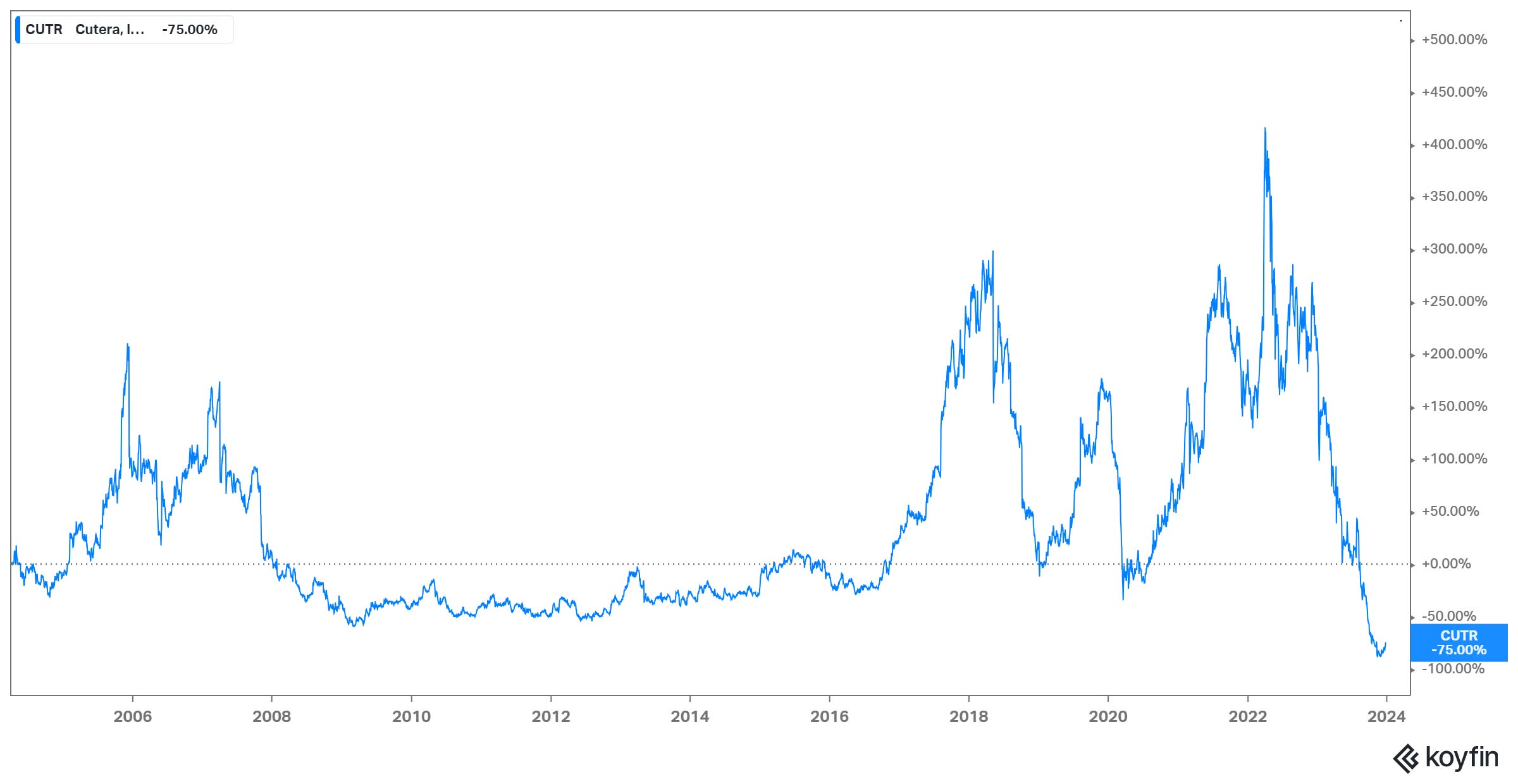
source: koyfin.com
The 2021 highs were driven in part by optimism toward the company’s AviClear acne treatment. But the launch has failed spectacularly. The supply chain is all fouled up due to problems with outsourced production, demand from providers and end customers has disappointed, and Cutera has even stopped placing new machines to get the product in some kind of order.
To make matters even worse, management has said that the focus of the company’s sales team on AviClear has crushed its ability to sell the other products (you know, the ones that actually work)2. And to top it all off, the company apparently has an accounting problem. In the Q3 release, it said that a physical inventory count came in $8 to $9 million below the system of record, which led the company to delay filing its 10-Q. In that release, Cutera promised the 10-Q “within the next few weeks”; that was seven weeks ago, and no filing has yet been made.
There are two tiny pieces of good news. The first is that new management has been blunt and honest about the problems that exist, and so there is at least an effort toward improvement. The second is that Cutera has time. The company has $417 million in debt outstanding, but it doesn’t mature until March 2026 ($67 million), March 2028 ($240 million), and March 2029 ($120 million). Post-Q2 cash of $181 million gives some cushion.
At this point, however, that good news doesn’t seem like enough. Cutera may not have as much time as its debt maturity schedule suggests: the company burned more than $90 million just in the first half of this year. Management said on the Q3 update call that purchase commitments to vendors for AviClear devices would use up cash in early 2024 as well. There’s absolutely a scenario in which Cutera issues a going concern warning within the next 12 months — and, of course, a scenario in which its accounting issues are much deeper than initial commentary suggested.
For both reasons, shorts haven’t gone anywhere. 33% of the float is still sold short, and that figure has actually steadily increased so far this year:
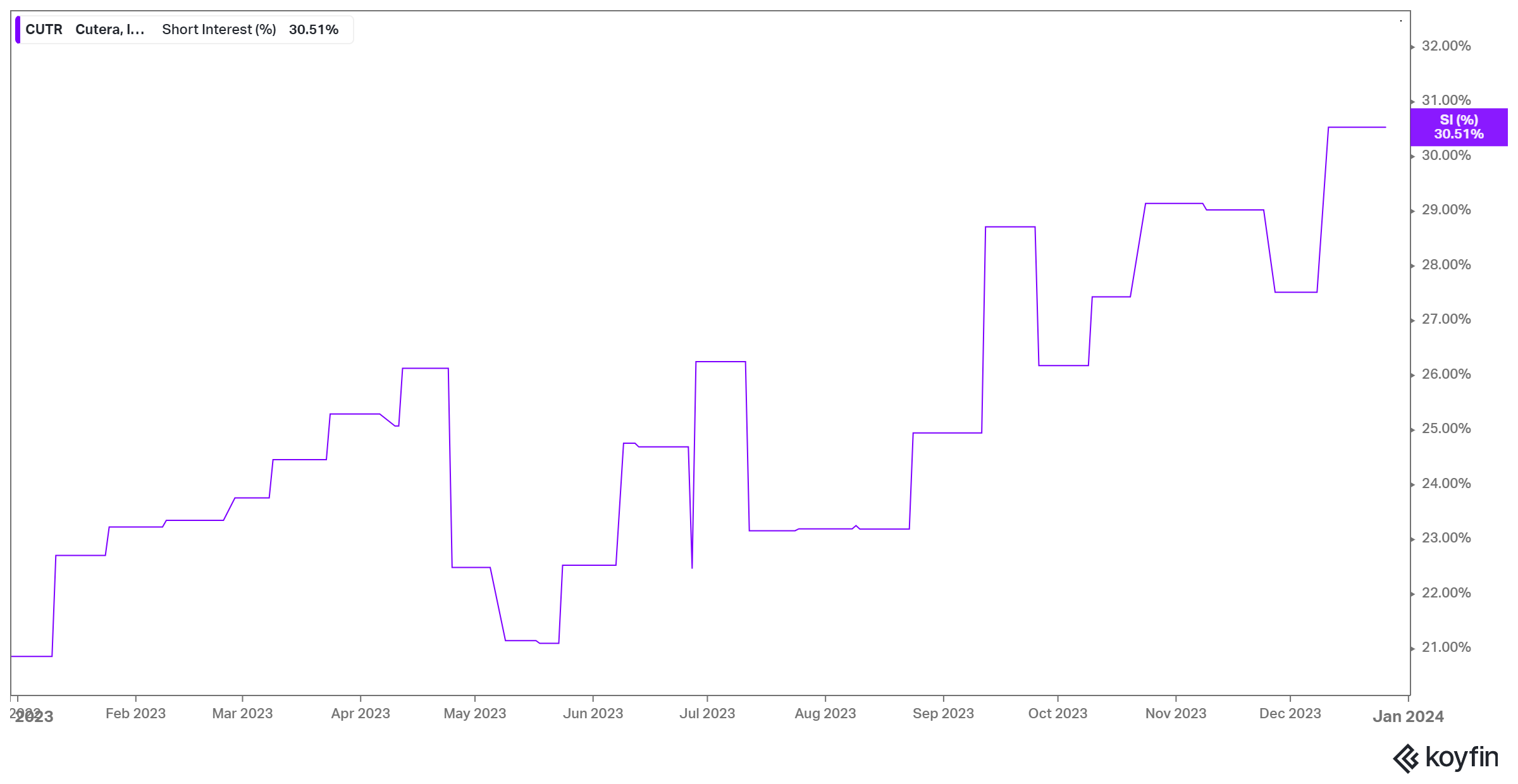
source: Koyfin
It’s not hard to see why. There’s a pretty strong case that 2024 will be even worse.
JD.com: A 50% Decline Seems (Kind Of) Explainable
The Chinese economy is scuffling, COVID lockdowns in the country lingered until this year, and it’s not like larger rival Alibaba has been setting the market on fire. Given those challenges, the results of JD’s business, as opposed to its stock, don’t seem that poor.
But actually, with a closer look, there are real concerns here beyond the external environment, and a sense that at least some of that YTD decline is due to the company’s missteps.
A Rough Year For JD
There does seem to be a bull case for JD at the moment after the steep decline. Year-to-date results do look disappointing on the top line: total revenue has risen less than 4% year-over-year. But, again, the Chinese economy is perceived as being rather weak, and bottom-line performance looks excellent. Adjusted operating income through the first nine months of 2023 is up 36% after nearly doubling year-over-year during the same period in 2022. Yet there are real concerns here, and the stock chart highlights one of them:
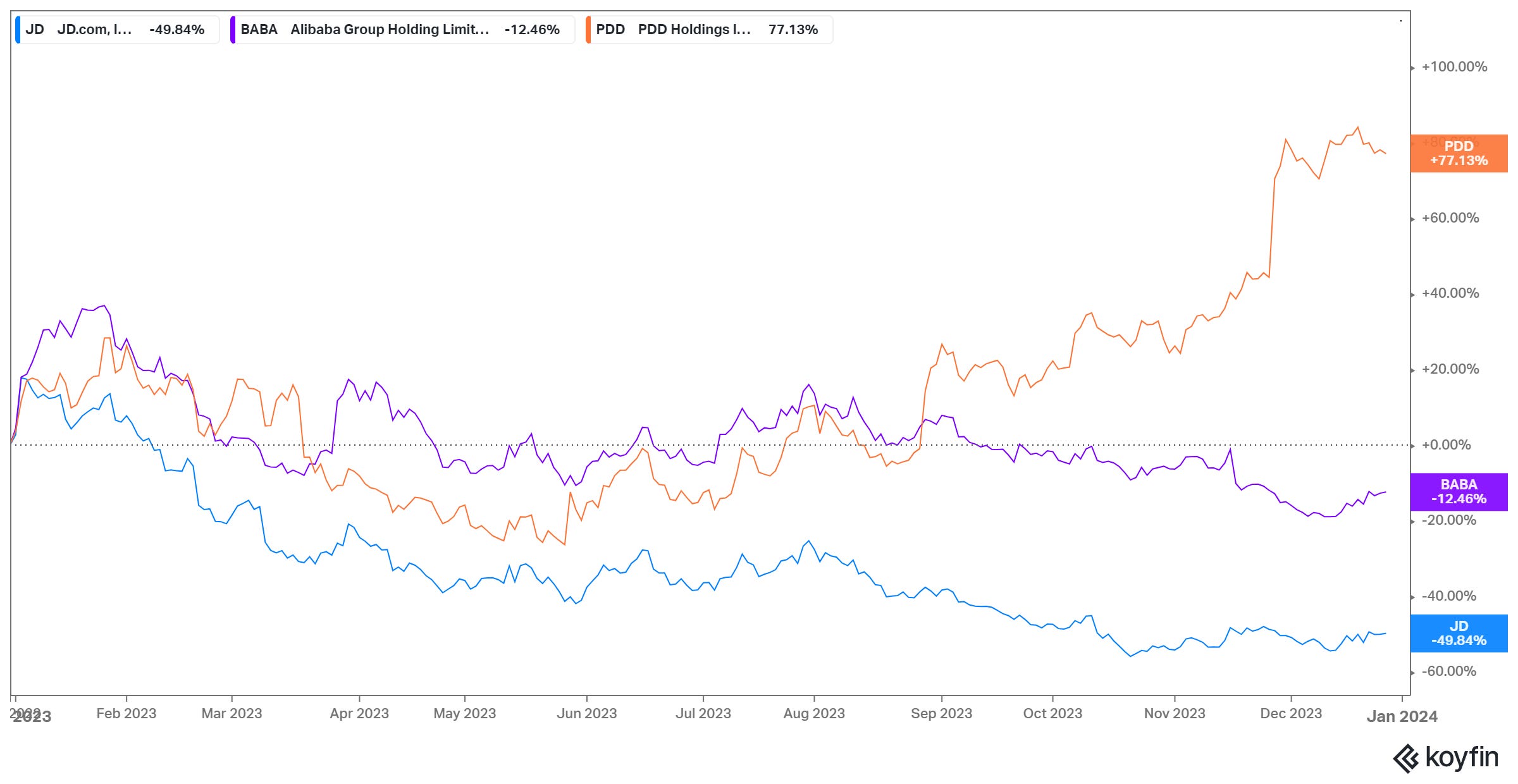
source: Koyfin
PDD Holdings — which operates as Pinduoduo —is clearly taking market share from JD.com, and in a hurry. While JD’s revenue has grown 3.7% year-to-date, Pinduoduo’s revenue is up 75%. Douyin, the mainland China counterpart to TikTok, is growing quickly as well.
And while profitability has improved of late, there are pressures looking forward. The company’s founder this month admitted in an internal memo that his company was facing deep-seated problems — including a “huge, bloated, and inefficient” structure. Despite that, just this week JD reportedly told employees that enormous pay hikes were on the way, at the same time the company is trying to compete with rivals on price. That strategy so far hasn’t worked: product revenue year-to-date is actually down year-over-year, including a 0.9% decline in third quarter.
It really wasn’t that long ago that the bull case for JD was that it was a credible rival to Alibaba, in part because its strategy of actually owning inventory created a more reliable, more attractive value proposition for customers. That bull case doesn’t really exist anymore: JD now needs to track down PDD, Douyin, and others, while at the same time improving operational efficiency enough to keep margins reasonably intact. It seems like a difficult juggling act, and a big reason JD has been halved this year is because the company hasn’t shown much reason to believe it can pull that juggling act off.
As of this writing, Vince Martin has no positions in any securities mentioned.
Tickers Mentioned: BABA 0.00%↑, BIG 0.00%↑, BVH 0.00%↑, CANO 0.00%↑, CPNG 0.00%↑, CUTR 0.00%↑, DG 0.00%↑, EVA 0.00%↑, FTCH, FTCI 0.00%↑, HGV 0.00%↑, JD 0.00%↑, MRNA 0.00%↑, PDD 0.00%↑, PFE 0.00%↑, PLUG 0.00%↑, SFIX 0.00%↑, T 0.00%↑, TMUS 0.00%↑, VAC 0.00%↑, VZ 0.00%↑, WBA 0.00%↑
Disclaimer: The information in this newsletter is not and should not be construed as investment advice. Overlooked Alpha is for information, entertainment purposes only. Contributors are not registered financial advisors and do not purport to tell or recommend which securities customers should buy or sell for themselves. We strive to provide accurate analysis but mistakes and errors do occur. No warranty is made to the accuracy, completeness or correctness of the information provided. The information in the publication may become outdated and there is no obligation to update any such information. Past performance is not a guide to future performance, future returns are not guaranteed, and a loss of original capital may occur. Contributors may hold or acquire securities covered in this publication, and may purchase or sell such securities at any time, including security positions that are inconsistent or contrary to positions mentioned in this publication, all without prior notice to any of the subscribers to this publication. Investors should make their own decisions regarding the prospects of any company discussed herein based on such investors’ own review of publicly available information and should not rely on the information contained herein.
As we discussed in June, whether wood pellets indeed are environmentally-friendly is a matter of some debate, but at least for now European buyers can treat it as such.
This isn’t necessarily a “blame game” thing, either; the former management team said the same.
In addition to these stocks (fortunately I didn't buy any of these), the picks I joined that perform horribly include BW, MTLS, VRNT, IHS. UFI has not went down much but has no exciting news either. My guess is they likely gonna disappoint too.
Personally I don't have the time and energy to research what have went wrong with respect to each of the above, so I'll probably sell to collect the tax benefits, and forget about them.
With my limited obersevation of the market, it seems to be bad time to invest in distress reverse ideas, particularly small cap ones. The other perspect is that this is an uncertain time. The world order is being destroyed and reconstructed. A company that did poorly in the past few years likely just has mediocre management who won't be able to navigate in this rapid moving environment. In short, if they have sucked and made mistakes, they likely will continue to be sucker and make more mistakes.
BTW, my best performing picks this year is COIN, APP, BKKT, and several bank stocks. So it may be wiser to bet on distress reverse on an entire sector that has been punished badly, rather than single stocks.