
💡 Highlights:
Enviri (NVRI) has gained 18% since our call in March. News since (mostly) confirms the bull case.
Babcock & Wilcox (BW) has been caught up in drama elsewhere. Down 76%, there’s still hope — but perhaps too much risk.
CarMax (KMX) has been a winner on an absolute basis, but relative underperformance has lasted a decade. That looks like a significant concern going forward.
We return here to three of our past long ideas, starting with a 2024 winner that looks set to have a strong 2025 as well:
Enviri Circles Back
In our March recommendation, we noted upfront that Enviri NVRI 0.00%↑ had all the attributes of a value play — both good and bad. The good was an intriguing valuation and a better business than the market might recognize. The bad was a leveraged balance sheet and some real questions about management and strategy.
The nearly six months since have provided some support to each side of the story. And, apparently, investors aren’t yet sure on which side they want to focus. A breakout ahead of Q2 earnings last month was followed by a no-news sell-off in recent sessions:
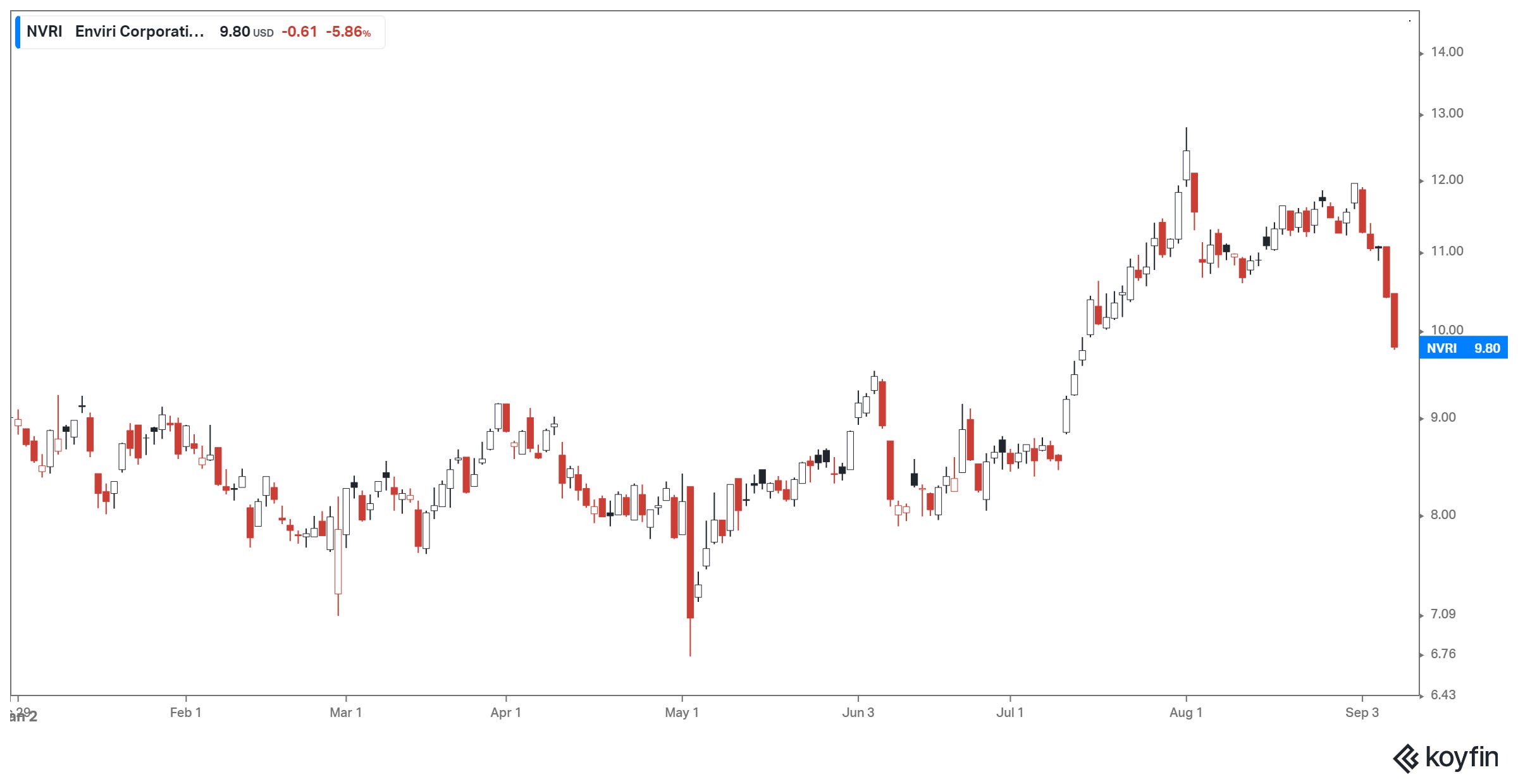
source: Koyfin
The biggest disappointment of late is that, after more than two years, Enviri has given up trying to sell its rail equipment business. A series of loss-making contracts in Europe dissuaded any interested buyer — unless, as chief executive officer Nicholas Grasberger noted at the June Investor Day, Enviri indemnified the buyer for any further overruns. At that presentation, Enviri disclosed (to our knowledge for the first time) that the contracts had, over five years, sucked up $200 million in free cash flow, a huge figure for a smaller business within a company that has a market cap of under $1 billion.
Grasberger said that Enviri was not alone in walking into these multi-year contracts, struck before the pandemic spiked inflation. But that isn’t a great explanation: pandemic or no pandemic, the risk in not only long-term, but complex. Projects should have been at least somewhat foreseeable after a decade of essentially zero inflation.
Similarly, the two-plus years spent trying to sell the rail business look like a fool’s errand, given that the CEO himself used the word “toxic” to describe the contracts. It was perhaps worth trying to find a buyer at the right terms, particularly given a leveraged balance sheet. But management previously expressed optimism toward the likelihood of a sale — optimism that in retrospect looks misplaced at best. And so both the contracts in rail and, now, management’s reaction to those contracts raise some concerns about execution and strategy.
But the flip side is that with some light at the end of the rail tunnel, the rest of the business is performing quite well. Harsco Environmental has managed through currency effects and the sale of a small business to keep profits intact year-to-date. Enviri has maintained its full-year guidance1 through the first half. Profit margins in Clean Earth, a specialty waste management business and the most important asset here, have expanded nicely, with management importantly attributing the increase to price hikes.
Those two quarters of performance matter. One of the arguments we made in March was that middling profit growth in that segment during the pandemic was actually a sign of strength, in that the business was able to hold up despite inflationary pressures. With those pressures abating, the fact that margins are expanding suggests that Enviri has real pricing power. Logically, that pricing power should exist: getting permits for new facilities is not a simple matter. Indeed, management argued at the Investor Day that the specialty waste management business was on a path to look something like the nicely profitable, but more mature, solid waste market. And if that’s the case, and Clean Earth can capitalize, NVRI is a multi-bagger from here.
NVRI Still Looks More Than Cheap Enough
When we recommended (and I bought) NVRI in March, about two-thirds of the enterprise value came from debt. And so the 18% rally in the equity hasn’t moved valuation all that much. Shares were around 6x EBITDA toward the beginning of the year, depending on an investor’s estimate for proceeds from the rail sale. They’re still under 7x at the moment, based on the midpoint of full-year 2024 guidance.
There’s still plenty of slack in that valuation for significant upside. Three-year targets given at the Investor Day — mid-single-digit annual revenue growth, 10-12% increases in Adjusted EBITDA — would get Adjusted EBITDA over $400 million, and free cash flow to about $150 million. With no multiple expansion, NVRI would more than double in three years2. Each additional EBITDA turn adds more than 40%. An exit EV/EBITDA multiple of 8.5x would be a roughly high-teens P/FCF multiple and lead to nearly a triple. A complete reversal in sentiment towards a business riding secular, significant environmental trends could expand those multiples and increase those gains.
Numbers aside, it’s the power of those trends, and the positioning of both businesses, that strengthens the bull case here. Clean Earth’s capabilities can’t be simply replicated by a solid waste business (or anyone else); there is real expertise in managing varying kinds of specialty waste, and, again, real difficulty in getting new facilities permitted. Harsco Environmental’s two major competitors are facing real challenges, with one, Phoenix Topco, exiting bankruptcy last year.
Per- and polyfluoroalkyl subtances (PFAS), the so-called “forever chemicals”, could provide a multi-billion dollar market for Clean Earth, with the U.S. federal government in April announcing a $1 billion project to remove those chemicals from drinking water. Harsco Environmental still isn’t a spectacular business — the acquisitions that underpin Clean Earth were made in large part to diversify away from that business, one in which investors were not terribly interested — but environmental concerns in that industry should drive consistent demand for its management of slag and scrap.
The blue sky thesis is that Harsco Corporation’s effort to move into specialty waste in 2019 was actually a masterstroke. The problem is that the pandemic and the resulting inflation (along with higher interest rates on the debt used to execute that strategy) have obscured that fact. It’s not hard to come away from the first half of 2024, and the optimism coming out of Investor Day, with more confidence in that thesis. Enviri has to execute, and it has to start driving better free cash flow to deleverage (first-half FCF was negative, though that should reverse in the next two quarters). But if it can do so, few stocks in the market have quite the same upside. I’m happy to keep owning the name here, even with the pullback over the last few sessions.
Can Babcock & Wilcox Do It Again?
The risk in owning a leveraged turnaround play with loss-making contracts is made clear by Babcock & Wilcox BW 0.00%↑, which is down 76% since our recommendation just over a year ago:
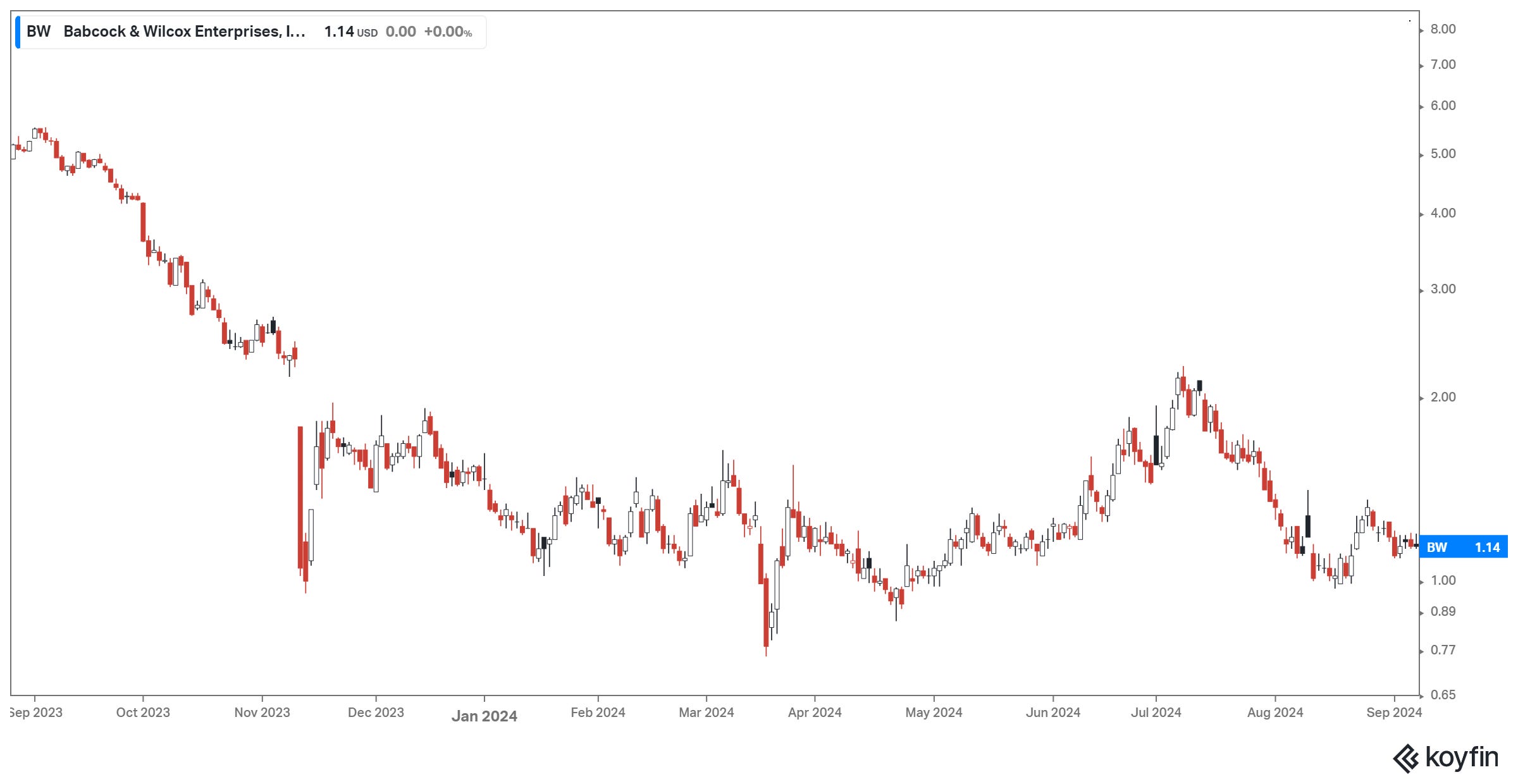
source: Koyfin; price chart since 8/27/23
What’s wild is that the decline has been caused in part by B&W doing the exact same thing it did before the pandemic. Then, a series of disastrous fixed-price contracts in Europe (for renewable energy plants rather than customized rail equipment) nearly put the company into bankruptcy. Now, a series of loss-making, fixed-price contracts in a solar business led to a “going concern” warning in the most recent 10-K filing, and have brought liquidity risk to the fore.
The situation is not yet as dire as it was in 2019 — B&W then extended some of its loans by just days amid a scramble for cash — but the risk is obvious, and the plunge in the stock seems to make some sense.
That said, it’s not hard to wonder if there’s been at least something of an overreaction. BW clearly has been brought into the mess that is B. Riley RILY 0.00%↑. Riley is facing liquidity challenges of its own and a hugely aggressive bear attack (78% of the float is sold short). Riley also owns ~30% of B&W (a legacy of its efforts to rescue the company five years ago) and in July registered its shares for sale. B&W itself has added a bit of selling pressure, issuing $2 million in shares during Q2 under an at-the-market agreement.
One RILY bear has claimed that B&W has silenced a whistleblower, and faces significant lawsuits over unpaid invoices, a claim that has made its way into the mainstream financial media. B&W itself hasn’t specifically disclosed such litigation; RILY/BW bears no doubt would argue that itself is further evidence of questionable leadership, given that B&W’s CEO, Kenny Young, remains the president of B. Riley. Young’s response to the solar contracts last year was to simply reclassify the business as discontinued operations, which even to my biased eye (I still own shares here) seems like a dubious maneuver.
But at the same time, it’s worth noting that the underlying business actually has performed reasonably well. B&W still sees Adjusted EBITDA this year coming in at $105-$115 million, excluding expenses related to startup businesses in the hydrogen space. Those businesses — BrightLoop and ClimateBright, which we highlighted last year — are heading toward commercialization, with Young once again citing a target of $1 billion in bookings by 2028. Backlog is up sharply, notably in the Thermal business, thanks in large part to a $246 million award announced earlier this year.
The sale of a European subsidiary netted $87 million in Q2, helping the balance sheet and sparking a rally in the stock that was undercut by the registration of the Riley shares. Net leverage is under 3x, and just over 4x even including perpetual preferred stock. (The figure does get near 6x when accounting for pension liabilities, but B&W is seeking a waiver of its contribution to manage near-term cash). Overall, EV/EBITDA on the most conservative basis (including preferred stock and the pension) is still around 7x — seemingly not unreasonable or unmanageable, particularly if BrightLoop gets anywhere close to Young’s targets.
Huge Risk/Reward
To be clear, there is a lot of smoke here, which suggests there is at least some kind of fire. In the context of the decline, we simply can’t recommend the stock anymore. The risks are too high, and the efforts being taken to conserve cash — including the pension waiver application and the suspension of dividends on the preferred stock — suggest the near-term chance of a zero for the common is material. Indeed, even the preferred stock is trading at less than 60% its face value.
But the story does remain at least worth watching, and one aspect of the common shares is striking. RILY now has the highest short interest as a percentage of float in the entire market. BW, whose near-term future would seem threatened by a Riley collapse — which would signal an eventual, and not necessarily orderly, liquidation of a massive stake in B&W — has short interest of barely 1%. It would seem at this point that BW might be the better short on RILY, given the latter’s huge decline and the potential for major bounces (RILY gained 10% on Monday, for instance).
So it would appear that even bears piling into a collapse of the Riley empire seem to see something in B&W that gives them pause. That, along with inertia and maybe a bit of stubbornness, has kept me involved with a now-tiny part of my portfolio, perhaps only to see if B&W can once again find a way to dodge a seemingly inevitable restructuring.
CarMax…Meh
Back in November 2022, we detailed the contrarian case for CarMax KMX 0.00%↑. We did feel like we were going out on a limb. The company’s most recent earnings report had fallen short of consensus EPS estimates by 54% — a stunning miss for a company with such detailed coverage — and the sentiment toward demand amid rising interest rates was exceptionally negative.
As it turned out, the call has played out reasonably well: KMX has gained 45% since. But it’s worth putting that return in context, since it says so much about the market of the last 22 months. 45% is nothing to sneeze at, but — almost incredibly — KMX has still lagged the S&P 500 over that stretch, by about five percentage points. Meanwhile, peers have done better. Carvana CVNA 0.00%↑ has roared back from the dead and been a 10-bagger, while AutoNation AN 0.00%↑ and Penske Automotive PAG 0.00%↑ too have topped the gains in KMX:
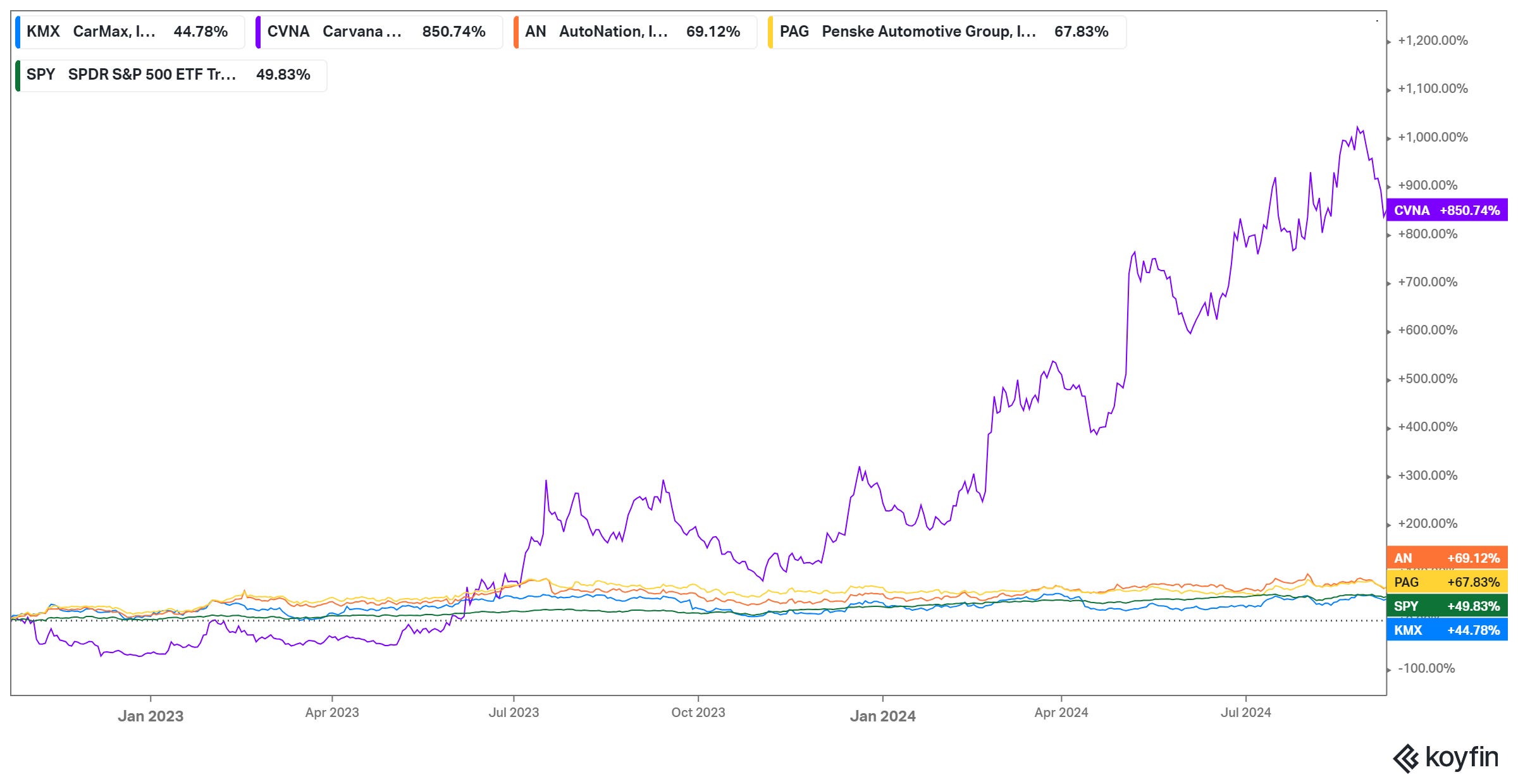
source: Koyfin; total return chart since 10/23/22
As a business, too, CarMax has performed well but hardly exceptionally. Some of the concerns we cited in 2022, such as SG&A spend, remain. With a still-premium multiple (23x forward earnings) and a more competitive environment, it’s hard to be too excited here. The consumer seems likely to give at some point, and clearly many investors believe margins across the space are coming down: KMX has short interest of 11% (a position worth about $1.4 billion), and peers beyond CVNA too are seeing activity from bears.
And while there’s still a sense that CarMax is simply a good business to own long-term, it’s worth noting that its underperformance has been significant over the past decade:
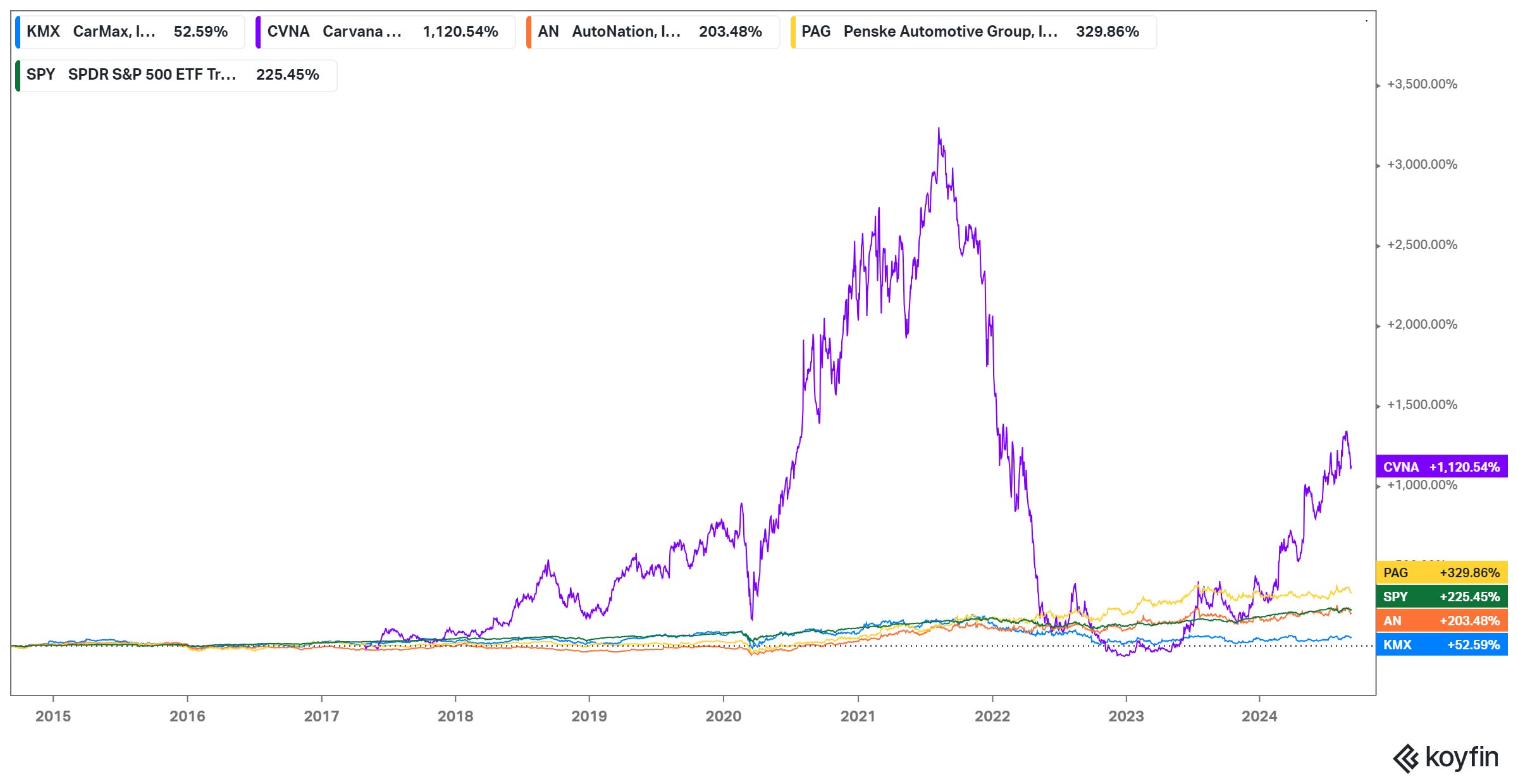
source: Koyfin; 10-year total return chart
At a certain point, KMX will no longer receive the benefit of the doubt as a quality business. In this environment, and after a decade, that point seems to have been reached.
As of this writing, Vince Martin is long Enviri and Babcock & Wilcox.
Disclaimer: The information in this newsletter is not and should not be construed as investment advice. Overlooked Alpha is for information, entertainment purposes only. Contributors are not registered financial advisors and do not purport to tell or recommend which securities customers should buy or sell for themselves. We strive to provide accurate analysis but mistakes and errors do occur. No warranty is made to the accuracy, completeness or correctness of the information provided. The information in the publication may become outdated and there is no obligation to update any such information. Past performance is not a guide to future performance, future returns are not guaranteed, and a loss of original capital may occur. Contributors may hold or acquire securities covered in this publication, and may purchase or sell such securities at any time, including security positions that are inconsistent or contrary to positions mentioned in this publication, all without prior notice to any of the subscribers to this publication. Investors should make their own decisions regarding the prospects of any company discussed herein based on such investors’ own review of publicly available information and should not rely on the information contained herein.
The outlook has been changed, but only to account for Rail’s return to continuing operations from discontinued operations.
7.1x Adjusted EBITDA of $440 million, roughly the midpoint of the target, gets EV to $3.12 billion. Net debt, currently $1.38 billion, drops to $1.2 billion in our model, leaving equity at $1.92 billion, ~115% upside from the current ~$850M assuming modest dilution along the way.
Thanks for the update on NVRI! It sounds like NVRI should have - and maybe still should - renegotiate the rail contracts with the threat of placing the business in bankruptcy if customers didn't play ball?